

The second part of the article, in which we try to map the prospects of the participants in the upcoming match for the chess crown, is dedicated to the world champion. While the challenger’s results allowed us to select suitable examples quite easily, analysing the long-term decline in the world champion’s level of play – and especially finding its causes – is a much more complicated task. What is happening to Gukesh? Can we attribute everything to the psychology of the „heavy crown“? To his youth and the fact that he conquered the highest peak already at eighteen? Or perhaps even label his phenomenal results of 2024 as a coincidence? No one holds the patent on the truth. So all that remains is to attempt some kind of reconstruction from what we really know – and especially from Gukesh’s games.
Just as in the first part we became acquainted with the Pomtow Gambit, in the second we will focus on a problem that troubles – and has always troubled – chess players of all categories: unforced blunders! Where do they actually come from? Why do we sometimes overlook something that we would normally see at first glance? They cannot be completely eliminated – but can we at least reduce their number? And if so, how?
Once again about the challenger
We concluded the first part about the upcoming world championship match with a summary of Sindarov’s strengths but also weaknesses. I wrote that I see certain shortcomings in the challenger’s play in deciding too quickly at moments when he should rather think. And also in technical endgames.
Several days passed and… we could actually convince ourselves of both. In the main tournament, Javokhir was clearly struggling before its last third.
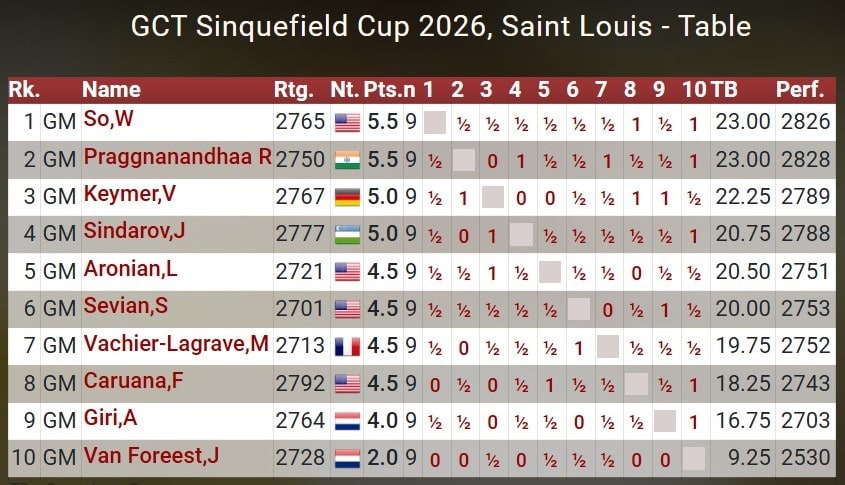
True, no tragedy in the form of a tournament „long castling“, as happened at least once to the world champion, but for two thirds of the tournament he remained on the sidelines at -1. However, what he showed in the seventh round certainly deserves to be watched and analysed.
And the beginning of the second part of the article Who will prevail? therefore we actually have to dedicate to another game from Sindarov’s last appearance before the Olympiad.
In the game Keymer vs. Sindarov Black chose the Volga Gambit in an attempt to defeat the German super grandmaster! Javokhir probably achieved everything he planned: the element of surprise and a complicated, unusual position in which, until move 21, all pieces except a pair of pawns remained on the board. Although there was approximate objective equality on the board, Keymer was losing too much time and the course of the game also really gives the impression that he was outplayed on the board.
And now let us look at the telling picture of the situation in the endgame after the played 46…f6.
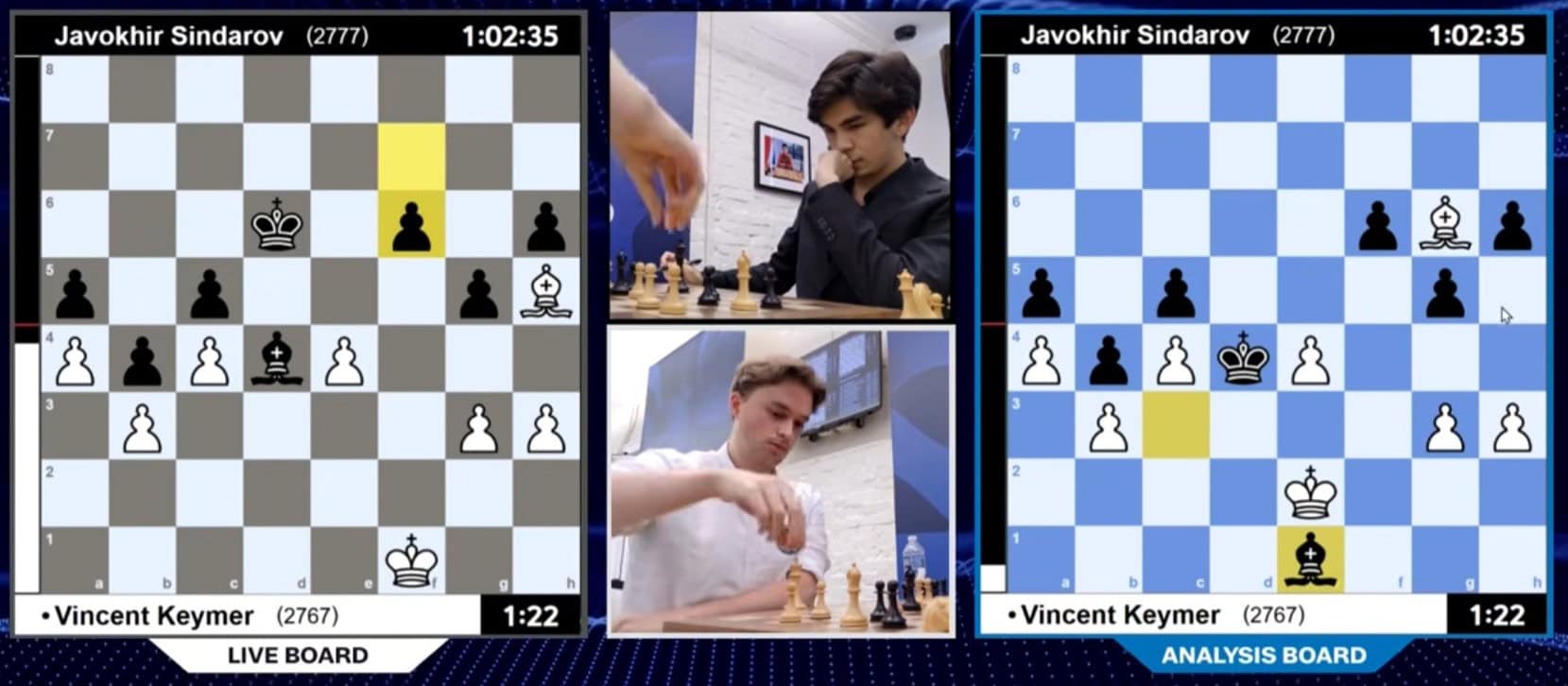
The theoretical opposite-coloured bishops endgame is in objective balance, but we do not have to be masters to quickly recognise who has the right to try to play for a win, and who must, on the contrary, be exceptionally precise in defence.
But why am I demonstrating this particular video clip? Let's look at the time consumption!!
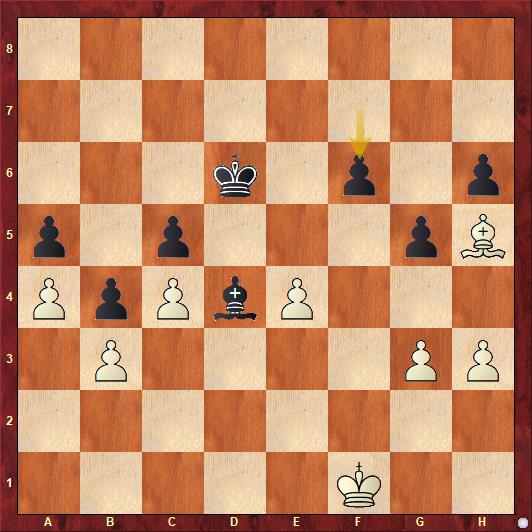
What followed was shocking (especially for those viewers who watch live broadcasts or games with the engine on, which I soberly estimate today at 90–95%)[#] 47.h4??
This blunder should upset Keymer for reasons beyond just probably costing him the game.
As Johann Berger, who studied opposite-coloured bishops endgames intensively, already knew, but as Fine and Averbakh probably formulated into a maxim: „The defending side in opposite-coloured bishops endgames should place pawns on the colour of their own bishop!“
The point is that the stronger side usually lacks sufficient means to capture such pawns (after all, only the enemy king can go for them). This significantly increases the chances of building a fortress. It is therefore the opposite principle to that which applies in „normal“ – not only bishop – endgames.
Keymer's approach thus goes exactly against the principles of correct defence in threatened opposite-coloured bishops endgames!
One of Berger's rules was discussed here: https://skolasachu.com/absolutni-mistr-sveta-nova-koruna-v-ere-casovych-tisni-hrubek-hrozeb-a-hadek/
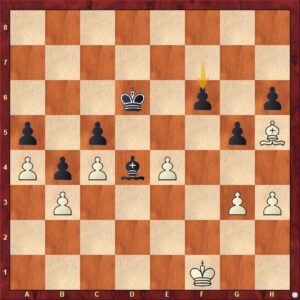
And so I will especially address advanced chess players, who, however, did not notice this moment, and ask the question: What do you think is the strongest continuation in the position? A continuation that relatively easily leads you to a draw (a fortress)?
The following video shows exactly the moment when the crash occurred.
GM Sergei Makarychev's video is a true didactic treat! It is set at the moment before the transition to the opposite-coloured bishops endgame. Nevertheless, I recommend watching the entire fragment that Sergei Yurievich demonstrates!
Gukesh's Overweight Crown?
The second part of the article, in which we attempt to map the prospects of the participants in the upcoming match for the chess crown, is dedicated to the world champion. While the challenger's results allowed us to select suitable examples quite easily – his strengths and certain weaknesses are visible without special effort – analysing the long-term decline in the world champion's level of play, and especially finding its causes, is an almost superhuman task!
What is happening to Gukesh? Can we attribute everything to the psychology of the „heavy crown“? To his youth? To the fact that he conquered what many consider the highest life achievement already at eighteen? Or even label his phenomenal results of 2024 as a fluke?
No one holds the patent on the truth! And since we do not know what is happening behind the scenes in his team nor to what extent psychological reasons underpin his current results, we have no choice but to imagine a significant part of the picture. To carry out a kind of reconstruction from what we really know, relying primarily on thorough analyses of his recent games…
Collapse in Chennai
In this article, we will focus mainly on the world champion's latest performance. The Chennai Grand Masters was played from 16 to 22 July 2026.
On home soil, the world champion completely collapsed, as the following table shows.
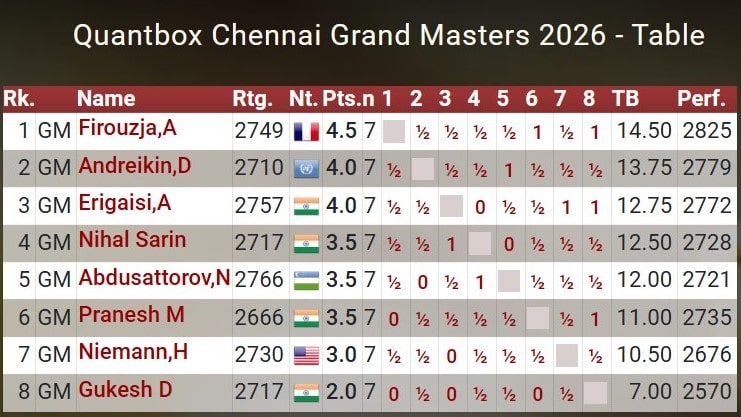
Of course, Gukesh is not well suited to the ever-shortening and experimental time controls. His inductive (calculation-based, if you will) approach to positions requires as much time as possible for thinking. In Chennai, players received only 90 minutes + 30 seconds increment per move for the entire game. But... this has always been the time control here! All previous editions of the Chennai Grand Masters were played at the same pace.
And it was here, literally on home ground, that Gukesh won in 2023 – and this victory ultimately secured his qualification for the Candidates Tournament in Toronto!
The table shows that Gukesh lost three games and, at the same time, that Firouzja needed only +2 to win.
I know that chess is not played on „what ifs“. Nevertheless, I dare to claim that many grandmasters of much lower calibre would have managed to draw the game against Firouzja – that is, if they were not playing it in time trouble for a win – and win the positions against Erigaisi and Pranesh without major problems!
And as we see, such a course of events would have put Gukesh in first place! „What if, what if! I've seen hundreds, if not thousands, of such what ifs on chessboards!“ might object not only a critically minded reader but also a more experienced chess player.
You know what? Let's then look at those three decisive games – more precisely to look at their key moments.
Oh, those blunders!
But before we do that, I would like to stop at something that troubles – and has always troubled – chess players of all categories: unforced blunders!
These are mistakes we make even when we are not under pressure or in a significantly worse position in the game. Where do they actually come from? Why do we sometimes overlook something that we would normally see at first glance? As chess players say, or perhaps used to say: „Even a passing stranger would see this!“ Or even: „The manager from the bar!“ 🙂
It is impossible to completely get rid of blunders, humans are fallible – but can we at least reduce their number? And if so, how?
I do not want to deal here with gross errors arising in time trouble and I will even omit tactical blunders, although – if they happen to us and not the opponent – they usually sting the most. (They are easier to spot!) I mean positional blunders. Mistakes stemming from strategic misunderstanding of the position.
To make it clearer to readers what I am talking about, I will help myself with two unfortunate examples from my own practice. First then „what it is not about“.
In the position from the game Bílek vs. Mikuláš (Slovakia rapid 1983) White just played 16.Nc3??
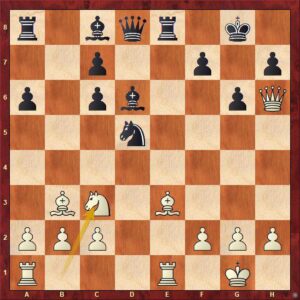
At that moment I considered the position equal and was primarily thinking about, what no one should ever think about!! Namely where I had lost the advantage from the opening when the opponent did not play according to „my“ theory at the time. I simply could not help myself. And it was a culpable negligence, especially since it was a team tournament – a kind of informal championship of the republic's city transport companies of Czechoslovakia.
Black's combination is truly well hidden. We might ask why neither I nor my opponent saw it (the game ended in a draw after a few moves), but it did not occur to me even during later analysis. I only discovered it relatively recently, and that was just because I had run an engine beforehand…
Can you find the strongest reply?
The example was therefore a tactical blunder leading to the so-called immediate combination motif – an exposed queen, a weakness on the dark squares.
In fact, from the perspective of a chess player's long-term development, it is much more important to recognise and eliminate gross strategic errors! These should worry players of all strengths, especially top players, far more.
And if it happens to you too often that you lose a serious game without knowing exactly where you made a mistake or inaccuracy, it is a warning sign! A tactical oversight is one thing, but a general misunderstanding of the position is another.
The following example a positional blunder (or choice of plan) is quite complicated.. I clearly remember that I only dealt properly with my mistakes in this game after many years. And I am quite proud that my latest analysis after many years was confirmed by engines.
In the game Bílek vs. Doležal (Kralupy nad Vltavou 1981) the Milner Barry gambit in the French Defence was played. Black has just captured the bishop with 18...gxf5.
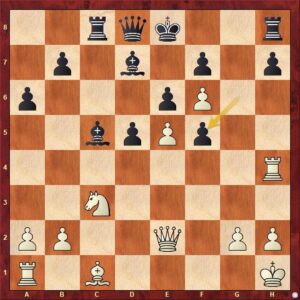
White has sufficient compensation for the sacrificed gambit pawn. Without making any visible tactical error in the game, the position collapsed for me over the next six (sic) moves (and Black also made a serious mistake at the end). I resigned the game already on move 24!
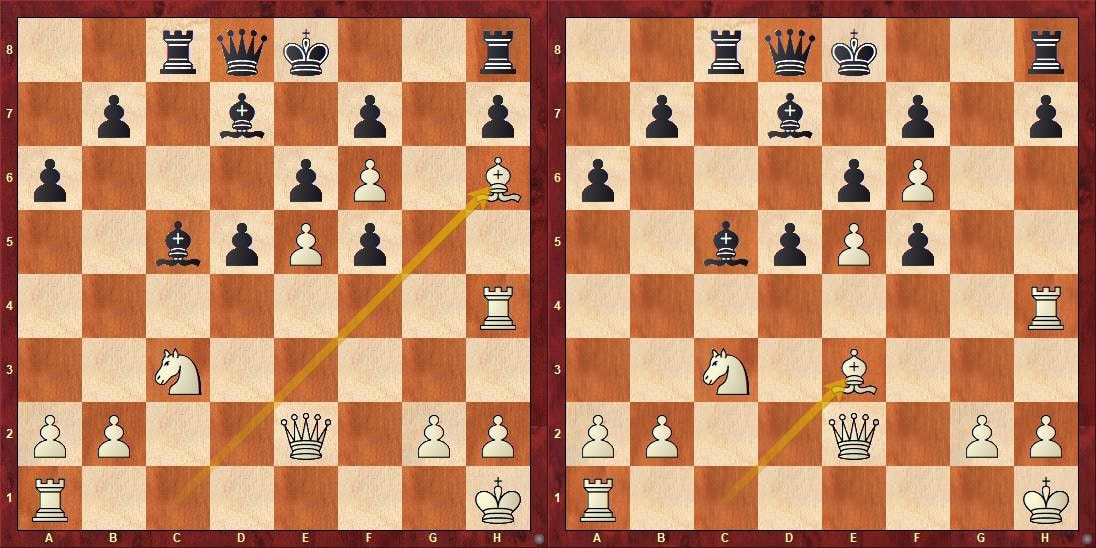
Which candidate move would you prefer to choose? 19.Bh6 or 19.Be3?
A blunder like a nightmare warning
So now finally let's see what a literal strategic crime the world champion committed in Chennai.
It is the 6th round, game Pranesh vs. Gukesh. The world champion found himself at the bottom of the tournament table with –2 and was certainly still shaken by the loss the previous day.
Nevertheless, he gradually completely outplayed the young opponent with Black in the Caro-Kann Defence and after move 20 was winning!
We will be able to replay and analyse the whole game full of inaccuracies from both sides in the viewer below. Now let's stop at that strategic blunder – a nightmare! White has just played 29.Rd1-b1.
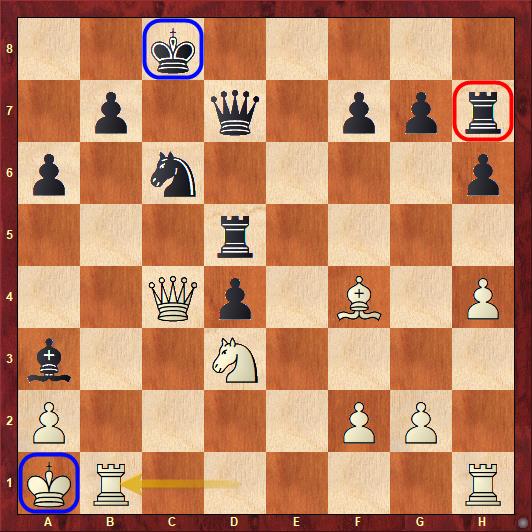
A logical move. Not only does it prevent the manoeuvre Rd5-b5, but it also shifts the remaining forces to the queenside, where a sharp clash will take place. We can say that the article's title Who's Who? now personifies both kings on the board!
White has more than sufficient compensation for two pawns and overall the position is dynamically balanced. Black must lose time to bring his last reserve into play – the misplaced kingside rook. And it is precisely this lost tempo that probably balances the objective chances for both sides.
At this moment Pranesh's clock showed just under 27 minutes, but the world champion had only four left! (I repeat, apart from the thirty-second increment per move, no additional time is added in Chennai.)
After less than a minute of thinking the world champion the board perhaps literally he blundered terribly in positional terms 29...b5??
Such a move would have haunted me in my dreams for many months, and my coach wouldn't even have needed to reprimand me! Well, and if even my young pupil played similarly, I wouldn't be able to fall asleep at all.
Here I cannot resist a somewhat biting, but I think apt, remark: „When the castling rule was invented, it surely did not take long before many realised that the pawns standing in front of the newly hidden king serve – or at least are supposed to serve – as a kind of personal guard! Usually, therefore, it is unwise to march forward with this group of troops without serious reasons!“ Gukesh, however, recklessly thrust this into the position!
Let's first look at a short video.
And finally, I must add a note: What did Gukesh's coach G. Gajewski probably think at first sight of 29...b5?
It is precisely such lapses that all Gukesh's supporters should be most worried about! The absence of deductive reasoning and insufficient knowledge of the classics... I cannot add more about the blunder itself here.
True, Gukesh was certainly shaken by the previous loss in a completely winning position against Erigaisi. And when almost nothing you touch goes well for a long time, you can easily get the feeling that fate – or perhaps the Matrix – is playing a nasty game with you.
Is it all the fault of time?
„It's all the fault of time,“ sang Lenka Filipová once. In Gukesh's case, we might add with some exaggeration: really all of it? It is hard to deny that a significant part of his failures and unnecessarily spoiled games is due to long-term poor time management. This is not a new issue of recent months. Gukesh openly spoke about this weakness already when, as a seventeen-year-old, he won the Candidates Tournament.
What is telling, however, is that during what was perhaps his best and most famous performance – at the 2024 Budapest Olympiad, where he achieved a fantastic 3056 performance rating – he was hardly troubled by time problems. And that is worth pondering. Is poor time management truly one of the causes of his current problems, or is it also their consequence?
Two things seem clear to me. Firstly, poor time management has significantly contributed to Gukesh's poor results at least since the second half of 2025. Secondly, his high consumption of time is closely linked to his very style of play. Gukesh is a distinctly inductive player: he wants to calculate, verify, seek concrete solutions and, if possible, accept nothing based solely on general rules. And calculation of variations simply consumes time.
Let us add to that Gukesh's chess maximalism. His nature is to look for ways to win the game, often even in positions where he must be well aware that objectively he stands somewhat worse. Instead of a simple solution, he sometimes seeks the best solution, instead of a safe path he searches for the path to victory – and the clock mercilessly ticks meanwhile.
Time therefore undoubtedly belongs to Gukesh's problems. But to claim that „time is to blame for everything“, would be too simple. Time trouble does not have to be only the cause of a mistake. Sometimes it is itself a symptom of what has been going on long before it.
In all three of Gukesh's losses in Chennai, poor – as he himself says – time management was indeed involved.
But let us look at the position from the second round. The game Firouzja vs. Gukesh. White has just stormed into Black's camp with the queen 29.Qe7.
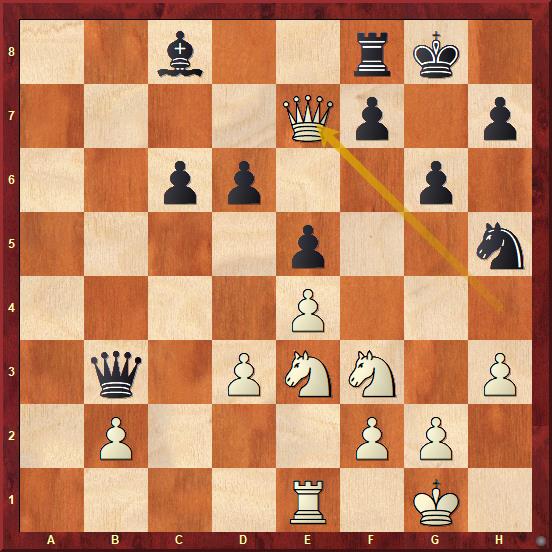
The record shows that at that moment Firouzja had 5 minutes and one second on the clock, the world champion just under 7 minutes. The position is balanced and moreover we all know what magic Alireza can perform in blitz. So I will just ask as a check: How do you think, dear readers, nine out of ten chess players would continue in such a situation?
Naturally 29...Qe6=.
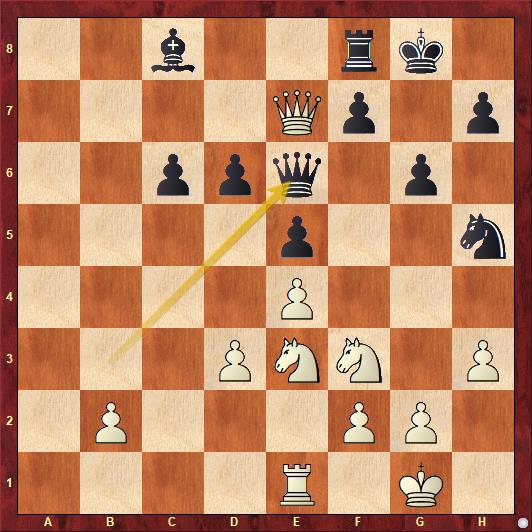
If the world champion had replied like this, I would almost certainly not be demonstrating the game here.
Not so Gukesh! The world champion „sacrificed“ three minutes of his remaining time and plunged into complicated entanglements. What followed was 29...Nf4??
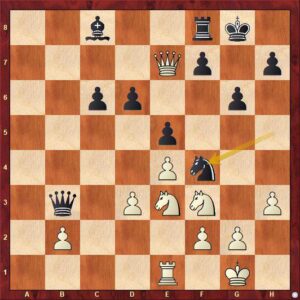
A competent or advanced chess player will most likely (correctly) declare that from a practical point of view we now face an unclear position. A number of pawns will disappear from the board, transformations will occur, possibly even sharp changes. Indeed, the fact that this is a tactical blunder will only become clear after a more detailed analysis or calculation!
In the notes to the game I wrote: The first blunder from a huge number that we will still see! Again that Gukesh maximalism, but applied in the wrong place! Black overestimates his position (again), which is simply an old pain of the world champion!
Indeed! Blitz continued until move 69! It was framed by many blunders of varying intensity and significance. I would call it a „comedy of blunders“ if I did not use this phrase too often and moreover the opponents did not play almost two thirds of the game in time trouble.
Let us first look at Sagar's shortened game record.
Displeased not only with the result but also with that comedy of blunders in blitz, I wrote at the end of the fairly thoroughly analysed game this: If I count correctly, in this game we witnessed about fifteen (sic!) blunders! That is, moves that fundamentally changed the evaluation of the position – win vs. draw. It can be said that all occurred either in the emerging time trouble, when the players had five minutes or less, or then on just a minute or even seconds!
And now I ask: Is this really an emerging new trend or even perhaps the ideal of modern chess? Is that why FIDE wants to shorten the time control to half?? Even from a didactic point of view – someone might argue that we can learn from mistakes – very strong players must ultimately lose the game with such a number of reversals!
Well, what to add at the very end? Perhaps this: The game is so terrible that even the famous Savielly Tartakower – seeing it all and if words did not freeze on his lips – would have to somewhat modify his famous aphorism „The winner of the game is the player who makes the penultimate mistake.“ somewhat...
From victory to the abyss (1)
It is said that Alekhine played even better after a loss! And we do not even have to go so far into history – the same probably applies to Magnus! Regardless of how they lost the game.
Nevertheless, of course, there are big differences between, how losing a game .. For many chess players it is much more demoralising if they lose a completely won game than when, as they say, they are „crushed“ or get into situations we analysed above – that is, lose after blunders.
Either way, the loss in round 5 must have had a devastating effect on Gukesh. Well, but let's not get ahead of ourselves. In the game Gukesh vs. Erigaisi the world champion came up with a novelty as early as move 9, which forced Arjuna to think for more than a quarter of an hour.
Although Black managed the difficult problems in the next few moves, he still made a mistake on move 22 that could have decided the game. Gukesh also missed the best continuation, but in the position after 29...Nf5 he is already winning.
(Move 29! three times in a row. Numerologists might start looking for a deeper meaning. I just note the remarkable coincidence. 🙂 )
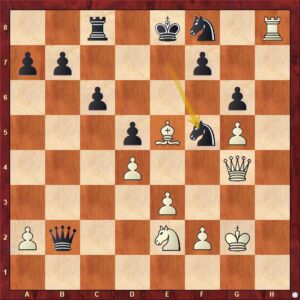
White is still winning! The problem, however, is that finding it is not easy in limited time. And moreover, a certain paradox arises here.
The best course here cannot be found by inductive reasoning – that is, immediate calculation of variations – but rather by deduction, where we need only minimal concrete calculation to find the right path!
Consider:
1/ If the most effective black piece and key defender – the knight on f5 – were to disappear from the board, White would immediately win after Bg7.
2/ How to remove this knight when the immediate Ng3?? runs into a tactical device – a pin and double attack after Nxe3+?
3/ Black is so helpless that White can even afford to lose a few tempi, set a plan, eliminate or drive away the knight, and then finish the winning attack!
In the game, the world champion surely tried to calculate all the way to the win – maximalism is his nature. He correctly realised that the position simply must be winning. But on the other hand, we all learned and know that in similar positions the greatest master is the component Time – by which I now mean time on the board, not on the clock. Not giving the opponent defensive tempi! But paradoxically, this does not apply here…
Even after 9 minutes of thinking, Gukesh did not find the win here! Can you handle the position, dear reader?
The video below first offers the traditional ChessBase India recording. At about 20:20 then Sagar Shah shows one of the ways, White could have won the game!
From victory to disaster (2)
After such misfortune, a chess player either somehow succumbs to the weight of fate or keeps fighting. Gukesh's strong point is his nerve stability – unlike some, however, I do not think this is the work of the „legendary“ mental coach Paddy Upton – and so at least the first part of the game against Pranesh recalled better times.
The game Pranesh vs. Gukesh. In the tense Caro-Kann, the world champion reached after 17...e5 the position in the diagram.
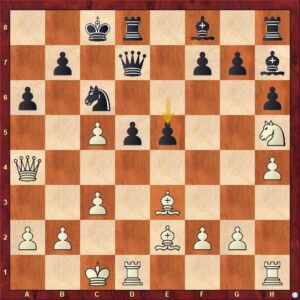
Who could resist the possibility of building the so-called. absolute pawn centre! (This differs from the ideal pawn centre in that the opponent's pawns do not stand on the files against it.) Let us add that while engines show draws, most strong players would probably prefer to play Black.
This was supposed to be the decisive mistake that White made after 20.Nf4??
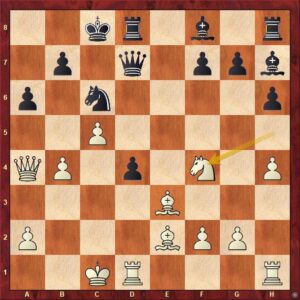
Let us imagine the position and try to find the winning continuation after 20...Qc7! 21.Bd2.
What is happening to Gukesh?
We have just been able to look at mostly an unpleasant display of Gukesh's mistakes at the recent tournament in Chennai. Not only more experienced or stronger players, who follow the world champion's games more closely, must, in my opinion, notice several recurring phenomena:
- In a considerable number of lost games, there are sharp and fundamental reversals: equal position – blunder – loss. Or even: equal position – winning position – blunder – equal position – another blunder – loss. Of course, this is only a simplified scheme. In reality, there are often even more such reversals, and the game sometimes resembles a kind of carousel, on which the evaluation of the position changes at an incredible speed.
- A significant part of Gukesh's losses is due to a lack of time on the clock. The time deficit is the immediate cause of many of his blunders. The reader will probably shake their head after reading this and add: „But that applies generally! Everyone blunders in time trouble!“ Yes. But here it is primarily about the extent – the number of such mistakes.
- Gukesh does not get into time trouble without reason. His completely unusual approach to positions practically invites it. An almost purely inductive (calculation-based) playing style, complemented by maximalism and a constant effort to find the best move, consumes a huge amount of time. And unfortunately, this happens quite regularly.
- Moreover, the world champion plays to win many equal positions even with significantly less time. He does not intend to give up his „maximalism number two“: settling for a safe solution when there is still a chance to pose problems to the opponent is simply not in his nature.
- A long series of failures today necessarily reflects on his self-confidence. And this last point can further multiply all the previous problems, if not outright amplify them. A player who fully trusts themselves decides faster and more easily accepts responsibility for their judgement. But once they start doubting their own decisions, they spend more time on them – and the circle closes.
If we sum up the above facts, we get, in my opinion, an almost complete picture of the mechanism of Gukesh's current misery. The individual problems do not act in isolation. They support each other and create a vicious circle: a demanding decision-making process consumes time, lack of time increases the likelihood of blunders, blunders bring defeats, and a long series of defeats undermines self-confidence. This can then further slow down decision-making.
All this combined has led and leads to a significant objective decline in performance, which of course also manifested in a drastic rating drop. We were able to look at Gukesh's tournament results since mid-last year and the development of his rating in the form of clear data in the first part of the article. Many of his fans are directly horrified when looking at them, and I noticed that quite a few of them, as they say, already – even before defending the title – throw in the towel.
Gukesh's results, that is especially the declines, are relatively neutrally summarised by the following video:
But I would rather use a different analogy: „Why pull your trousers down when the ford is still far away!“ Let's return to history for a moment.
Viswanathan Anand successfully defended his World Champion title in May 2012 in a dramatic match against Boris Gelfand. However, let us look at the results he achieved in classical chess individual tournaments in the years leading up to this match:
Anand_classical_tournaments_2009_2012
I think comments on the table are superfluous here!
Means or goal?

Critics will of course again point to the drastic drop in Gukesh's rating. Regarding ELO points, this – the reader may forgive a somewhat expressive comparison – the sacred cow of many of today's chess players, it is necessary to add a few words.
The rating system of Professor Arpad Elo, adopted by FIDE in the early 1970s, was created for purely practical reasons. The rating was primarily intended as a measure of a player's strength. That is a means, not a goal of endeavour.
But here, in my opinion, a value reversal occurred, characteristic not only of chess. From a measure of strength, it gradually became an almost independent goal. Instead of the rating merely recording where the player's chess growth had led him, the player often began to think primarily about where he must lead his rating. The difference may seem slight. In reality, it is fundamental.
Indeed, masters and grandmasters may object that the saying, which I borrow from my former pupil, the prematurely deceased GM Petr Neuman, no longer fully applies today. When someone asked him if the grandmaster title was important, he replied: „You can't eat ELO alone.“ Invitations to tournaments today are indeed primarily governed by two criteria: title and rating. The magic number thus has a very concrete practical – and sometimes financial – value.
But... how about training properly, playing as well as possible, and simply not following rating or titles? „Unthinkable!“ many object. However, I am convinced that to the east of us some chess players and their coaches think „constantly“ in exactly this way. Rating is then not the goal of their work, but its by-product. And in my opinion, it should always have remained just that!
Who will prevail? Prospects and rehearsal in Samarkand

In order to seriously and competently assess the prospects of both young players in the November and December contests, I believe we must still wait.
Wait for what? Above all, for their performance at the upcoming Chess Olympiad! After it ends, only 47 days will remain until the start of the World Championship match. And here another interesting question arises for analysis: for whom will it be an advantage that the Olympiad is held in Samarkand – that is, in the challenger’s homeland?...
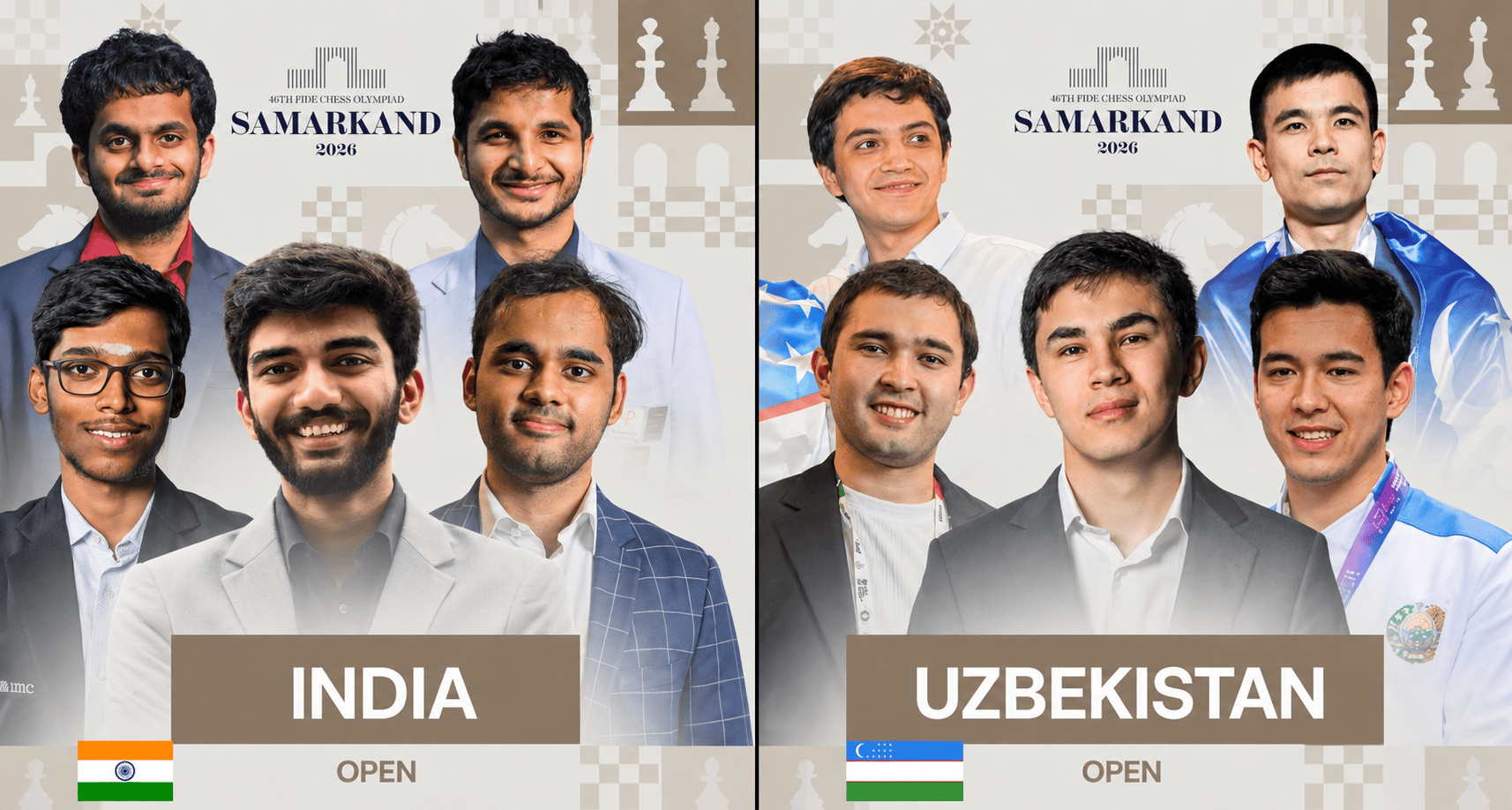
Will Gukesh repeat his triumphant performance from Budapest 2024? I believe not. It was a historic outlier and a performance 3056 which, in my opinion, no chess player who plays at least ten games for their team will reach again for a very long time. For our considerations, however, it will not be essential whether Gukesh repeats such a miracle. Much more important will be, how he will play and with what confidence he will leave Samarkand.
In Geneva itself, from the challenger’s perspective, we can expect two psychological scenarios.
(1) Sindarov will play at his usual fast pace. Such a scenario would undoubtedly follow a simple match strategy: to chase the world champion into time trouble and exploit the mistakes Gukesh makes in it.
But precisely this strategy can also bring serious risks. As we have seen in some examples not only in this article, Sindarov sometimes has a tendency which we might call „everything is clear“. He may not always recognise the critical moment of the game and at such a moment he can play too quickly. Speed tempts superficiality – and it is superficiality that Gukesh can punish!
However, in order to punish and strike at the opponent’s sensitive points, he must rely on a sure hand – on his own confidence. And we are again at the huge importance of the Olympiad performance!
(2) If coach Roman Vidoniak guides Sindarov towards a slower and more deliberate style of play, we might witness a completely different scenario. Sindarov could then utilise a fuller range of his classical chess education. On the other hand, the world champion is still better oriented – or at least was better oriented – in sharp positions where precise calculation plays a decisive role. It is precisely there that he can fully develop his „inductive gift“.
If in Geneva the world champion appears in full armour and with his former self-confidence, in my opinion he has better chances. However, if his poor results, games full of blunders and constant time trouble continue in Samarkand, Javokhir Sindarov will become the world champion.
Despite the enormous importance of the Samarkand rehearsal, I believe that in this historically „youngest“ match for the chess crown it could be entirely decisive the very start of the battle. More precisely, the first and second games.
We all remember that in the Ding Liren vs. Gukesh match in 2024 the challenger lost the first game. At that time, nothing particularly unusual happened. Gukesh was mentally strong, confident, and still had the whole match ahead of him.
However, this time losing the first game could mean something completely different. If Gukesh were to start the match with a defeat and all the doubts of the past months echoed again in his mind, his already tested self-confidence could suffer a very severe blow.
And believe me, dear readers, that at such a moment no mental coach would probably help the world champion anymore. Maybe not even Paddy Upton.

Current situation! A chess symphony of light and darkness… Caissa has not decided yet. How will it all end?
You can download the game and fragments from both parts of the article „Who is Who?“ here in PGN, CBV and 2CBV formats: