


Profile
Professional CV of Jan Bílek
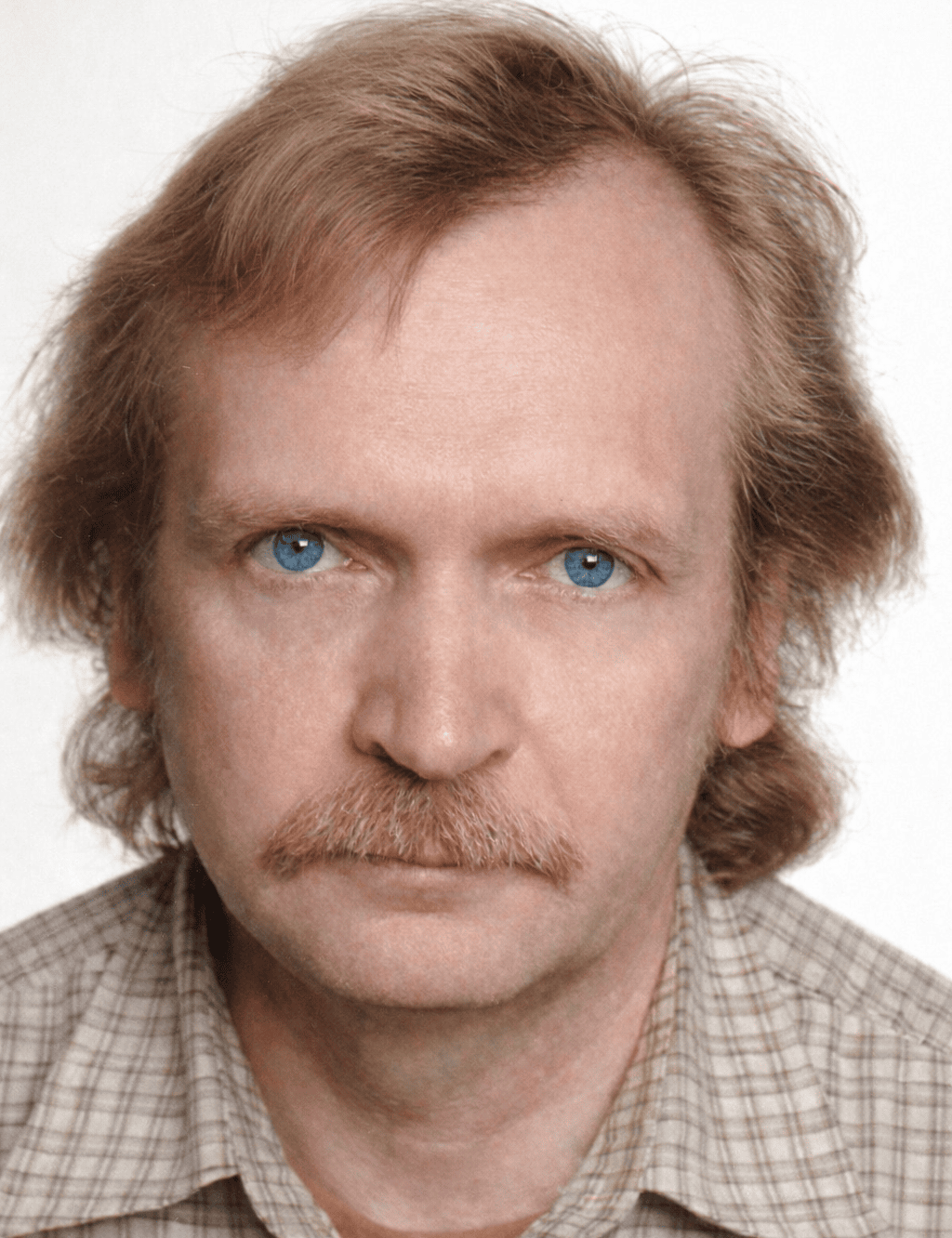
The first fully professional chess coach, theorist and analyst in the Czech Republic since the mid-1990s. Long-term most successful coach of children, youth and juniors in the Czech Republic in terms of the results of his pupils, to whom he devoted systematic attention from the beginnings of their chess careers.
He does not take any pupils into his care without the prior coach's consent; he considers such behaviour a form of unethical business practice.
Over more than 30 years of professional activity, he has trained hundreds of regional champions and medalists of the Czech Championships, dozens of medalists of the official Czechoslovak and later Czech Republic Championships, several dozen masters of CSFR and the Czech Republic, and approximately the same number of young representatives at World and European Championships. Nearly a thousand children and youth of varying talent, interest in chess, intelligence, diligence and character have passed through his training.
He has also trained (and later collaborated or consulted) FIDE masters, international masters and grandmasters. He has coached and consulted with dozens of adult chess players.
He has actively played chess since 1972. His „children's“ career started in 1973 with a draw in a simultaneous exhibition against the then second highest-rated player in the world, Mikhail Tal. It ended with 7th place at the Czechoslovak youth championship in 1978 in Bojnice.
Later he specialised mainly in team competitions; he played nearly 10 years on the first board of the young Plzeň team ZČE Plzeň in league competitions. In the 1980s, he achieved a technical norm for the title of Master of Sport there. Mainly for family reasons, he could not participate in tournaments abroad at the end of the 1980s.
At the beginning of the 1990s, he consciously decided on a career as a professional coach, at the expense of active tournament play. This decision was partly forced by his health condition, but also stemmed from the conviction that top-level coaching work requires full concentration.
In agreement with one of the world's most respected coaches, the late Mark Izrailevich Dvoretsky, he holds the view that it is not possible to fully and qualitatively devote oneself to coaching work while simultaneously competing in demanding tournaments or being burdened with organisational duties. He is critical of so-called semi-professional coaches who only supplement their other activities with coaching.
He advocates the line of educating pupils in accordance with the historical development of chess (Réti: „First we must learn to combine, so that later we can also play positionally!“).
He rejects modern approaches that lead to superficiality – both in general education (permissive and anti-authoritarian models, inclusive education, uncritical adoption of Western educational concepts) and in chess training.
He does not accept an approach based on passivity, waiting for the opponent's mistake or reducing the game to minimising one's own errors. On the contrary, he promotes an active, creative and, if possible, maximalist approach in seeking the best solution to the position and a thorough, deep understanding of the game.
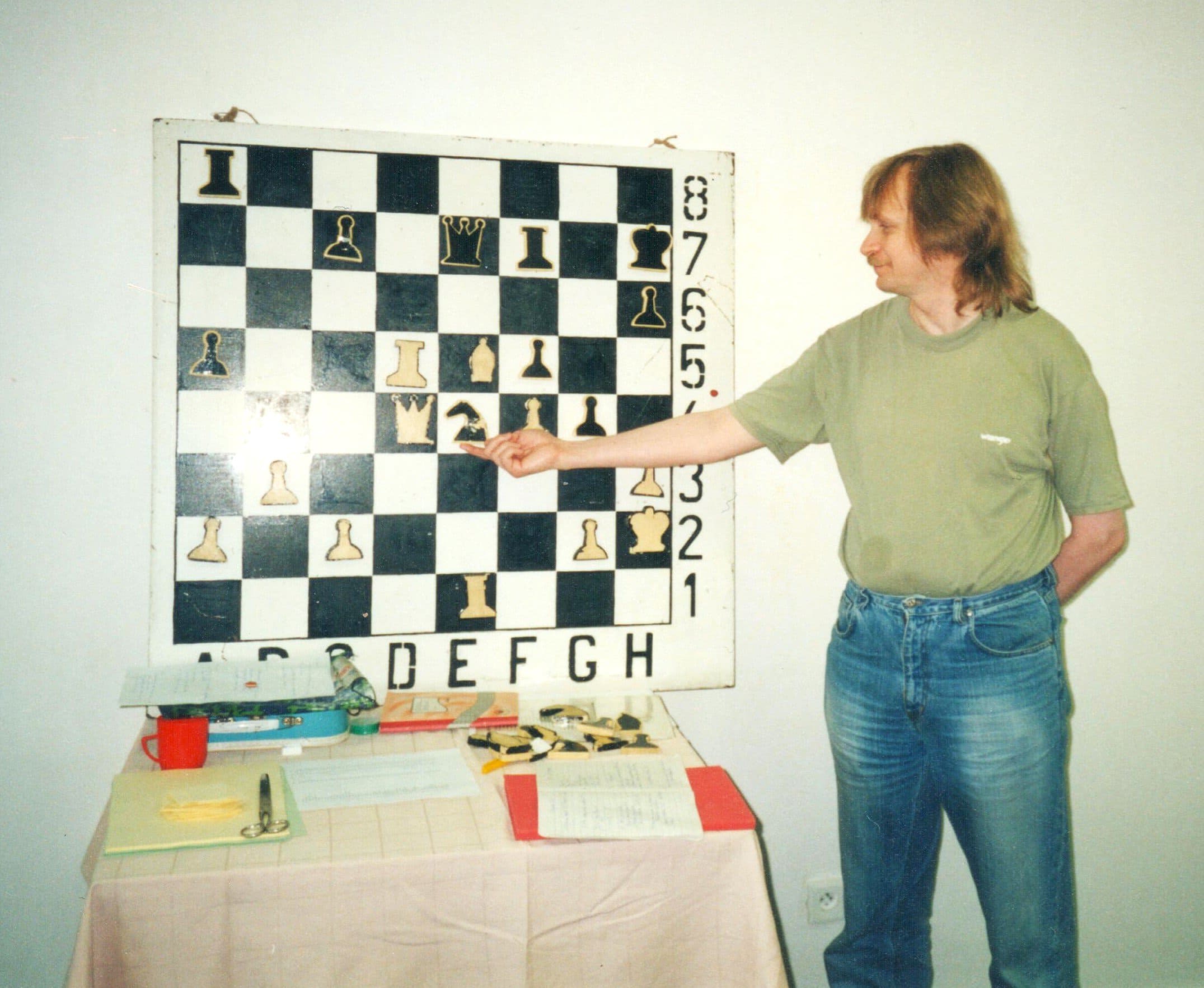
Theme 'The Power of Centralisation'. We have already covered the classic model game Stolberg vs. Botvinnik (Moscow 1940), so now something more recent... "The only pride of Black's Nxe4 must disappear from the board. Then White will achieve full dominance in the centre! How should White continue?"
He has long published a series of specialised articles focusing especially on the opening repertoire selection for less experienced players (ŠachInfo, 2004–2006). He is the author of numerous coaching materials, for example on the now defunct website chesslady.com.
On his website www.skolasachu.com he has published extensive chess works, some of which in their scope reach or surpass theoretical book publications. In the future, he plans to publish more materials of various focuses here.
As a chess theoretician, he created several original strategic conceptual ideas and methodological aids. He is convinced of the correctness of general teaching principles based on classical authors – Nimzowitsch, Botvinnik, Kotov, Zak, Kasparov, Chebanenko, Dvoretsky, Aagaard and others. He has read and studied hundreds of professional and coaching works, mostly from the former USSR, and he is a convinced supporter of the Russian and Soviet chess school.
He created and generalised some aids for evaluating positions on the chessboard, for example the safe square method for the queen in positions with an open centre (without pawns) or the principle of correct evaluation of positions with opposite-coloured bishops in the middlegame.
His speciality is the issue of calculation of variations: selection and choice of candidate moves, the principle of completing calculation of variations, selective thinking, heuristic analysis and critical comparison of opinions of various authors on the technique of calculating variations. In this area, he conducted a number of his own psychological experiments, building on the works of Botvinnik, Krogius, Zlotnik, but also authors of the younger generation.
In recent years, he has also been engaged in questions of the (combination) of computer chess and psychology…
Now allow me, too – for your amusement and instruction – to contribute to the game cake, from which some other authors of theoretical articles, streamers, analysts and occasionally coaches also give you a taste.
I deliberately chose games with tactical and dynamic charge. I have analysed all four again in detail after years and corrected a number of earlier incorrect evaluations.
The games were played in an ultra-dynamic style, perhaps following the great models of Chigorin, Alekhine, Nezhmetdinov or Simagin, whose games I literally devoured in my youth! How successful they were – and whether the above-named geniuses of our beautiful game would praise me or condemn me – I leave to your judgement. The memorable games are connected by one of my favourite weapons: a real developmental sacrifice in the opening.
Chess quote
Johann Wolfgang von Goethe
Chess quote
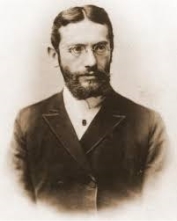
Siegbert Tarrasch