

Many beautiful moments at the chessboard, the enthusiasm of hundreds of thousands of spectators, plenty of happy moments, not a few sporting and human tragedies, but above all a faithful copy of today's world lacking empathy. A world that has gone out of joint. One example among many: The results of the 2024 World Rapid Chess Championship are announced. The top three places are taken by chess players... from which country? The largest one by far! Instead of the anthem familiar to us older ones, a cacophony of tones or a compilation of melodies meant to represent the FIDE anthem is played. However, FIDE itself has nothing to celebrate after the World Championship! If anyone totally failed at the end of the year, it was its leadership, which is also incapable of presenting consistent views externally. But let us focus more on the events that interest most readers! Beautiful experiences at the board, demonstrations and other interesting things. The first part is mainly devoted to the World Rapid Chess Championship.
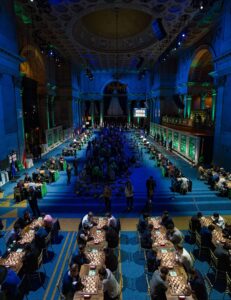
A look into the beautiful, magnificent playing hall in the Cipriani Wall Street building in New York (I don’t even know if the word ‚hall‘ can be used here) sharply contrasts with the small interest of spectators. It cannot be compared to the Budapest Olympiad. Yet chess enthusiasts here had the opportunity to come very close to the playing tables and literally touch the players!
Two critical positions that decided the world champions
Below we can see two diagrams with critical positions. White’s continuation in both cases decided the holder of the world champion title! Why? In both, White blundered badly and the opponents actually celebrated a double victory.
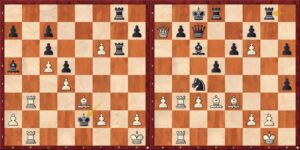
How would you continue in the positions of the diagrams?
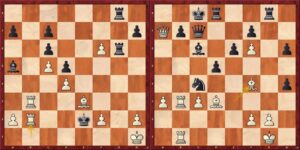
In the position of the left diagram, in the game Praggnanandhaa,R vs. Murzin,V (rapid, round 12), White continued 34.R1b2+??. In the 4th game of the blitz final Carlsen,M vs. Nepomniachtchi,J the world champion started an incorrect combination with the idea of distracting the queen. After 25 seconds of thinking, he played 25.Bf4??.
Dear readers, can you punish White in both cases and achieve a winning position?
Well, now let us enjoy the conclusions of the games in the broadcasts. The second one really deserves attention. This is how blitz is played today at the very top of professional chess! The emotions of both great chess players are certainly worth watching too!
The case of Magnus’s jeans and the dress code
As many people, as many opinions! The result of the rather unpleasant case of Carlsen’s clothing was that the world rapid chess champion Magnus Carlsen, after a somewhat unsuccessful start to the rapid (see also the examples below), withdrew from the tournament on the second day, after round 8. The official reason was his clothing. The chief arbiter did not like Magnus’s jeans! For readers who are not so familiar with the whole case, I will explain this: Some time ago, FIDE established – probably after the uproar at the World Cup a few years ago – a so-called dress code. That is, what clothing of male and female chess players at a given competition is still acceptable and what is not. The so-called first warning here, at the World Championship, meant – if I understood correctly – a fine of 200$ and a condition to change clothes between rounds; the second warning then meant forfeiture of the game.

Personally, I could somehow understand the behaviour of the chief arbiter, a certain Alex Holowczak (*1990, interestingly the same age as the world champion) to understand, he behaved according to the rules, although later I saw other chess players dressed… well, just terribly.
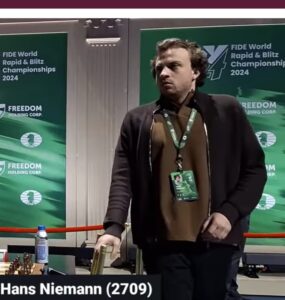
Hans Niemann's tracksuit (what else could you call the clothing in the picture?) apparently fitted the organisers' and FIDE's idea of appropriate attire for the World Championship…
I will summarise the problem like this: jeans or tracksuit? 🙂 Only afterwards did I come across a video, a fragment of which speaks to the problem…
Apparently the dress code does not apply to Magnus's underwear or… the visible part of his backside! 🙂
So after several mishaps with one loss and two saved lost positions, Magnus withdrew from the tournament and planned, according to his words, to travel to better weather. Fortunately, after the rapid event there was a rest day and FIDE representatives had the opportunity to try to resolve the situation. I especially liked the information that the talks initially took place with Magnus's father Henrik. I had to check when the age of majority is in the Kingdom of Norway… 🙂
The world champion reconsidered his status (what a surprise 🙂 ) to appear on 30 December at the start of the World Blitz Championship… of course wearing jeans.

Explanation for those who do not speak Russian: 27 December: Magnus is excluded from the tournament for violating the dress code… 30 December: Magnus returns to the World Championship… wearing jeans.
To conclude the case around the dress code and jeans, I would still recommend this otherwise nice short video to dear readers. How much do you think Magnus's clothes, which he wore during the first day of blitz, cost? I believe the arbiter who sent Magnus to change, would not be able to afford such clothes on his monthly salary nedosáhl!
Yes, this is exactly how I imagined it appearance of a punishing arbiter he represented! Could chess do without people of this kind? Mr Holowczak surely slept sweetly that day! After all, he managed to win a dispute against one of the strongest chess players of all time…
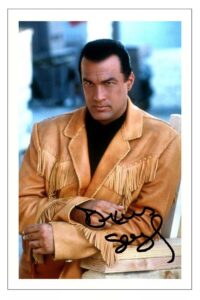
Ta bit of a breather before the chess part. The famous jacket of Steven Seagal. I borrowed the idea of a several-month salary for a piece of clothing from one of the famous films of this action hero!
Unexpected winner of the Rapid World Championship and a long-unseen triumph for Russia
Three years ago, the then only 17-year-old Nodirbek Abdusattorov unexpectedly became the world rapid chess champion. The years 2022 and 2023 brought no surprises. Even Abdusattorov’s victory in Warsaw did not cause as much astonishment as this year’s triumph of the young Russian grandmaster Volodar Murzin.
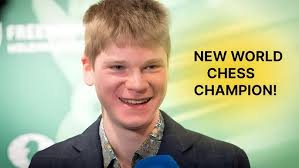
Volodar Arturovich Murzin (*18 July 2006) world rapid chess champion. Will his greatest achievement so far become a springboard to a career among the world’s elite players, as it did for Nodirbek Abdusattorov? According to his own words, he devotes all his time to chess…
Coaches and professionals know this boy’s name. Volodar was among the stars of children’s and youth chess, and because he is close in age to both the Indian prodigies and other extremely talented children, he has often faced them… and beaten them. His – let’s say – slower visible progress can of course be partly attributed to the isolation of Russian Federation athletes, but also… to his style of play! I can’t help but see a young Anatoly Karpov in him! In this context, two episodes from the life of the 12th world champion almost always come to my mind: The first supposedly happened in the early 1960s, when the patriarch of Soviet chess Mikhail Moiseyevich Botvinnik at one, what we would now call, national training camp, declared (of course I paraphrase): „A likeable boy, a pity he will amount to nothing.“ The main reason for the patriarch’s harsh judgement was the fact that Anatoly Yevgenyevich at the training camp prepared for mandatory analysis his own games, intended for demonstration to coaches and other participants, those which… he had lost! The second episode I remember directly from contemporary press. About ten years later, in the early 1970s, before the Candidates tournament quarterfinal match, and even afterwards, Karpov used to say in interviews: „This is not my cycle!“ As it turned out, it was!
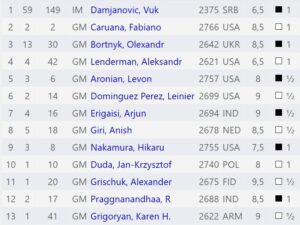
Murzin's results at least command respect. Also, a performance of 2881 is truly impressive for rapid tournaments, where even the top players' ratings are usually lower.
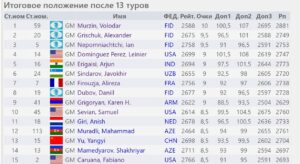
The final results for the top 15 places were as follows. Readers can view the complete results at the end of the article.
The Merciful Matrix? Did Volodar himself please Caissa?
Going through Murzin's games, we cannot help but notice that the World Championship found him not only in excellent form, but that in the rapid section Caissa's interest in his play was, well… more than just curious! Those readers who are accustomed to frequently using the words luck or bad luck, will find quite a few moments when they can rightfully speak of Volodar's outrageous dodges Indeed, we saw one example at the beginning of the article. Pragg did not want a draw in the game (rightly so), so he (undeservedly?) lost. Well, the clocks are not there next to the board just for show, as they say. On the other hand, it should be noted that in the remaining games Volodar was not really endangered at all.
Besides the examples you can see in the attached video analysis by Sergej Makarychev, I would like to demonstrate a typical Murzin approach to the opening and then also a brilliant, truly Karpov-like technique in one of the knight versus bishop endgames.
Let's start with a simpler and more entertaining example from the game Bortnyk,O (2642) vs. Murzin,V (2588) from round 3.
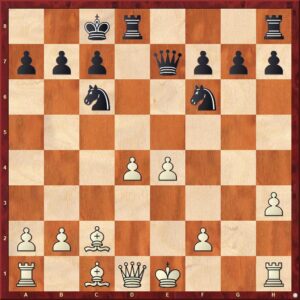
(A four knights game with an exotic 4.Nd5 sortie was played.) How would we evaluate the position in the diagram? I can quite easily imagine looking at it in some regional student tournament! "Where on earth did White lose so much time? Where have his developed pieces gone??" you will probably ask.
Another interesting fact: If we remove all the pieces from the board and focus only on the pawn structure, know that we are facing the so-called absolute pawn centre. White would stand excellently or at least satisfactorily if he could... make say 3 or 4 moves in a row on his half of the board 🙂. In the game it continued 14.Ne3.
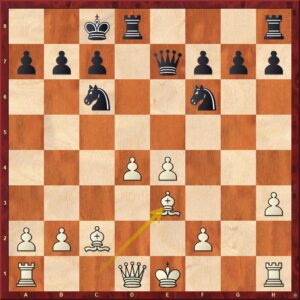
How would you respond with Black?
The young world champion demonstrated excellent technique in the endgame in the 4th round game: Murzin,V (2588) vs. Lenderman,A (2621)
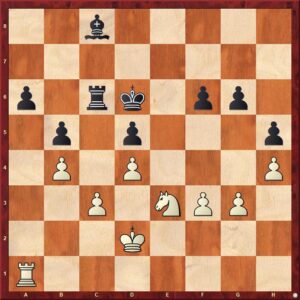
Would you play 55.f4 or rather 55.g4 in the position of the diagram? Or would you choose another option?
You can watch the entire game in the record:
Further Murzin games are analysed below by Sergej Makaryčev.
For readers interested in the development and current views on the Greco Attack in the Italian Game (and why it no longer appears at the highest level), I recommend paying attention to the opening analysis of the game Praggnanandhaa vs. Murzin from the same source. After all, Sergej Jurijevič is one of the spiritual fathers of the rebirth of the Italian pianissimo with d2-d3 and c2-c3…
Volodar Arturovič gave a short interview (in Russian) after his victory at the World Rapid Chess Championship.

Volodar Murzin with his long-time coach Grandmaster Michail Kobalija in New York.
Misgivings around Calsen rapid performance

Apart from the jeans controversy however, the world champion really did not show much in the mere eight rounds of the Rapid World Championship. Except for the bitter pill of defeat against Denis Lazavik (see the shortened video record of the game), he twice more found himself on the very edge of the abyss of another loss. His tactical oversights and weak play in sharp calculating positions probably kept many knowledgeable and more critical fans awake at night. „What will he do in blitz? He simply cannot overlook things like that there!“ „If everyone stops fearing our Magnus and many do not get cold feet in advance, it might turn out that the king is naked!“ This is probably what the sharper critics of the world champion thought again… and I am somewhat closer to them. 🙂
Not only an excellent material for coaches became the following pawn endgame, which arose in the game Carlsen,M (2838) vs. Šimanov,A (2578).
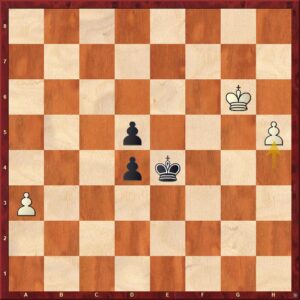
Can you calculate the forced win for Black? If you, dear readers, have the desire and time, and have not yet seen the game or its fragment, I recommend you to pause. After all, there is nothing better than the good feeling that we are able to calculate about 10–11 moves ahead. Moreover, the usually confident face of the Levitov Chess channel grandmaster Alexandr Šimanov, with his eternal happy smile, could not cope with the task!
The world champion found himself on the edge of the abyss with Black in the game against the young Belgian grandmaster Daniel Dardha in round 7. After 40.Nf5 the position in the diagram arose.
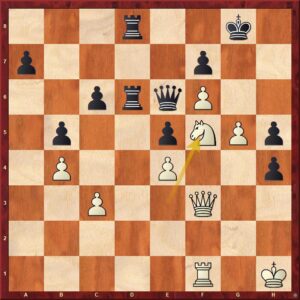
The computer shows satisfied equality and draws its three zeros, but in practice? We see that White has a very dangerous attack, threatening 41.Qxh5 with forced mate! In earlier times, the position would have been the subject of thorough research lasting not just a few hours. Rather, we are talking about days or discussions in magazines!
It is truly beyond human powers to defend correctly with Black in a limited time – or more precisely to find a saving counterattack (Black continued 40…R6d7??). It would certainly be interesting to see how the 16th world champion would cope with the problems if he had not minutes but perhaps an hour on the clock! Would he be able to orient himself and find one of the two paths leading to a draw? The first consisted of the study-like 40…Rd3! 41.Qxh5 Rh3+ 42.Kg2
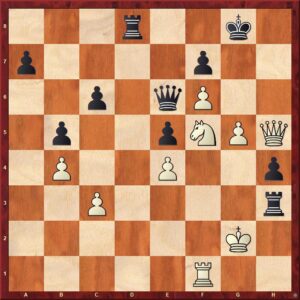
Dear readers, can you find that truly study-like path to a draw? If yes, you are probably not far from master-level strength! So the task is: Black to move draws!
We can rummage through the jewels, but choosing among them is difficult
That’s how I feel when I have to choose brilliant examples from an inexhaustible quantity… of brilliant examples! 🙂 But choosing from a thousand games of titled players, that is tens of thousands of interesting positions, is simply impossible, even though I devoted hundreds of hours to the World Championship. My several sieves the best examples that finally passed through were strategic and tactical gems, which I will introduce to you dear readers either with diagrams or you will find them only in the viewer below. So let's dive into a series of small tests.
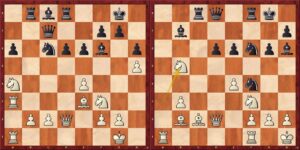
In the positions of both diagrams Black continued with the same procedure! Which move was it? Would you play it in both cases too or not?
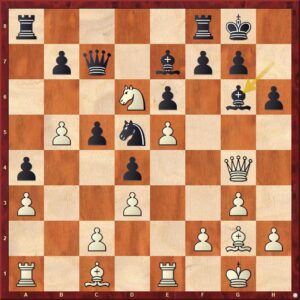
After a nice win in the first round, Alireza Firouzja could have achieved a win in the next round as well. In this case, however, the task of finding the winning continuation is not at all easy. If it happened, the whole game would be a candidate for the gem of the year! Will you, dear readers, try to untie the knot of this problem? That is: what is White's strongest move in the position?
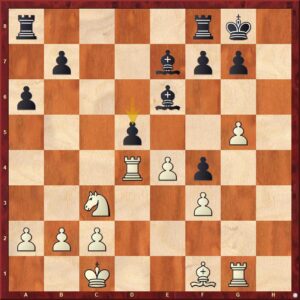
For the third time from the work of one of the most talented players of today. Black with the last move initiated a tactical operation by playing 19...d5. How would you continue with White and on which variations would you rely?
In the game Abdusattorov,N (2740) vs. Rachmanov,A (2561) Black played 19...Rd5.
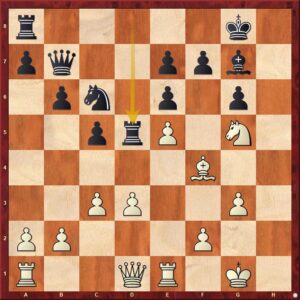
From this manoeuvre, he hoped to meet the threat Qg4-h4-h7 or Qg4-h3-h7 with a fierce attack on his king. Indeed, concrete variations in this case show that White would have a pleasant compensation for the sacrificed central pawn e5, but nothing more. But... can you find a continuation that refutes Black's entire defensive or counter-attacking concept? How would you continue if you were White, and which variations would you calculate?
If there were prizes for beauty, the following game would be a serious candidate. Nodirbek Abdusattorov really did not need much encouragement to decide in the diagram position to break through Black's king's defence at the cost of material sacrifice. After 22.f4 (I deliberately do not give the symbol; more can be found in the viewer)
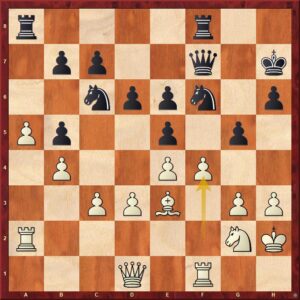
Black did not hesitate twice. He probably considered the last move an oversight and after about a minute and a half decided to gobble up the offered material: 22...exf4 23.gxf4 e5
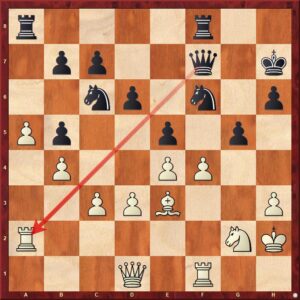
How do you think White reacted?
In the game Duda,J-K (2740) vs. Naroditsky,D (2638) The young Polish grandmaster managed to lure his opponent into a trap!
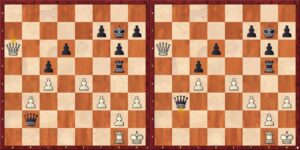
„You with your tricks on me? I see 35.Qa1?? Rxg2! and I could resign, wait a moment,“ Jan-Kryštof perhaps thought and played the inconspicuous 35.Qa7-a6! (left diagram). The clock shows that Black, after an incredible more than two minutes of thinking... fell into the trap! Can you after 35…Qxb3?? calculate to the winning position? Or analytically prove White's win? A hint: this is an exceptionally clear example of the power of heavy pieces invading along adjacent open files, but there is also a chase after the king, who tries to hide… wherever possible 🙂. Once again, this confirms the saying that heavy-piece endgames are not really endgames!
If the former Indian prodigy Rameshbabu Praggnanandhaa were no longer a junior, I would consider his performances over the past year with a clear conscience as a warning sign of stagnation! After all, in the light of the rising stars of the world champion Gukesh and Arjun Erigaisi, this is an undeniable fact. However, I could not hide from the reader (also) with a clear conscience the charming combination with which he crowned his game against the experienced Azerbaijani grandmaster Durarbayli, , with a clear conscience 🙂. .
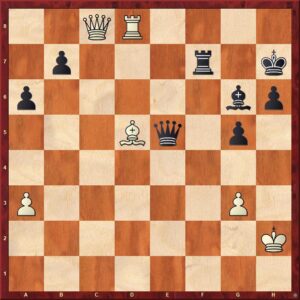
Can you calculate to Black's winning position?
I will briefly mention the Women's World Rapid Chess Championship. Here, experience won hands down! The gold was taken not for the first time by the 37-year-old Indian grandmaster Humpy Koneru ahead of the world champion Ju Wenjun and Ekaterina Lahno (the fourth medal out of six for the Russian Federation).
The game Munkhzul,T (2333) vs. Kostenjuk,A (2486). After a strong, though not the only correct 45…Qd3
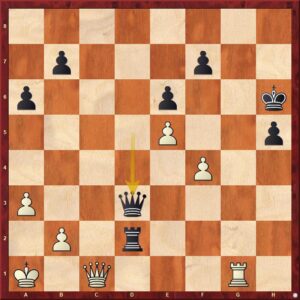
the young Mongolian grandmaster played 46.f5. How would you continue if you were Black?

New World Rapid Chess Champions!
Complete overall results of the World Rapid Chess Championship can be viewed by clicking the link.
All examples in CB format: