
What if Rome had not won the Punic Wars, but Carthage? What if parallel worlds existed, as postulated from the perspective of quantum mechanics by the brilliant physicist Hugh Everett? Are there other iterations? What if in one of them, on 13 July 2024 at a campaign rally in Pennsylvania, Donald Trump had not turned his head exactly at the moment of the assassin's shot?... And how would chess history have developed if Anatoly Karpov had won the 6th game in the 1984 match against the young Kasparov, adjusting the final score to 6-1 or even 6-0? What if the 2013 Candidates Tournament winner had been decided not by the number of wins as a tiebreak, but by the traditional Sonneborn-Berger? What if Carlsen had not equalised the match score only in the 10th game out of 12 planned in his 2016 battle against Karjakin? What if Caruana had won the rook endgame in the balanced 6th game of the 2018 match?... On the eve of the World Championship match, let us speculate, remember and of course train…
Butterfly effect and iteration hypotheses

Well then, let us speculate! Just as in history as such there are critical moments believed to have significantly influenced future events, so it is no different in our chess world! The so-called Butterfly Effect simply means a sensitive dependence on initial conditions, in which even a small change in one state can result in large differences in a later state.
Today, the increasingly popular iteration hypothesis assumes that in other parallel worlds history could have unfolded differently precisely based on a change at a single moment. Seemingly insignificant changes, just as well as those universally recognised key moments in history. The flutter of butterfly wings can thus have far-reaching consequences.
iteration = repetition of a certain process in a changing context
Our chess world boasts an immensely rich history, and so naturally we find many moments that shaped its further development. For example, what would have happened if FIDE had approved Fischer’s last demand regarding new rules for the World Championship match in 1975? The Fischer vs. Karpov match was supposed to be played to 10 wins without a limit on the number of games, as was often the case at the beginning of the history of the chess crown matches. Officially the match did not take place only because FIDE refused to accept the last American’s demandWith the score at 9-9, the title remains in the hands of the current world champion!
Let us now look into possible iterations, in which, let us say, the butterfly flapped its wings differently and at other times, than what happened here at home…
Iteration one: World Chess Championship match Karpov vs. Kasparov 1984

Today, no one knows for sure, why the system of matches for the chess crown, which suited everyone for decades — that is, 24 games, with the world champion retaining the title if the score reached 12-12 — stopped being suitable. Nevertheless, it is so. The first match under different rules (again not new; almost the same rules governed, for example, the famous Capablanca vs. Alekhine battle in Buenos Aires 1927) was played in 1978 (the cycle for the highest title was then three years) in Baguio, Philippines, between world champion Anatoly Karpov and challenger Viktor Korchnoi. It was played to 6 wins with no limit on the number of games.
In a dramatic ending, when the challenger equalised the score in the 31st game from a daunting 2-5 to 5-5, Anatoly Yevgenyevich won the following 32nd game.
Three years later, in Merano, Italy, however, the ageing Korchnoi could no longer keep pace. The match ended 6-2 after only 18 games. At that time, a new young generation of grandmasters was just coming of age, and moreover, the Candidates Tournament final was not even properly completed. (West German grandmaster Robert Hübner resigned the match against Korchnoi with the score at 3.5-4.5 and left.)
Despite various — let us say — political twists in the first half of the 1980s, when there were mutual boycotts of sporting events between the USSR and the USA (with their satellites on both sides of the divided world), Karpov’s challenger ultimately became the very young Garry Kimovich Kasparov.
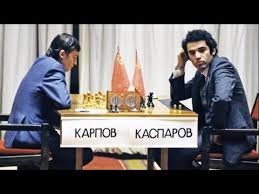
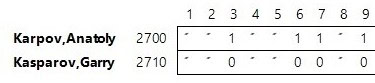
The match started on 10 September 1984 and… in our iteration was never completed, but rather on 15 February 1985 was cancelled and the result annulled! „How is that possible?“ Younger readers, or those who have never really studied history, might be surprised. Even greater astonishment will probably be caused by the part of the table you can see below:
… and its next part:
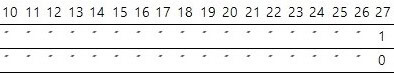
While the start of the match resembled a steamroller driving over sun-baked asphalt, and Kasparov's attacking onslaughts evoked attacks with a meat mallet against a tank (which cannot be underestimated, but a tank is a tank 🙂 ), Garry gradually realised that this approach would not work and stopped trying to break the positions. Nevertheless, he still lost the 27th game.
At the score of 5-0, naturally the chess public's interest in the match began to wane. The 27th game was won by the world champion 23 November 1984, that is after more than two months! What odds would be offered today on both players? (For younger readers, I add that it was not customary then to play games every day, only with occasional rest days; players had the right to short breaks, and some games were finished the next day because play was suspended after move 40.)
Now let us examine the final part of the table:

The 48th game of the match was also the last. In it, Kasparov adjusted the match score to 5-3. By that time, the match had already lasted more than 5 months!
On the evening of 15 February 1985, the then FIDE president, the Filipino Florencio Campomanes, declared the match over, effectively cancelled, annulling the results. In his statement, he expressed that the main reasons were concerns for the physical and mental health of the players and the fatigue of the organisers.
However, both participants outwardly expressed strong protest against this step, stating that they wanted to continue the match. According to all the rules valid at the time, no individual or group had the right to end an ongoing match… For safety (?) a plane was already arranged for the president that evening, and he flew back to his homeland…
To balance explicitly tendentious interpretations of the match’s ending (especially after the collapse of the USSR) in favour of the challenger, and also the statements of Garry Kasparov himself published in his books, I would recommend readers this link:
https://bigenc.ru/c/bespretsedentnyi-shakhmatnyi-marafon-v-matche-karpov-kasparov-1984-1985-4ee647
Anatoly Yevgenyevich offers an exceptionally interesting – and in my opinion more logical – explanation of all the events in his autobiography Жизнь и шахматы (Life and Chess) published in 2022.
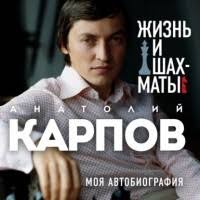
I will mention just a few interesting facts:
The match was moved several times from place to place in violation of the rules. This was because, of course, no one expected a 5-month match and the main Moscow hall The Column Hall of the House of Trade Unions was designated for various other state and party events.
Kasparov was extraordinarily strongly supported by the Soviet state and party from early childhood. He was assigned two personal coaches (Alexander Shakarov and Alexander Nikitin were not allowed at that time to coach anyone else!) and Garry's mother Klara Shagelovna later gave up her job to fully devote herself to raising (or also training 🙂) her son! For this activity she received a significantly higher salary from the state than a university-educated engineer in the two-million city of Baku.
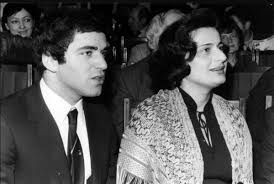
Garry Kimovich Kasparov with his mother Klara Shagelovna Kasparyan
Where did this generous support come from? After all, Kasparov was by no means the only huge talent of the Soviet Union! A decisive role in this was played by one of the most important Azerbaijani and later Soviet party officials Heydar Aliyev (later the third Azerbaijani president). Member of the Politburo of the Central Committee of the Communist Party of the Soviet Union from 1982 to 1986 and also the first deputy chairman of the Council of Ministers.
Regarding the end of the match, Anatoly Karpov writes in his biography about his visit to the office of the Minister of Sport Marat Gramov: „This is absolutely disgraceful!“ I said to Gramov the next day. „Look at what is happening! How outraged the press is! The match must be immediately resumed…“ At that moment the phone on his desk rang, a connection from the Kremlin. The minister picked up the receiver and said: „Greetings, Heydar Aliyevich! Yes, yes, everything is fine. Tjust as we planned. I have Anatoly Yevgenyevich here. Now we will discuss the organisation of the next match.“
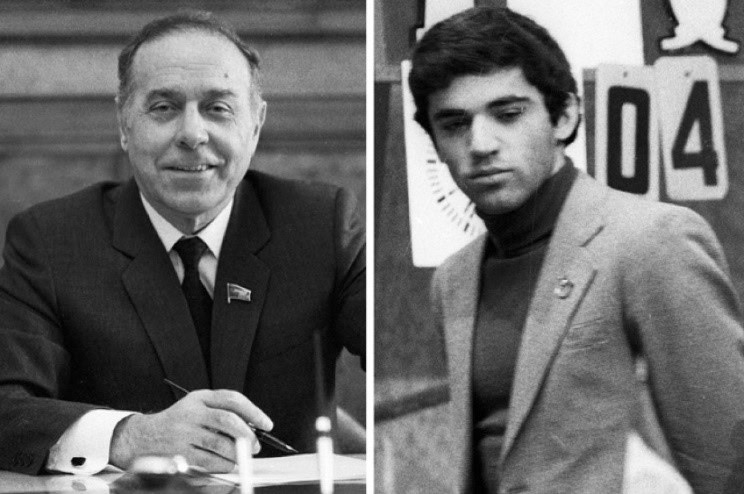
One of the most powerful politicians of the USSR in the first half of the 1980s, after its collapse the third Azerbaijani president Heydar Aliyev (1923–2003) and the young Garry Kasparov.

This picture in the text introduces a transition to a possible alternative reality, a different iteration!
It is 14 January 1985. The 41st game is on the agenda, the match score is 5-1. After 32...Rxb4 (a bishop stood on b4) the position of the diagram arose.
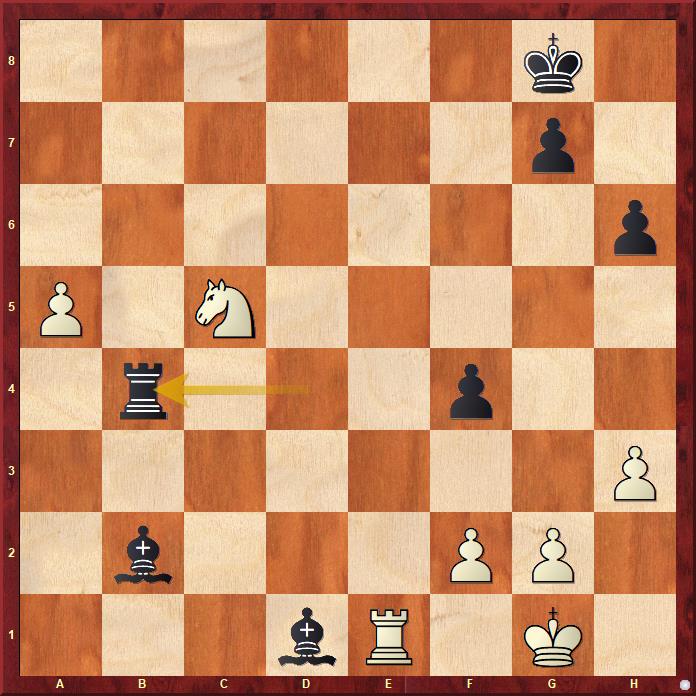
The World Champion did not have much time to spare, and so at this moment (in our reality) the flutter of butterfly wings did not intervene. After 33.Rxd1? Black defended the endgame without the pawn. However, the win of the game and the end of the match was promised by 33.a6!
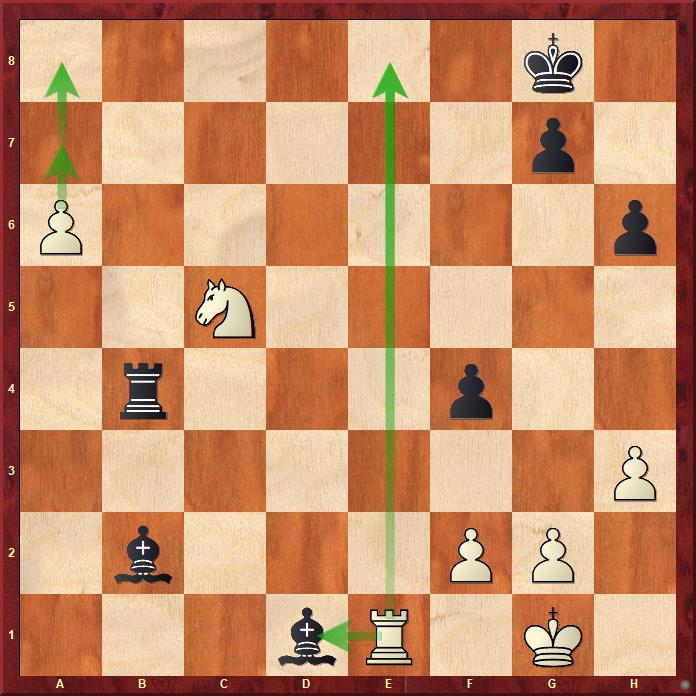
(a continuation that Karpov saw, but it seemed to him that the usual 33.Rxd1 simply wins more reliably). Computers evaluate this position around +4, and it also turns out that no unclear complications occurred in which White could have gone wrong. On the contrary, it is a technical endgame with a clear plan to bring the distant passed pawn to the promotion square.
A small combination would have fundamentally changed chess history! The World Champion would have won the match almost with a dry score of 6-1 and remained World Champion until 1987.
On the other hand, Kasparov would have had to go through the Candidates Tournament again (where he could have met a very unpleasant opponent for him, Artur Yusupov, or the rapidly progressing Andrei Sokolov) and, if successful, face Karpov again… FIDE would probably not have split or it would not have happened under the conditions prevailing in the early 90s...
Another question remains whether Garry, after a crushing defeat, would not have suffered the so-called. Sokolov syndrome. What is it about?
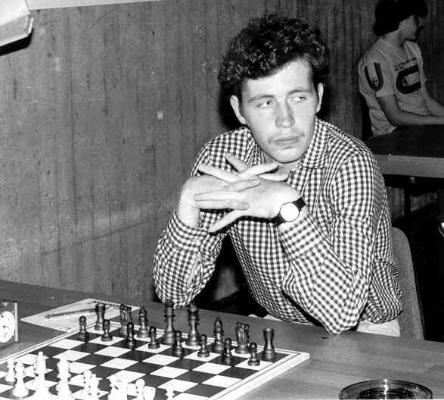
Andrei Yuryevich Sokolov (*1963), in 1987 the world number three by rating! He shone like a meteor! However, the superfinal of the Candidates Tournament Karpov-Sokolov (-4 =7), played in the same year, meant the end of his short star career. In the next cycle of the Candidates Tournament, he was eliminated already in the round of 16 and faced an unstoppable decline in performance…
Would the young, extraordinarily sensitive and from early childhood favoured Garry Kimovich have not ended up similarly in an alternative reality after the crushingly lost 1984 match?
Iteration two: World Championship match Karpov vs. Kasparov 1985
The annulment of the first match between two greats K resulted in FIDE returning to the traditional format of playing World Championship matches. 3 September 1985 Thus began the second of a total of five (sic) matches between Karpov and Kasparov. The well-informed and of course rapidly improving 22-year-old Garry Kimovich, who – as Karpov himself wrote – had previously received 48 coaching lessons from him for free 🙂, eventually won it 13-11 and thus became the 13th world champion in our history.
The last 24th game of the match is being played (the score is therefore 12-11 in favour of Kasparov; +4 -3 =16) and Karpov must at all costs win with White. If he succeeds, he will retain the world champion title at least until 1988. After 23…Re7!
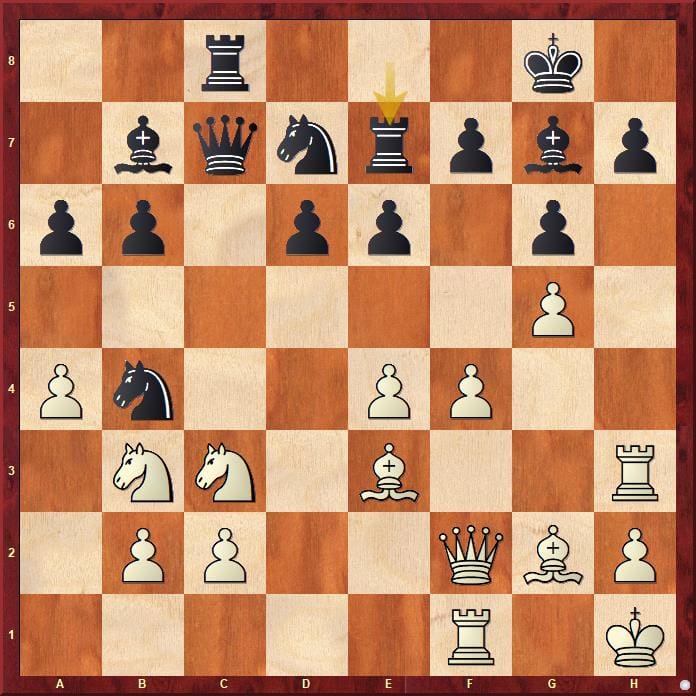
a position arose which Anatoly Yevgenyevich mentions, among other things, in his autobiography. Black had approximately 10 minutes for 17 moves until the time control, while White he had a whole hour...
It must be added that the computer does not confirm the obvious objective advantage of White, which Karpov mentions, but it does give White a certain plus. From a practical point of view, I also believe that the position of Black's king, to put it mildly, causes concern...
After several logical moves and the last 28.Nd1! the following position of the diagram could arise.
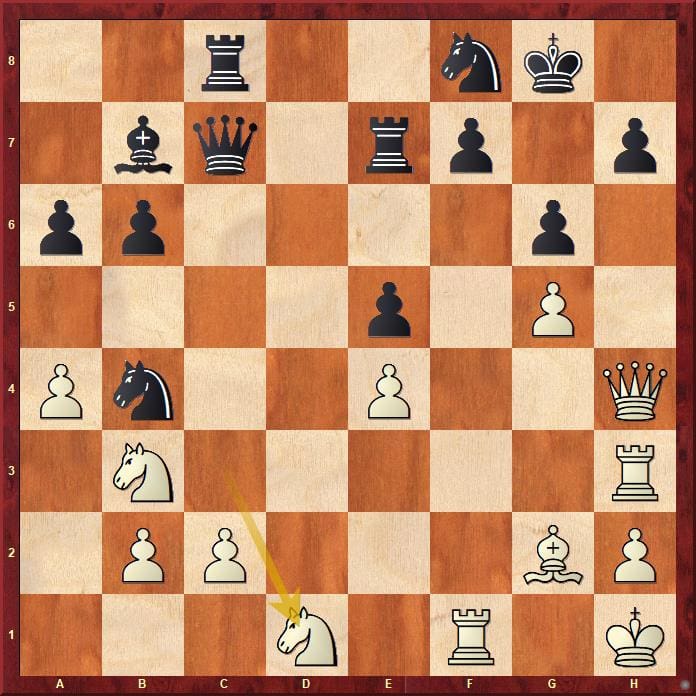
Kasparov would certainly have plunged deeply into thought here! There is much to consider! How much of those maximum 10 minutes would he have spent on the correct answer? White, who - I repeat - plays in modern terms armageddon, simply must intensify the attack at all costs, and the manoeuvre Nd1-f2-g4 (or e3-g4) suggests itself at first glance! The computer will of course defend Black's position, but...
Task and test for you, dear readers. Black has only one reply available that holds the position. Unlike the challenger, we have plenty of time to unravel the tangle of complications. How would you continue as Black?
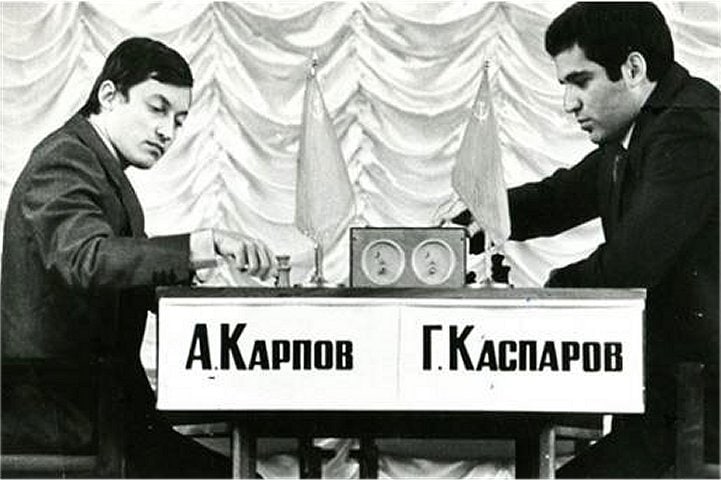
The interpretation that Karpov was always a representative of the old Soviet Brezhnev regime, whereas Kasparov was a dynamic young man of the new era. A child of change.
Nothing could be further from the truth! To the above facts about support from the Soviet state, mostly from one of the USSR's most powerful politicians, Heydar Aliyev, I might add that Kasparov joined the Communist Party of the Soviet Union at the age of 17! He did not have to go through a one-year candidate period and was granted an exemption by the party's central committee. The objection that he did this because otherwise it would have hindered his career development does not hold. As Anatoly Karpov writes, world champions such as Tal, Petrosian, Smyslov, and Spassky were never members of the Communist Party...
Personally, I share Sergey Karjakin's opinion: We must view Kasparov (on 22 May 2022 he was declared a foreign agent in the Russian Federation) from two perspectives. On one hand as a brilliant chess player, one of the greatest in chess history, and on the other as a person of questionable character. After all, some Czech representatives who faced him over the board could certainly tell a lot about his behaviour...
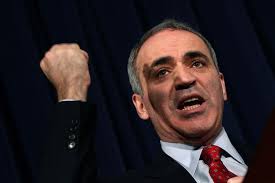
Two great K together in our iteration played a total of 5 matches for the World Championship title: Moscow 1984-1985, Moscow 1985, London-Leningrad 1986, Spain 1987 and France 1990. The overall score of the five matches favours the younger by +21, -19, =104!
Both certainly belong among the unforgettable giants of world chess in many, many iterations!
Third iteration: The world without the Carlsen era as we know it

The 2013 Candidates Tournament held in London was to select the challenger for then World Champion Viswanathan Anand. The final tournament table looked like this:
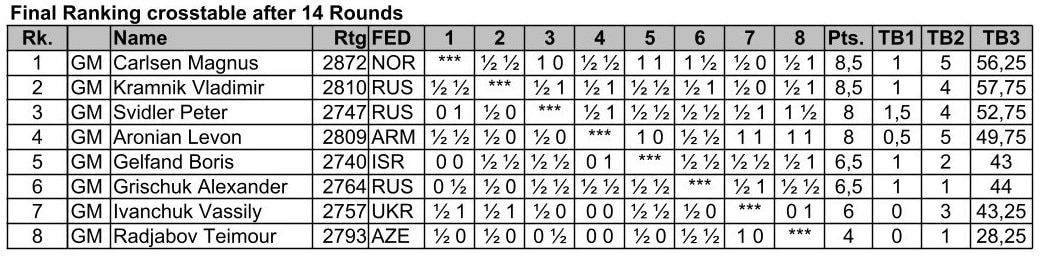
For the victory of Magnus Carlsen, the deciding factor was the second tiebreak criterion. One would be mistaken to assume (in the absence of tiebreaks at that time) that in the event of equality in their individual games, the traditional and historically proven Sonneborn-Berger would decide.
Let us look at the table. By which criterion did in our iteration the future world champion win the tournament?

In this very important tournament, the criterion chosen was... the greater number of wins! „Why not the opposite, the smaller number of losses?“ one might wonder with the same logic!
In November of the same year, in a short match, Magnus Carlsen defeated Anand, who was twenty-one years his senior, 6.5-3.5...
Iteration four: Carlsen-Karjakin 2016

The 2016 World Chess Championship match took place from 11 to 30 November 2016 between World Champion Magnus Carlsen and challenger Sergey Karjakin in New York.

The match began with seven draws in a row, then Karjakin won the eighth game.
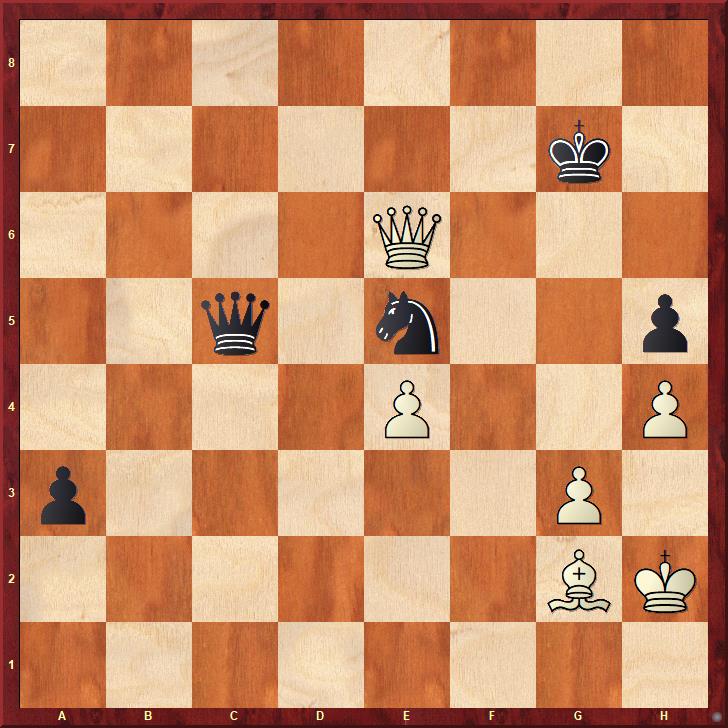
How would you continue as Black and on which variations would you rely?
In the table we see that in our universe Carlsen equalised the score with White by winning the tenth game, and it was precisely here that the iterative turning point could have occurred!
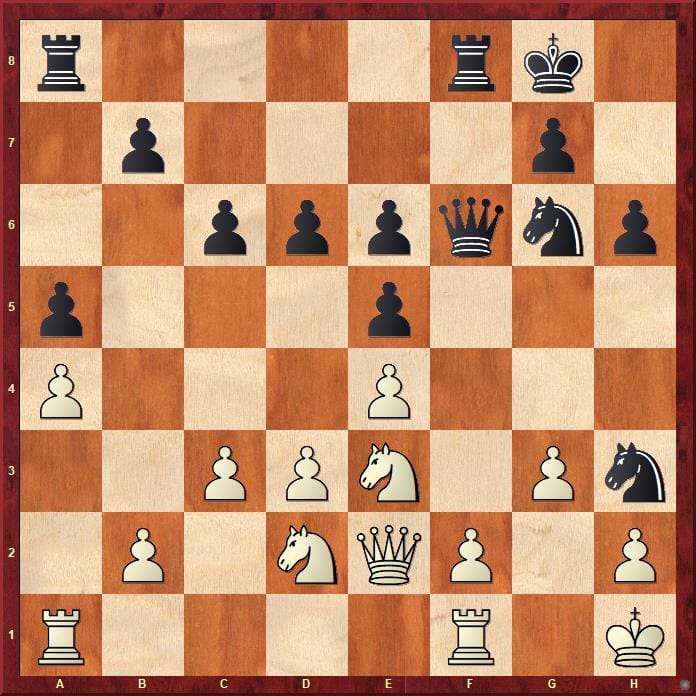
A critical position that could have decided the fate of the entire 2016 World Chess Championship match. After this game, only two remain. The World Champion therefore had with the White pieces one of the last chances to try to equalise the match score without too much risk of outright collapse. Extreme tension prevails in the hall, the press centre, and on the computers of tens of thousands of spectators and fans.
The position is balanced. Try to find Black's strongest solution!
True, in an alternative reality, where the match for the world championship title was won by the Russian grandmaster, they would be deprived of the spectacular finale of the last tiebreak game, and… the readers of my pages would not be able to enjoy the well-calculated following position.
Carlsen-Karjakin 4th tiebreak game, New York 2016
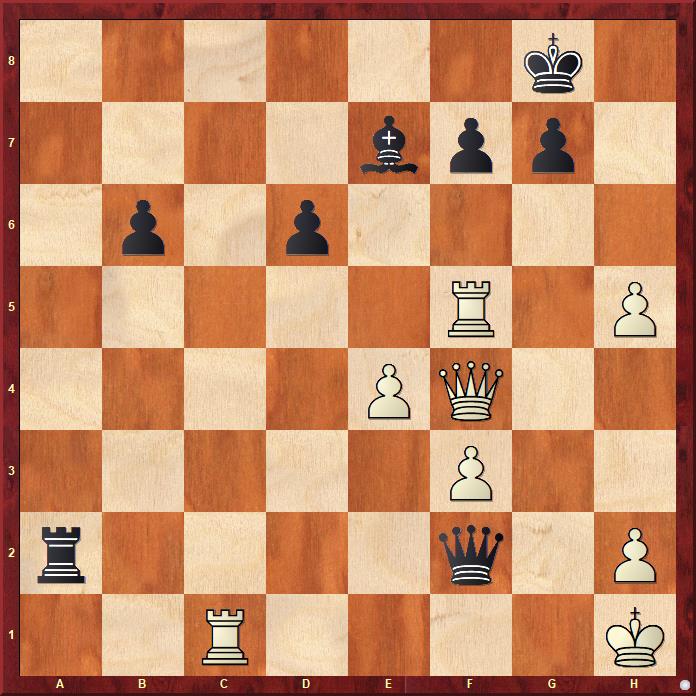
Can you calculate White's winning line?
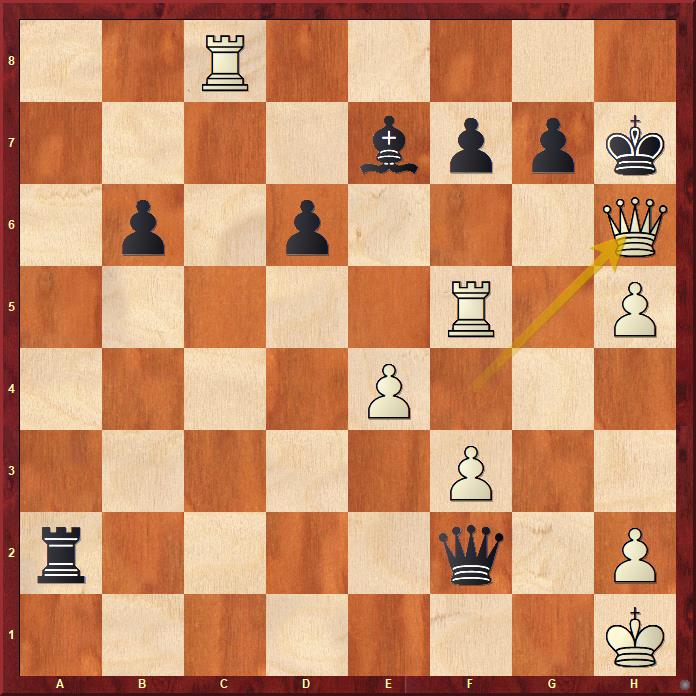
Strike 50.Qh6+! became a truly spectacular conclusion to the thrilling match.
Fifth iteration: Carlsen-Caruana 2018 and a study-like endgame


„Twelve consecutive not very interesting draws and the expected end of the tiebreak.“ This is how some observers at the time characterised the match. They were deeply mistaken! The sixth game of the match could have… moved us into another iteration!
In the 6th game, the world champion made a decisive mistake in an already precarious endgame with the move 67.Kg6?? (there was a fortress on the board, but it required truly – let’s say – extraordinary care).
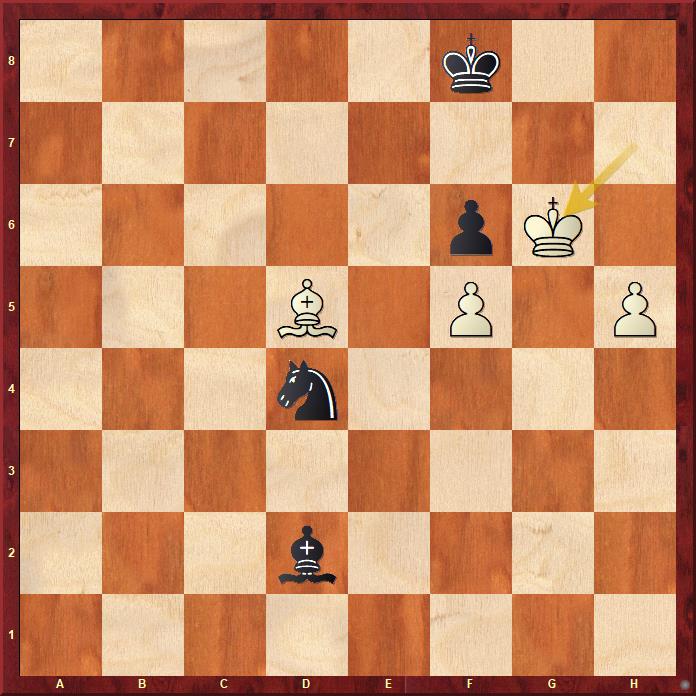
„After this move, the chess world's chat rooms exploded along with the news of the world champion's decisive error! True, with the mighty power of the computer behind us, it is easy to say so, but on the board, tired after a demanding game, finding the answers that the computer sees immediately is extremely difficult!“,“ wrote later in the monthly magazine Obozreniye 64 Grandmaster Konstantin Landa. After 67...Bg5 68.Bc4
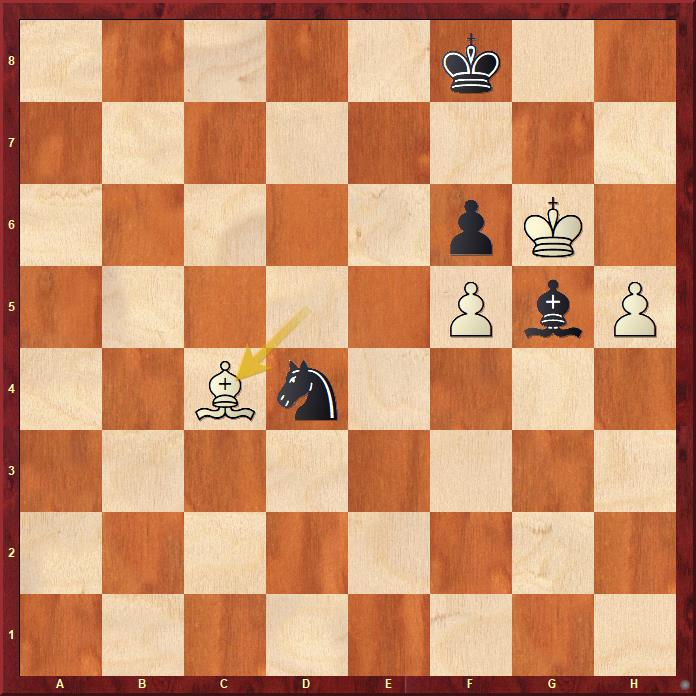
Black will achieve a win if he finds the study-like solution to the position’s problem! Caruana managed to do so in some other iterations, but not in ours! Unlike, for example, Konstantin Landa, who excuses and understands Fabian's failure, I believe that, for instance… if the opponents had swapped colours, Magnus would have found the win with at least a basic sufficient amount of time on the clock!
It is indeed a difficult nut to crack, but nevertheless: How would you, dear readers, continue? Or can you even find a winning plan?
Iteration six: Carlsen-Nepomniachtchi 2021 and the record-long game

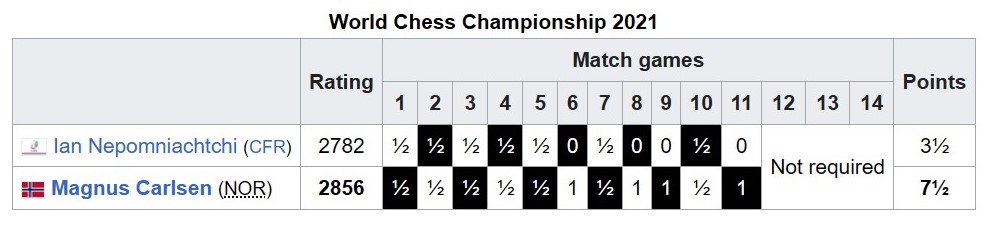
„The challenger exposed,“ how else to characterise one of the shortest and most ambiguous matches for the modern World Chess Championship title. After all, 14 games were scheduled and after 11. it was all over! The match held in Dubai at the end of 2021 also experienced a significant iterative turning point!
In the first five games of the match, the challenger clearly maintained the initiative! The sixth game then became not only the longest in the history of World Chess Championship matches (lasting 136 moves and the opponents thus went through three time scrambles), but also witnessed a dramatic iterative adventure!
A decisive role in the game itself, adorned with an exchange of a large number of mistakes, was played by psychology, and that immediately disguised in two costumes! In the first, as we will see, it nimbly weaved through the game itself. In the second role, much more crushing for Ian Nepomniachtchi, it then influenced the further course of the match.
After losing the sixth game, the challenger literally collapsed and the following five games meant a drop in performance by several classes! Nepomniachtchi even considered it necessary to apologise to the spectators and his fans for some single-move oversights and his overall exceptionally poor play!
Jan's nervous instability and unsteady hand are as well known as his genius, his enormous speed of thinking and calculation of variations. We will shed light on his psyche if have in the following chapter, but it itself did not have a decisive influence on the exceptionally instructive conclusion of the key sixth game! The sixth game of the match is underway. After two time controls, the opponents gradually find themselves in the third time trouble! After
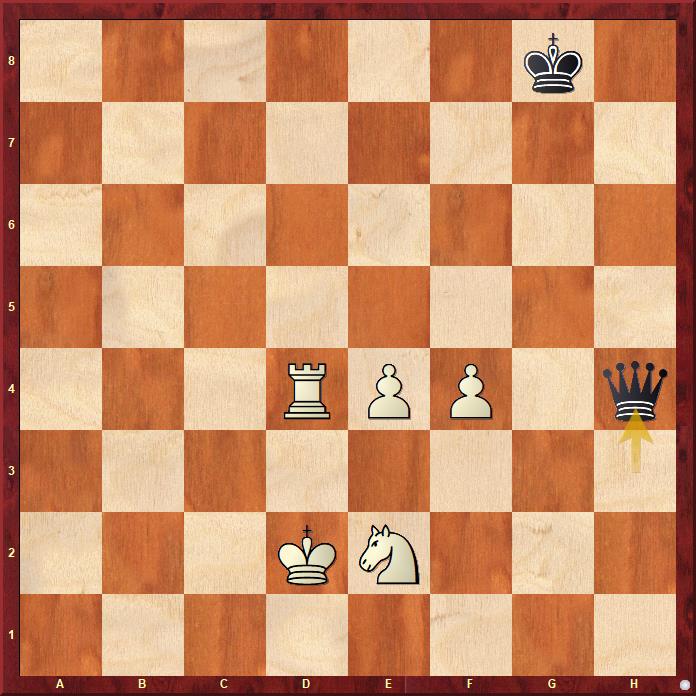
The sixth game of the match is underway. After two time controls the opponents gradually find themselves in the third time trouble! After (Black captured a pawn) the position of the diagram arose. How would we evaluate the position? What prospects do the sides have in practice? In reality, these are two different questions, or rather different answers!.
A more experienced and knowledgeable chess player should first realise that we are facing a seven-stone endgame! From the theoretical point of view, we have thus arrived
A more experienced and knowledgeable chess player should above all realise that we face a seven-stone endgame! From the theoretical point of view we have thus reached ! Although even some stronger players – readers may be surprised,the position before us is theoretically drawn!, First, let us outline the plans of both sides: White will create
1/ from his remaining warriors a the so-called. Testudo
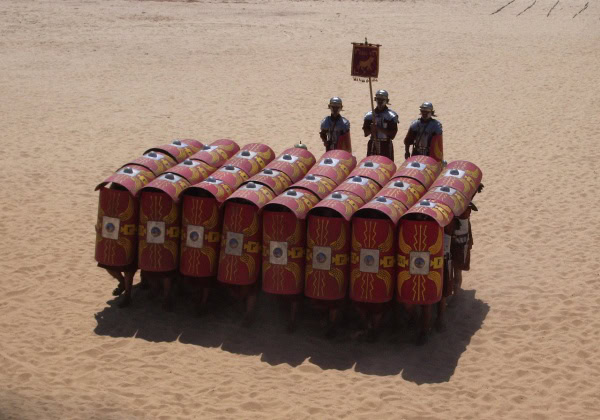
(an ancient Roman military tight battle formation, designed both for defence and for advancing forward - called the testudo in Latin) and will advance forward with it. If he manages to achieve this, within the horizon of the 5th to 6th rank the game will be decided.
2/ What about Black? From a certain point of view (unfortunately incorrect) his task looks simple. He has no other option but to skillfully check or defend the advance of the Testudo forward, and to make the strongest last piece as mobile a unit as possible.
But now the main point! I dare say that from a psychological perspective the fate of the game was almost decided! Why? Because while White operates in almost every move with a multitude of continuations (regardless of whether they are objectively winning after an opponent’s mistake or drawn), Black’s choice will also be considerable, but very few continuations (often one or at most two) will lead to the desired draw!
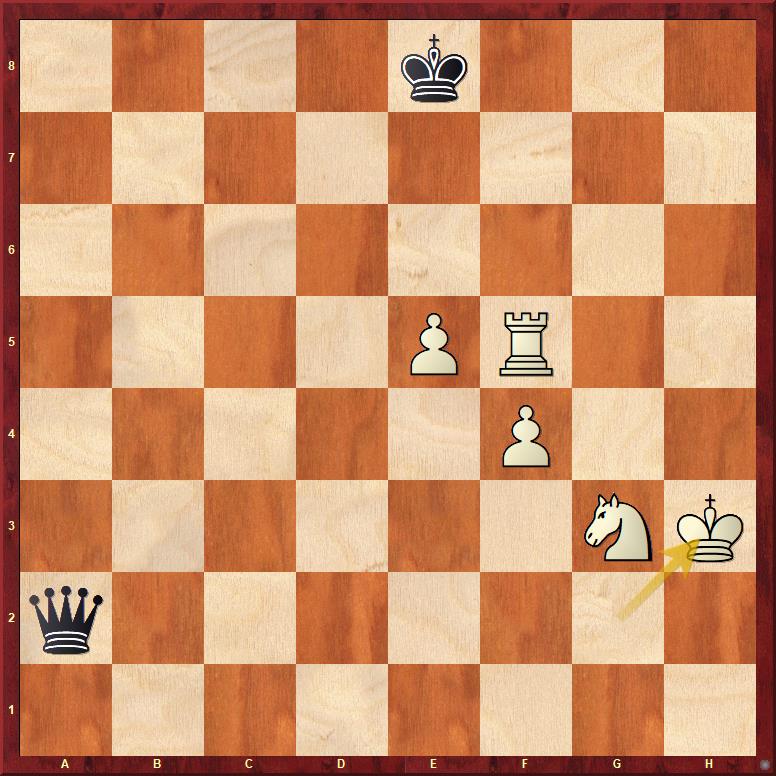
A critical endgame position in which the challenger made a decisive mistake. Checks with the queen are not available, and the draw can only be achieved by two methods! Even if Jan Alexandrovič coped with this task, further and further difficult tests would await him…
If we remove the human ability to orientate in the multitude of arising positions with the result draw - White wins (this is undoubtedly a fact!), probability theory comes into play! I dare say that in this particular case of limited time to think White must win 8-9 games out of 10!
Perhaps only in one or two out of ten iterations did Jan Alexandrovič achieve draws. But in such a case, in that 10th iteration, the match would develop completely differently. Above all, we would not see a psychologically completely broken challenger!
Seventh iteration: Nepomniachtchi-Ding Liren 2023; the hand of the faster thought

At the outset I cannot fail to mention two facts (out of three) that in our world created the world championship match precisely between these two super-grandmasters: a sociological experiment on humanity called Covid 19 and the American-Russian conflict in Ukraine, which logically developed into the Special Military Operation of the Russian Federation there in February 2022.
Without wishing to impose my view of reality on the esteemed reader, I cannot omit these events here. They were causally connected with the fact that in our reality it was possible that in 2023 the seventeenth world champion a Chinese player Ding Liren. The third reason is, of course, Carlsen's decision not to defend his title.
The World Championship match took place in the capital of Kazakhstan from 9 to 30 April 2023.

The table this time faithfully reflects the course of the match. Nepomniachtchi took the initiative from the start and Ding Liren only equalised the score. Even by today's standards, the match was characterised by an unusually high number not only of inaccuracies but outright blunders, which sometimes reversed the evaluation of the position by 180 degrees. Jan felt his huge opportunity, and although the Chinese terminator had settled in second place on the world rating list for quite a long time in previous years, he was rightly considered the favourite of the match rather than Jan.
The decisive moment was Game 12, in which Jan Alekseevich played Black. The advantage shifted from one side to the other, but the fact remains that Black could have forced a win in at least two places, thus effectively ending the match, which was drawing to a close, with a score of +2. Finally, even a draw would have helped Jan, because with +1 and a win in the penultimate 13th game, Ding Liren would certainly not have found the remaining two games comfortable to play.
For the readers, I have prepared two diagrams that show exactly those two critical situations in which Black could have scored (as certainly happened in other iterations).
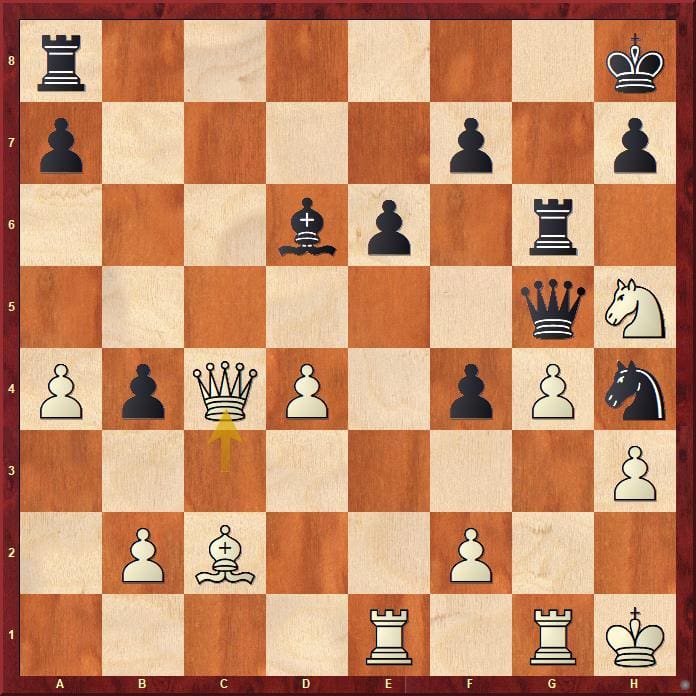
Ding Liren played 27.Qxc4 (he captured the pawn that Black had sacrificed in the previous move) and… Jan could have won! Instead, after 27 seconds (sic) he played a seemingly natural move, after which an approximate balance was again established on the board. If you, dear readers, have enough time and peace, try to unravel the tangle of this sharp position and find the best and at the same time to find Black's winning continuation! But still,. Introduction to the winning attacking manoeuvre.
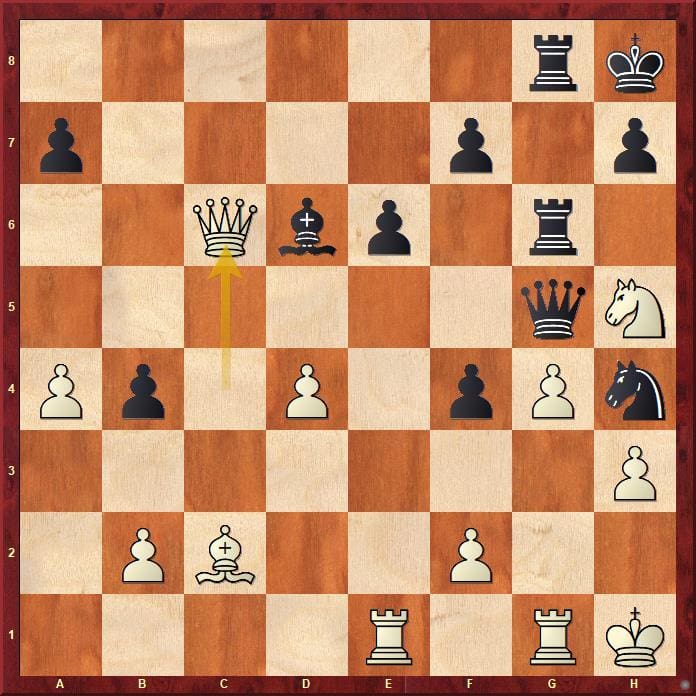
Ding Liren blundered again with the move 28.Qc6??, and Nepomniachtchi thus had another chance to practically decide the entire match. True, the solution here (the task Black again wins) is more difficult, but Black had absolutely enough time on the clock. If you find the winning sequence and the necessary variations, your strength is probably at a master level!
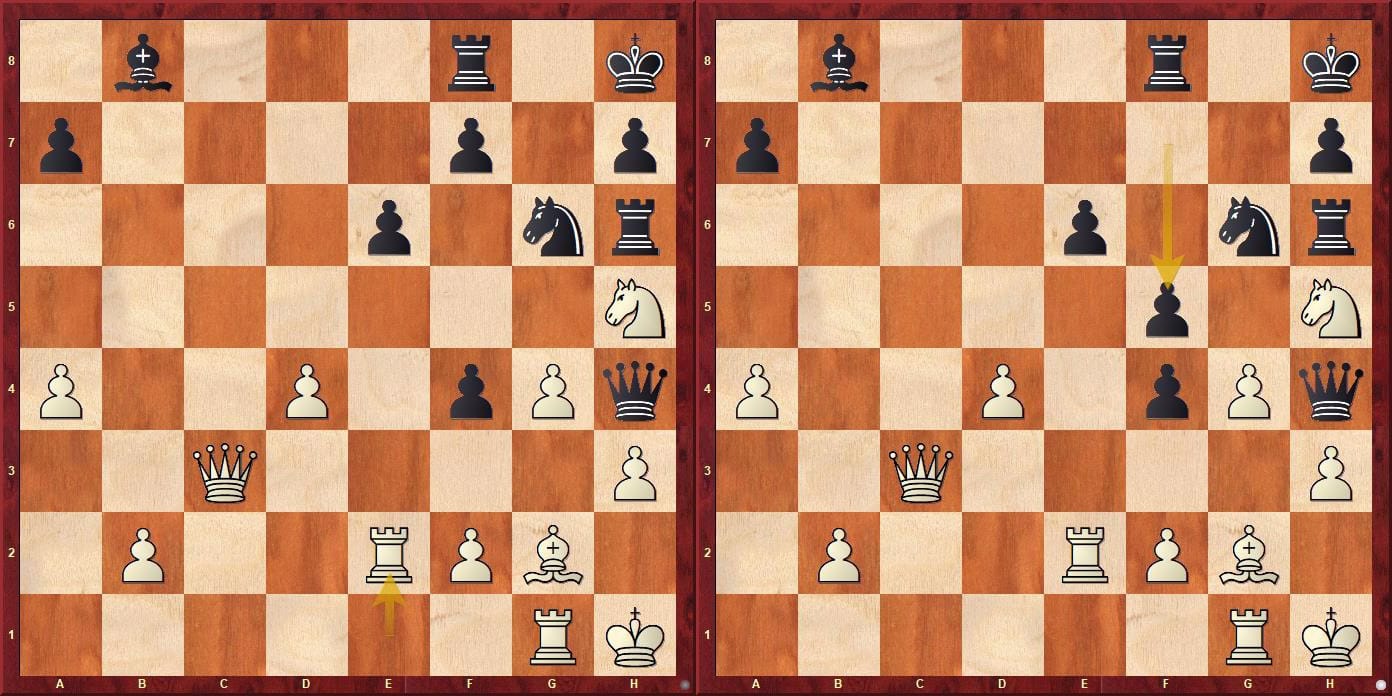
I am among Nepomniachtchi's supporters, so the end of the game (not only) probably took a bit of life from me. Too much of anything is too much!
Ding Liren played 34.Re2 (left diagram), thus maintaining a certain advantage. The clock shows that Black thought for almost 3 minutes to play perhaps the worst possible move in the position. An active blunder 34...f5??. Jan, who was completely overcome by emotions, did not notice that he thus lost the cornerstone of his entire construction - the pawn on e6. Ding Liren was clearly shocked, could not believe his own eyes, because he spent more than a minute on the obvious 35.Rxe6 And Jan? He replied after only after sixteen and a half minutes!
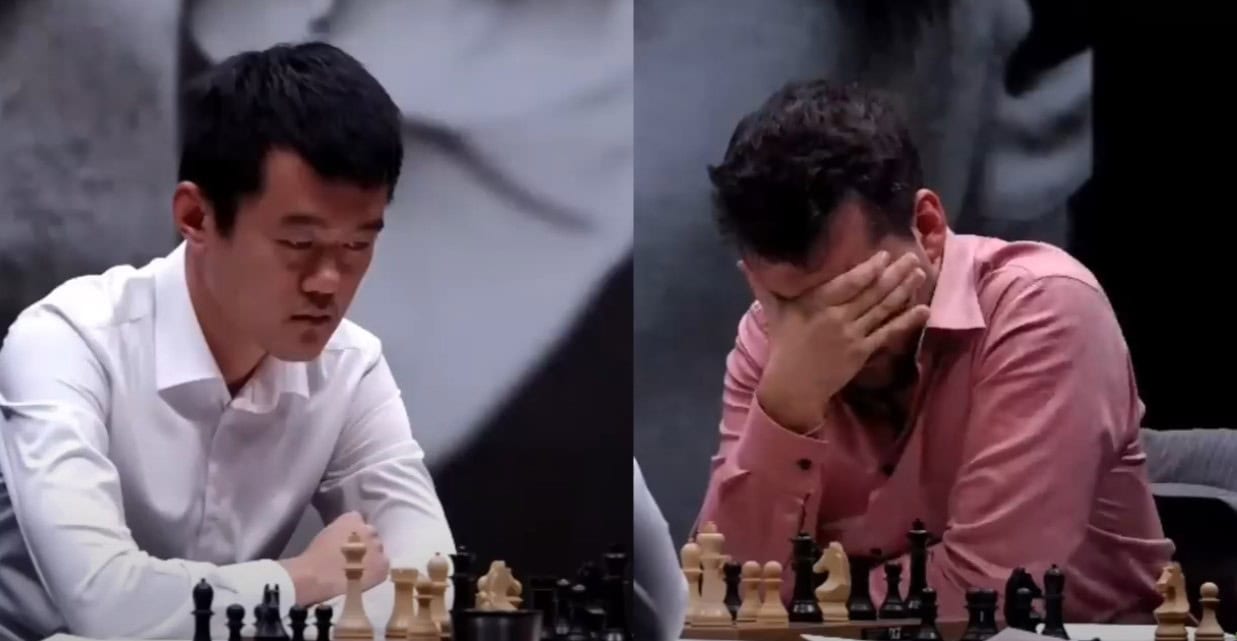
Of course, it no longer matters how he reacted or whether it was appropriate to resign immediately. I write this to inform the reader how much time he still had available! Simply a quick hand of sheer misfortune, if I may slightly alter the proverb.
In the player below, the reader will find both a fragment of the 12th game with solutions to both tests, and then the entire game with notes by Grandmaster Samuel Shankland. I will say straight away that I do not agree with his comments. For example, I would never directly into the notation add a question mark to the objectively strongest and moreover winning move in the position with a reference to the psychological aspects of the situation. However, the reader will surely form their own opinion.
Although the 17th world champion was decided only after a tiebreak, perhaps at this moment, after a terrible blunder, Jan had a flash of thought: „This is the decisive moment!“
In our iteration, fate decided! The highest title in 2023 became for Jan Alexandrovič something like Schrödinger's dead cat...
How will the upcoming match proceed? In which iteration would you like to live, dear readers? Would you prefer the 18th ruler – the youngest world champion in history – to take the throne? Or would you rather see the thirty-two-year-old Ding Liren in his old form, once again at the peak of his powers?