

„The worst bishop is better than the best knight,“ a classic player supposedly said once. However, this bon mot may have a rational core, and when we examine the texts and opinions of those who are now classics for us, we at least begin to consider the problem. The following article can be understood both as a supplement to my old work Bad Bishop – Reality, Dogma or Chimera?, which received considerable attention many years ago, and also deals with new perspectives on the issue. The corrections introduced by computers may be shocking for many readers.
A bit of geometry and the absolute value of pieces
Almost every beginner’s book contains a chapter or mention of the so-called absolute value of individual pieces. (Curiosities, such as Capablanca not dealing with this ‚inferiority‘ at all in his books 🙂 or that the queen’s value oscillates between 9 and 10, we will leave aside for now.) Few authors, however, warn beginners that the value of pieces is given in pawn units, but these are natural numbers… rounded. Steinitz was categorical in his works: the absolute strength of the knight he evaluated with a decimal number 3,05 the pawn, the bishop however 3,50! Perhaps an innate thoughtfulness led me to the idea of how proficient the first world champion was in mathematics and whether he derived decimal values from the geometric movement of pieces on the board plus constants reflecting the bishop’s main disadvantage… In any case, what we see in the working diagrams below is valid, and probably needs no further comment.
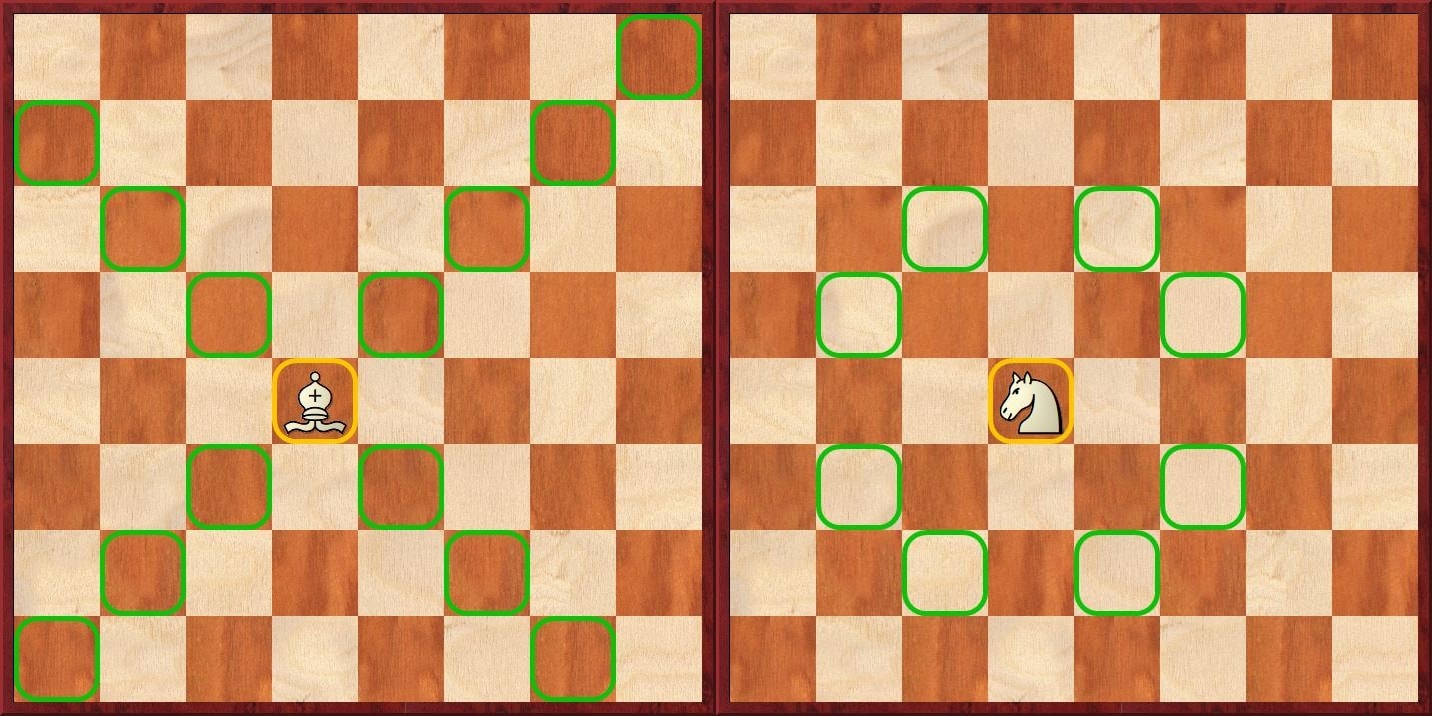
Note: my speciality is not the education and training of children under 10 years old, yet it has paid off for me to test them, for example, on propositional logic. Children have to judge without looking at an empty chessboard whether a statement is true, for example: „A rook on an otherwise empty chessboard can reach anywhere in at most two moves.“ „A knight can reach anywhere in at most six moves,“ and finally a ‚trick question‘: „A bishop can reach anywhere in at most two moves.“ 🙂
Wilhelm Steinitz wrote roughly the following about the bishop and knight issue: Bishop – masters and authorities have different opinions on the relative value of this piece. Some clearly prefer the knight in the endgame and claim that combined with the queen and rook the knight is stronger than the bishop. After careful study and analysis of typical positions and excluding some exceptions on both sides, we have come to the conclusion that the strength of the bishop in solving practical tasks in mathematical expression exceeds the strength of the knight in all three phases of the game. This also applies to most situations involving the cooperation of other pieces. The tremendous power of the bishop, especially in cooperation with the other bishop, in attack and also in defence was first systematically and thoroughly demonstrated in practice by the great German master Louis Paulsen.
For defensive purposes, it is generally recommended to have the bishop on the colour of squares where we have (or will be blocked by) our pawns. Especially if they stand on different diagonals. For attacking aims, the bishop is better placed on the colour of the opponent's pawns. The advantage will be particularly evident when trying to break through the enemy pawn chain using our own pawns.
The superiority of the bishop over the knight is also evident from the fact that a bishop placed on any square of the board can control at least seven squares on one or several open diagonals. In the centre of the board (squares d4, e4, d5, e5) it controls 13 squares. On the other hand, the knight's influence can be reduced to controlling only two squares if it stands in the corner. At most, a knight controls eight squares.
We have already referred to the great power of two cooperating bishops earlier.
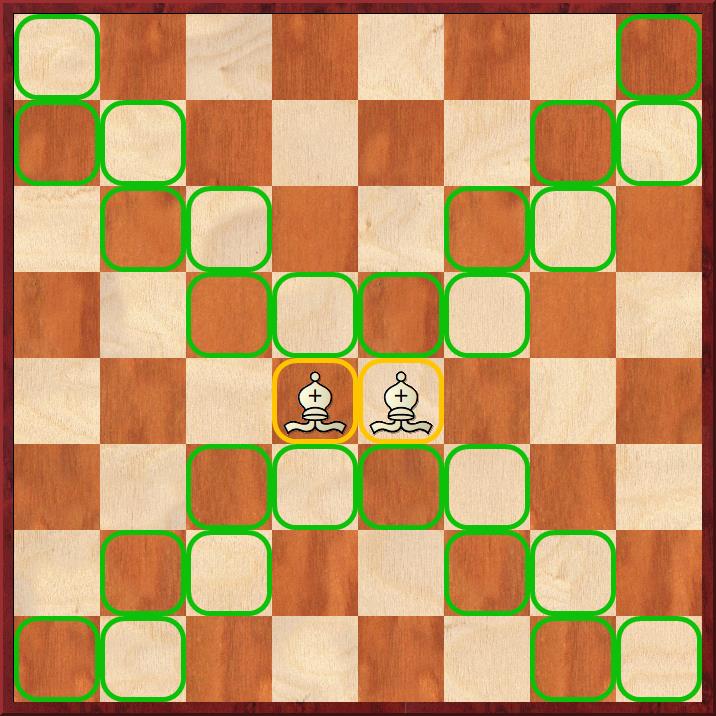
A pair of bishops „erases“ the only disadvantage of the piece itself, namely the prohibition of entering the alternative reality 🙂 in the form of squares of the opposite colour. By controlling a maximum of 26 squares, they almost match the most powerful piece! Bishops standing next to each other or on neighbouring diagonals are called Horwitz bishops.
They are slightly stronger than a knight with a bishop and significantly stronger than two knights. Two bishops and two pawns are considerably stronger than a rook and a knight. A bishop is stronger than three pawns.
Knight - a knight copes well with its basic role of „searching for and occupying holes or weak squares of the opponent“. Especially when supported by pawns. A knight is usually only slightly stronger than three pawns. It has another interesting property: it is usually stronger than a bishop in the endgame in cases where the opponent has doubled pawns and cannot get rid of this disadvantage.
Piece values in absolute numbers - knight = 3.05, bishop = 3.50.
The first world champion demonstrated the superiority of the bishop in many games even decades before the official title was introduced and before he wrote his fundamental works! The first classical example of demonstrating the power of the bishop over the knight strikingly resembles the following – contemporary one. Does today's young generation draw experience from these classical games? The second fragment of my favourite young super-grandmaster will at least partially answer this. The reader who takes this contribution as a serious subject for study should also notice the verbal remarks. The Prague native in the above text did not make it up!

Minor exchange, Tarrasch and the Russian chess school
The term „minor exchange“, that is the situation when one side has a bishop and the other a knight, most probably comes from Siegbert Tarrasch. To my knowledge, however, he sometimes put quotation marks around the term. Later it was used more in cases of the advantage of a pair of bishops.
Steinitz in his above description mentions that some masters prefer the knight over the bishop. He apparently had in mind a group of Russian chess players led by his great chess rival Mikhail Ivanovich Chigorin, the founder of the Russian chess school. He was responsible, that for a certain time – let’s say – respect for the knight was considered a certain hallmark of the Russian chess school! Such an approach, of course, could not survive more than a few decades, wiped it out probably to the greatest extent A. A. Alekhine. A slightly different attitude to knights, however, has always been and still is felt constantly! If we consider only world champions, then an obvious advocate of knights was the seventh of them Vasily Vasilyevich Smyslov.
Capablanca’s unsurpassable didactics, but…
The third world champion wrote roughly this: Inexperienced chess players usually consider the knight a more valuable piece than the bishop. They do so mainly because the knight, unlike the bishop, can threaten both white and black squares. However, they do not take into account the fact that with every move the knight changes the colour of the square it stands on and, of course, also the squares it controls. To transfer a knight from one wing to the other, the knight needs significantly more time than a bishop for the same task. Besides, the bishop can trap (the famous dominance position – note J. B.), when the knight cannot reciprocate this unpleasantness by itself!
The weaker the player, the more terrible a weapon the knight is in his eyes knight. However, as a player improves, the advantages gradually become apparent to him of the bishop. In his eyes, the relative value of the knight gradually falls. In this sense, today's masters have far surpassed their predecessors of the last century. Until relatively recently, many masters, such as Pillsbury or Chigorin, preferred the knight; now it is hard to find a master who would agree with such views. (Here Capablanca is too categorical. On average, the knight is indeed somewhat weaker than the bishop, but everything depends on the character of the position - M. Botvinnik). A few typical examples where the knight is stronger than the bishop are blocked positions, where most or even all of the bishop's side pawns are on squares of the same colour. In such positions, the side with the knight has excellent chances of winning.
If, however, the pawns are on both wings, the knight is not stronger! (This evaluation is also not fair – M. Botvinnik.)
The main drawback is of the pawn structure on on squares of the same colour as the bishop. Beginning chess players often make this elementary mistake. In endgames, it is generally recommended to place pawns on the opposite colour to that controlled by one's own bishop! If pawns are on squares of the same colour as the bishop, they restrict its scope and thus the value of the bishop decreases, because the value of a piece often is measured by how many squares it controls. I would like to emphasise that, in general, it is advantageous to place pawns on the same colour squares as the opponent's bishop, especially passed pawns supported by the king. These principles can be formulated roughly as follows: If your opponent has a bishop, keep your pawns on the colour of that bishop. If you have a bishop yourself, keep your pawns, regardless of whether your opponent also has a bishop, on the opposite colour to your bishop. It is clear that these rules do not apply in every case, and it is possible and sometimes necessary to modify them according to the specific situation.
Capablanca supplemented his explanation with the following working diagrams. These both demonstrated the above and also guided readers and listeners towards independent considerations of further advantages of the bishop, but occasionally also the knight. Let us therefore also look at the didactic methods used by, according to many, the most naturally gifted chess player in history, to teach his listeners and readers! Under each diagram we always find the author's brief commentary, although some positions we will later analyse in more detail!
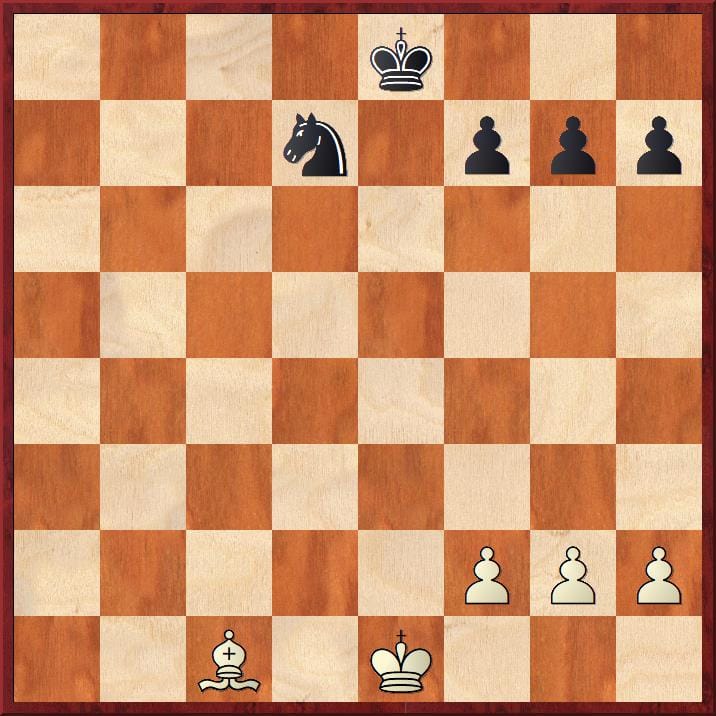
In this position all the pawns are on one wing, and so neither the knight nor the bishop guarantees an advantage. The game would obviously end in a draw.
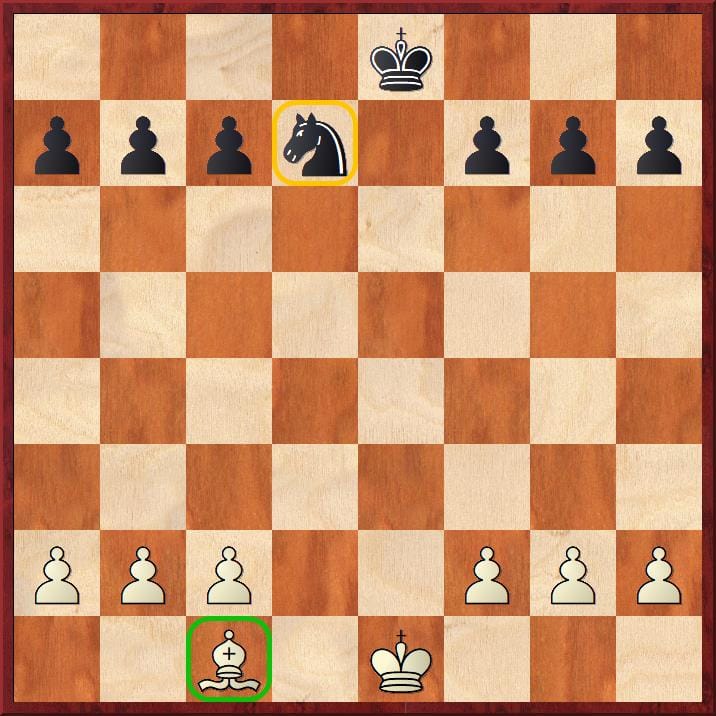
Here it is more advantageous to own the bishop, even though with correct play a draw must still arise.
Here I encountered an interesting point: In the book „Chess Primer“, which is intended for beginners, Capablanca, as we see, gives a slight preference to the bishop. However, in the text „Capablanca's Last Chess Lectures“, which was evidently published later – probably after his death – he states a complete equality of the position. Personally, I attribute this not to a change of opinion but to didactic reasons! Capablanca's lectures were certainly also listened to by qualified chess players…
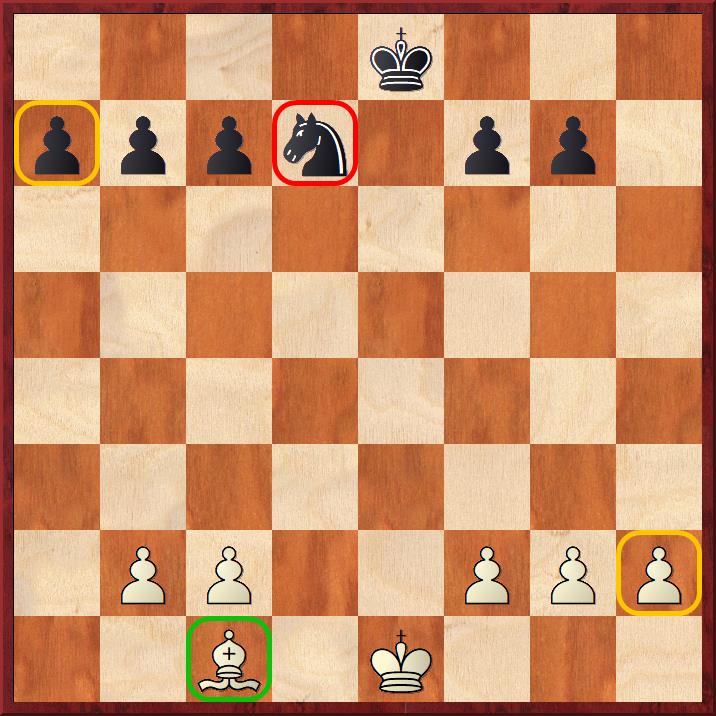
In this position the bishop represents undeniable advantage. Both sides have the same number of pawns, but there is no balance on the individual wings of the board… although White has slightly better chances, with correct defence a draw must arise.
The pawns h2 and a7 marked in yellow were called by Nimzowitsch ‚candidates for passed pawns‘. As an enthusiastic follower of his postulates, I naturally use this term in training and my works, including the subsequent logical rule „start with the candidate“; in my texts (game players) I sometimes abbreviate the term to CPP.
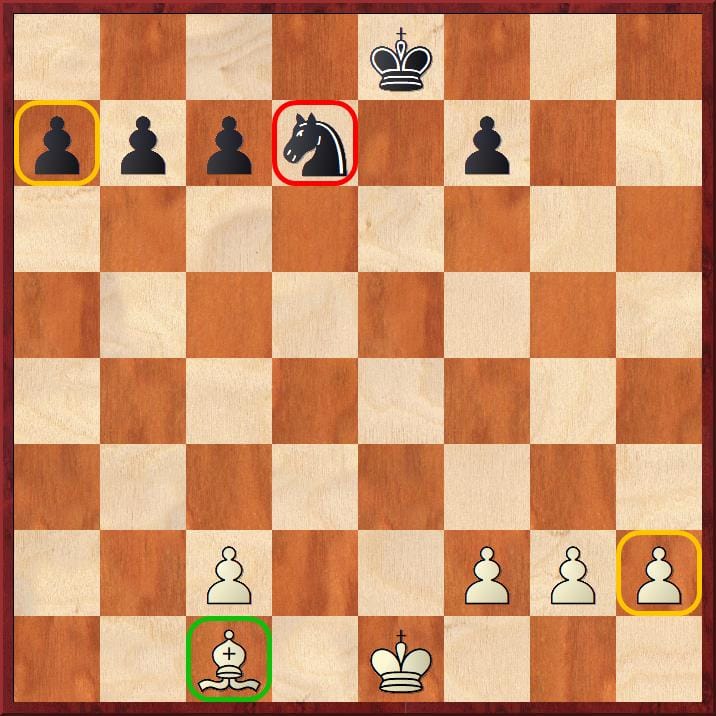
In this situation the bishop clearly represents a decisive advantage, because the pawns are not only distributed on different wings, but there are also passed pawns among them (White's ‚h‘ pawn and Black's ‚a‘ pawn). For Black it would be extremely difficult – if at all possible – to achieve a draw.
According to Capablanca, the position of White is therefore most likely winning. Well, we shall see below in the concrete analysis! I should also mention a fact that the world champion does not mention in his brochure: In the working diagrams he the number of pawns on the board (a maximum of six) is constantly reduces, which of course on the other hand conversely causes an increase in the draw potential of the weaker side – thus acting in the opposite direction! Capablanca, I assume, was aware of this but did not consider it necessary to acquaint readers – more or less beginners – with it. Generally, it is correct that less experienced players do not know about the ‚real draw corridors‘. Otherwise, as coaches, we might in extreme cases risk problems with their fighting spirit or will to win…
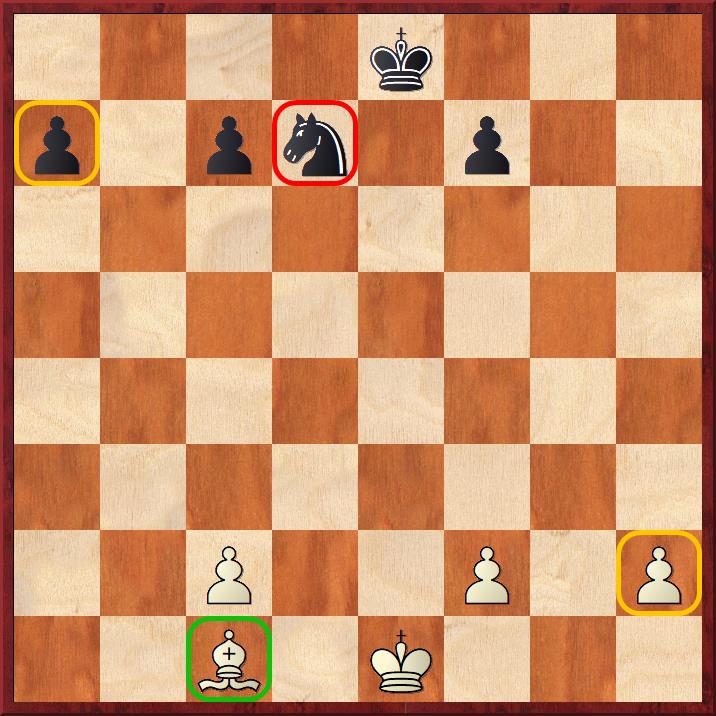
Even in this position it would not be easy to save a draw.
The following only diagram with a knight advantage Capablanca inserts in the book even before the above positions with a bishop advantage.
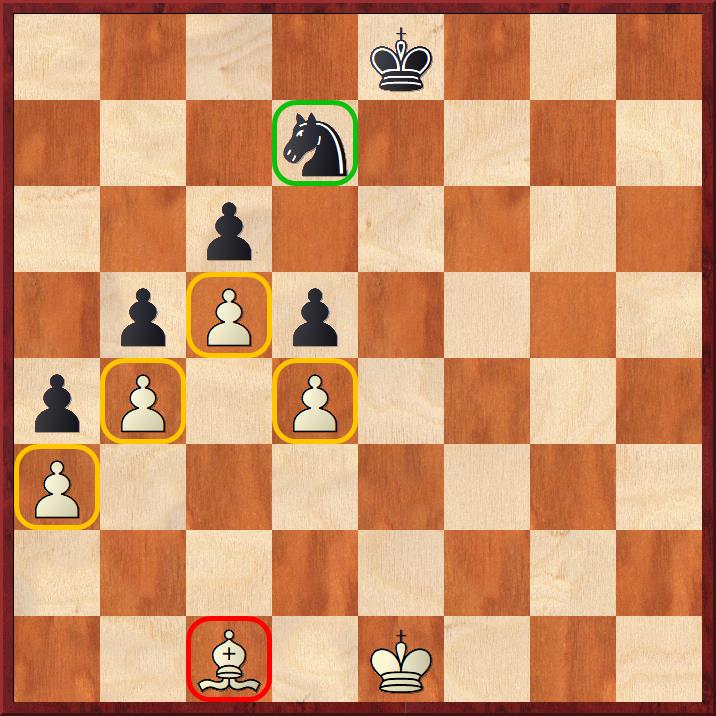
He writes: This is one of the few typical examples, where the knight is a more useful piece than the bishop. Such positions are called blocked, with all the pawns located on one wing in this case. If the pawns were on both wings, the knight would not represent an advantage. (This note about the influence of pawn placement on both wings is not always applicable either – M. Botvinnik.)
…computer-revealed errors
Let us now subject Capablanca’s conclusions and his evaluation of positions to scrutiny – revision. First, let us state that 1/ in his opinion Black can defend his positions with precise play in all cases except the diagram „4x4“ situation with distant passed pawns. 2/ although we emphasise didactic shortcuts that are easily found by an experienced player, it holds true that if the author wrote „victory of the stronger side with a bishop“, we should take this into account in the analysis!
The famous Nimzowitsch position also came up
Computers, however, did not refute only some conclusions of Capablanca's didactic material. A bigger shock for me was the refutation of an example used by many coaches for almost a century from Nimzowitsch's masterpiece „My System.“ The author demonstrates the power of the knight here and resorts to this fictional, but in practice not unattainable, position. (Incidentally, it is even included in the book „Modern Chess Strategy II,“ Luděk Pachman, Prague, 1958. The Pachman-Hromádka 1944 game!)
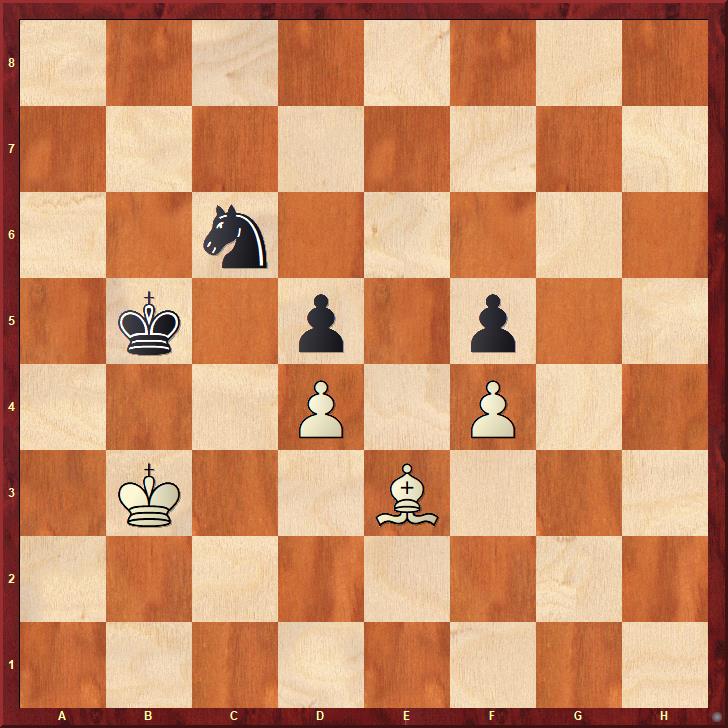
Nimzowitsch writes laconicly in his book: White loses due to the weakness of the light squares… Black's shameful bishop manoeuvre develops approximately as follows 1…Na5+…
For a flawless demonstration of the superiority of the dominant knight, Aron Isajevich would have to shift the entire position one file to the right!
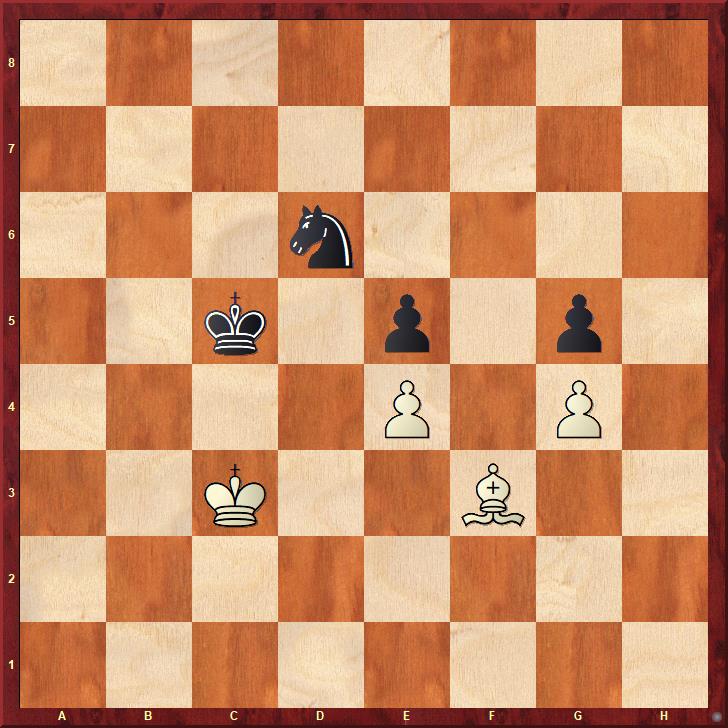
Here after 1…Nb5+ Black obviously wins, because White's counterplay disappears, that is actually the opening of a second front… and thus we smoothly move on to the next important chapter!...
The 3xBest rule as an aid to position evaluation
In training, aware of the complexity and colour sensitivity of the topic „sometimes this, sometimes that,“ the following approach has paid off for me when deciding which piece is stronger in which cases. I introduced an aid – a rule – and tentatively called it 3xBest. It should serve as a kind of compass for correct orientation in endgames, in which a Bishop meets a Knight.
With some simplification, our aid, the 3xBest rule, states the following:
All else being equal, the Bishop is the stronger piece in these three situations.
- It dominates the knight, see for example the diagram below from the game Berger - Chigorin 1905
- The position has an open character. There are no blocked pawns or only a minimum on the board
- The pawn constellation promises a clash on several fronts simultaneously.
However, the 3xMost rule also says this:
All else being equal, the Knight stronger piece in these three situations.
- It dominates the bishop (the eternal knight, structurally bad bishop), see the diagram below Wei Yi - Giri 2016
- The position has a blocked nature
- The pawn structure promises a simultaneous clash only on one narrowly defined front.
Dominance
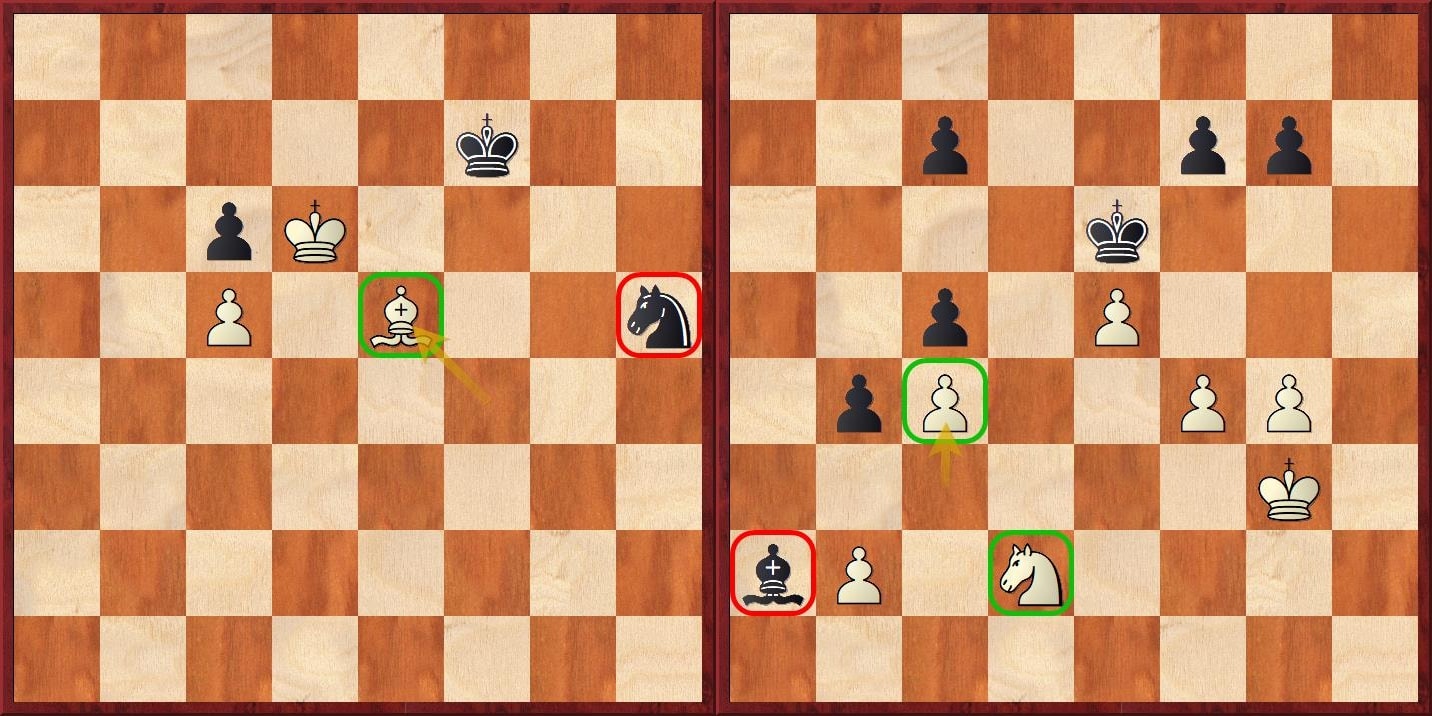
Typical examples of dominance from the game Berger - Chigorin 1905 (bishop dominance) and Wei Yi - Giri 2016 (rarer knight dominance)
While, at least theoretically, the first two conditions of superiority of both minor pieces in mutual combat are, I think, clear, in practice there are plenty of examples, when the opponents did not use the opportunity to create the situation dominance. Moreover, I believe that an excess of theory above requires several practical tests. The solutions and at the same time examples on the topic of the dominance of the Bishop over the Knight and vice versa can be found by the reader in the player below, but I simply cannot resist and will present a real treat to truly advanced chess players:
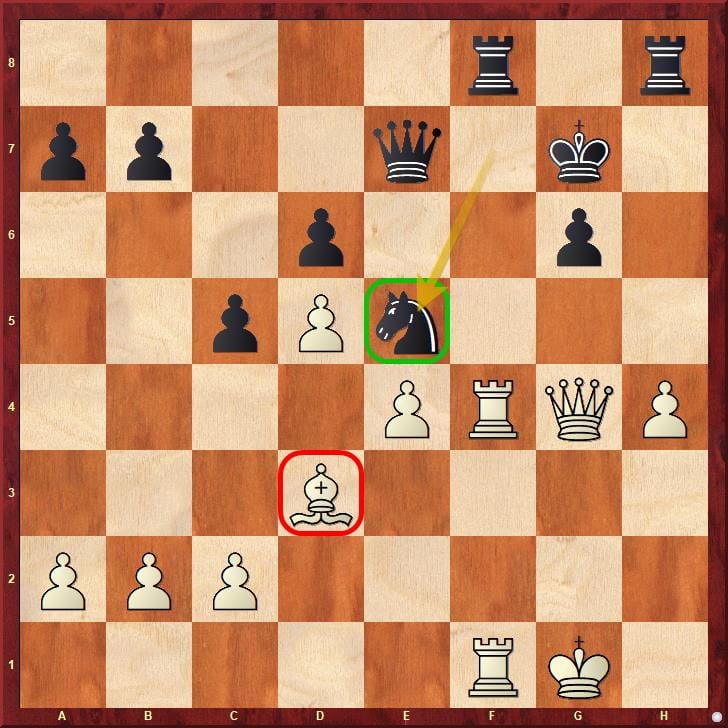
In the position of the diagram, Black sacrificed a pawn, but in return gained indisputable compensation in the form of a dominant knight – an outpost. White's queen is hanging and the game continued as follows: 29.Qg3 Rxf4 30.Rxf4.
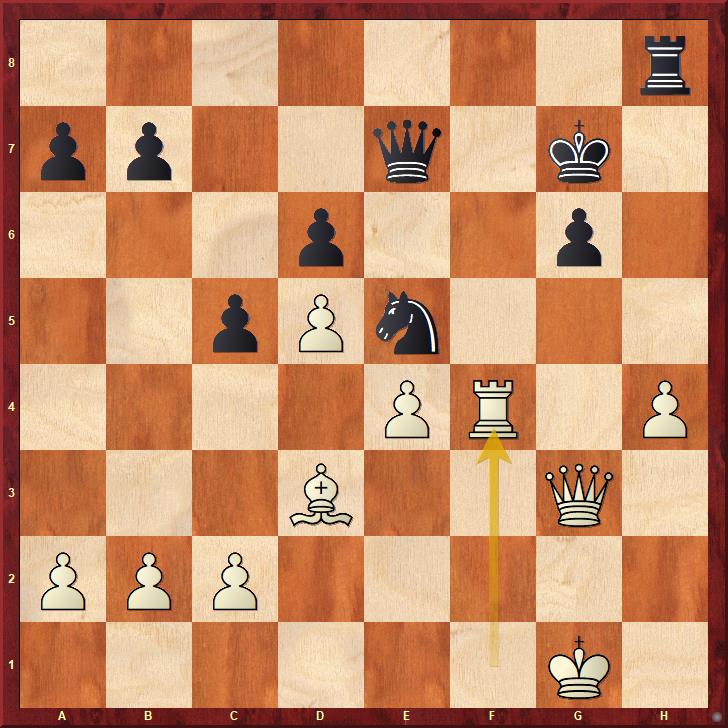
Test assignment: How would you recommend Black to continue and how would you evaluate the prospects of the sides? Support your opinions with variations!
Of course, the example and the solutions to the tests can also be found in the player below. So let's get to it!
Below, the reader will find both all the solutions to the tests and further examples of the dominance of one or the other minor piece.
The fairly extensive material certainly requires some time for study... but what can the reader look forward to in the second part?
Typical endgames using the rule of 3xMost, the silently respected rule of exchanging (gaining "the minor quality") a Bishop for a Knight, the paradox of so-called invisible moves, troubles with Fischer's remark...
A very interesting and deep reflection on the value of pieces. I am already looking forward to the continuation.