

It is simply impossible to write a brief article about this year's record-breaking Olympiad in Samarkand. And it's not just about the number of participating teams. So many beautiful games, unexpected twists and powerful experiences positively invite me to share them with the readers! So let us return to the most beautiful and most critical moments of the Olympiad, to the joy of victory and the bitterness of disappointment. We will look at the triumph of the home Uzbek team, the return of the Chinese women to the top of the podium, and also at why the Indian men failed to defend their title. Special attention is deserved by the undisputed king of the Olympiad, Nodirbek Abdusattorov. And we certainly won't miss Wesley's queen sacrifice, in my view the most beautiful combination of the whole tournament! The Olympiad also offered the chance to watch both protagonists of the upcoming World Championship match. What did their games reveal to us ahead of the most important chess event of the year in Geneva? The final part of the article will be devoted precisely to comparing Gukesh's and Sindarov's play, their strengths and weaknesses.
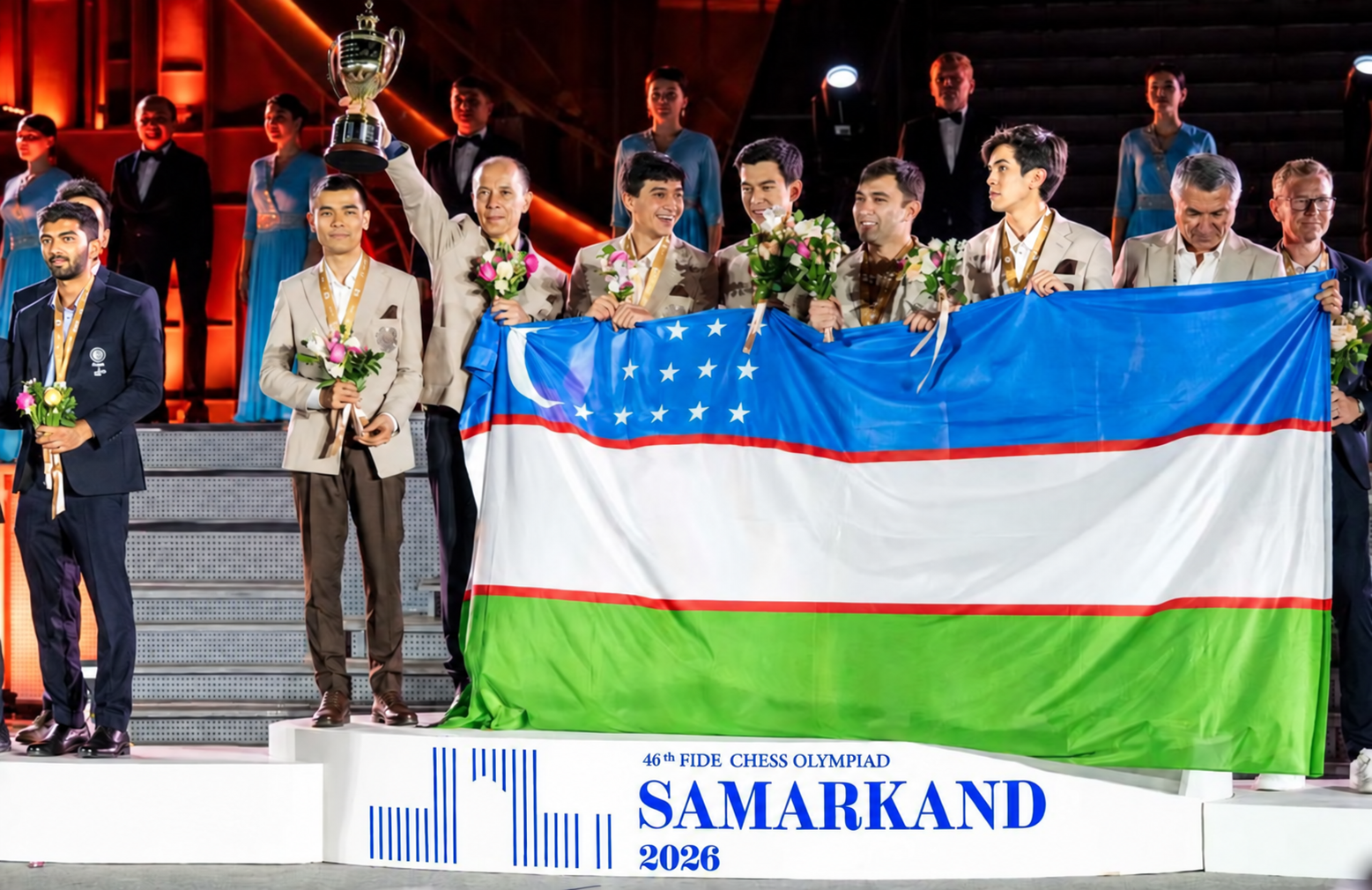
Sometimes a photograph says more than words. The home team of Uzbekistan celebrates Olympic gold again after four years – deservedly and with a clear lead. Standing next to the winners were the representatives of India. Notice the faces of World Champion Gukesh (far left) and his challenger Javokhir Sindarov (third from the right), who is looking towards his future opponent. As if the anticipation of their upcoming match for the chess crown was already reflected in this festive moment…
Dominance of the Home Team
Let us first take a look, without lengthy commentary, at the ranking of the top 22 teams.
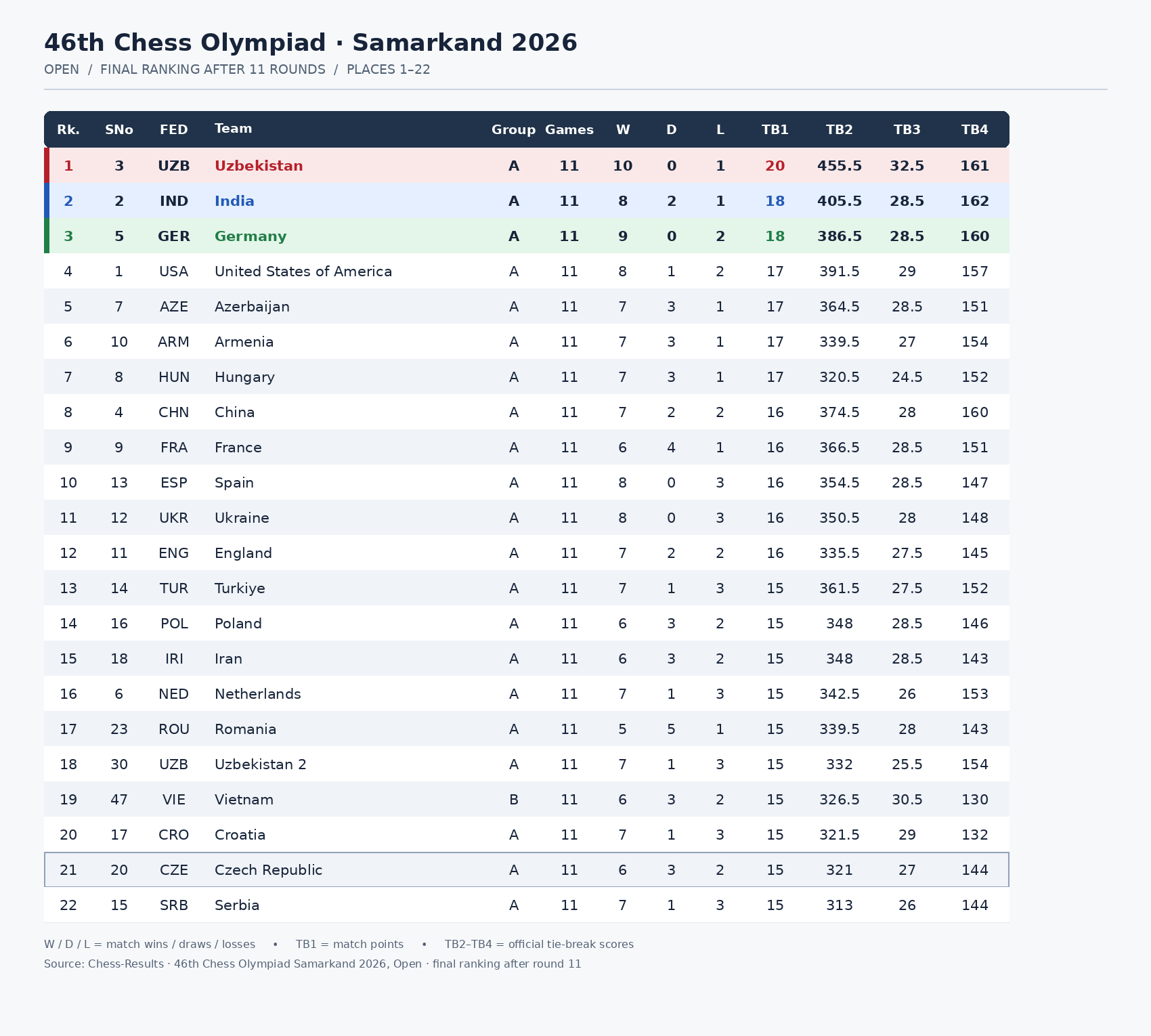
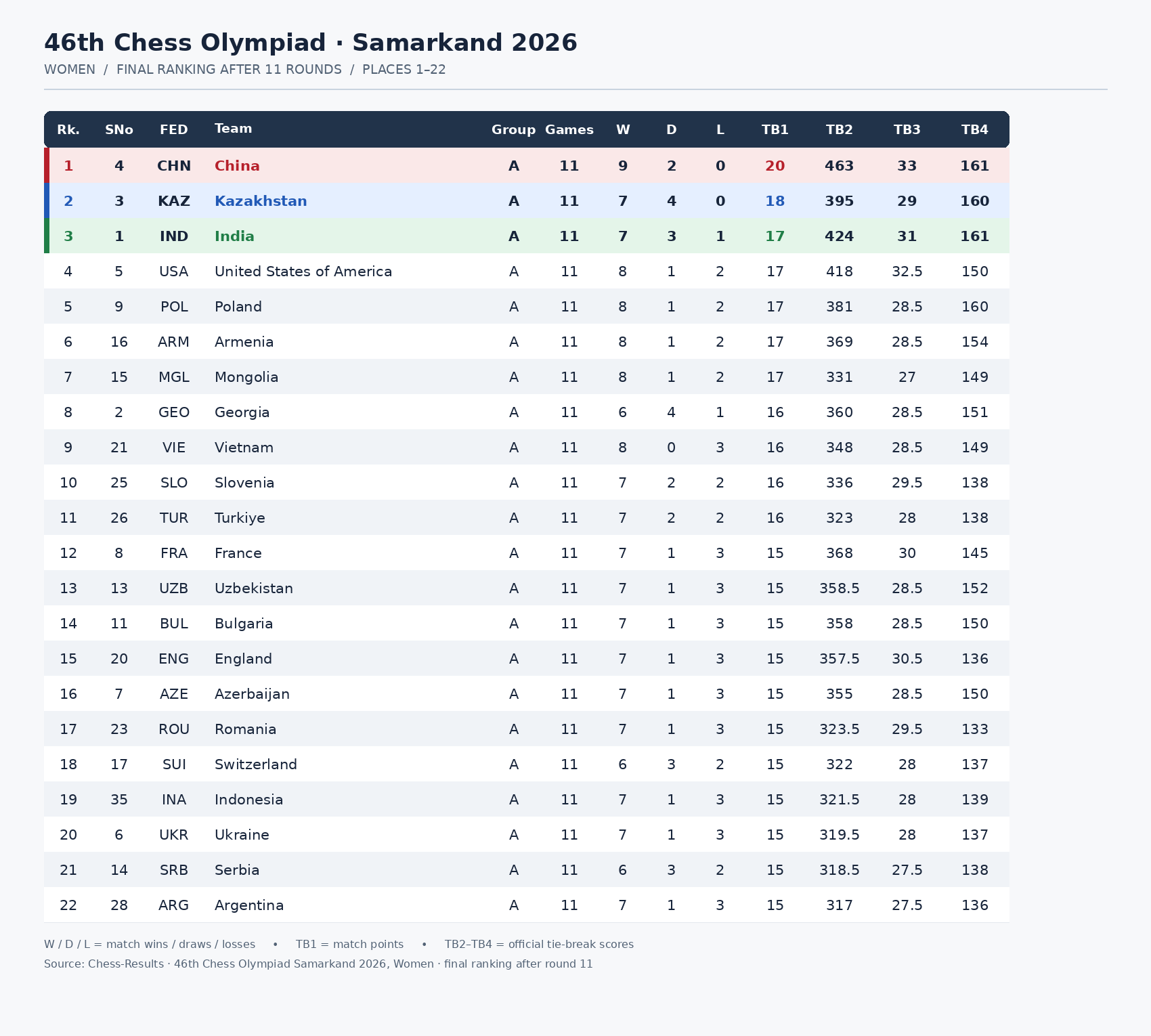
In the event of equal match points, the final ranking was decided by a somewhat unusual tie-break for many of us. It was not the traditional Buchholz, but rather a kind of combination of the achieved score and BH. Those interested will find an explanation with an example by clicking on the link below. Tie-break_criteria
The complete results of the Olympiad can be viewed by clicking on the links: Samarkand 2026 OPEN Samarkand 2026 Women
The Olympiad also made history in terms of participation. In the OPEN, 205 teams took part, and in the women's section 189 teams, making a total of 394 teams. This was the largest chess Olympiad ever held up to that time, and the number of teams in the women's competition was also a record.
With these numbers, another interesting consideration arises. Is eleven rounds with around two hundred teams participating really enough? A simple test: let us take the final top ten in the OPEN. Even the teams that ultimately finished in it, of course, could not all play each other by any means. The example is particularly striking USA – the fourth team in the final standings faced only three of the other nine teams in the top ten during the eleven rounds.
Well, it's not just the old-timers who know that while the Swiss system in team competitions is fairly reliable at determining the winner, when there are a hundred or even two hundred participants, whether a team finishes twentieth or fortieth can sometimes be decided by a single game! Of course, these facts don't stop Czech fans from – as usual – evaluating the Czech team's 21st place, just as nothing prevents Slovak supporters from sharing their disappointment over Slovakia's 49th place.
When assessing the Olympiad, the number of teams and their strength, I simply can't leave out (again) the absence of the team of the Russian Federation – let's not forget that this is the successor state of the greatest chess superpower after the Second World War! It is alarming how many even intelligent people in this context confuse their own opinions with actual facts! Yet chess players should be able to distinguish between reality and feelings, as well as possess the ability for analytical and synthetic thinking. So let us just hope that by the next Olympiad the political situation will stabilise: the real culprits of the current state and the heirs of Nazism will at least in the first step be deprived of influence, and the Russian Federation team will once again be able to fight for medals!
Women's Olympiad – China's Return
Let's give precedence to the ladies: after eight years, China returns to the Olympiad throne. Even this time, their line-up did not include all of their biggest stars, but the team certainly did not lack ambition for gold. On board one, they were led by Zhu Jiner, a member of the world's elite and a participant in this year's Candidates Tournament in Cyprus. Behind her, youthful energy – after all, Lu Miaoyi is only sixteen! – was combined with experience, represented at the end of the line-up by thirty-year-old Zhai Mo, a veteran of China's triumph in Batumi 2018.
A new chess superpower?
Once again, between China and India came Kazakhstan. While in Budapest 2024 their women celebrated their very first Olympiad medal, in Samarkand they already defended their silver. So we can hardly speak of a random surge. Chess in the country enjoys significant state and sponsor support, is spreading into schools, and great attention is paid to nurturing talent. Moreover, Kazakhstan's growing influence received a symbolic confirmation in Samarkand: the chairman of the local chess federation and billionaire Timur Turlov was elected to head FIDE.
At the chessboard, the face of this rise is Bibisara Assaubayeva, triple world blitz champion and runner-up in this year's Women's Candidates Tournament. Two consecutive silvers suggest that Kazakhstan should continue to be reckoned with at the women's Olympiad summit.
I'm attaching a somewhat older, short, but funny and charming video – by now, almost everyone knows about the mutual affection between Bibisara and Javokhir Sindarov.
The following video by my favourite streamer Alexey Pugache demonstrates, I think, quite faithfully the current state of women's chess. In it – among other things – the King's Indian Defence enjoys a relatively comfortable life. 🙂
From gold to bronze
If a team is aiming for the top spot, it can hardly afford a significant lapse from one of its mainstays – unless it has an exceptionally strong substitute in reserve. Unfortunately for India, this is exactly what happened with the challenger to the world champion Vaishali. The Olympiad was a disaster for her: from six games she managed only 2½ points and watched the last three rounds as a spectator. Substitute Savitha Shri played excellently, but even her performances were not enough to defend Budapest gold this time. The lapse of one of the mainstays was certainly the main reason why India had to settle for „only“ bronze.
The article is, of course, devoted primarily to the men's competition. The main focus is on our two „future heroes“ – world champion Gukesh and his challenger Javokhir Sindarov – as well as the true king of this year's Olympiad, Nodirbek Abdusattorov! But what kind of article would it be if we didn't at least once illustrate the women's battles for medals with a concrete example?!
It's the final round and the fight for medals is reaching its climax! India faces the strong Georgian team, and let's take a look at what happened on the top board in the game Koneru vs. Dzagnidze. White has just played fully in the spirit of the position 18.Rh3!
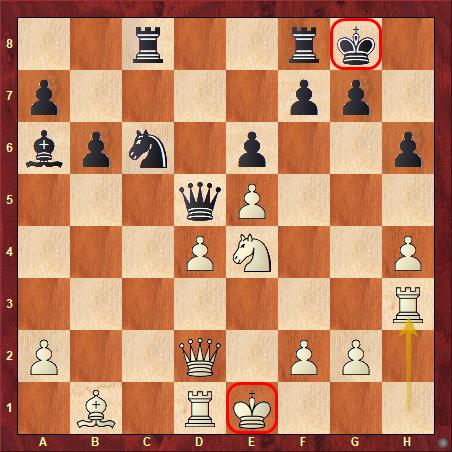
The position is dynamically balanced. We see that neither monarch is exactly in the best of health right now! 🙂 In other words: neither has anything to reproach the other for.
We can certainly imagine the tension that must have prevailed in this game – in the final round, fighting for medals, and on the top board to boot! Black, with plenty of time on the clock, continued 18…Rfd8??
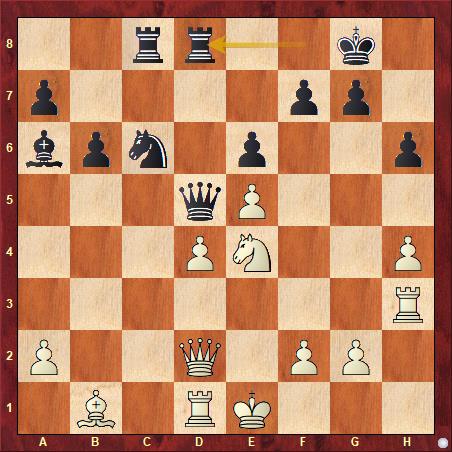
Of course, we'll learn more in the analysis in the viewer below; but now a question naturally arises, and it's quite a tough nut to crack even for stronger players: How did White continue? And can you – like her – calculate all the way to a forced win?
The royal Uzbek collective
If India deserved their gold in Budapest two years ago, the same can be said of this year's victory by the Uzbeks on home soil! A compact team without weaknesses, with stars on the top two boards. And if anyone had doubts about whether the „tail“ of the line-up – that is, the fourth and fifth boards – would withstand the onslaught of the strongest teams, those fears proved unfounded!
Here are the individual results:
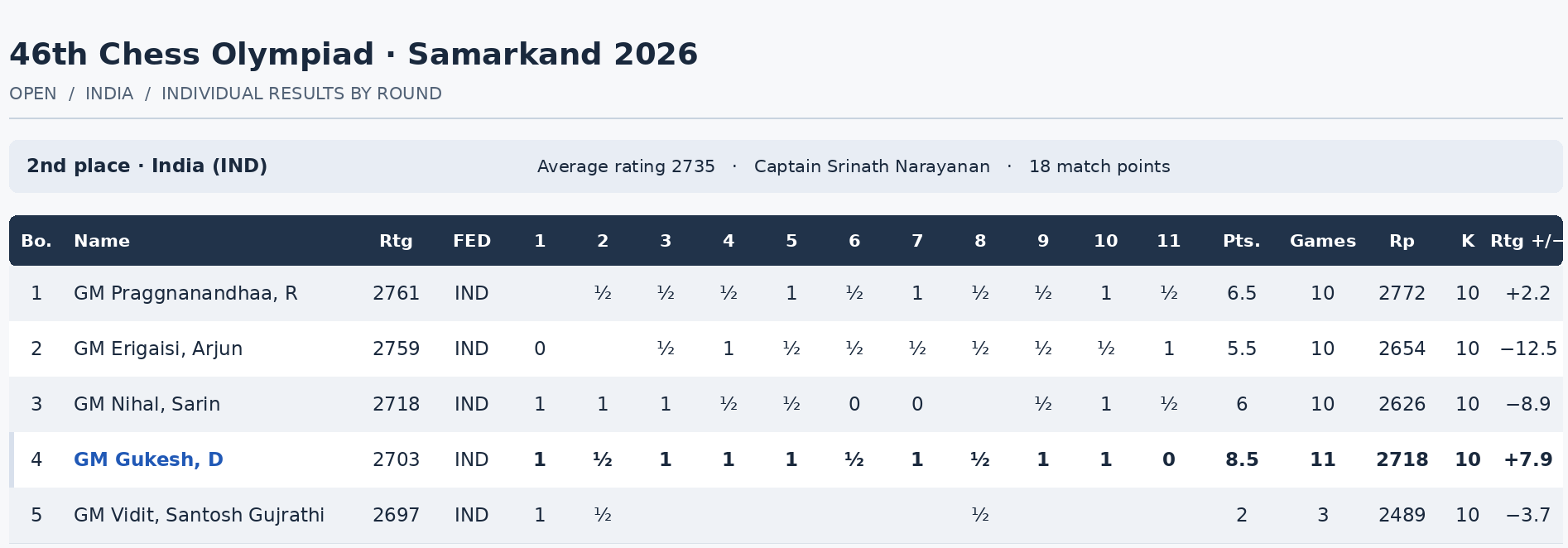
In my opinion, the outstanding performances of the Uzbek team are enhanced by the excellent relationships among these otherwise remarkable young men. The team spirit is evident in every video. Indeed, much is revealed by a certain concession from Sindarov – his statement immediately after the Candidates Tournament: „I will definitely play second board behind Nodirbek.“ And he did not change his mind even after he overtook him in the rating.
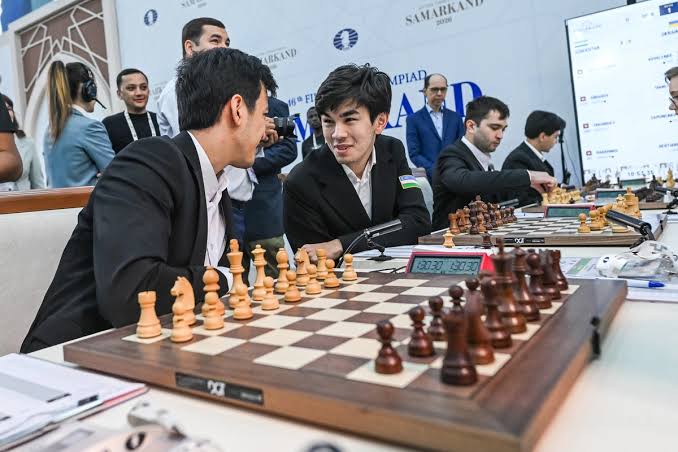
Finally, it is also significant that this is truly a Uzbek team. I am not claiming that it is impossible to build a great team from a „foreign legion“, such as the one the USA regularly brings to the Olympiad – it is all about the people. But… now allow me to express my opinion: everything has its limits… even though we could certainly have a long discussion about what exactly the original name „Tournament of Nations“, as the Olympiad used to be called, really means.
The final press conference of the Uzbek team and, of course, team captain Rustam Kasimdzhanov – apart from those somewhat unnecessary enthusiastic phrases about the best players in the world – only confirms that this is a great team.
King of the Olympiad
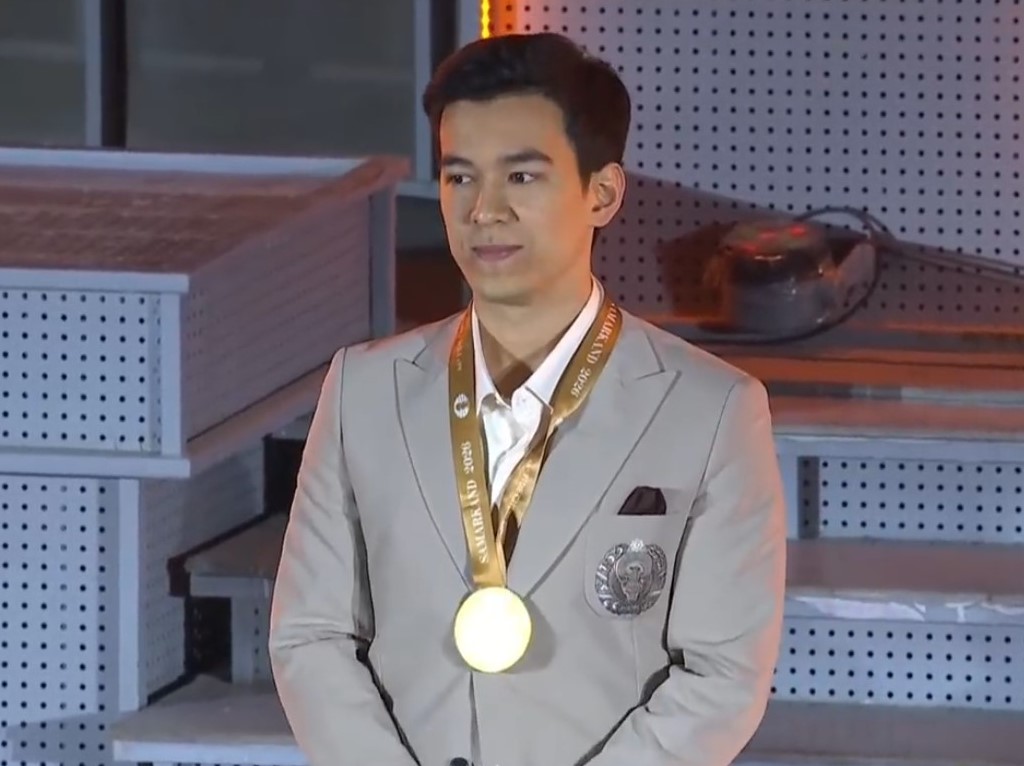
If the undisputed king of the Olympiad in Budapest two years ago was then challenger and current world champion Dommaraju Gukesh with an incredible score of 9 points out of 10 and a performance of 3,056, this time too there can be no doubt about the strongest player. Gukesh's historic achievement will likely not be surpassed any time soon, but the performance delivered by Nodirbek Abdusattorov… well, hats off.
Let us look at his individual results:
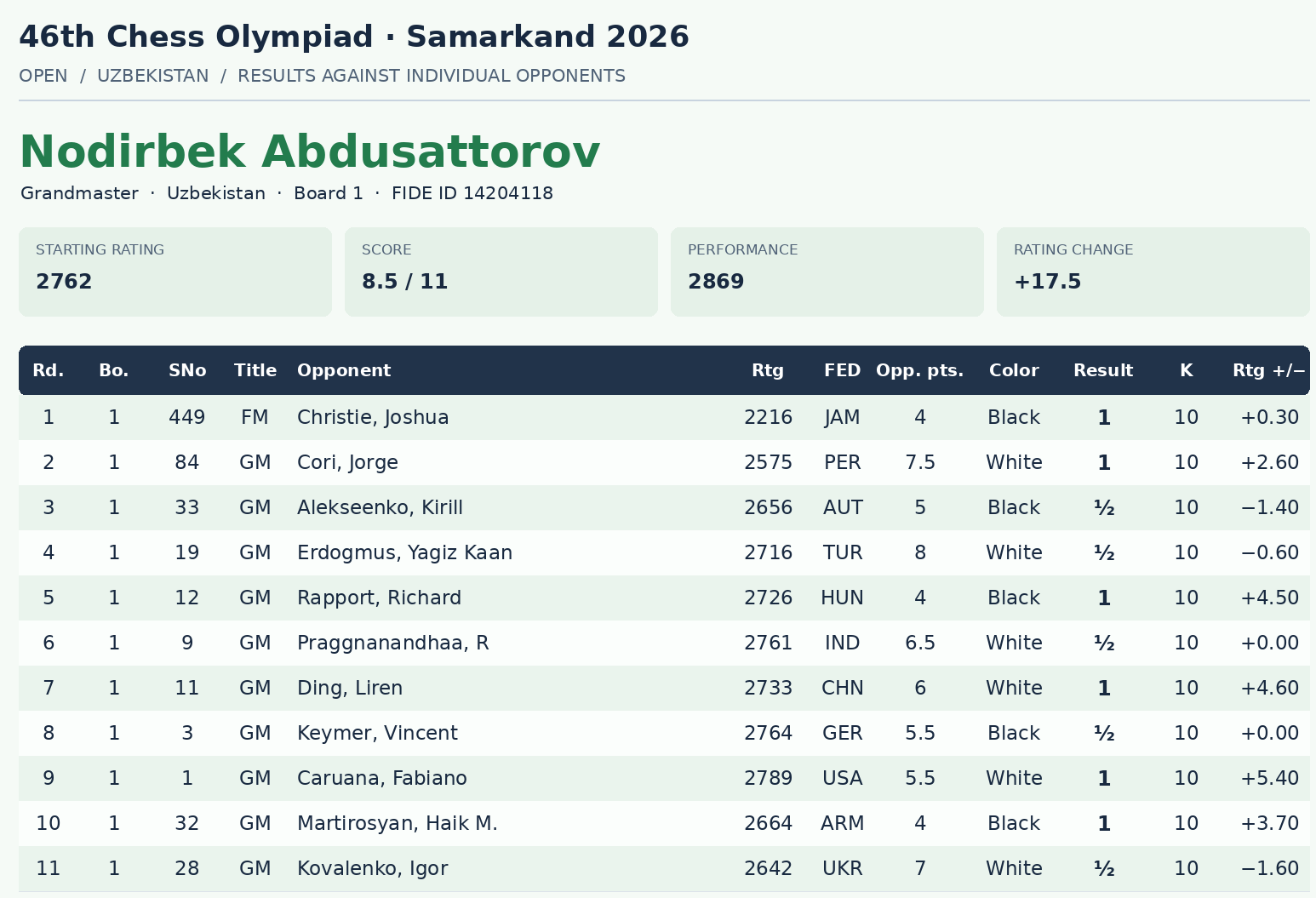
It could have been +7 instead of +6, had Nodirbek, at the moment when his team was already celebrating Olympic gold in the final match, paid a little more attention to the following endgame against the Ukrainian grandmaster… With a win, he would have increased his tally to 9 points out of 11 and his performance would have risen from the final 2,869 to an impressive 2 920!
In the game Abdusattorov vs. Kovalenko thus arose after 63…Bc5
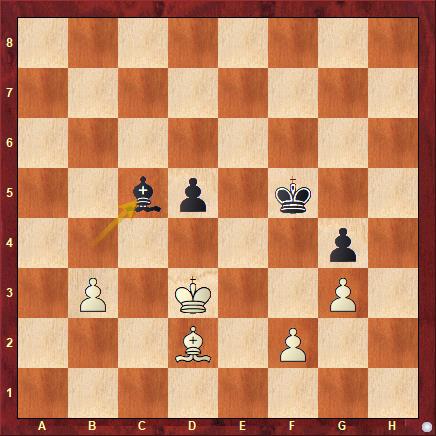
an endgame position which is technically won for White, with Black also in time trouble. How would you continue if you were White?
The end of the game is shown in a video set to the critical moment of the diagram.
How could White convert the bishop endgame into a win?
Readers of my articles know that Abdusattorov is – despite his occasional outbursts 🙂 – among my favourite young chess players. However, I think that not only his Olympiad performance, but also this year's other results by this 22-year-old justify a bolder thought: today, are we not looking at not just a universally skilled super-grandmaster, but probably also the objectively strongest player of the present day?!
Many may object: „But he hasn't even played in a single Candidates Tournament yet!“ Well yes, in my view a large part of the blame lies with the qualification system. It gives a fairly large scope for „random surges“ in tournaments played by the Swiss system or in the knockout World Cup, while on the other hand, one or two slip-ups in individual games can mean… waiting for another two-year cycle!
Not only with nostalgia, therefore, do I recall the former Interzonal tournaments. A long round-robin tournament, in my opinion, provided a more reliable picture of the true strength of the participants. Moreover, it wasn't just about winning: you could qualify even from fourth place, in Palma de Mallorca in 1970 even from sixth. Such a format limited the consequences of individual „crashes“ and gave room for recovery – now and then a slip could be put right. After all, even Fischer lost to Larsen in Palma, yet still won the tournament by a huge margin!
Despite all this, I am convinced that the next Candidates Tournament will not take place without Nodirbek.
From the games of the king of the Olympiad I have chosen „a bit of everything“. It should perhaps be added that, just as the world champion at the Budapest Olympiad was never seriously threatened, neither was Nodirbek in Samarkand in any game! So there can be no talk of luck, or even „outrageous good fortune“. We find ourselves in round 5 of the Olympiad, in the match Hungary – Uzbekistan. This is the first complete and stronger team the Uzbeks are facing.
In the previous round, the match against Turkey, Nodirkek drew with Yagiz Kaan Erdogmus; however, the work of this brilliant boy would deserve not only a separate article, but a long essay! Well, perhaps paradoxically, his youth allows us to postpone Yagiz's tournament appearances for a later time… 🙂
In the game Rapport vs. Abdusattorov the current Hungarian number one chose, in the fight against the Sicilian Defence, not surprisingly, the Chekhover System 1.e4 c5 2.Nf3 d6 3.d4 cxd4 4.Qxd4. Its significant advantage is the fact that the system is still far from being theoretically exhausted. Since I regularly taught my students the „Czech Defence“ with White, I was naturally curious not only whether Rapport would come up with something new or at least a fashionable approach, but also which structure and move order Nodirbek would choose.
And I was not disappointed! A characteristic position arose with opposite castling, promising a sharp clash. In other words, a battle that could only suit the Hungarian grandmaster. After 16.Rhg1 with the unambiguous aggressive intention of g2–g4–g5
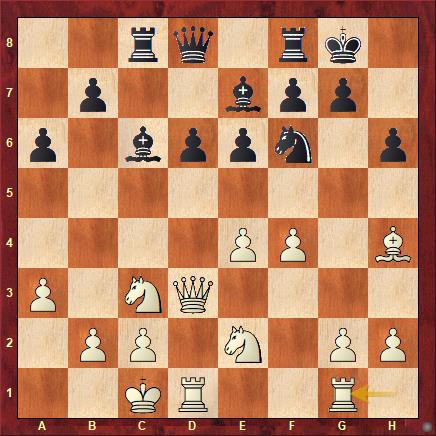
Nodirbek replied with a move that looks understandable at first glance, but is in fact also very strong 16...Qc7!!
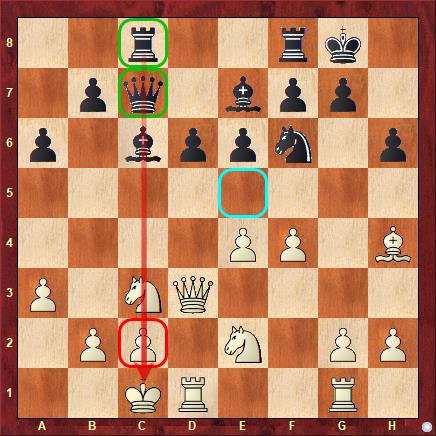
The clock shows that Rapport spent almost 12 minutes considering his reply. He then responded stubbornly, with a move that looks logical, but is tactically flawed 17.g4?
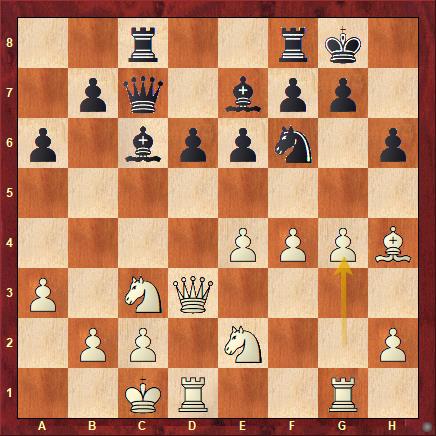
A passive blunder! That is what I call this kind of slip with my students and in my writings. Of course, you can find out more in the game viewer below. Dear readers, can you refute White's plan?
A key game is being played, as well as the match Uzbekistan vs. USA, the game Abdusattorov vs. Caruana. Fabiano is „again“ defeated on top board in a principled battle! (Two years ago, he was outplayed by Gukesh.) White has just played 38.Rfe3.
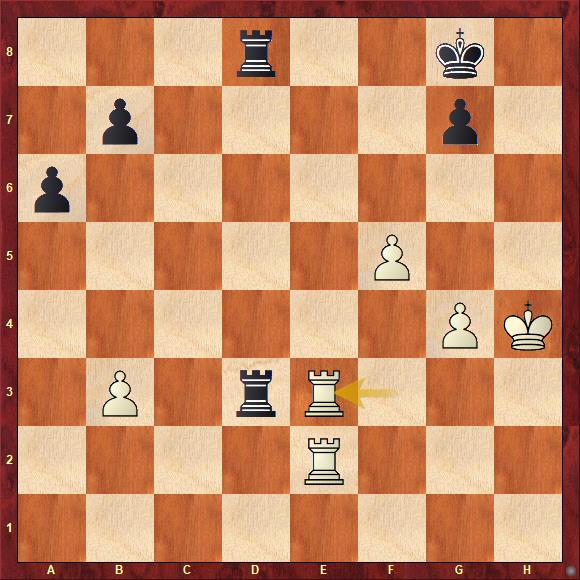
At this moment, the opponents' clocks show the following times: White 3:58, Black 1:33. Only three moves remain until the time control, and for a grandmaster of Caruana's calibre, such a time reserve is more than sufficient – all the more so as each move adds another thirty-second increment.
We, however, have far more time! Moreover, the match is not going badly for the Americans, so there is no need to force the situation at all costs.
How would you continue if you were Black?
We should first watch the game between these world-class opponents on replay!
Not only for fans of the Vienna Game or those interested in this new trend, but also from the perspective of endgame analysis, it will certainly be interesting to compare two analyses of the entire game: one by Hikaru Nakamura, the other by Sergei Makarychev. For younger or less experienced chess players, let me remind you that Sergei Yuryevich is a brilliant analyst! He was Karpov's second in the „two Ks“ matches in Moscow in 1985 and in London and Leningrad in 1986. Nowadays, the more general and, in this context, less precise term „coach“ is often used for the role of second.
Caïssa's Kiss and the Falling Skittles Syndrome
Surely I am not the only one who has noticed another rather typical phenomenon among players at the very top of the world.
If the very best, as they say, „hit form“, everything seems to go their way with incredible ease. White pieces or black? Even that seems a mere detail at such times.
Of course, the Samarkand Olympiad was not the first tournament in which Nodirbek experienced that kiss of Caïssa or touch of genius. But this time, in my opinion, it was particularly evident!
At such moments, I feel that even current or former super grandmasters (2700+) are unable to put up much resistance; they simply fall like skittles! For many years – and surely not just me – I have seen these kisses of Caïssa with Magnus, and in 2024 with Gukesh. But during the Samarkand Olympiad, touch of genius I felt only with Nodirbek!
I saw a completely clear example of such a kiss from Caïssa – or if you prefer, the „falling skittles syndrome“ – in the penultimate round. 🙂 The Uzbeks faced the Armenian team, and on board one we witnessed the game Martirosyan vs. Abdusattorov. I deliberately did not use the word „battle“, because although the game lasted 64 moves, in my view there was no real fight. And it should also be said that even Nodirbek's play was really quite far from perfect this time…
Abdusattorov surprised his opponent right from the first move by choosing the Scandinavian Defence and equalised easily. The position in the diagram is also balanced. Theoretically! But in the actual game, the „Scandinavian fortress“ begins to show cracks.
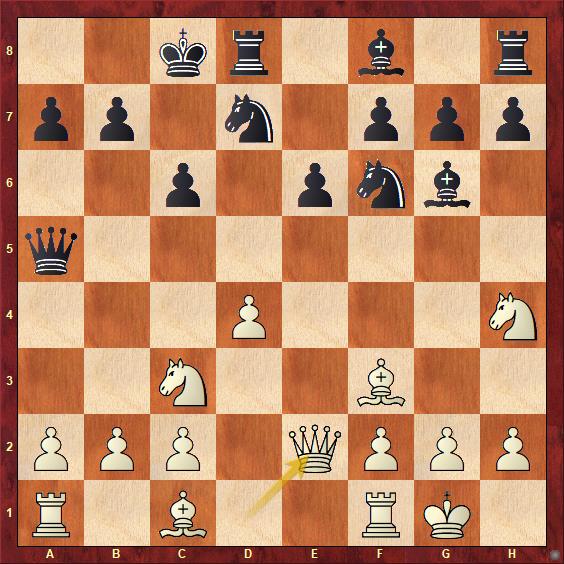
Dear readers, how would you continue here as Black?
If you would like to form your own impression of how this encounter unfolded, take a look at the game recording on the Chess Flow channel. Besides the moves, the behaviour of both players and the time they devoted to individual decisions are also worth noting.
I wonder whether you too will feel that „kiss of Caïssa“ while watching…
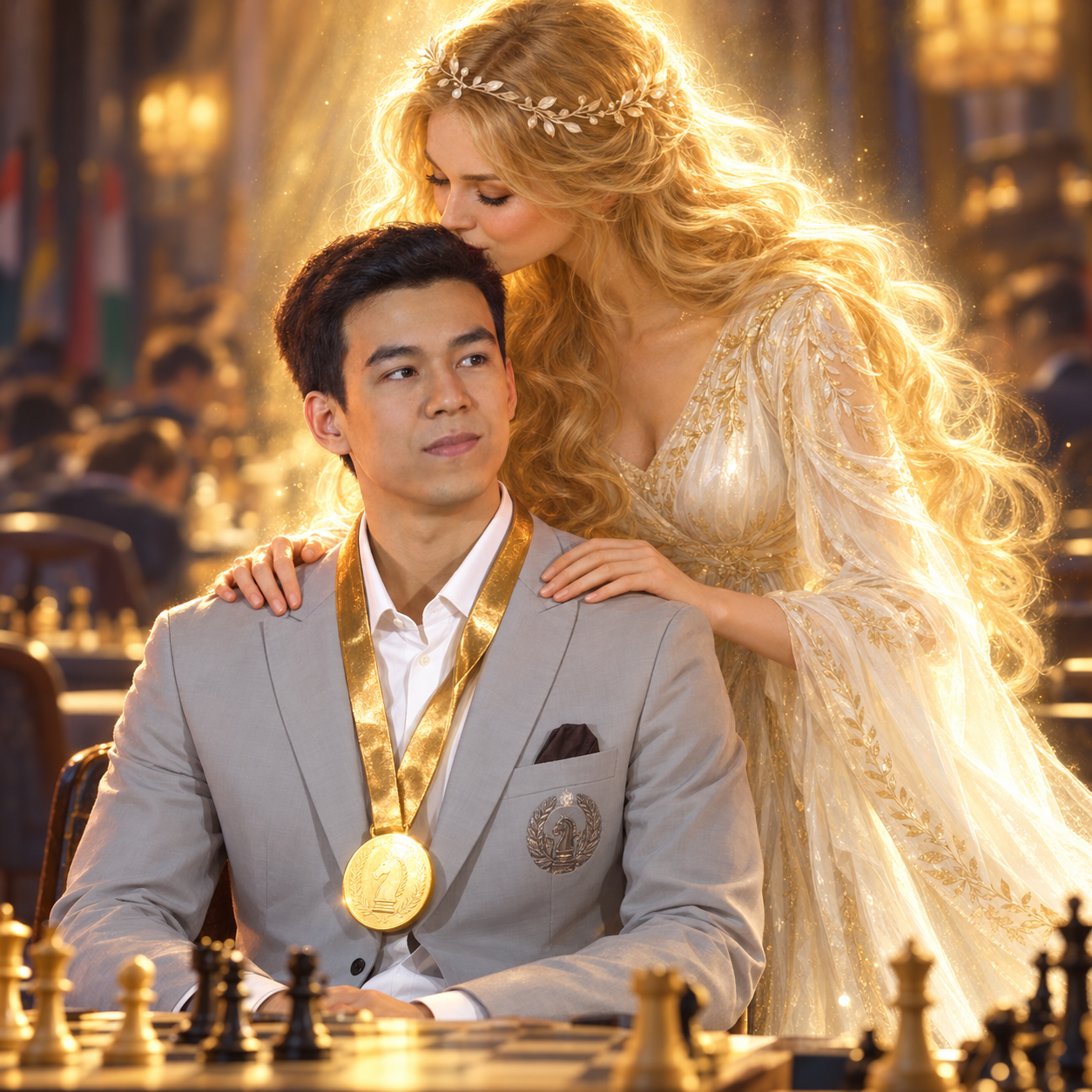
no words needed here…
Wesley's Olympiad Game, or The Queen Sacrifice and the Uncalculated Variation
The Olympiad, of course, offered many, many beautiful moments. It is truly beyond human capacity not only to process them all, but even to view them. So in recent years, or rather decades, I can hardly blame the organisers of huge events for not making beauty prizes an official part of the competitions. Nowadays, such prizes would almost certainly lead to more dramatic disputes than we ever saw a hundred or more years ago! Many readers have enough imagination to picture the dissenting arguments or even protests along the lines of: „Well, someone plays 30 moves of theory, makes five of their own prepared moves, and the beauty prize is theirs!“ 🙂
However, great attention is traditionally attracted by spectacular combinations…
One of the strongest chess players in the world, former world number two and member of the 2800 club, the Filipino-American super-grandmaster Wesley So drew attention to himself in Samarkand at least twice. Besides being the only one to defeat the challenger Javokhir Sindarov in a fine and „clean“ game (we know he really doesn't lose very often; we'll return to that game below), he had already shone earlier with a truly brilliant game.
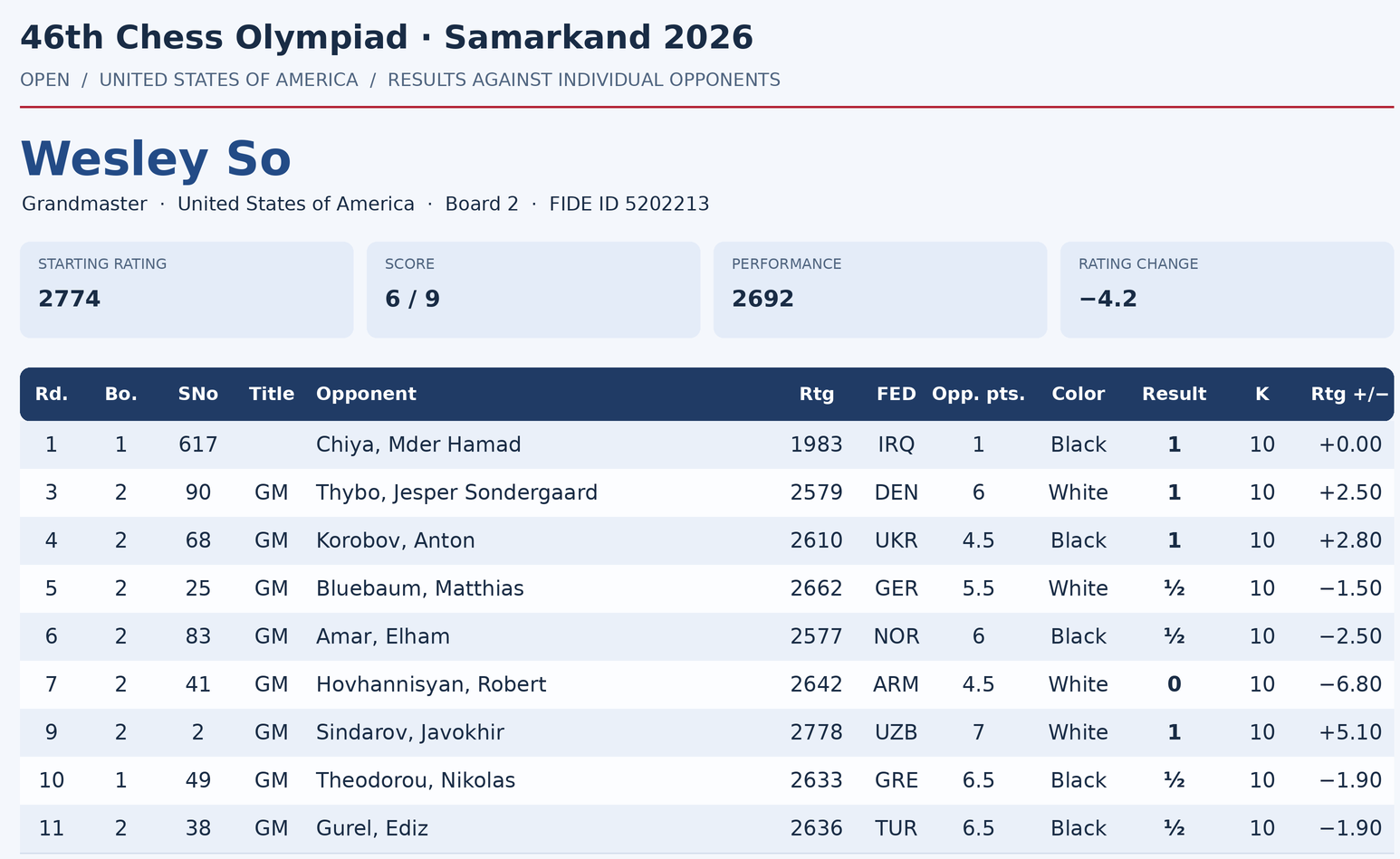
It's round 3 of the Olympiad and the USA team is facing Denmark. In the game So vs. Thybo the opponents play a giuoco pianissimo (the quiet Italian Game) with what are now the traditional – fortunately only two – donkey's ears. However, the course of the game ceased to be „pianissimo“ after the spectacular
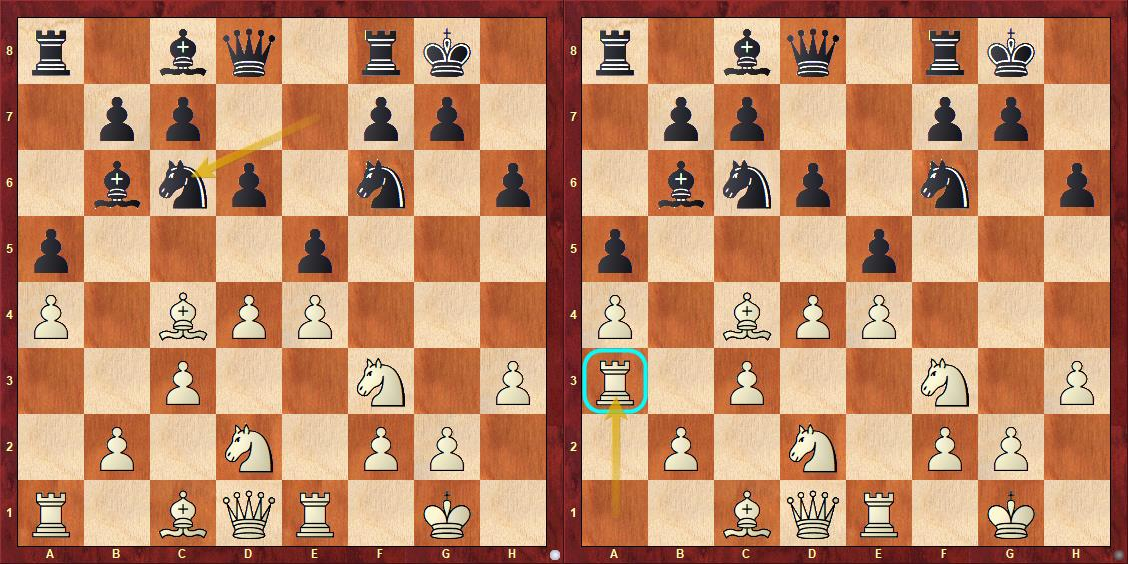
12.Ra3!! „A beautiful introduction to a new plan!“ one is so tempted to write. Except... that's not the case! A look at the databases reveals that this has already been played, and more than just a few times.
Well, of course, that doesn't detract from the beauty of this – as Nimzowitsch wrote in another context – enigmatic rook move. And since I've mentioned Nimzowitsch: he called the a3 square a bridge for the rook!
I'll just add that, at least according to the databases, the narrowest claim to the patent the Swedish grandmaster Nils Grandelius. We will of course find out what happened next – after the belated acceptance of the central pawn sacrifice – in the game viewer. Now let’s move on – to the best part!
Wesley has just played 23.Rg3!
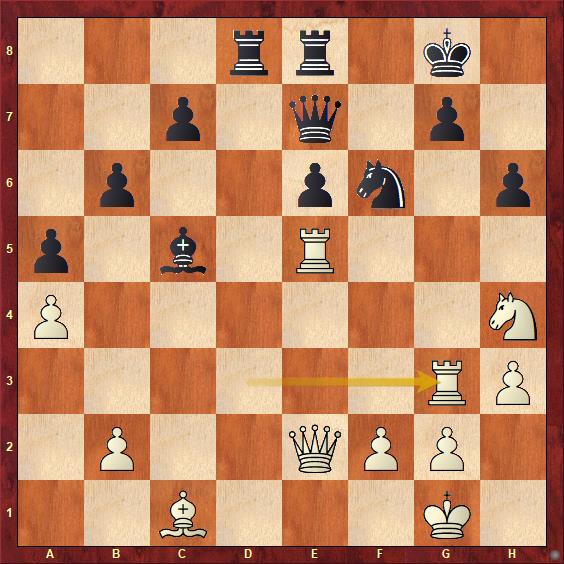
If Black „ran out of theory“ at this point, as the video recording may suggest, and after exhausting his concrete knowledge his first or second independent move in the game was also a decisive blunder, then we can speak not only of bad luck, but also of the tragic state of our information-saturated age!
Although I must add that I have experienced the situation „your first independent move and immediately a decisive blunder“ many times before… even in the pre-computer era! So I have certainly not just reinvented the wheel! 🙂
Followed by 23...Rd5?? 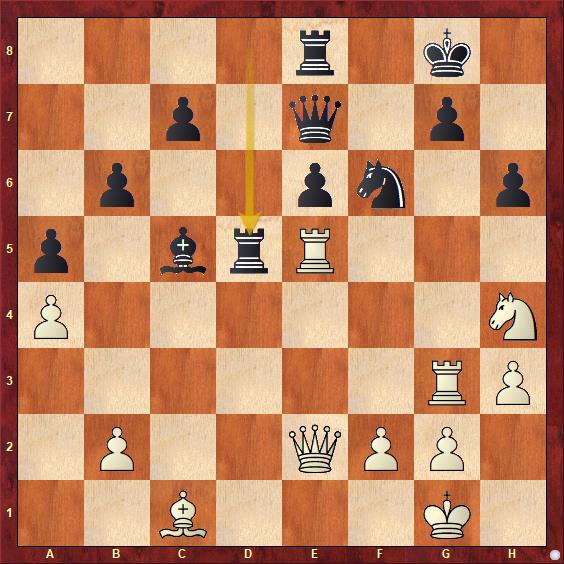
Dear readers, I don’t want to deprive you of the pleasant feeling if you manage to solve the following test – riddle – puzzle.
Let’s imagine this further course of the game: 24.Bxh6 Rxe5 25.Qxe5 Bd6. How would you continue after that?
The solution to the test can of course be found in the game viewer. In this case, however, I especially recommend playing through the whole game! For it’s not just about the final spectacular combination. Wesley’s work is run across multifunctional!
Naturally, I have stored the combination itself and its calculation in the relevant training databases. But if we play through the game from the beginning, we find it offers much more. It is also excellent for the topic of open files and fits nicely into Nimzowitsch’s concepts and the theory of open lines. That’s why I have left strategic reflections of this kind in the commentary.
The Butterfly Effect, or Where Did India Miss Out on Gold?
After what I wrote in my previous article at the very start of the Olympiad, I would of course be tempted to answer: „Mainly because the captain put the players in the wrong order on the team list!“ (The fact that he respected the world champion’s wish to play on board 4 doesn’t change that.)
Nevertheless, I believe that the order of players on the team list did play a certain role. But in my view, the Indians really are experiencing a certain dip in performance. At the Olympiad, it was just more clearly visible.
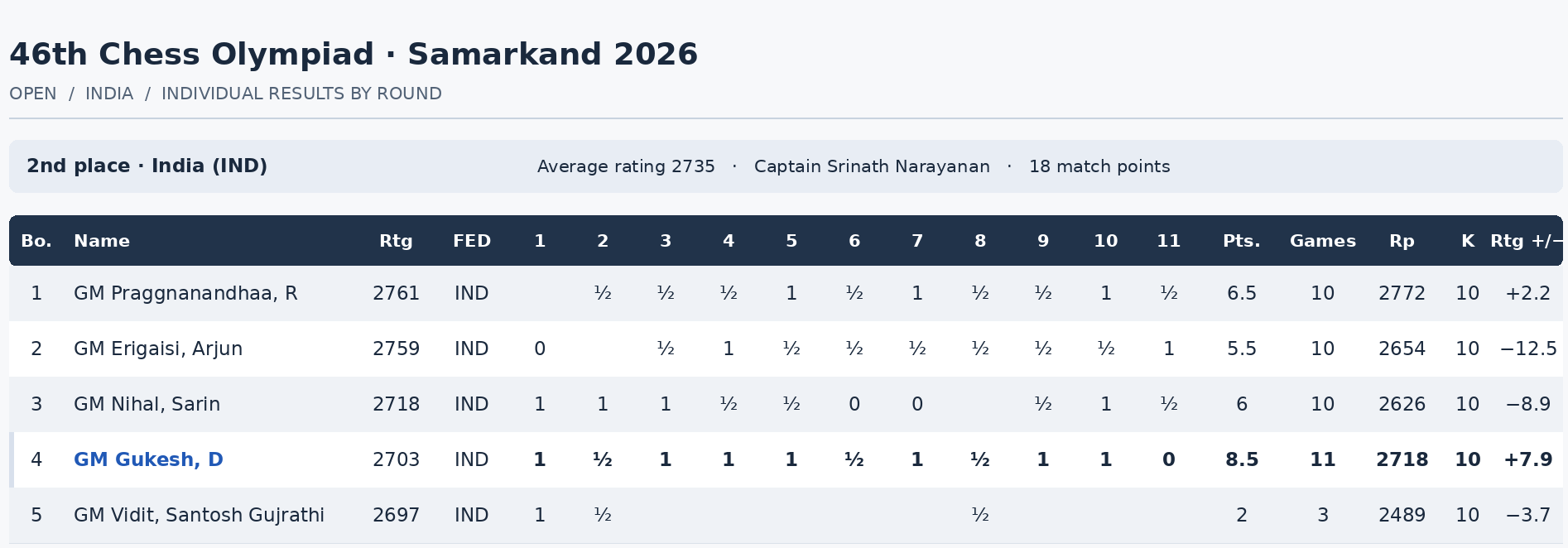
The comparison of the players’ results with the previous Olympiad is striking. Let me remind you that in Budapest, besides the phenomenal Gukesh, the team’s driving force was Arjun Erigaisi. On board three. Scoring 10 points out of 11 with a performance of 2968, he was catapulted immediately after the Olympiad to world number three. Well, India also won the Olympiad by a four-point margin!
But that is now in the past. With the result he produced this time on board two, and with only one star in the team, you simply cannot win the Olympiad.
Although... we do have the Butterfly Effect!
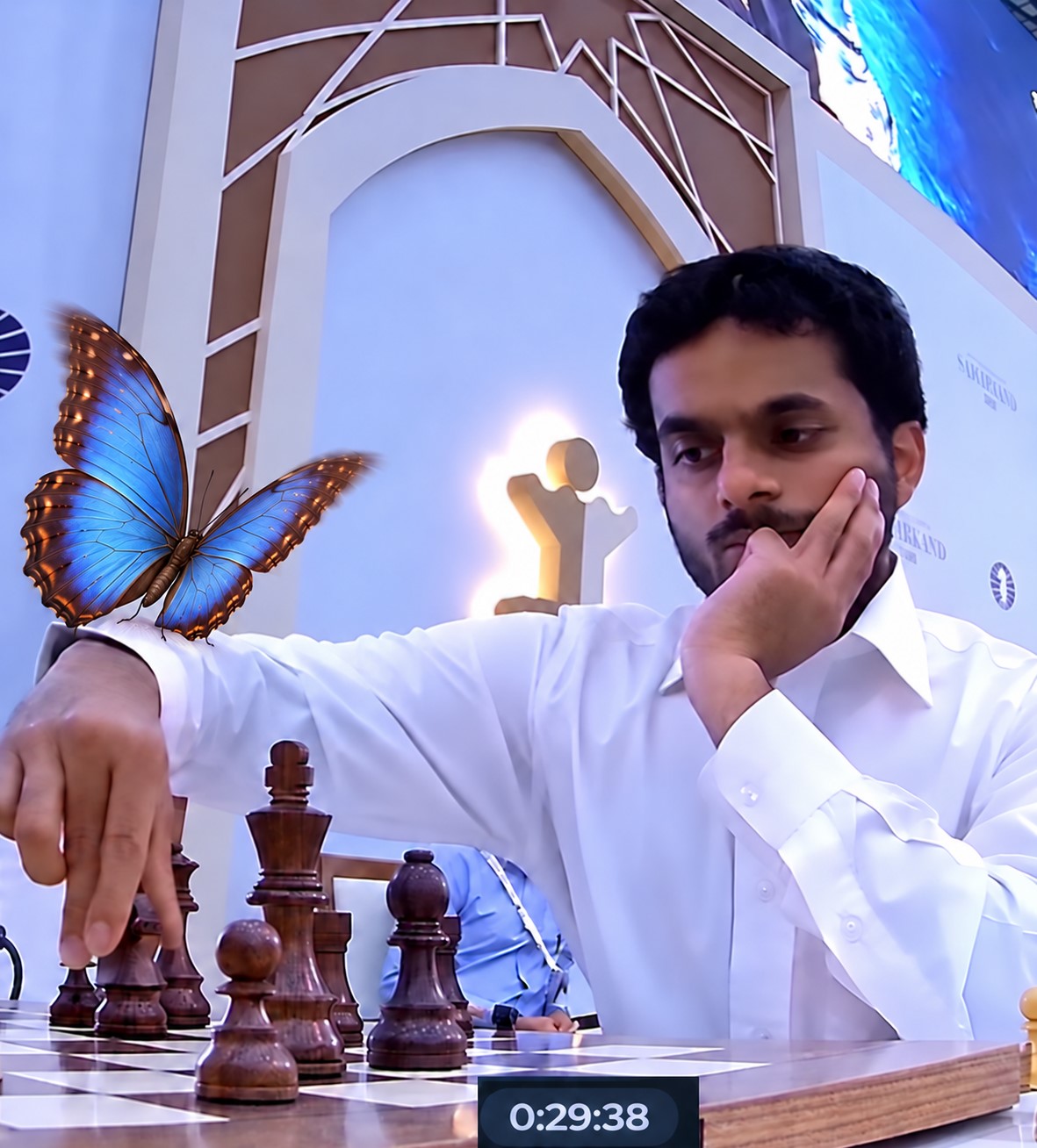 Nihal Sarin, with almost 30 minutes (!) on the clock, is just about to play the fateful 37...Nf5??...
Perhaps just a moment's extra calm before a single move would have led to a very different story being written about the gold!
How did it all unfold? Up to round 6, both India and Uzbekistan were cutting through the tournament like a knife through butter. On 21 September, the two leading teams of the competition faced each other. The games on boards one, two and four ended in fairly quick draws.
Everything was decided on board three, in the game Jakubbojev vs. Nihal Sarin.
Let me say straight away that this 22-year-old Indian player, who only quite recently joined the ranks of the super-grandmasters (he crossed the 2700 mark in October 2025), is not exactly – how shall I put it – my cup of tea. My account of the game will probably reflect that.
Years of constant blitzing on online platforms led Nihal to develop a corresponding opening repertoire. However, I have the impression that in all that, he didn't have enough time to work out a somewhat more serious repertoire. The kind he could rely on even in high-category tournaments.
In the game against Nodirbek Jakubbojev, which as a supporter of the Indian team I was most worried about, he not only survived a strangely looking line, but gradually built up a promising position. Besides his amazing tactical vision, Nihal also has an excellent feel for piece coordination. And it is precisely those tens of thousands, if not hundreds of thousands, of blitz and bullet games that have taught him valuable skills: he can slip out of passive or otherwise ugly-looking positions like an eel.
After 32...Kh6
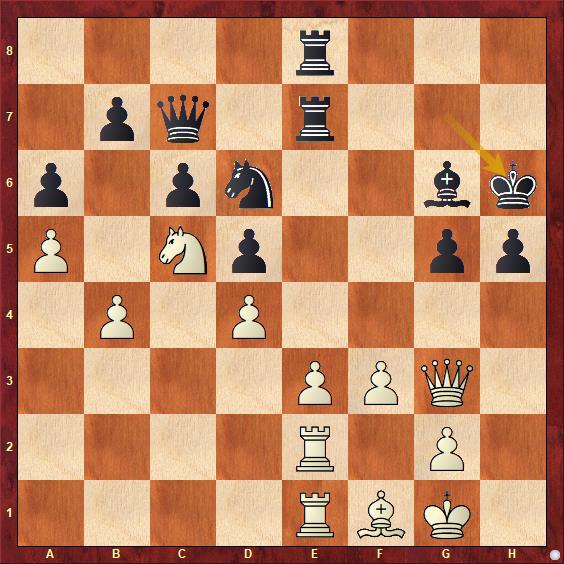
Nodirbek considered it desirable to carry out the planned 33.e4; this was followed by 33...h4! 34.Qh2 dxe4.
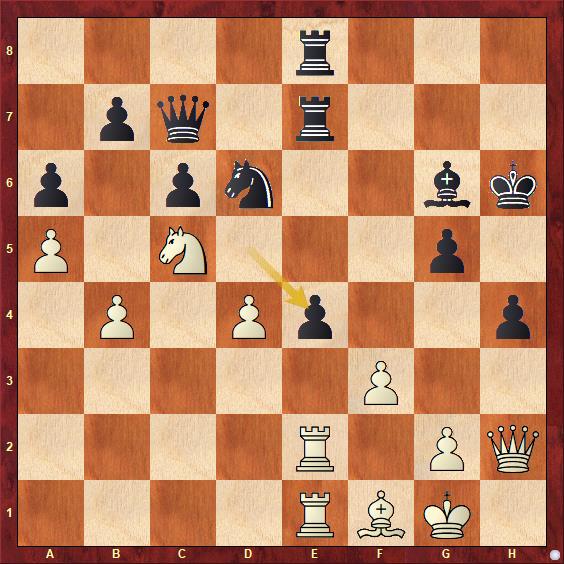
We are probably looking at the first of two decisive positions, not only of the game, but of the whole match – and who knows, perhaps of the entire Olympiad! To better assess what happened next, it would certainly be best to look directly at the video recording. After 34.e4, Jakubbojev had just over 9 minutes left for the six remaining moves to the time control, while Nihal had almost 35 minutes at his disposal!
At that moment, the position was objectively equal. If Jakubbojev had simply recaptured on e4 with the pawn, a complicated situation with mutual chances would have arisen. However, Nodirbek sacrificed six (!) of his nine minutes to choose an erroneous move, objectively losing, but on the other hand in practice in the end winning 35.f4??
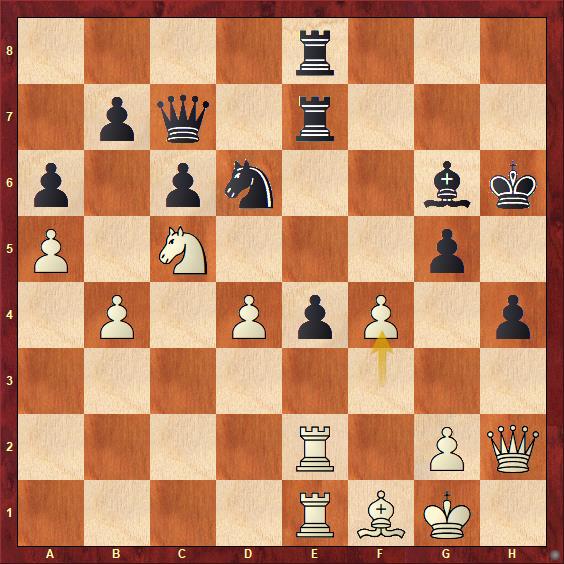
Black has just reached a winning position! Moreover, with 32 minutes on the clock against White's three and a half minutes. In a position that fits his playing style perfectly, he should win more than nine games out of ten. But not this time!
Nihal somehow confused a classical game with a blitz game! In a winning position, he first set off with his king on an adventure, and it only took him two seconds to decide on such a journey! Everything then culminated in the positions shown in the last diagrams.
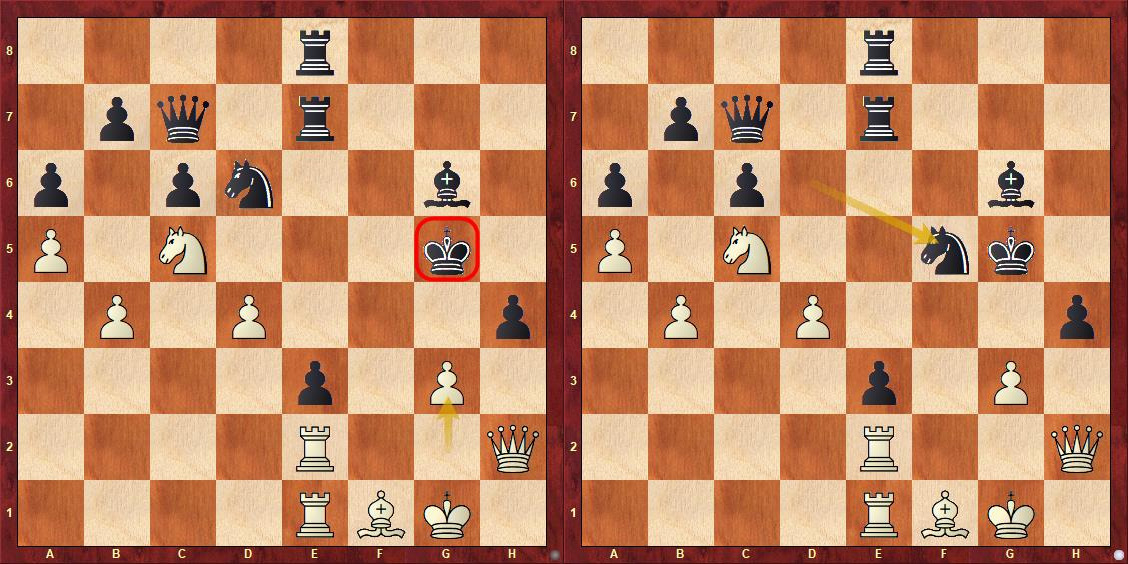
After 37.g3! Black could no longer hold himself back. Still with half an hour on the clock, but also visibly nervous, he played 37...Nf5?? and got up from the table.
Those of you, dear readers, who have not yet seen what is probably the decisive position of the whole Olympiad, will surely enjoy sinking your teeth into the juicy apple of tactics in the right-hand diagram. And for the fans of the Uzbek team, not only at the venue but surely also in front of screens and displays, a weight was lifted from their hearts. And there were so many weights that when they all fell together, even Mother Earth herself shook. After all, physics doesn't lie! 🙂
So now, with some distance and without unnecessary emotion, let's first savour the record of the game itself. And I'm sure you'll agree with me, dear readers: no one does this better than ChessBase India, or more precisely, Sagar Shah!
However, in my opinion, the highest quality video commentary on this game is offered by GM Sergei Makarychev:
The most critical moment of the Olympiad, which may well have decided the final standings on the podium, is brought to life in the following video.
The Olympiad in a Nutshell
Before we leave the Olympiad itself and shift all our attention to the two chess players who will, in the coming weeks, fill – hopefully not only – the chess media space, let's take a look at a really nice, faithful and apt summary of the critical moments.
Grandmaster Petr Svidler has recorded a very well-made video with a running time suitable even for those who „can't manage more than a quarter of an hour“. 🙂
A Grand Ceremony
The full recording of the closing ceremony of the Olympiad in Samarkand
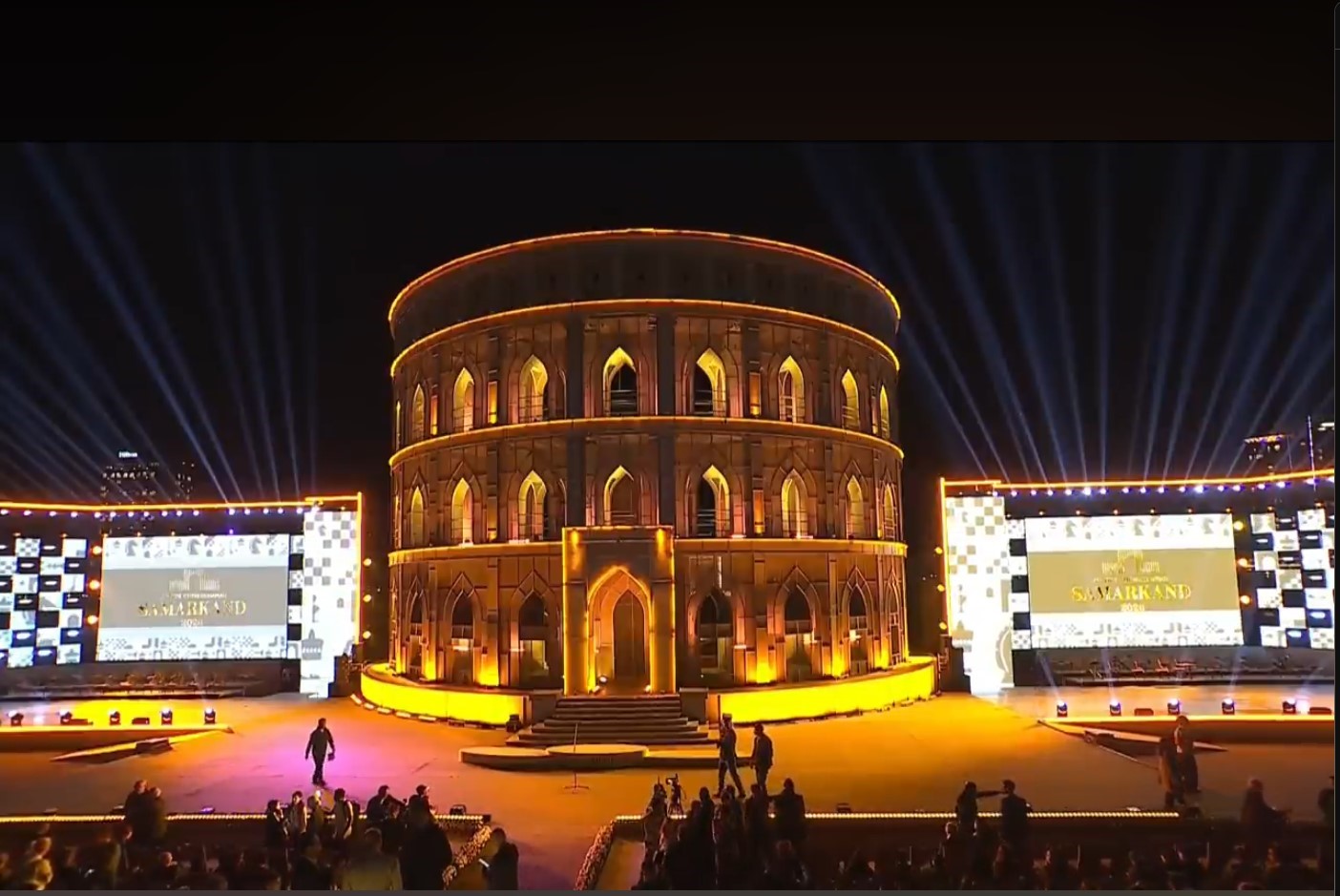 A magnificent finale worthy of a chess superpower. And today Uzbekistan undoubtedly belongs among them.
Who Will Prevail (3)
The main reason why I chose to approach my article on this year's Olympiad in this way was the desire to assess the performances of two chess players who will soon find themselves at the centre of attention not only in the chess world. In the previous two-part article „Who Will Prevail?“ I tried to predict the possible course and outcome of the upcoming highlight of the year: the match for the chess crown between the reigning champion Dommaraju Gukesh and the challenger Javokhir Sindarov. The Olympiad in Samarkand has now provided us with further valuable material. Has it confirmed my previous conclusions, or does it call for their reassessment?
So, let us for a moment „forget“ about the team results, the battles to the last bullet, and the beautiful chess moments in the games of the other participants. Let us focus entirely on our two heroes. And that they are heroes, I have no doubt, whether you, dear readers, are fans of one or the other young man!
So what did their performance in Samarkand show? Let us first look at the bare facts. But we will not stop there: points and performance alone do not yet tell us how convincingly each played, what chances they created, and how many they in turn offered their opponents. It is precisely the analysis of games and critical moments that may help us unravel the tangle of questions that arise before the match.
Is the challenger still the clear favourite? What is the world champion's form like? And does Javokhir maintain the level of play he showed in his dominant victory in Cyprus? Of course, the Olympiad cannot reveal the result of their future encounter. However, it can give us a hint as to what strengths and weaknesses both will bring to the match.
Let us give precedence to the challenger:
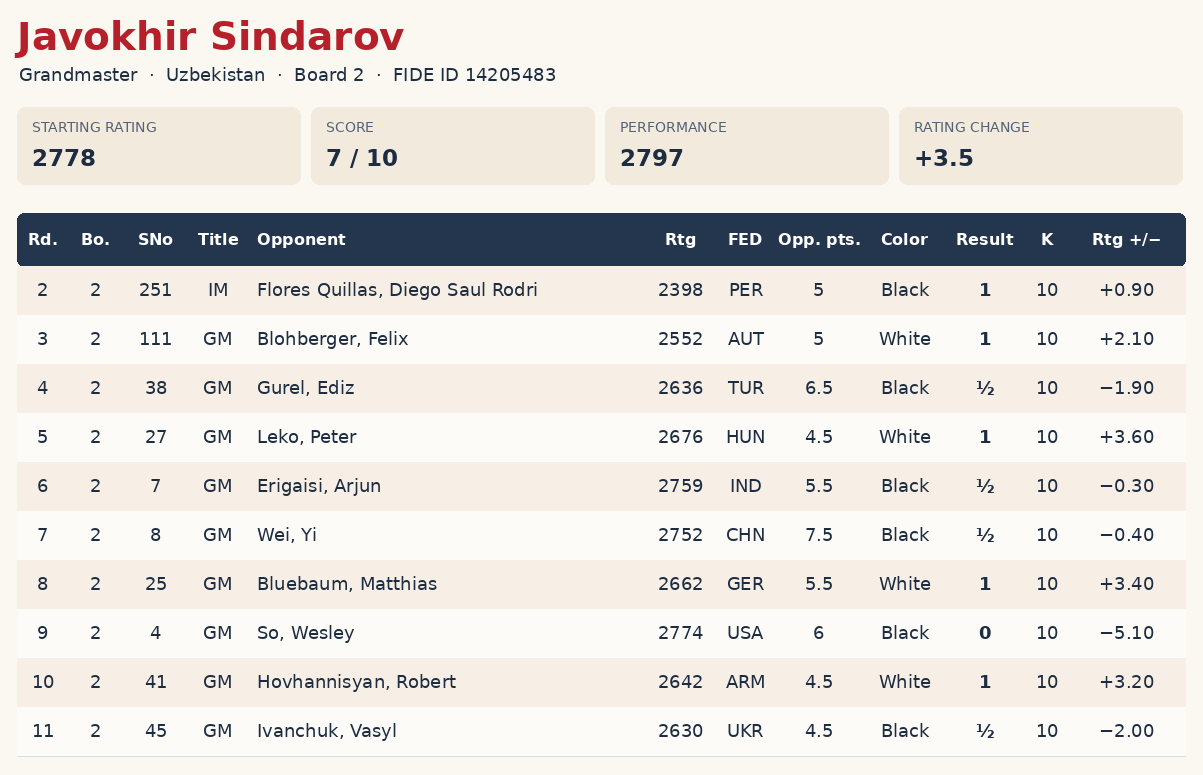
The table of „bare facts“ clearly shows that Sindarov performed to his usual standard on board two. Compared to the result of the king of the Olympiad, Abdusattorov, his performance may pale, but his position in the absolute world elite remains beyond any doubt defended.
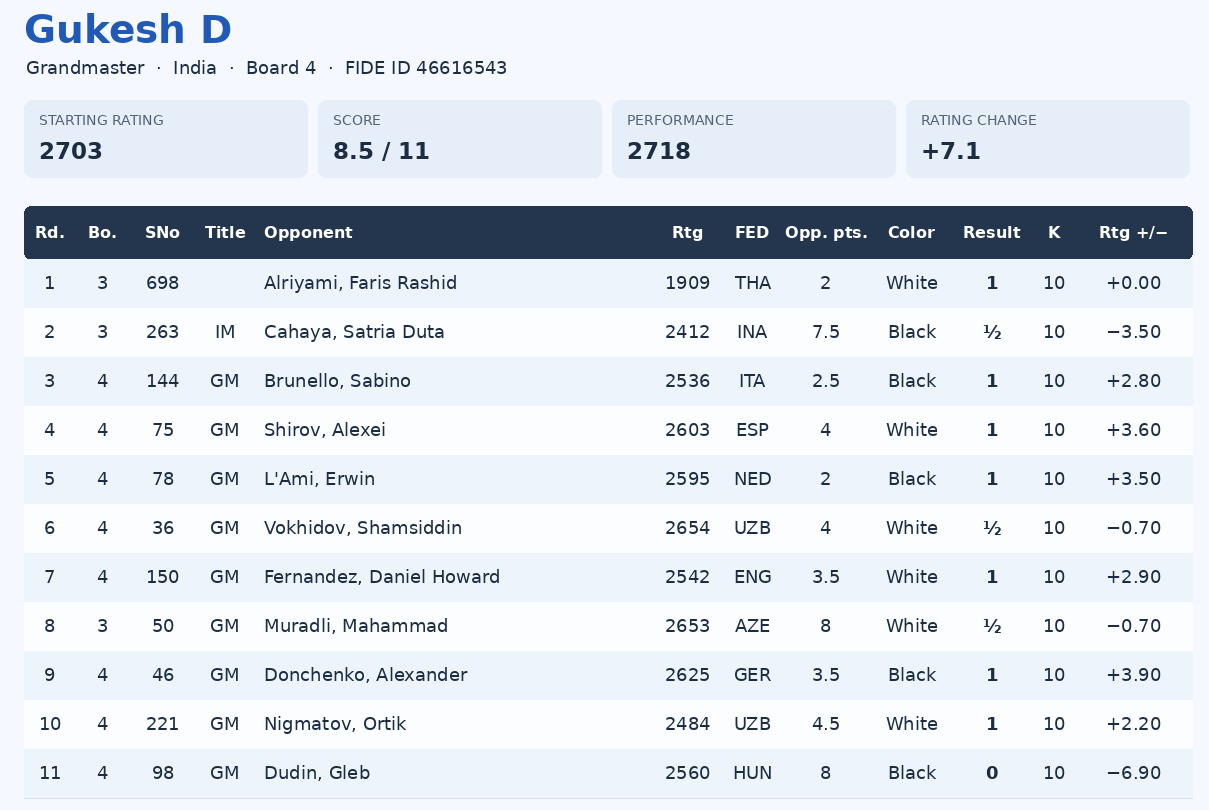
Although the world champion's individual result surpasses Sindarov's in terms of points, his performance rating is several dozen points lower. However, the points tally alone cannot be compared without taking into account the strength of the opponents. Gukesh mostly played on board four, while Sindarov defended board two. For such a comparison, performance rating is therefore a more suitable, albeit still „bare“, indicator.
By that measure, Sindarov comes out better, but… before an ugly a loss in the final round with Gukesh scoring 8½ points from 10 games, his performance rating was exactly 2797. That is, the same, with which Sindarov finished the whole Olympiad! If the world champion had not played in round 11, both would have shown an identical performance rating with the same number of games played. A single game thus significantly changed the final statistical comparison. All the more reason to look at the content of their games as well!
For I have not yet mentioned in the article that in the final rounds of the Olympiad, the participants were ambushed by a sneaky virus. Quite a few chess players were feeling unwell – among the Czech representatives, David Navara mentioned it. The captain of the Indian team, GM Srinath Narayanan (in my opinion, the captain of a top team should support the players also in chess matters; organisational skills alone are not enough) mentioned in a short video also the world champion's illness, and not only his! Under normal circumstances, Gukesh probably would not have played the final round…
A brief digression: tournament routine and empathy
But there is another thing that has troubled me for decades: moving the final round to a much earlier hour. Imagine, dear readers, that you are playing an important tournament. Day after day you sit down at the board at 3 p.m. You adjust your sleep, meals, walks and preparation accordingly. And then comes the final round, often decisive for success or failure, and suddenly you have to play at eight in the morning!
In Samarkand, the change was not so drastic: the final round started at 11 a.m. local time instead of the usual 3 p.m. Even so, the players had to change their established daily routine just before the decisive battle. And when I think of Mikhail Moiseyevich Botvinnik… he would, as the saying goes, turn in his grave! He attached extraordinary importance to a regular tournament routine and followed it to the smallest detail.
I understand that the organisers need to allow time for the closing ceremony and for participants to depart. Still, I cannot shake the question: why should the player's preparation and rest give way to organisational convenience precisely on the decisive day?
Allow me a brief digression from my own coaching experience. When once the organisers of the Czech Republic Youth and Junior Championship combined the final round at eight in the morning with the requirement that the children pack their things and vacate their rooms before it began, that was something I truly could not understand. Instead of calm preparation and focusing on their opponent, they had to worry about whether a sweatshirt, charger or slippers had been left behind! And all this after an early wake-up, before a game that could decide the outcome of the whole tournament…
Sometimes, perhaps, it would take very little: when drawing up the schedule, to put oneself for a moment in the shoes of those who have to perform at their best over the chessboard. Especially when they are children. A bit of ordinary empathy would do more good here than a perfectly planned departure.
But let us return to our as yet „dry statistics“. Certainly, one lost game by the world champion is not enough to build an argument upon, however alarming his performance may have been. But I cannot resist presenting you with one more table!
Gukesh Dommaraju
Performances at Chess Olympiads
| Olympiad | 2022 Chennai | 2024 Budapest | 2026 Samarkand |
|---|---|---|---|
| Age | 16 | 18 | 20 |
| Board | 1 | 1 | 4 |
| Points / games | 9 / 11 | 9 / 10 | 8½ / 11 |
| Performance | 2867 | 3056 | 2718 |
This is how Gukesh performed at the last three Olympiads!
Queen sacrifices as forerunners
Before the actual clash takes place, it is often necessary to show your opponent who they are dealing with! In the animal kingdom, displays of strength are part of the age-old struggle for position: who will gain the upper hand and who will yield? Sometimes such a demonstration even decides things before the real fight begins. We humans have a nice word for it: strutting!
Human civilisation has gradually developed its own forms of these rituals. Instead of muscles, one can display self-confidence, and instead of threatening gestures, make grandiose statements. In sport, they thrive wonderfully, and today's media environment provides the perfect breeding ground for them.
The young men who will face each other at the end of November, however, are far removed from such macho posturing!
In my view, Gukesh positively radiates modesty, sincerity and directness. He may seem more reserved, but for example the patience and willingness with which he obliges fans asking for an autograph or a photo, even before an important game, are remarkable. Nor does Sindarov strike me as someone who needs to defeat his opponent with words in advance. In this, both are quite a striking contrast to the younger Magnus Carlsen. I still remember his words: „I think I would beat Tal quite easily. Fischer would be more difficult, but I think I could beat him too.“ (From an interview with Nigel Farndale for The Telegraph, November 2015; translated from English.) I doubt journalists will hear such confident predictions from Gukesh or Sindarov any time soon.
Nevertheless, alongside the comparison of performances on boards 2 and 4 in Samarkand, there was another interesting contest. This time, a truly aesthetic one. Although its participants probably did not perceive it that way at all…
Both young prodigies, in one of their games, crowned their play with a spectacular sacrifice of the strongest piece – the queen. If we wish, we can see in these combinations a small demonstration of their strength ahead of their mutual clash. Such a performance always attracts the attention of the audience!
Well, dear readers, you can decide for yourselves which of the combinations you like more. 🙂
In the game of round 2 Flores Quillas vs. Sindarov Black had already once left – sacrificed – his queen on f1. Now followed
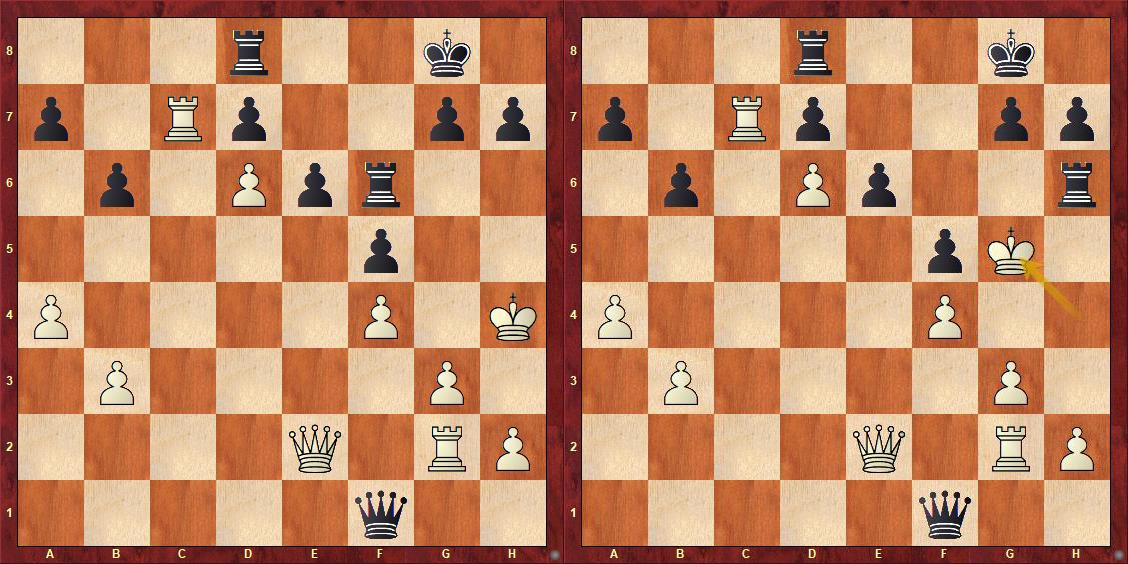
30...Rh6+ 31.Kg5 (see the position in the right-hand diagram) 31...Kf7!! This time, the Peruvian player accepted the offered queen 32.Qxf1, only to face the brilliant 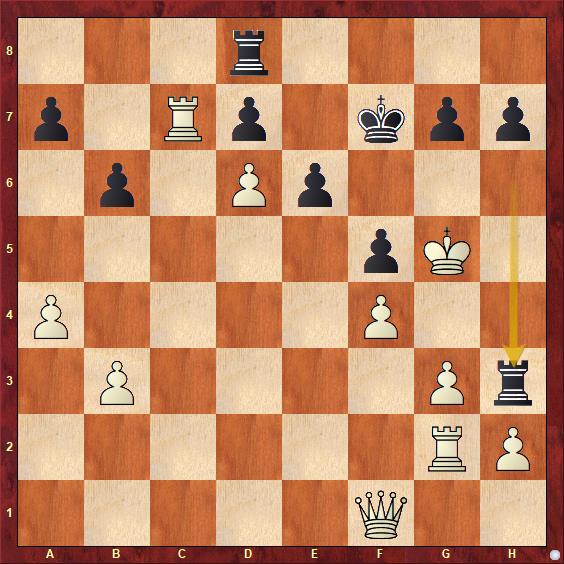 32...Rh3! and laid down his arms.
As the always witty and quick-witted Andrej Mikitin remarked in one of his videos on his channel Шахматы – это Круто (Chess is Cool): „The Peruvian International Master will one day show his descendants how he took the strongest piece from a future world champion! That must be the real reason why he kept playing.“ 🙂
The world champion shone with a brilliant finish only in round 9. In the game Donchenko vs. Gukesh White had just made the decisive and final mistake by playing 51.Be2?? 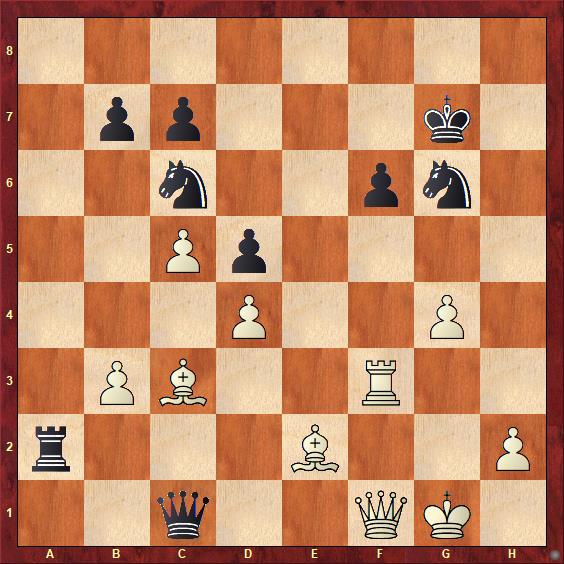 This was followed by the crushing 51...Nf4!!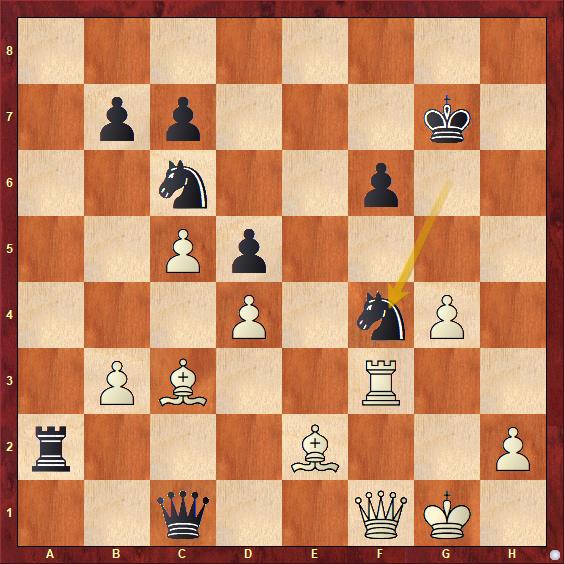
Admittedly, Gukesh's sacrifice of his strongest piece perhaps cannot, strictly speaking, be called a combination (that is, a sequence of forced manoeuvres involving a sacrifice). After a short think, strong chess players will probably find only one playable continuation in practice, 52.Bd1, after which we cannot calculate our way to victory using only forced lines. Nevertheless, the analysis in the viewer clearly shows that White's position was objectively lost…
Very, very strong!
Let us begin our focused journey through the games of the opponents, who will soon be facing each other in the match of the year, with the challenger.
The following examples will take us through both Javokhir's victorious run and, at the end, the only mishap he suffered at the Olympiad. Incidentally, we will proceed in a similar way in the final chapter of the article, which will be devoted to the world champion's Olympiad games.
Let me add: it really isn't hard to see where Sindarov's enormous practical strength comes from! Everything seems clear, and in this respect, in my view, Gukesh's coaches, seconds and collaborators will actually have little to do. They simply need to acknowledge that his strengths far outweigh any weaknesses!
I believe I wouldn't even need to divide his Samarkand performances into further groups. Nevertheless, for greater clarity and comfort, dear readers, I shall do so.
A compass called the classics
The vast majority of today's young super grandmasters, as well as those just knocking on the door of the magical 2,700 rating barrier, are inductive-style chess players. Their play is dominated by excellent memory, quick calculation and tactical vision, honed both by solving tens or even hundreds of thousands of puzzles and tactical exercises, and by practical experience in blitz. However, that alone is not enough to reach the very top. In the role of an excellent brake (in the best sense of the word) is classical chess education.
As I have written several times before, if exceptionally talented children and young players are „lucky with their coach“, they are bound to encounter the question of the classics. Knowledge of classical games and the works of past masters helps to dampen purely inductive habits and, at least from time to time, to think in terms of plans. It also leads to a marked improvement in endgame play.
Not only in previous articles have I mentioned that one of Javokhir's significant strengths, which – who knows – may play a very important role in the upcoming match, is precisely his classical chess education. Indeed, the Soviet chess school, through which most quality coaches have passed, and thus indirectly their students as well, leaves its mark!
I think the following fragment is clear proof of that! In the game from round 3 Sindarov vs. Blohberger the challenger delivered a precise positional performance. He completely outplayed his opponent.
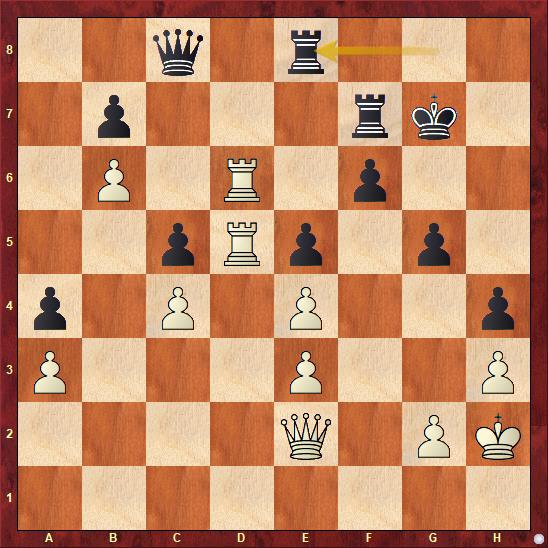
In the diagram position, he has many ways to gradually tighten the noose around his opponent even further. The latter lacks counterplay, so time is not the main factor here. However, when I saw the position live, I almost would have bet that I could guess Sindarov's next move. And so it was!
A classical education simply dictates – indeed, insists – that you continue with 36.Qd1!
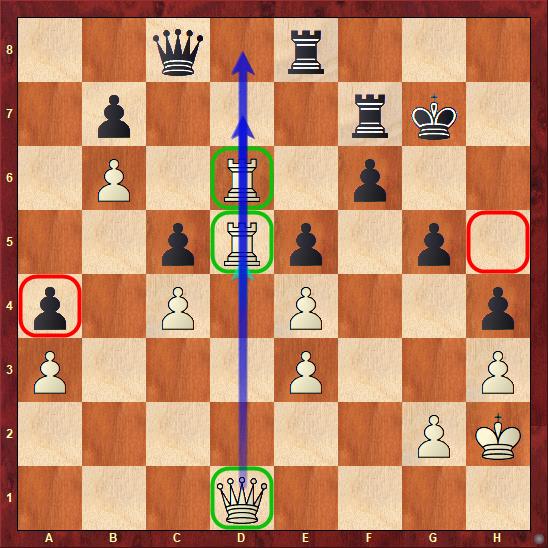
If we want to reinforce control of the open file even further, it pays to „line up the carriages“ correctly, that is, the heavy pieces: rook + rook + queen, with the queen at the very back. „The aim of all operations on open lines is to penetrate into the enemy camp!“ he wrote in his work, which will soon celebrate its hundredth anniversary, Aron Isaevich Nimzowitsch. That alone suffices to explain why such a rule works.
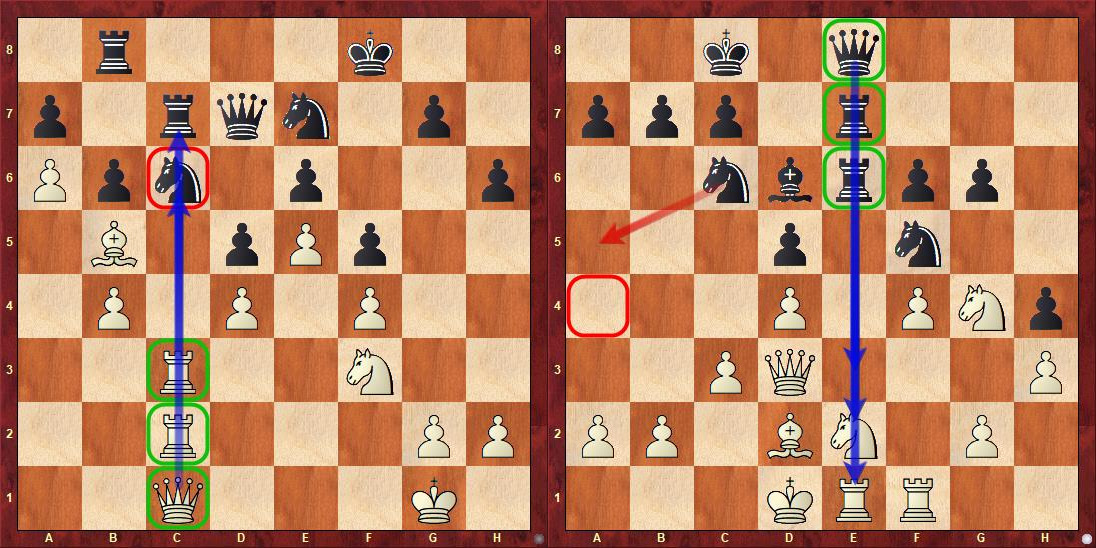
Not only experienced chess players will probably recognise the positions in both diagrams. Yes, they come from famous games Alekhine vs. Nimzowitsch, San Remo 1930 after 26.Qc1! a Winter vs. Alekhine, Nottingham 1936, in which the then former and future world champion continued in the same fashion 24...Qe8!
Such an arrangement of heavy pieces is sometimes called Alekhine's Gun. The name is mainly associated with his game against Nimzowitsch, but exactly when it arose and who first used it is not reliably documented. I must admit that this term passed me by for a long time; I only heard it years later as a coach. In the meantime, I used to compare this manoeuvre to shunting wagons in a marshalling yard for my students, so in my teaching I „remained loyal to the wagons“. 🙂 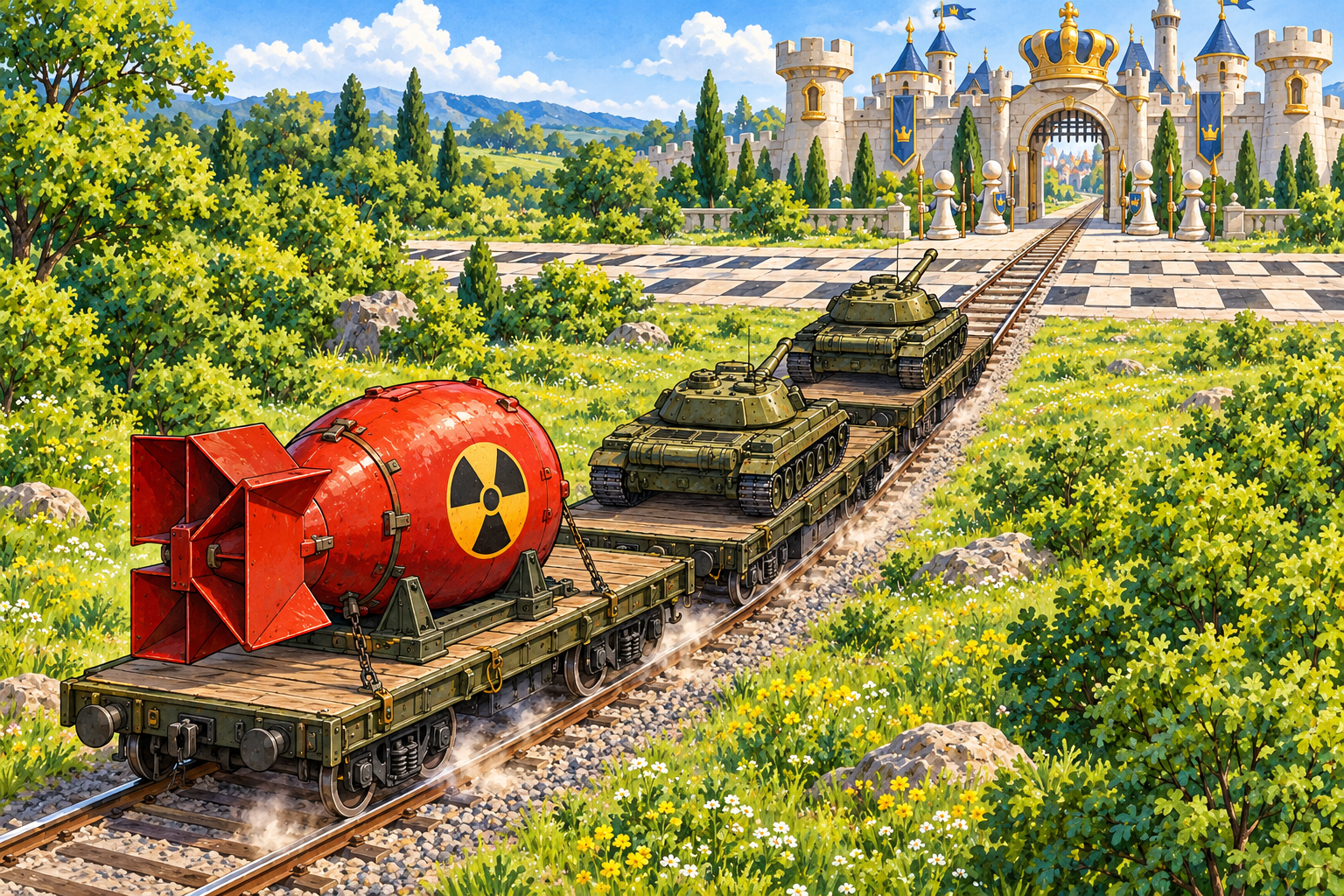
In round 5, in the game Sindarov vs. Leko the challenger finished the game with an attractive combination in the endgame. How would you finish the game in the most elegant way?
Viennese Pressure Without Pause
In the game of round 8 Sindarov vs. Blübaum we can observe a course of play entirely characteristic for the challenger: excellent theoretical preparation, with the resulting position perfectly suiting Javokhir's style. From start to finish, White never lets go of the initiative.
Once again, the Vienna Game was played – with a touch of exaggeration, one could say it's the hit of the moment: 1.e4 e5 2.Bc4 Nf6 3.Nc3; followed by today's by far most played
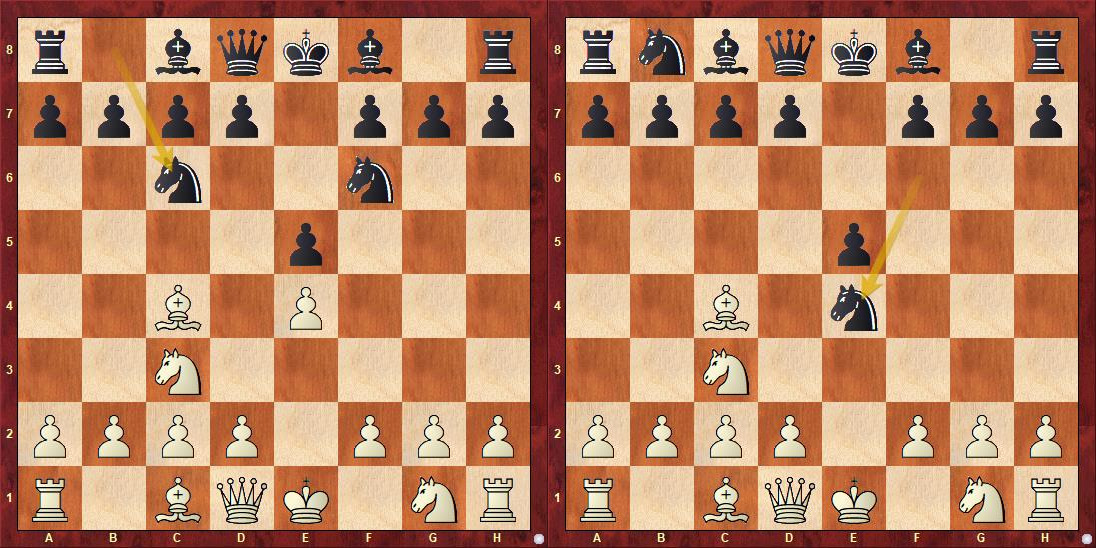
3...Nc6. Sindarov and his team surely based their preparation mainly on the opponent's recent game against Wei Yi, and so they expected that Black would choose precisely this continuation.
But... for quite some time I've been asking myself what would happen on the board if „someone, someday“ finally dared to play the so-called. Frankenstein–Dracula Variation s 3...Nxe4!? (Blübaum, however, is not the type of grandmaster from whom I would expect something like that. Moreover, both sides would have to be willing to embark on such an adventure.)
Let's look at the position in the right-hand diagram and continue: 4.Qh5 Nd6 5.Bb3 Nc6 6.Nb5 g6 7.Qf3 f5 8.Qd5 Qe7 9.Nxc7+ Kd8 10.Nxa8 b6
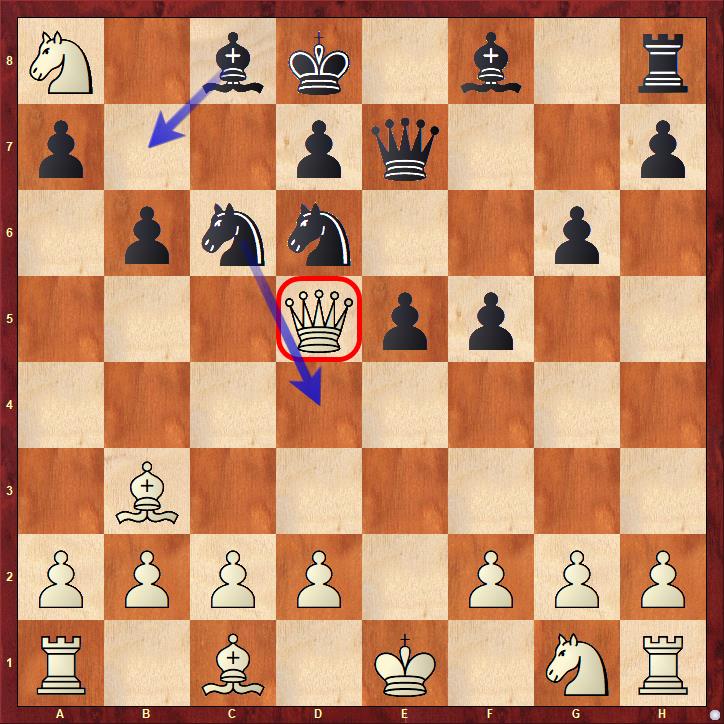
The historical development of the evaluation of this exceptionally sharp continuation of the Vienna Game is interesting. For example, Paul Keres, in his analyses from 1970, considered the resulting positions to be unclear. However, with the advent of chess engines, the view of the variation gradually changed. Roughly as late as 2010–2020, computer analyses assigned White the advantage and Black's concept was often considered unsound.
But the development of chess engines continues! The latest generation is finding new resources for counterplay for Black. The results of games between strong engines also suggest that a clear refutation of the variation (if such a thing even objectively exists) is nowhere in sight. In a sense, the situation is thus returning to the days before computers, when a question mark also hung over the final evaluation of this complicated system.
The bold variation beginning with 3...Nxe4!? also bears an impressive name Frankenstein–Dracula Variation. Its author is the Irish chess theoretician and correspondence chess player Tim Harding, who in 1973 compared the wild nature of the resulting complications to a battle between Count Dracula and Frankenstein's monster. In 1976, he included a whole chapter under this name in his book on the Vienna Game.
It must be admitted that for one of the wildest variations not only of the Vienna Game, he chose an exceptionally apt and expressive name. 🙂

Four hours of preparation for the Double Fianchetto?!
The following section is devoted to the penultimate round game Sindarov vs. Hovhannisyan. After six opening moves, the following position appeared on the board.
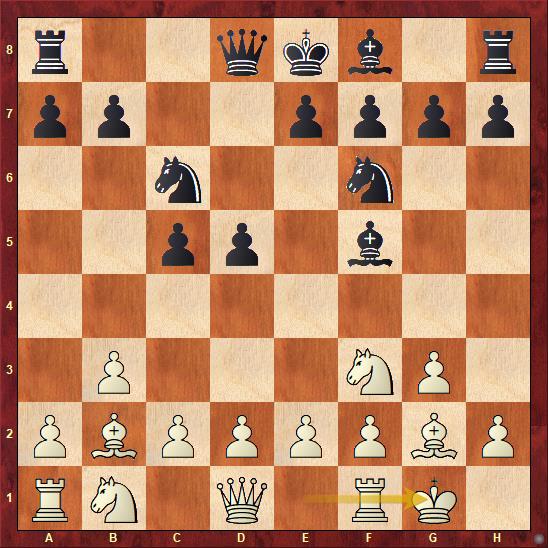
„What's so special about that?“ some readers may ask. Especially those who themselves occasionally opt for the Double Fianchetto. Or, more sharply: „Has the author never heard of the hypermodern school of chess? Of Réti, Nimzowitsch, Grünfeld?!“
Of course he has. 🙂 I wasn't even surprised by Sindarov's choice, a certain departure from his repertoire. Two things about the game astonished me, so I'll take them one at a time!
In a short post-game interview with Charlize van Zyl on FIDE Chess, the challenger uttered a sentence that left me shaking my head in disbelief. It concerns preparation for the game, about which we learn more right at the start of the interview, around the 25th second.
Is it really possible, out of the countless possible responses Black could make and the various set-ups, to pick out exactly the one that will actually occur in the game? Or to base your preparation on what your opponent played in some other game? (How many such examples would we actually find?) Or, in the second case: is it really possible to cram all the theory and plans of the double fianchetto into your head in just four hours?
However, the video is valuable in other respects as well. Here Sindarov mentions collaboration with Shakhriyar Mamedyarov! So will he also appear as his second in Geneva?
And I noticed one more seemingly minor detail! Sindarov is actually overestimating his performance in the game! He literally says that he managed to find the best moves. As we will see in the analysis, in the game he on the contrary committed a serious blunder, which, several moves before Black's resignation, could not only have saved Black but even allowed him to equalise!
Optimism is certainly possible and is the prevailing outlook among young people, but a lack of self-criticism can later lead to self-centredness. The beginning of the interview rather reminded me of Capablanca's remarks… 🙂
A sacrifice without a sacrifice
I once witnessed the following event: a coach leading a group was demonstrating a model game on a demonstration board. When he reached a critical position, he said: „Now White has sacrificed the exchange for a bishop and two pawns!“
No one but me noticed that the lecturer had just uttered, if not a direct oxymoron, then at least, according to chess logic, a false statement. It's „almost“ the same logical error as if we were to describe the events of a game with the words: „White has just sacrificed the queen for a rook and two minor pieces!“ In fact, this is not a sacrifice at all, but a material gain! The correct way to put it would be: „White has just gained a rook and two minor pieces for the queen!“
In our first case, however, it's not a sacrifice, but rather an exchange! More precisely, according to the literature I once studied, a so-called. non-equivalent exchange.
That, however, did not stop many commentators and streamers from putting the words „Sindarov sacrificed the exchange“. „If only Tigran Vartanovich could see this!“ I thought to myself. „He would explain the problem to you more thoroughly, once and for all!“
It was Petrosian himself who, in his commentaries and lessons, claimed that a bishop and a pawn are already sufficient compensation for a rook. And that's not even mentioning situations where the active side had a pair of bishops!
Let us now take a look at Sergei Makarychev's video analysis, which is of high quality despite how little time the author had to prepare it after the end of round 10. Let me also remind you of the option to turn on English dubbing.
A chink in Sindarov's armour
I kept the last part devoted to the challenger in reserve. As we have seen, and indeed know, Sindarov rarely loses in classical chess. Since his triumph at the World Cup, his losses could be counted on the fingers of one hand.
The one dealt to him by Wesley So, however, is particularly valuable. For whom? In my opinion, above all for the world champion and his (not only) psychological preparation! For in this game, one can truly discover the weaker sides of Javokhir's play.
Originally, of course, I intended to subject this game to a detailed analysis as well. In this respect, however, I was pre-empted by someone incomparably stronger, more experienced, and far better acquainted with the situation!
Video analysis Hikaru Nakamura contains everything! However, in my view, its most valuable contribution is the psychological analysis of the challenger's weaker points. And not only that. Hikaru hits the bullseye when describing which specific positions do not suit Sindarov.
Let us first watch the game recording and then that psychologically valuable analysis by Nakamura!
Is the world champion finally coming back?

Regardless of the fact that Gukesh played in Samarkand on board three, but mostly board four, and thus in a „slightly“ different tournament than Sindarov (and of course a completely different one than he himself did four, but especially two years ago in Budapest), some of his games suggest that he is beginning to climb out of that dreadful swamp of poor results and performance.
Not flawless, but in his good old style, Gukesh played his round 3 game. In the match against Italy, in the game Brunello vs. Gukesh, arose after 13...Bf8 a typical, one could even say textbook, position with so-called hanging pawns.
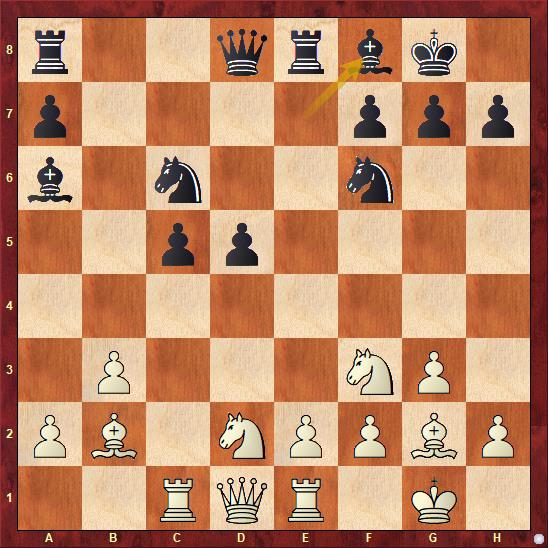
Formally, the position is roughly equal, but – at least these days – most young players certainly find it easier to play as Black. And it suits Gukesh especially well! Here he can fully display his talent for piece play and dynamics. Even the statistics (at least according to the online CB database) speak quite clearly. The hanging pawns on d5 and c5 serve not only as a dynamic tool, but also restrict White's space.
Despite a single mistake, which could have saved White at a critical moment, the game can quite well be included in databases of typical positions with the theme „how to play with hanging pawns“. Gukesh explains his mistake in the „bus analyses“, which can be seen in the video below, also thanks to the link inside the player.
With the last move 19.Ne3? White made a gross blunder.
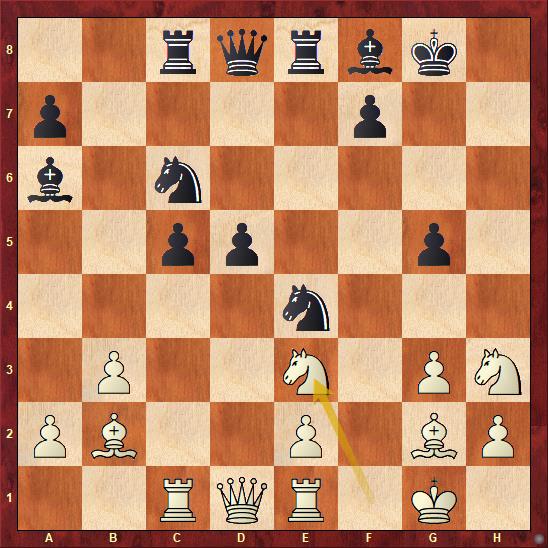
In the player we see that this move led to chaotic, truly devilish complications, which simply cannot be calculated in the limited time of a game. (Allow me to provoke the younger generation a little: they would have been a challenge even for Alekhine! 🙂 )
No matter how good one's intuition or heuristic analysis, here they simply cannot guarantee finding the correct solution, just as a mere glance at Riccati's differential equation certainly won't reveal the exact result of its calculation!
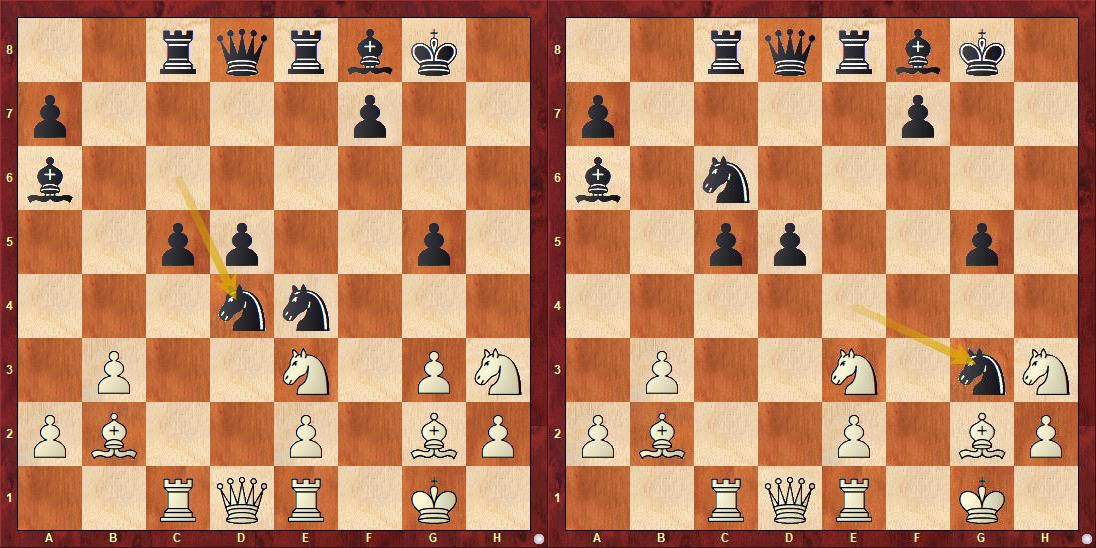
In the diagrams we see the situation after two seemingly logical replies: 19...Nd4 a 19...Nxg3. Which of the two continuations would you trust more?
Gukesh like Karpov? Not yet!
In round 7, the Indian team faced England. This time I didn't manage to tune in to the live broadcast in time, but when I looked at the position from the game Gukesh vs. Fernandez after 28.Nc5!
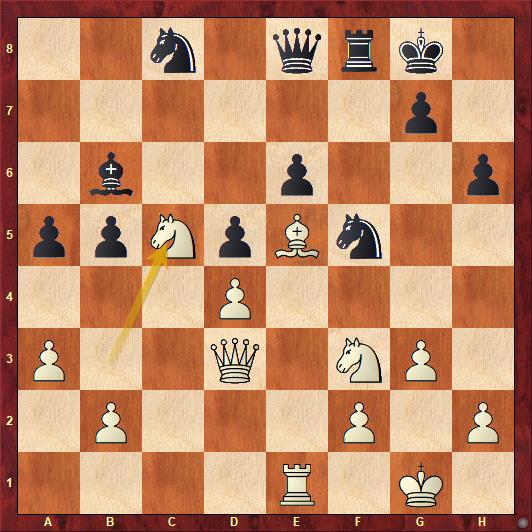
I preferred to check the players' names once more, just in case I was watching a different game! 🙂
The beautiful outposts on Be5 and Nc5, together with the French pawn structure, immediately reminded me of the positional masterpieces that the 12th World Champion Karpov used to demonstrate in the Tarrasch Variation of the French Defence!
However, unlike Anatoly Yevgenyevich, Gukesh fell into time trouble – it must be said, along with his opponent – in which he squandered his positional advantage. And at the end of the game, another surprise awaited the world champion. This time, a pleasant one!
Let us now look at the traditional game record.
A Successful „London“
So far in the article I have not mentioned quite an important circumstance, which both future opponents had to take into account. Of course, neither of them is willing to reveal what main weapons in the opening – or perhaps rather in specific variations – they are preparing in their home laboratory!
That is precisely why, for example, Sindarov chose a double fianchetto in one of the key games of round 10, and Gukesh in the same round played the London System. Nowadays, he plays it at most in blitz games, whereas sometime between 2020 and 2023 it was part of his standard arsenal.
However, in the game against Uzbekistan's second team, the London setup suited him perfectly. Thus, the world champion played one of his cleanest games at the Olympiad.
A Chink in Gukesh's Armour
and quite a significant one, we must add! His Olympiad performance could be rated almost as top marks, if it were not for that truly dreadful game in the final round! Well yes, a large part of the blame here we must lay at the door of poor preparation! Yet the whole game gives an odd impression in the sense that the opponents perhaps ought to have been sitting on opposite sides of the table. 🙂
In the game Dudin vs. Gukesh it could hardly have come as a surprise to the world champion that this appeared on the board Rossolimo System.
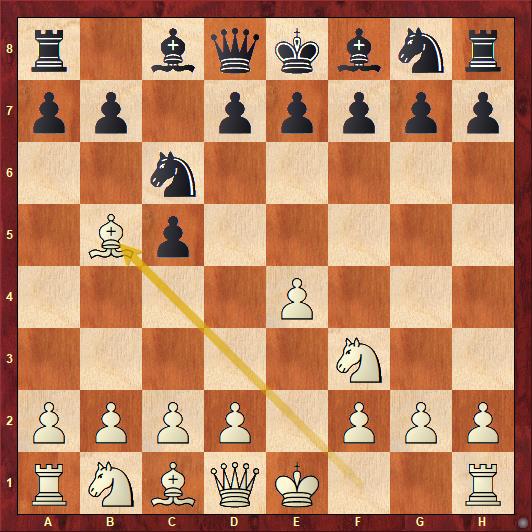
The Russian-American-Hungarian globetrotter plays it more often than just now and then (I've prepared a short profile of this grandmaster below). However, the quality of preparation for the game was incomparable! After the moves 3...g6 4.0-0 Bg7 White responded with what is statistically only the fifth most common and, at first glance, rather bland 5.d3.
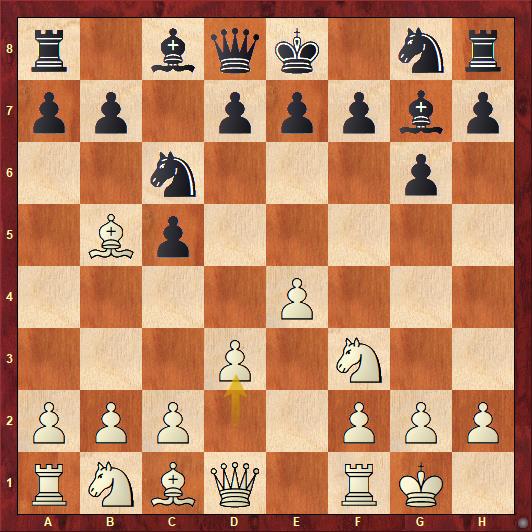
However not for nothing it was played by Kramnik, Carlsen, Nepomniachtchi, Morozevich and above all Aronian! (Let's leave aside that all of them mostly played it in rapid.) Gukesh, however, remained faithful to his favourite setup, so I believe that he „walked into“ his opponent's prepared and rather tricky variations. After the principled 5...e5
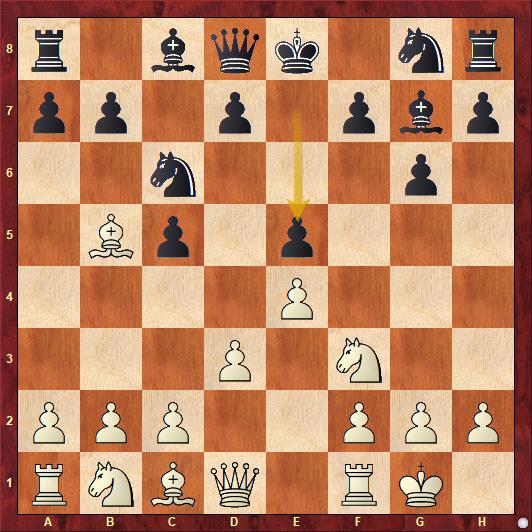
there followed 6.a3 Nge7 7.b4! 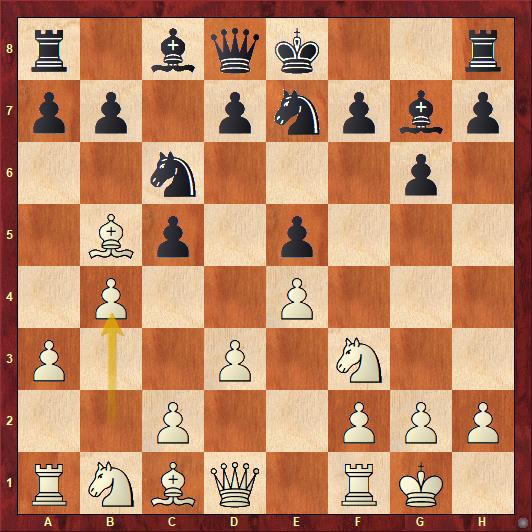
In the notes to the analysis, which contains many other interesting points, I added: Gukesh's next, this time more than fifteen-minute think over the following move suggests that the gambit either caught him completely off guard, or he was only now beginning to recall how the line continues.
Given that the online CB database already contains almost a hundred games, one can only marvel! Even more remarkable is this: you can also find in it a three-year-old game in which another Indian star, very close to Gukesh, Divya Deshmukh, played out the position before us... as White! I should also mention that Black's statistics are truly dreadful!
What is the essence of the pawn sacrifice? If Black were to accept the gambit 7...cxb4 8.axb4 Nxb4?, the following ensues
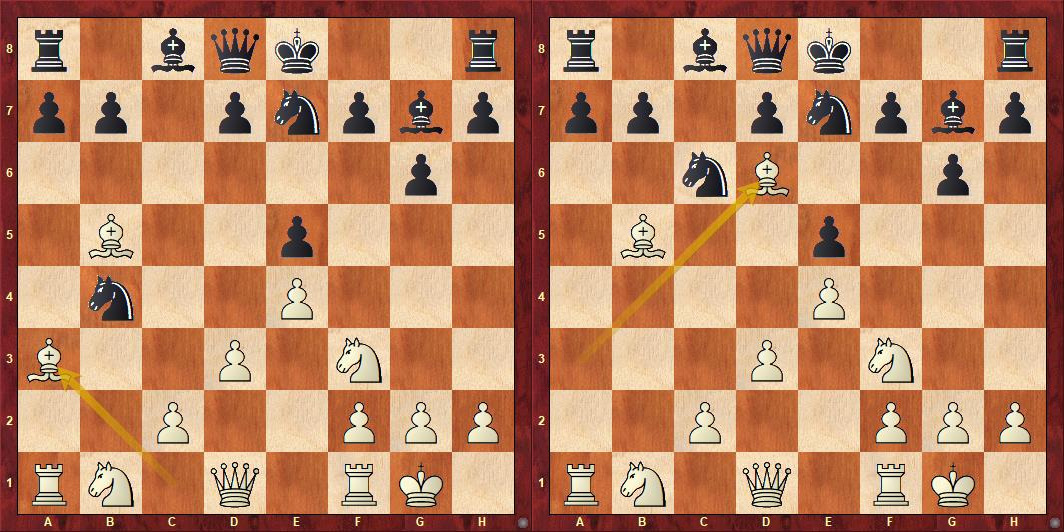
9.Ba3! and after 9...Nbc6 will suffocate Black's position 10.Bd6!
I devoted many hours to analysing the game, including the opening. Nevertheless, besides the obvious live game record, I will first present here what I believe is a successful analysis by the popular chess YouTuber Antonio Radić on his channel agadmator's Chess Channel.
If Gukesh's game, to put it mildly, did not go well and in the „bus analysis“, which you, dear readers, can play below, he admits that the manoeuvre with the pawn sacrifice on c4 15.Nb3 was completely overlooked, his opponent certainly played the game at the level of a strong grandmaster! To what extent and how deeply he had prepared the line, we will probably never know. But that does not detract from his performance!
Here is a short profile of this grandmaster, who is almost unknown, at least to me.
Young_Globetrotter_Gleb_Dudin Young_Globetrotter_Gleb_Dudin_RU Young Globetrotter Gleb Dudin_EN
Ah, that Rossolimo
Not only experienced chess players, but I think to a large extent also coaches, will sigh. Speaking for myself, I have never had a problem „Rossolimo with Black and My Students“ I never managed to solve it to complete satisfaction.
I tried all sorts of things. My truly strong students, who later went on to reach master level, understood the strategic depth of systems with 3…g6 in the end, although it took weeks of study!
However, with children or less experienced chess players, I tried to simplify the problem. The long manoeuvring and complex positional issues that arise in systems with 3…g6 or 3...e6, would not have understood. On the other hand, systems with
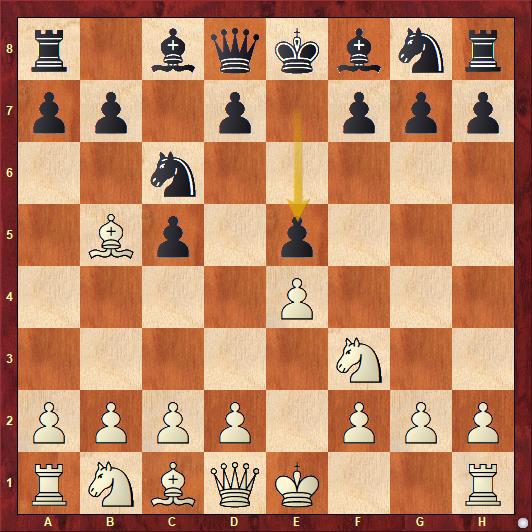
3…e5 are explained, taught and played noticeably more simply. There are plenty of model games available. There is, however, one „but“: we must not run into a superbly prepared opponent – or we must accept the kind of positions that, well... do not exactly promise lively piece play.
Some time ago I noticed that even Fabiano Caruana himself quite regularly tried to defend in a way that many still consider inferior. I hardly need to stress that engines have their own opinion: 3...Nf6 4.Nc3
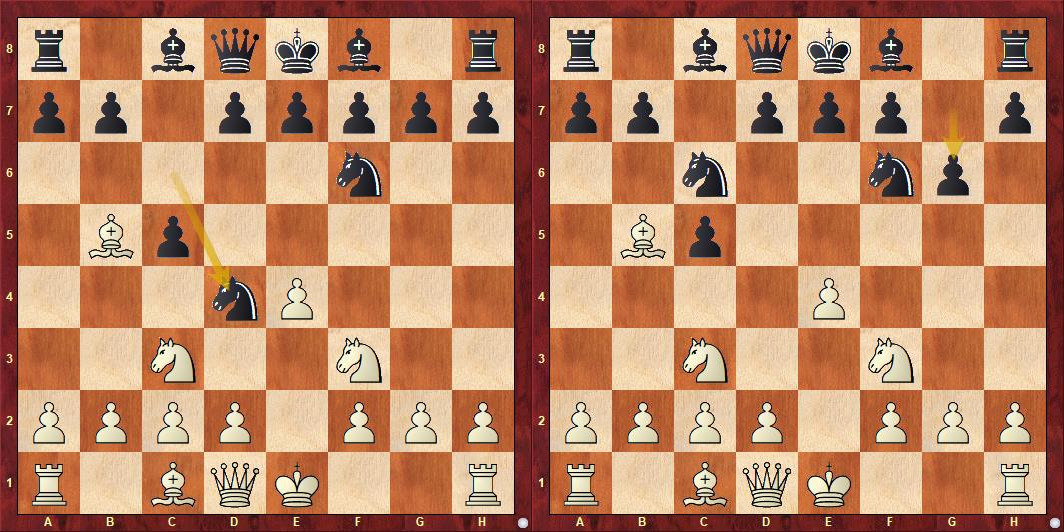
4...Nd4; true, later he humbly switched to the solid 4...g6, only to abandon the experiment completely in the end and return to the traditional 3…g6, or occasionally to 3...e6.
The following text certainly does not claim to advise you „what to do about the Rossolimo“. After all, one article would hardly suffice for that, and certainly not a single video, no matter what the authors who now pop up on YouTube one after another may promise you.
However, I believe it will serve well as an entry point into the subject. Let us first get acquainted with the history and basic division of the system; only then should we move on to serious study.
It is quite possible that thanks to this short introductory text I may end up attracting more Rossolimo fans for White, even though that was certainly not my original intention. 🙂
A Short Walk with the Rossolimo A Short Walk with the Rossolimo_RU A Short Walk with the Rossolimo_EN
Bus Analysis
Sometimes the simplest ideas are also the most brilliant. Shortly after the end of the Olympiad, the Indian team are sitting on the bus, Sagar Shah picks up his tablet and, together with Gukesh, launches into an improvised analysis of the entire tournament. Going through it round by round, game by game.
And here, in my opinion, it is really worth watching the video closely. Sagar highlights individual critical moments, asks what the world champion calculated, why he didn't choose a different continuation, which of his opponent's moves he feared or what he completely overlooked. Gukesh usually answers from memory and only occasionally glances at the virtual chessboard on the tablet. In this way, they go through all eleven rounds! For a chess player, it is almost fascinating to see how many variations, positions and small details he still has stored in his head immediately after the tournament.
And perhaps even more valuable is the atmosphere itself. This time, India were unable to repeat their gold from the previous Olympiad and had to settle for silver, but we are certainly not witnessing a funeral gathering. 🙂 There is a relaxed mood on the bus, other team members occasionally join the conversation, and above all, you can feel the camaraderie of the whole group. That is precisely what gives the video something no studio analysis can offer.
Under the ChessBase India video, I eventually wrote: „This video shows that world champion Gukesh is not the only genius – notice how he analyses almost all the positions without a board. Sagar is one of them too! To come up with such an idea and bring it to life, to let us share in that amazing post-tournament atmosphere and the camaraderie of such a fantastic group – simply wonderful. Huge thanks!“ And even with hindsight, I wouldn't change a thing about this assessment.
Well, dear readers, if you watch only one video from this whole chapter, I recommend this one. Not just for Gukesh's specific answers to individual games. It is also a rare opportunity to glimpse the way one of the world's strongest chess players reconstructs his own thought processes shortly after the end of the tournament – almost without the help of a chessboard.
What did the Olympiad reveal?
What new insights did we gain after the performance of both youngsters in Samarkand? Did they affect our predictions before the start of the Geneva match? After all, there is only about a month left until the match begins!
The challenger maintains his consistently high level of performance. On the one hand, it is clear that the form he showed at the World Cup in Goa, but especially at the Candidates Tournament in Cyprus, cannot last forever. On the other hand, Sindarov's immense strength is underlined, for example, by the fact that he lost only three classical games in the whole year! Probably not only the old-timers know that in history, only a handful of absolute top players could boast such a record! I myself, for instance, remember that the defeat of the 12th world champion Anatoly Karpov used to be reported in the daily press. Such a rare occurrence it was! Incidentally, long unbeaten streaks were also recorded by Mikhail Tal in his later years or Magnus Carlsen.
More complicated questions arise when we start to assess the world champion's performance! On the one hand, his Olympiad games showed that he is probably finally emerging from a long, deep crisis, but what will the next trend be? After all, in Samarkand he did not face a single 2700+ opponent and only four opponents rated 2600+.
The analyses show that apart from that dreadful loss in the last round, he was in serious danger – or rather in a lost position – only in the game against Donchenko. That is, in a battle he eventually won thanks to a spectacular tactical blow.
In my opinion, predicting the result of the upcoming match is much more uncertain than for any previous world championship match in the last approximately fifteen years!
Robinson's Table
Let us now create a kind of „Robinson's Table“. In other words, what works in favour of each participant.
Note: „Robinson's Table“ is my working title, inspired by Defoe's Robinson Crusoe, who used to write down his situation in two columns – „evil“ and „good“, a kind of balance of minuses and pluses. In our case, there will also be a mirror effect: an advantage for one is usually a disadvantage for the other.
Gukesh +
- experience with a long and psychologically exhausting match
- has played more tournaments at the very highest level
- has been among the absolute world elite for longer
- after a long slump, his form is finally on the rise
- psychological resilience
Sindarov +
- excellent results in the past year
- rarely loses
- better time management
- a more pragmatic approach to positions
- classical chess education
The super-grandmasters are divided
So, how do those who themselves belong or have belonged to the absolute world elite see the chances of these two young men? First, one caveat: logically, we will not take into account the opinions of Indian and Uzbek chess players, nor those of the coaches, seconds or other collaborators from either camp.
Even so, there is no real consensus of opinion. Garry Kasparov considers Sindarov the clear favourite based on current performances. At the same time, however, he points out exactly what we have already noted in our „Robinson table“: Gukesh is mentally very resilient, able to find resources even in worse positions, and unlike the challenger, he has already played – and won – a world championship match.
Even more emphatically, the challenger was supported by Magnus Carlsen. He described Sindarov as a fairly clear favourite and a more universal player. He even warned that if Gukesh were to fall behind at the start of the match, the rest of the contest could take a very unpleasant turn for him.
A similar conclusion was reached by the two-time challenger Ian Nepomniachtchi. His relatively recent estimate from October is roughly 65:35 in favour of Sindarov. However, from his own experience, he also reminds us that a world championship match is a completely different discipline from a tournament, and a single poor start can dramatically change the psychology of the entire contest.
Fabiano Caruana is much more reserved. He would give Sindarov only a slight edge, about 55:45, and warns against writing off Gukesh after a weaker period. He points out that the world champion has already managed several times to rise from very mixed form to extraordinary performances.
And then there are the super-grandmasters who refuse to name a favourite at all. Vincent Keymer rates the match at 50:50; in his view, the form of young players fluctuates too quickly and the match has its own dynamics – preparation, nerves and psychology. For example, the same numerical estimate was reached by Anish Giri a Maxime Vachier-Lagrave.
A special chapter is Hikaru Nakamura. Immediately after the Candidates Tournament he tipped Gukesh and believed that experience from the previous match and less psychological pressure could play a significant role. However, by August he had changed his mind considerably: looking at the then current form of both opponents, he estimated the chances at roughly 75:25 in favour of Sindarov. So far, however, I have not noticed Hikaru changing his opinion again – though, to be fair, I am not a regular consumer of his videos. 🙂
One thing is clear from these voices. If we were to vote today, Sindarov would probably receive more votes among the elite grandmasters. Yet there is a wide gulf between saying „Sindarov is the favourite“ and „Sindarov will win the match“.
Fifty-fifty, or the start will decide
Personally, I believe the prospects of the opponents are evenly matched. Besides, of course, the psychological aspect and current form, I think two factors will be decisive:
1/ The start of the match: exceptionally important – perhaps more so than ever – will be the start of the match! The first and second games will reveal a great deal. Gukesh, who will be trailing after two games, will in my view be only half the Gukesh we know, even though we are aware that his psychological resilience is high.
2/ Time management: Sindarov makes decisions and plays quickly enough, which actually brings with it… „another Robinson“! On the one hand, unnecessarily fast play can lead to superficiality, but on the other it puts pressure on the opponent!
Gukesh regularly gets into time trouble! And here, of course, he makes mistakes, unfortunately, quite often. I can say this with certainty, because I have analysed his games – with clock times or video recordings – more in the hundreds than just dozens. Let me remind you that in Geneva the time control is the same as usual: that is, two hours for 40 moves without increment. The increment only comes into play from move 41 onwards!
If the world champion starts to succumb to time pressure and regularly gets into time trouble – in other words, if he wants, as a true inductivist, to calculate everything and always –, it could have for him catastrophic impact!
On the other hand, I believe that Gukesh's „genius of 2024“ was no random fluctuation! If Caissa helps him finally regain his lost form of this calibre, I don't think he can lose the match. More generally, his understanding of chess is simply deeper.
As for theoretical preparation: the opponents will certainly arrive with teams made up of both strong grandmasters and exceptionally capable theoreticians. From this perspective, it is impossible to say in advance whether and when the advantage in theoretical preparation will shift to one side or the other.

So we really do have something to look forward to! The match for the world championship title is always the highlight of the chess calendar, a festival for all chess players – and this time we approach it with perhaps even greater anticipation because finding a favourite is proving so difficult.
And one thing pleases me especially. At a time when chess is constantly speeding up and even some prominent players argue that the whole world is accelerating and chess must adapt, classical chess still firmly holds first place. Two hours for forty moves, no increment before the time control – it is still here that we seek the world champion! After all, how far should we take the logic of constant acceleration? To one minute per game? To half a minute? And in a few years, will bullet chess truly be king? There must be a limit somewhere.
It is precisely the long game that allows us to observe not only the speed of the hand or instant alertness, but also deep calculation, strategic plans, time management, psychological resilience, and often a battle lasting several hours between two very different chess worlds. And in my view, the world championship match remains the place where all these qualities are put to the toughest test.
Well, dear readers, whether you are rooting for Gukesh or Sindarov, are fond of both young men, or are simply looking forward to some fine and fighting games, don't miss this chess festival!
Geneva is already waiting – and so are we!
Below, all the games and examples mentioned in the article are available for download in PGN format.
Samarkand – Gold and the Crown