

By the time the reader can read this article, the question may already be answered. At the beginning of December, a closed tournament took place in London, where the likeable 17-year-old narrowly missed qualifying for the Candidates Tournament by a hair’s breadth. An unfortunate loss in round 4 brought him only 3rd place, leaving his participation uncertain. Apparently, FIDE itself decided that the 7th or 8th participant would be determined by another small tournament.
Also fighting for a place in the Candidates Tournament in Indian Chennai were our familiar player (from the previous article – remember that terrible blunder at the Qatar tournament?) Arjun Erigaisi and the 23-year-old Iranian Parham Maghsoodloo. However, he only had a chance (thanks to a huge rating increase) if he scored at least 5.5 points out of 7 in the tough tournament. It is clear that such a result ‚on demand‘ would only be within the power of… Hans Niemann, naturally again with some kind of helper in the form of a computer chip; scoring +4 in 7 rounds was, however, a truly superhuman task for an ordinary mortal.
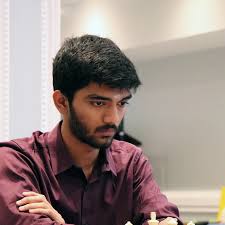
Be that as it may, in this article I would like to show the kind readers 3 games created by the young, likeable, extremely talented and moreover exceptionally hardworking grandmaster. Each game is different in the sense of demonstrating completely different, widely divergent strategic and tactical problems, and moreover, in all of them Dommaraju Gukesh played with the white pieces.
Is the selection system for the Candidates Tournament (CT) fair?
Let us return for a moment to the selection system for candidates to the most important tournament of next year. The paradox will probably remain that if the Indian prodigy had simply not played any tournament since September, he would very likely have qualified for the CT thanks to his huge rating or his excellent tournament results up to that point. As the youngest chess player in chess history, he almost disproved Einstein’s theory of relativity and in September 2023 surpassed the magical 2,750-point barrier at a speed greater than light 🙂; he reached 8th place in the world rankings!
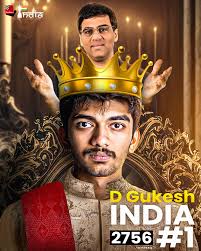
Former World Champion Viswanathan Anand (in the background) passes the symbolic chess crown to the then highest-rated Indian player. India surely owes its huge chess boom in the world’s most populous country primarily to him, the 15th World Champion!
Meteor or meteorite
Let us return, however, to the games of Dommaraju Gukesh! Of course, I am not familiar with what caused the crushing autumn drop in his performance by almost 40 points.
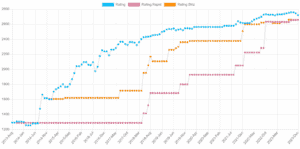
On the graph taken from the official FIDE website, we can see that autumn drop in the results of the Indian grandmaster. For coaches or some parents, it may also be interesting to compare Gukesh’s rating growth since the age of 7 (date of birth 29 May 2006). I cannot resist a little ‚dig‘: While in the Czech Republic on the chess federation’s website we immediately ‚celebrate‘ if a player earns the title of International Master around the age of 20, or conversely – "no one reacts" if the greatest child talent has more or less stagnated with their rating for three years, in the chess-developed world of the East it is not unusual at all if a boy or girl obtains the grandmaster title by the age of 15 at the latest!
Nevertheless, in the London Classic tournament, I think better times began to dawn again. After all, we can hardly expect stable results from a 17-year-old boy. Or put differently – who among the world elite produced those stable results this year? We know about today’s objectively probably strongest player in the world in classical chess Fabiano Caruana and the second American Hikaru Nakamura. Magnus Carlsen won the World Cup, but some of his other classical results are quite meagre or, put differently – they raise doubts.
First, let's warm up with a little exercise
In the inserted chapter, I would like to draw the kind readers' attention to a small test of calculation ability. It will be about a variation – the conclusion of Gukesh's game from the London tournament – not only to calculate it but also to evaluate it correctly. The test can be found in the TRAINING section.
Creation – a broadly spread style of play
Now let's gradually look at those 3 games, each however from a promised different barrel. A classically played game, a hypermodern example that can perhaps be classified among the chess of the future (here the reader can also reflect on the evaluation of a very dubious position and recall an analogous case from a contribution on my old pages). We will finish the selection with that unfortunate ‚invisible‘ blunder in a winning position with the later second winner of the tournament (as it was written earlier). So that the reader can first get acquainted with the game more closely and at the same time perhaps assess the drawbacks of videos (with this technique it is often impossible to get to the core of the position, only the most necessary twists and a few nice variations can be demonstrated), I will first present the game with video clips from various sources. Then the readers – those interested – can start a serious analysis using a player or download the clip directly to their favourite system – player or platform.
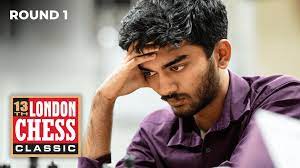
Round one – French Defence smashed to smithereens
Round three – chess of the future?
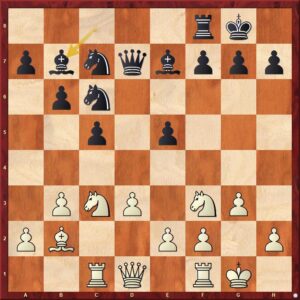
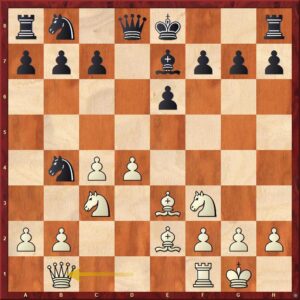
How would you evaluate the prospects for the sides after the last move played? In both cases it is the one marked with an arrow, in both the same the material balance of the position is disturbed! You can compare your opinions in the first case in the note to White's 10th move in the following game Gukesh vs Volokitin (alternative 10.Nc3), opinions including those of titled players on the position of the second diagram can be found by clicking the link to the old lesson.
- Analysis no. 9 – 8.8.2014 – Even a master carpenter… II. Compare your ability to evaluate a materially imbalanced position with grandmasters; test your „evaluation algorithms“...
A fatal mistake
By a blunder in a winning position, Gukesh spoiled his result in the tournament in the following game with White. However, if the reader is looking for a suitable weapon against the ironclad Russian Defence and does not shy away from sharp clashes, he will surely like not only the opening position but also the very nice variations arising with an attack against the king with various castlings!
Finally, let's look at a newer video with Gukesh's analysis immediately after the end of his successful 4th round of the tournament in Chennai. He is on the right track, but...
Instead of a conclusion, more disputes, but what else to expect today?
In the following video, which was released while I was finishing the article, we can – admittedly from Ilja Levitov's "somewhat" subjective perspective – look behind the scenes of the fight for candidates spots. The Indians did not slack off, the French do not slack off either, and Anish Giri and Wesley So are probably fighting for a place in the Candidates Tournament by various means. Meanwhile, the Candidates Tournament today is not only about victory and the chance to become the world champion in classical chess. The prize fund of the Candidates Tournament will be huge compared to 'ordinary' tournaments...