

At the Sickbed of the King's Gambit
That was the title of an article by a disappointed and shaken Rudolf Spielmann, published at the beginning of 1924. Five ugly defeats, almost in succession, forced one of the last knights of the romantic era to give up his favourite weapon, which had served him faithfully for decades – the King's Gambit. And who was the main culprit at the time? What was the proverbial last straw for Spielmann's confession or admission? the Falkbeer Countergambit! If only the last romantic had known that a few decades later it would be the countergambit itself lying on its sickbed, when everything could have turned out differently!
And what is the state of health of the King's Gambit today? Can it still be played openly even in serious games against a diligent opponent? And how should one respond as Black? Is it really necessary to write off the Falkbeer Countergambit? In this first part, we will focus on the battle between the King's Gambit and the Falkbeer Countergambit, which began as early as 1851.
The first part of our journey in the footsteps of perhaps the oldest and truly royal gambit is therefore devoted to my old love – the Falkbeer Countergambit! Whenever the opportunity arose, I simply refused to consider any other reply as Black, and later I didn't want to teach my students anything else against the King's Gambit. Well, yes, I knew that the 1970s marked a certain turning point. But didactics and pedagogy dictate that less experienced chess players should be taught rapid development, fighting for the centre, and not to worry about the odd gambit pawn. And what about the Falkbeer Countergambit today? After several months of intensive study, I know I can continue to teach my students „the Falkbeer“ with a clear conscience. And I believe that in the first part of this article, I will manage to convince the readers as well. Especially those who, from the very first moves, prefer to attack rather than defend. Just like the brilliant American 170 years ago.
Morphy Stronger Than the Analysts
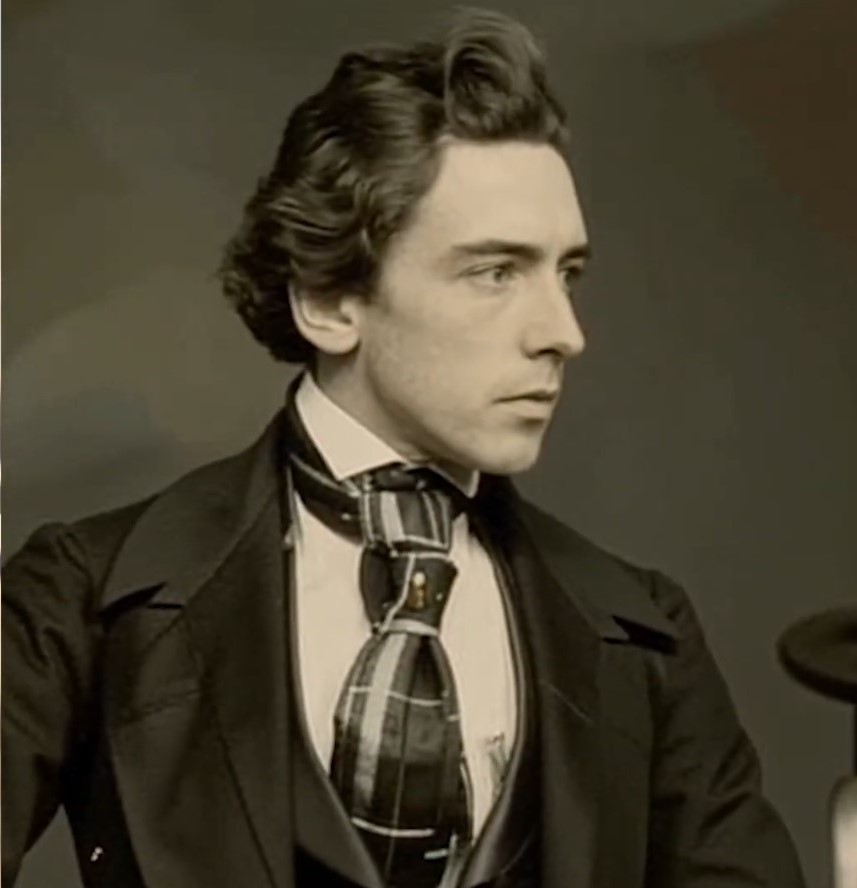
For many coaches and stronger chess players, the names Morphy and Schulten bring to mind one of the most famous miniatures of the first unofficial world champion. The initial enthusiasm for the brilliantly played game, in which Morphy chose the Falkbeer Countergambit, that is, 2...d5 and 3...e4, was later replaced by a certain scepticism. Engines, however, show that Morphy may have seen more at the board than dozens of critically minded analysts – including the 13th world champion.
We will return to the Schulten vs. Morphy game shortly. But first, it will be useful to take a brief excursion into the past. For if we really want to understand the ideas of the Falkbeer Countergambit and what has fuelled the battle between these two irreconcilable gambits, for more than 170 years, we should at least get acquainted with a few exceptional personalities who played a decisive role in shaping the theory of both these openings.
Some names will surely be familiar to readers. But I would almost bet that even many of those who have studied chess history from books, magazines, and nowadays increasingly from videos, will be surprised. And they may even discover that they knew considerably less about some of the greats and their relationship to both gambits than they previously thought!
The Last Romantic
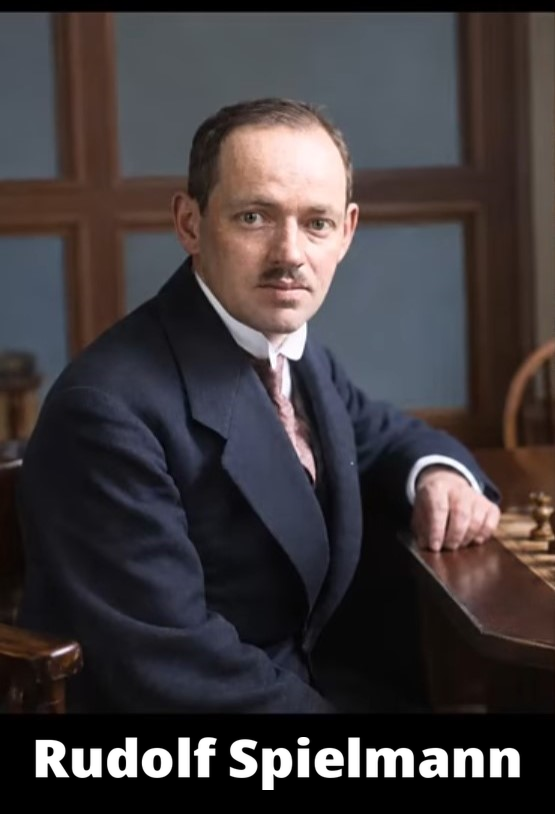
Rudolf Spielmann (1883–1942) was one of the last great representatives of romantic chess. A native of Vienna, he loved open positions, attacking the king, sacrifices and complications, in which his extraordinary combinational talent could fully shine. It is no wonder that one of his favourite weapons was the King's Gambit. An opening that many of his contemporaries already considered a somewhat outdated relic of the previous century seemed tailor-made for Spielmann's temperament. He was given a remarkable opportunity in 1912 in the seaside town of Abbazia, today's Croatian Opatija. The organisers prepared what was already an unusual event at the time thematic tournament: all games had to begin with the moves 1.e4 e5 2.f4 exf4. The accepted King's Gambit thus found itself, for several weeks, under fire from the leading masters of the day on both sides of the board. And it was precisely in this environment that Spielmann felt at home. He won the double round-robin tournament of twelve players with a commanding lead:
| standings | Player | points |
| 1. | Rudolf Spielmann | 15/22 |
| 2. | Oldřich Duras | 13,5 |
| 3.–4. | Erich Cohn | 11,5 |
| 3.–4. | Richard Réti | 11,5 |
| 5. | Moishe Lowcki | 11 |
His victory is all the more interesting because the King's Gambit itself did not enjoy any particular triumph in the tournament. Black won significantly more games than White. However, Spielmann managed to handle his favourite opening better than his opponents from both sides.
The successful period continued in 1913. Spielmann won in Vienna and also in Budapest, and was already among the very top players in the world. The King's Gambit remained one of the characteristic weapons in his repertoire. At a time when chess thinking was gradually beginning to change and the ideas that would later grow into hypermodernism after the First World War were already taking shape, Spielmann still acted as a knight of the previous era. Not because he did not understand modern chess, but because his nature remained one of battle, initiative and combinations.
That is precisely why the label „the last romantic“. later suited him so well. The King's Gambit was an almost ideal weapon for such a player – and for many years it served him faithfully.
Let us now look at one of Spielmann's games from that thematic tournament. It is also characteristic for the rather sophisticated method of defence that Black used quite often in Abbazia. They had to capture the pawn on move two, but often did not choose the less principled (or most stubborn, if you prefer) ways of defending it. Instead, they focused on early counterblows with d7-d5. I believe it was precisely this approach that may have contributed to the rather unexpected final result.
Even at the very beginning of the 1920s, it might have seemed that this symbiotic union would last forever.
But then something happened...
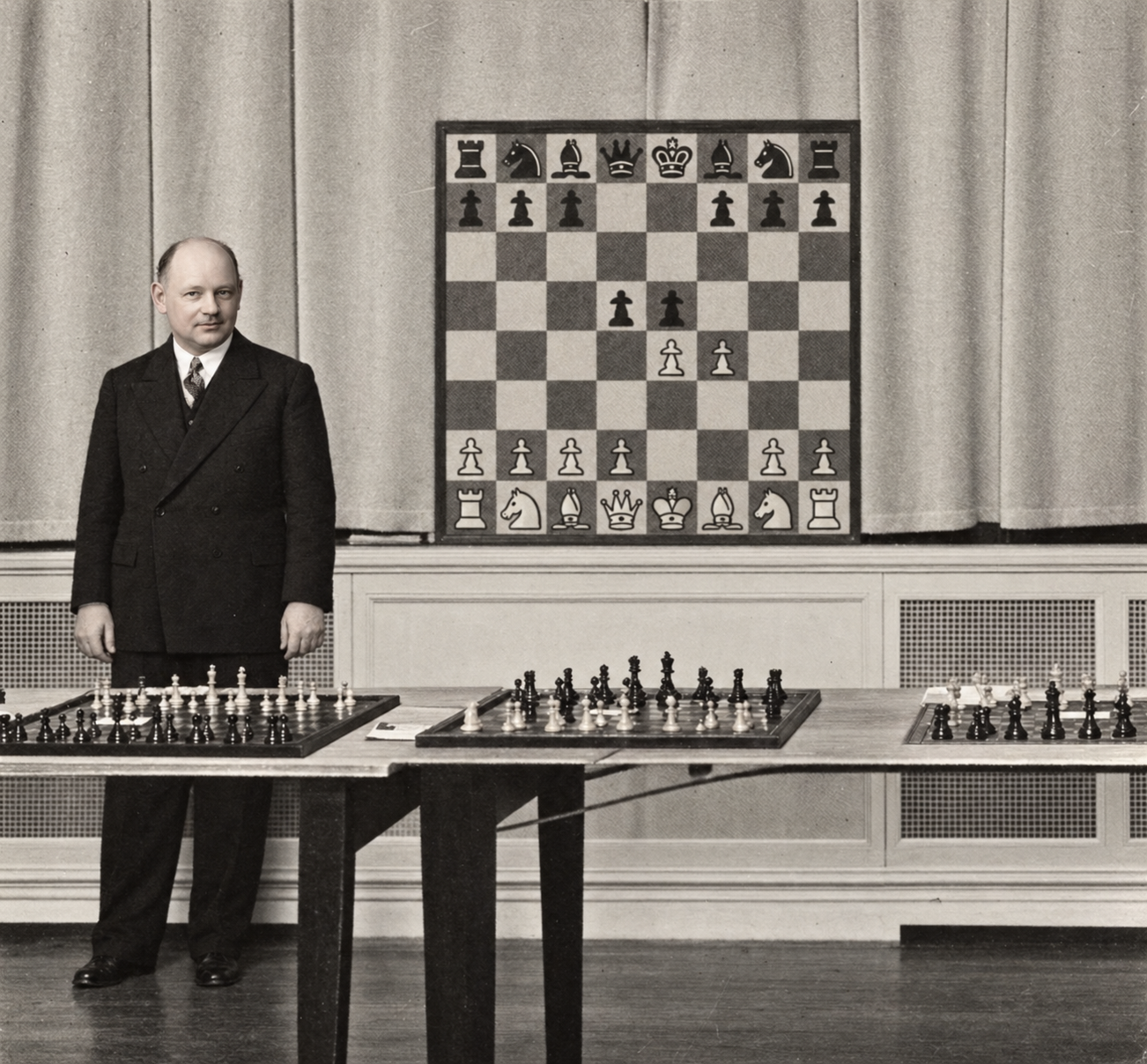
Spielmann was so closely associated with the King's Gambit that, in our article, we can almost consider his name a synonym for this opening! A happy Spielmann meant a revival for the King's Gambit and extreme danger for his opponents.
And what is very important? Right up until the early 1920s behind him = behind them, admittedly, with certain fluctuations, even the theory of the time supported it!
Yes, with fluctuations...
Until one day Falkbeer arrived…
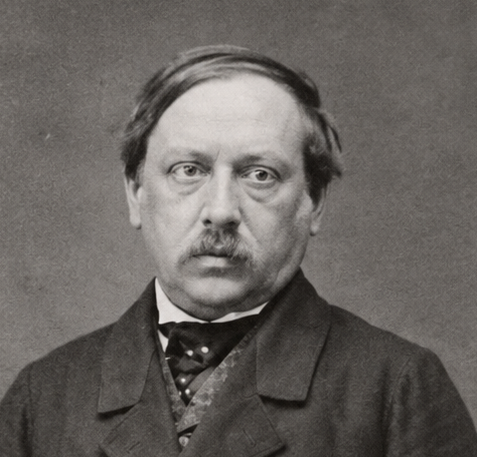
Ernst Karl Falkbeer (1819–1885), born in Brno, was one of the leading figures of chess life in the mid-19th century. He was not only a strong practical player, but also a chess journalist and theoretician; in 1855 he founded a magazine in Vienna Wiener Schachzeitung. Judging by his surviving games, he was certainly no stranger to the spirit of the Romantic school – the willingness to sacrifice material for a lead in development and the initiative. Indeed, his most famous contribution to opening theory speaks for itself in this regard.
Allow me a brief digression here. In my database of the Göring Gambit, the very first model miniature I included was a fairly well-known game Falkbeer – NN 1847 The game even enjoyed an unusual „second life“. Nearly thirty years later, its spectacular combination was to be demonstrated using living chess pieces in the operetta Der Seekadett (The Naval Cadet). It is from here that the still-used second name for the Légal mate originates – the Naval Cadet. 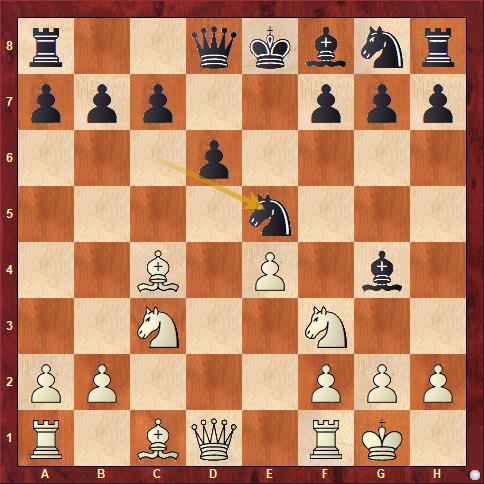 How did Falkbeer continue?
Falkbeer's opponent remains unknown to history. However, some sources refer to him, instead of the usual NN, in a much more charming way – „Dilettante“. Given the course of the game, one almost hesitates to translate this word merely as „amateur“. 🙂
The birth of the Falkbeer Counter-Gambit can thus be traced to Berlin in the spring of 1851. In a game against Anderssen, Falkbeer after 1.e4 e5 2.f4 d5 3.exd5 played 3...e4!
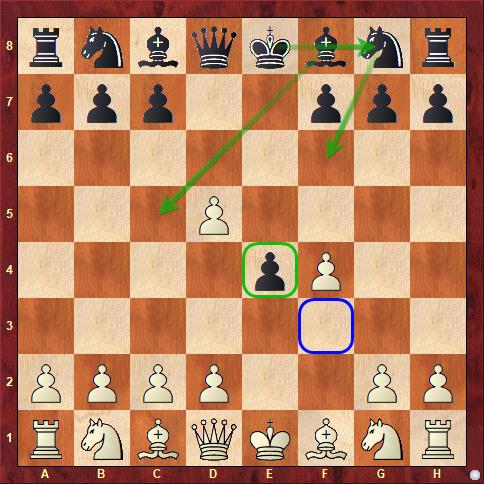
This move is the essence of Falkbeer's idea: Black does not try to regain the sacrificed pawn immediately, but controls the f3 square before a knight can even get there. He drives a wedge into White's position. In exchange for material, he gains time, space, and from the very first moves tries to fight for the initiative.
Although the historic premiere ended in Falkbeer's defeat, his idea did not. The novelty spread surprisingly quickly among chess players. It was precisely this emphatic „no“ to dull defence after accepting the gambit and passive pawn protection – and instead the effort to fight for the initiative from the very first moves – that soon brought Falkbeer's Countergambit into the limelight of popularity!
Interestingly, Falkbeer used his idea only about four months earlier than one of the most famous chess players of the first half of the 19th century, the Englishman Howard Staunton. He played 3...e4 in a game against Jänisch, although we do not know whether he was already aware of Falkbeer's novelty. The history of discoveries and inventions knows many such cases. Let us recall, for example, the famous dispute over priority in the invention of the telephone between Alexander Graham Bell and Elisha Gray. The telephone, without which especially the younger generation today probably cannot imagine even a single day! 🙂
Miniatures – the spice of chess
Only six years later, in 1857, we encounter the countergambit in New York in the game Schulten vs. Morphy.
And it is with this game that our journey through the history of the opening begins, which was to lead Rudolf Spielmann, almost seventy years later, all the way „to the bedside of the ailing King's Gambit“.
Any work on the King's Gambit, or indeed Falkbeer's Countergambit, cannot overlook its most famous game! The year is 1857 and a friendly match is being held in New York between the not yet twenty-year-old Paul Charles Morphy and John William Schulten. Morphy, who would soon embark on a triumphant journey to Europe, crushes his opponent. The match ends with a score of 23:1 in his favour. Of course, there was a vast difference in playing strength between the two opponents.
The game itself is Schulten vs. Morphy something of a „one-sided affair“. Besides the brilliantly conducted attack against the white king in the centre and the final spectacular combination, you could replay it in a few minutes, including a short test.
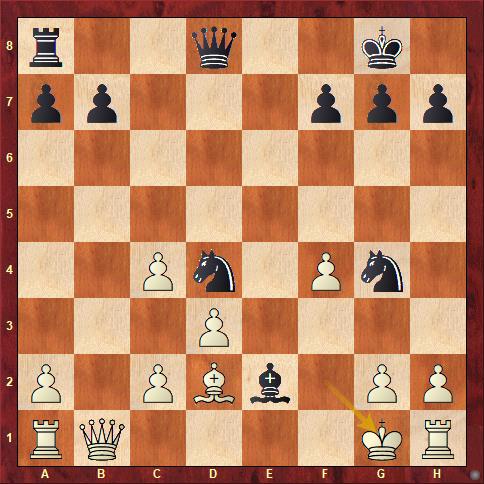
It is hard, very hard to estimate how manytimes this position – in book and magazine diagrams, on classroom demonstration boards or nowadays in videos – has been used for training or simply for fun!
Black mates in no more than seven moves with the help of a spectacular combination involving the ideas of vacating a square and indirectly disrupting the white king's pawn cover.
The problem only arose later. Some grandmasters, masters and theoreticians found Morphy's play in the opening to be inaccurate. So, as the saying goes, I went back to basics. Therefore, dear readers, you can take the following example either as a charming miniature (in which case you can ignore most of the variations), or as a theoretical challenge. In my opinion he namely Morphy no inaccuracies were made in the game.
I should just add that even Garry Kasparov, in 2020 – in the revised first volume of his book „My Great Predecessors“ – does not consider Morphy's play to be entirely flawless.
The following delightful miniature (for a change 🙂 ) is almost completely absent from the databases. In the game Zubovová vs. Konstantinovová 1968 arose after 9.Qa5? the position in the diagram.
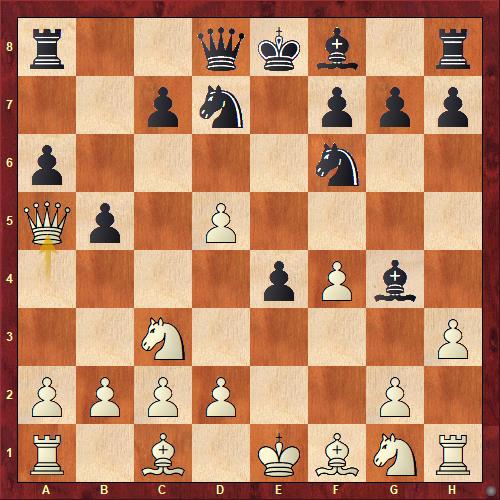
More experienced and educated chess players and coaches (who really should, when playing White, reach for the e-pawn as their first move more than just a few times in their lives 🙂 ) will immediately recognise that the position arose from the Falkbeer Countergambit!
How did Black finish the game?
Well, now tell me honestly, dear readers: is it possible, having seen both opening games, not to fall in love with the Falkbeer Countergambit? Or at least not to become fond of it?
A famous book, an unknown genius
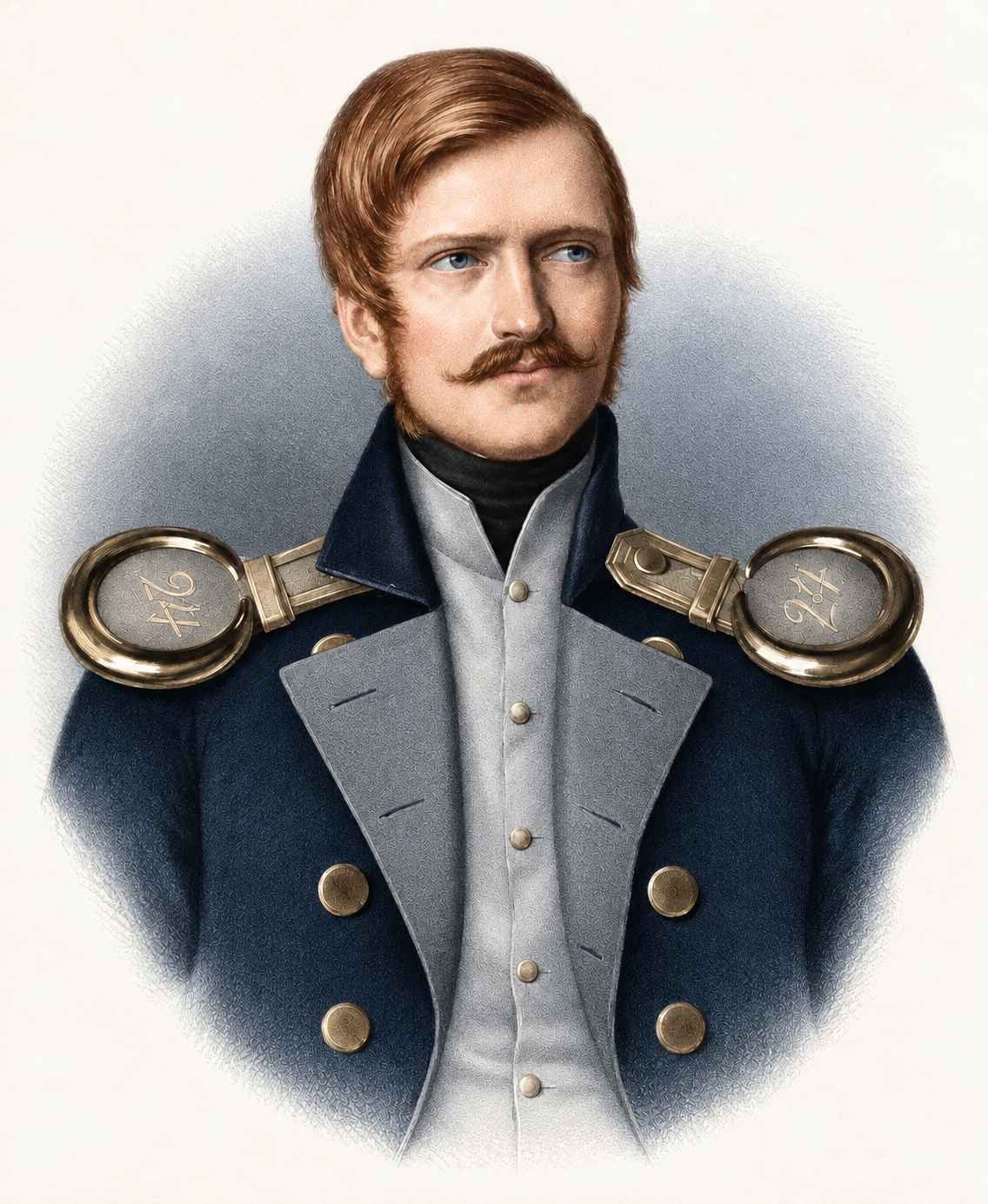
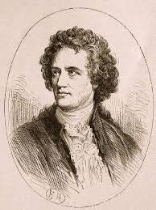
Paul Rudolf von Bilguer (1815–1840). The portrait is based on a period lithograph made after an earlier original likeness; here it is only gently digitally retouched and colourised.
To be able to follow the current state of health of the King's Gambit, and first of all the Falkbeer Countergambit, we must take a small but important step aside.
Most educated readers will probably know about the major theoretical works simply called „Bilguer“, but I suspect far fewer know about Bilguer himself. How is that possible? At the birth of this major historical work – in fact the first opening encyclopaedia, which saw many continuations – stood a chess player about whose games we know nothing.
Paul Rudolf von Bilguer could not even make his mark in history – among the notable strong chess players. He died before reaching the age of 24!! Tuberculosis was taking its toll at that time – and for more than another 100 years it was no different.
Paul Rudolf Bilguer biography Paul Rudolf Bilguer biography_RU Paul Rudolf Bilguer biography_EN
Bilguer did not live to see his book published. It only came out in 1843. And if anyone is amazed by the way the book was constructed, or if it „reminds them of something“, I would not be surprised. I was just as astonished myself, once!
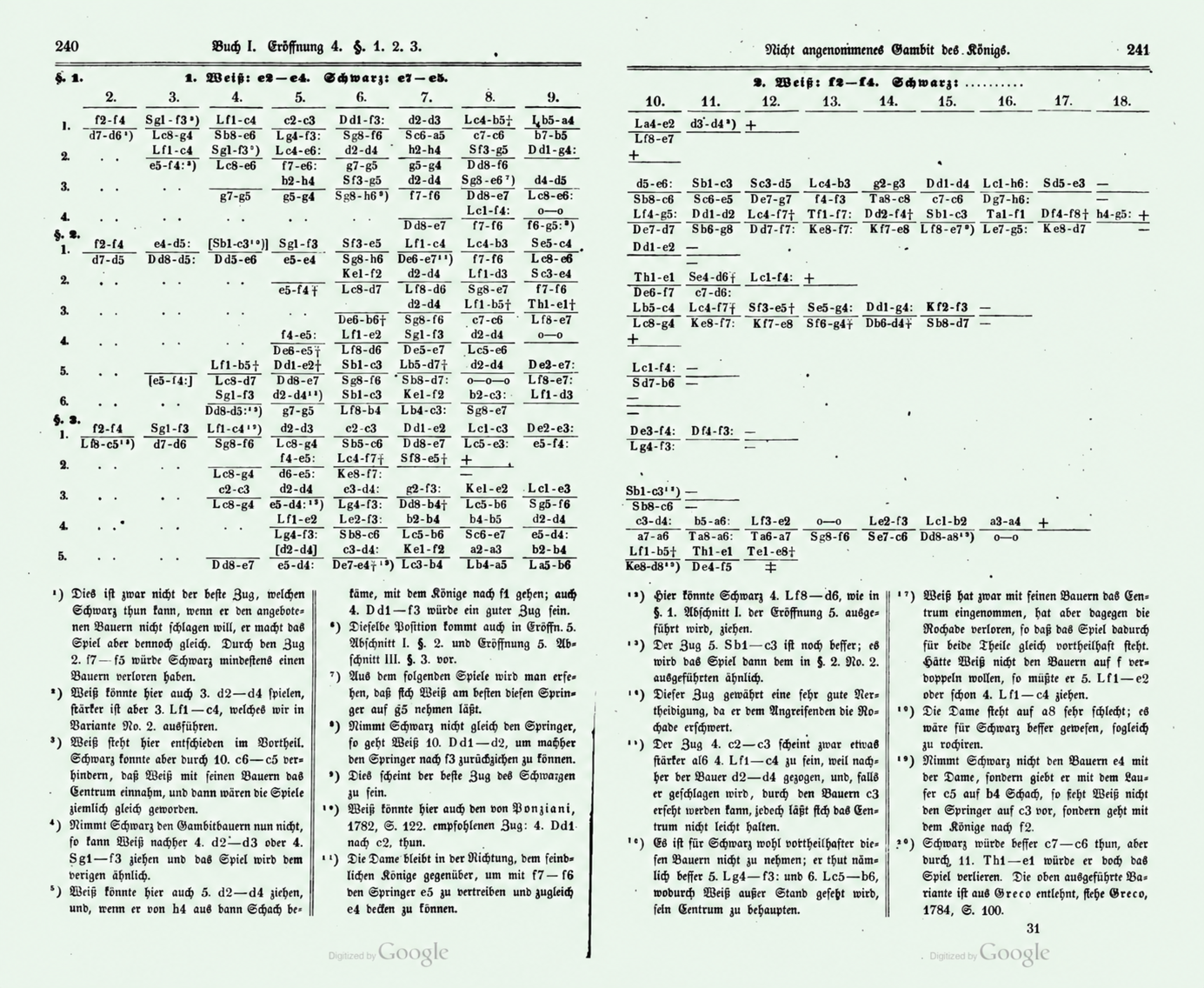
Selected pages from the first edition of the „Handbuch“. Everything fits together. The book gives the option of declining the King's Gambit with 2...d5, but not yet Falkbeer's 3...e4. Why? Because Falkbeer only played it against Anderssen 8 years later!
The first assault of the countergambit repelled
Theorists, and thus later „Handbuchs“ as well, dealt with Falkbeer's Gambit quite quickly.
To simplify the issue a little, let me put it this way: Above all, it was soon realised that the e4 pawn must be eliminated as quickly as possible, even though its place (as Paul Keres wrote about a hundred years later) is taken by the seemingly no less annoying king's knight. But then White can develop the kingside.
After 1.e4 e5 2.f4 d5 3.exd5 e4 4.d3 Nf6 came in 1867 Johan Berger with a simple plan which – it must be noted – not only works as it should, but is still considered the best method today: 5.dxe4! Nxe4 5.Nf3
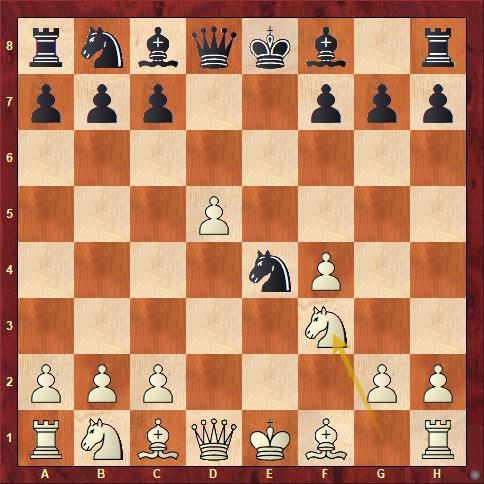
6...Bc5 7.Qe2!
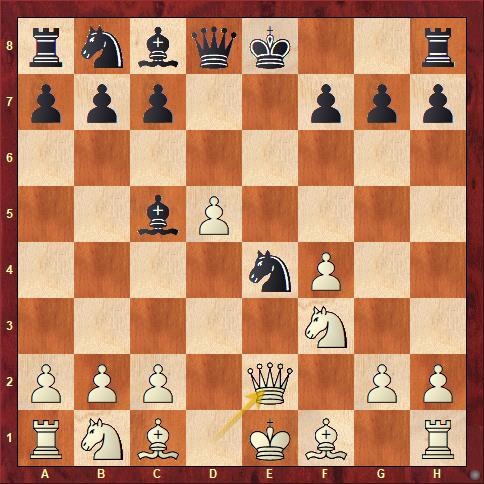
Well, let us now consider! How should Black continue satisfactorily? After 7...Qe7 comes 8.Bxe3 (exchanges, of course, favour White); 7...0-0? – as we can easily see – this does not work either, and 7...Bf2+? 8.Kd1 f5 or 7...f5 it depends on the pins along the e-file – Nfd2 and Nc3 as appropriate (we can check all this in the examples in the viewer).
Well, and it seems that even rapid development in the true spirit of the gambit does not work either 7...Bf5 through the simple 8.g4!
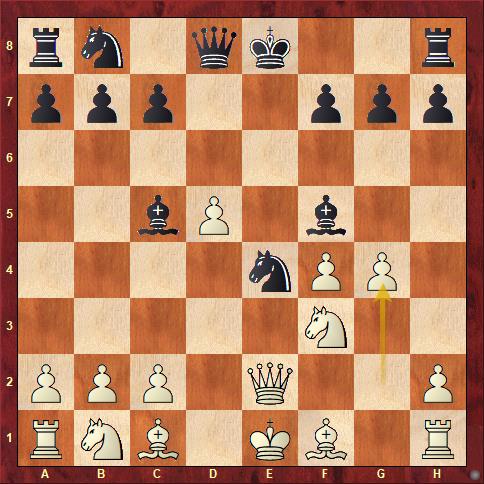
Falkbeer Counter-Gambit somehow became rather commonplace and, for example, the 8th edition of the Handbuch in 1916 – edited by Karl Schlechter, but with the collaboration of none other than Spielmann – offered seemingly quite clear paths to an advantage:
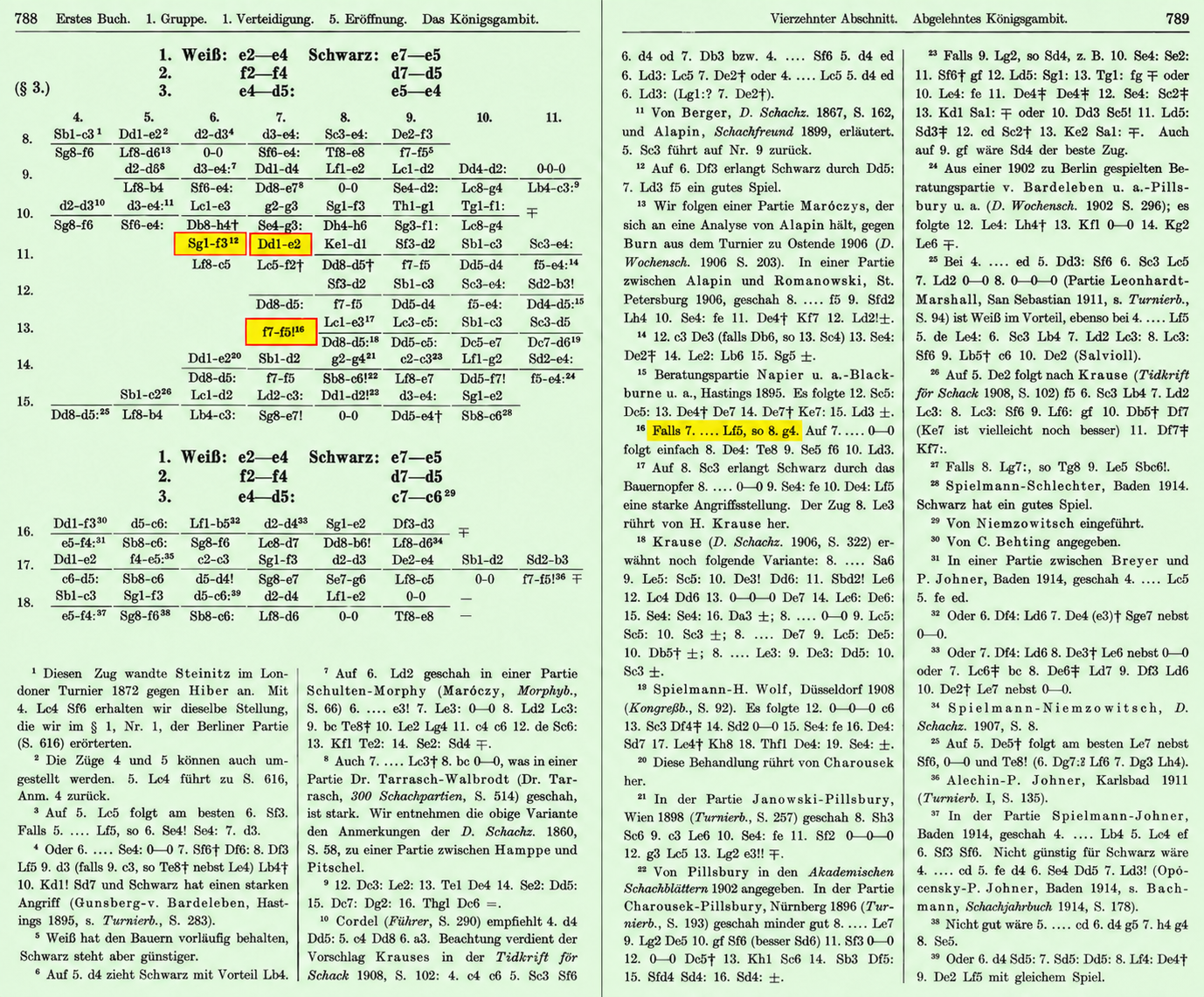
For several decades, the Falkbeer Counter-Gambit was written off a the King's Gambit thus once again enjoyed its „well-deserved“ popularity!
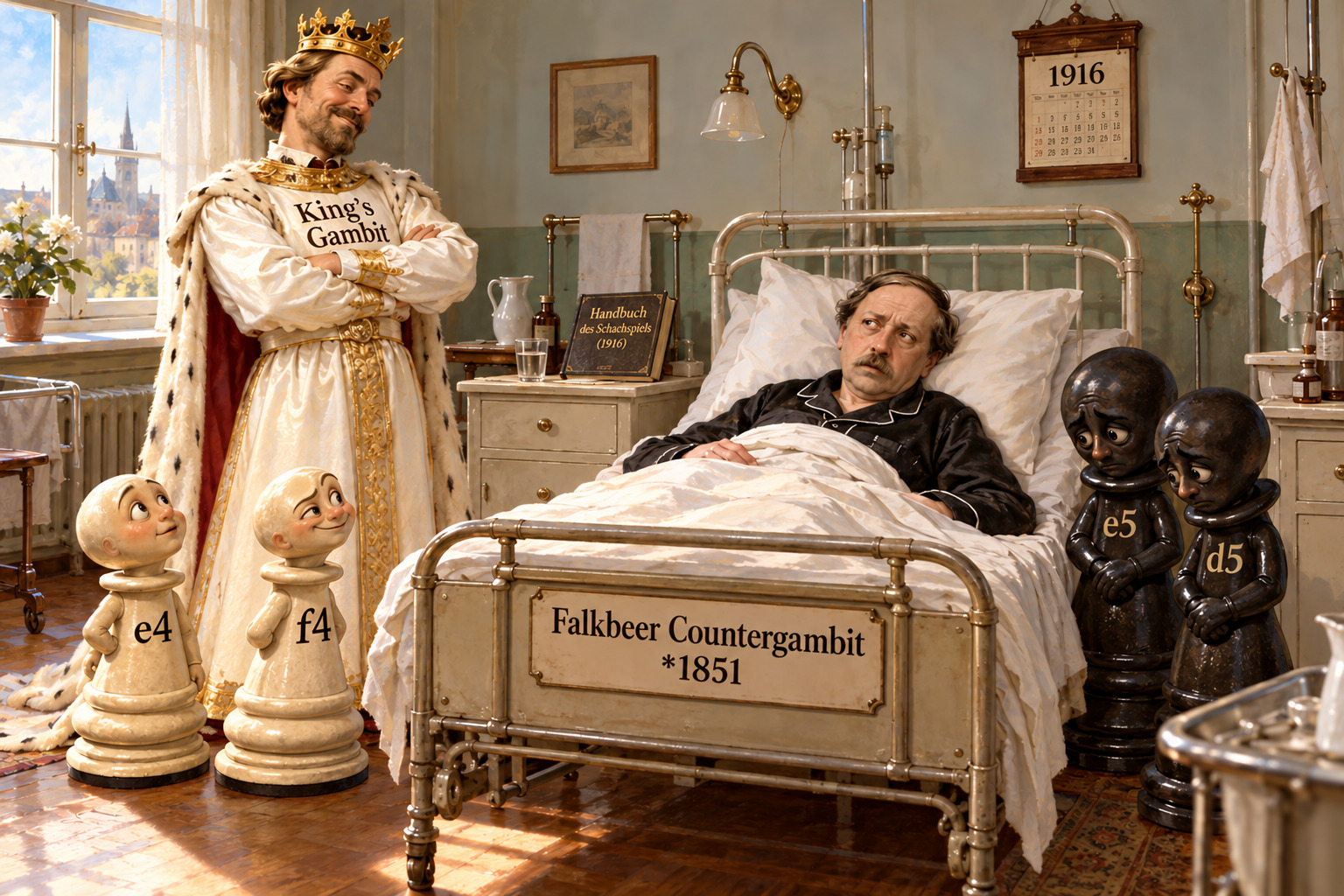
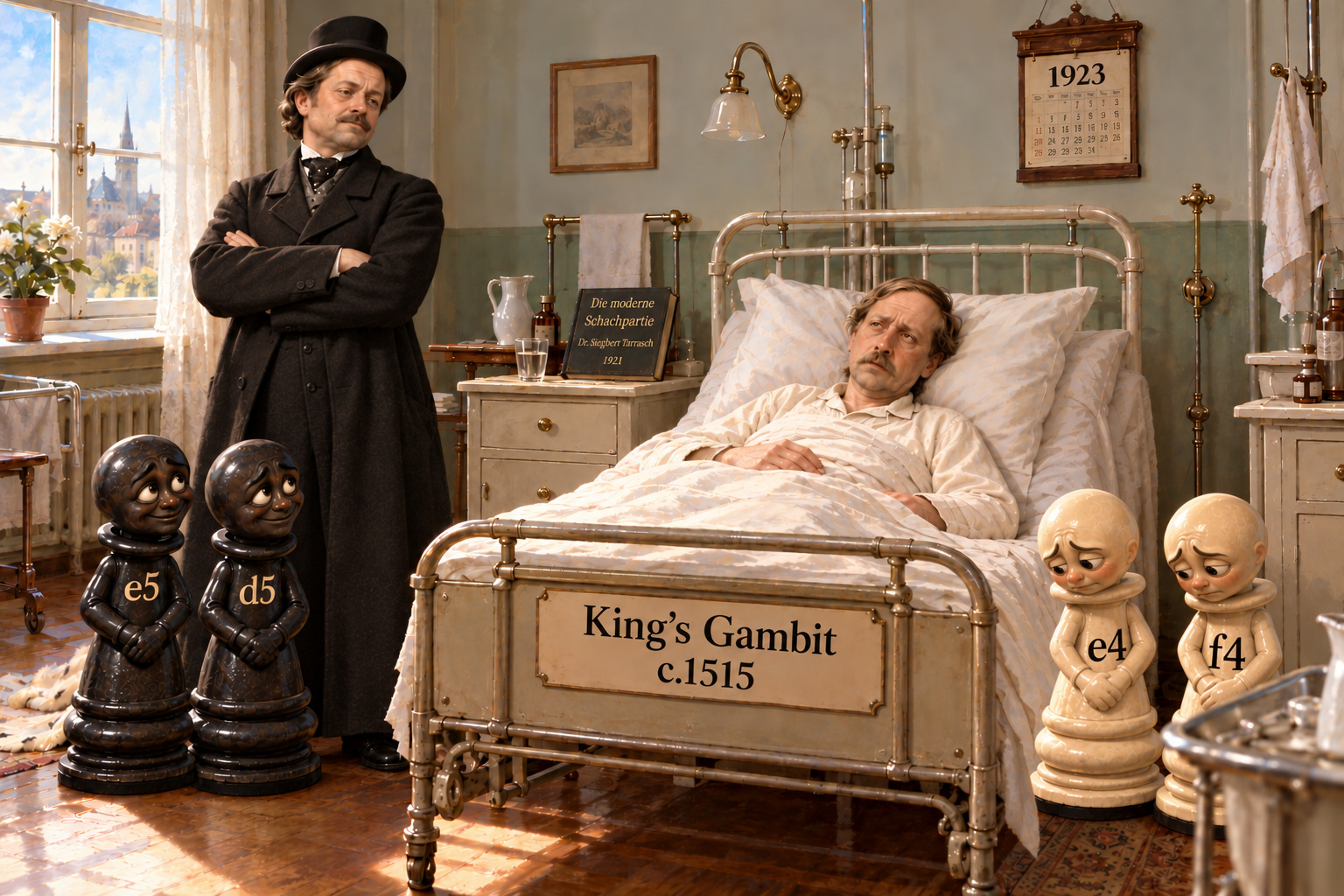
If we borrow Spielmann's splendid comparison of the King's Gambit on its sickbed, then the state of the Falkbeer Counter-Gambit after Berger's discovery and the publication of the eighth Handbuch in 1916 looked roughly as our illustration shows. 🙂
But in 1923, a heavyweight entered the ring. And with a single blow, it was supposed to send the prevailing theoretical verdicts crashing to the ground – literally!
Her name was Siegbert Tarrasch…
A dogmatist who broke dogmas?!
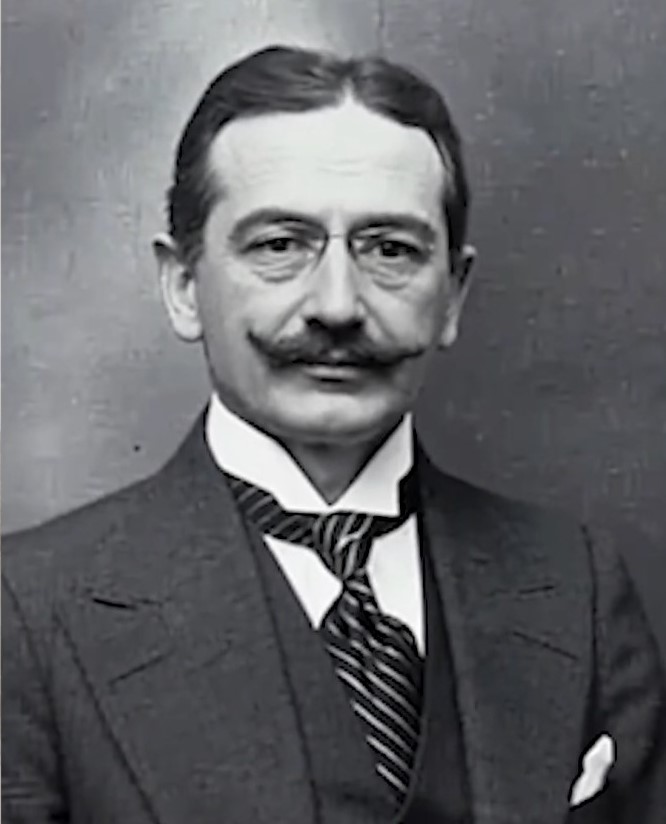
„Tarrasch was a dogmatist!“ This is how the opinion of the Soviet chess school could be summed up! At least, it was with such an assessment that I repeatedly encountered, not only as a young pupil, but also later on.
Almost all Soviet books – with honourable exceptions – more or less held or supported this view. One might even think it was a kind of folklore. After all, it is not true that „a knight on the rim is always dim“ or that – as we can once again read or hear in various videos today – 4.Ng5 in the Two Knights Defence: 1.e4 e5 2.Nf3 Nc6 3.Bc4 Nf6 4.Ng5, with which White lures the opponent into the Fried Liver Attack, „a patzer's move“ („ein richtiger Stümperzug“). After all, this line still appears from time to time even at the highest level today!
Well yes, the views of the Russian and Soviet chess schools were to a large extent based on the Doctor's ideological disputes with Chigorin. But that would take us too far afield.
To sum up all these opinions, let me quote what Vasilij Panov and Jakov Estrin write in one of the best opening monographs, A Course in the Openings: „The famous German master of the late 19th and early 20th centuries did not in practice stick to his own theoretical recommendations, leaving this ‚honour‘ to his followers. In his works, Tarrasch consistently rejected creative risk, bold combinational play and sacrifices, but at the board he willingly plunged into wild complications that could not be calculated.“
Of course, the Doctor had his faults, but such an assessment can be challenged quite simply and on several levels. I choose this one: „Tarrasch the teacher formulated general rules; Tarrasch the grandmaster recognised the specific exceptions.“
It is enough to look at some of Tarrasch's games to see that the reality was much more varied. And after all, this is also shown by the opening that bears his name. Can it really be claimed that, for example, the typical positions of the Tarrasch Defence to the Queen's Gambit with an isolated pawn lead to a slow siege of the opponent, blockade and „tightening the screws“? Quite the opposite: here the isolated pawn is often the price for piece activity, space and dynamic possibilities.
And the following game is perhaps even more convincing evidence. For against Spielmann himself, Tarrasch played a game that hardly fits the image of a cautious dogmatist avoiding open battle. 🙂
Moravská Ostrava 1923 – ideological opponents at the chessboard
The duel between the King's Gambit and Falkbeer's Countergambit was personified at the Moravská Ostrava tournament in 1923. Seven years after the publication of the Handbuch, which continued to condemn Falkbeer's Countergambit to the role of a theoretical whipping boy (thanks to Berger's line 5.dxe4!), something significant was finally about to happen…
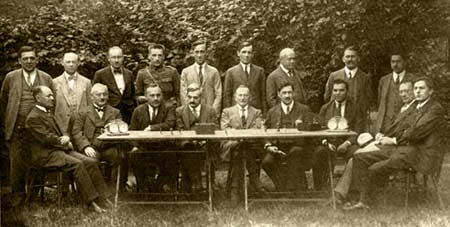
Moravská Ostrava 1923. The tournament marked a magnificent comeback for Emanuel Lasker, who played his first tournament here since 1918 and won without a single defeat. Lasker is seated in the centre, fourth from the left. Both our protagonists did not fare too well: Rudolf Spielmann (seated at the far left) finished ninth, 61 years old Siegbert Tarrasch (fifth from the left, next to Lasker) shared 7th–8th place.
Seated from the left: Spielmann, Viktor Tietz, Efim Bogoljubov, Lasker, Tarrasch, Heinrich Wolf, Richard Réti, Ernst Grünfeld and the young Max Euwe. Standing from the left: two unknown men, Alexei Seleznov, Karel Hromádka, Max Walter, Amos Pokorný and three unknown men. Akiba Rubinstein and Savielly Tartakower are missing from the photo.
What Spielmann wrote about Tarrasch is, in more modern language, on the borderline of a kind of „ideological hatred“. Let us read what Garry Kasparov writes in the introduction to a key game Spielmann vs. Tarrasch (Ostrava 1923):
Let me remind you that Spielmann was a prominent chess neo-romantic, a successor to Anderssen and Chigorin – „the last knight of the King's Gambit“. And to help you better appreciate the fundamental nature of this encounter, take a look at what he wrote about his opponent:
„Hardly had the direct attacking style given way to the positional, when Tarrasch appeared, proclaiming ‚new principles‘ of battle. If we follow these principles in Tarrasch's own games, it is clear that there is no spirit of attack in them. Slowly, terribly slowly, as if creeping, the chess armies advance into battle. Their motto is: avoid open combat wherever possible, besiege the opponent, blockade and wait until his vital resources are exhausted, until he runs out of ‚water and air‘, and then slowly suffocate him.".
This Tarrasch method of play enjoyed extraordinary success for a long time. Opponents either lost patience and bled out in premature attacks, or remained passive and found themselves in complete strangleholds.“
Well, now let us finally see how Tarrasch, with a single game, not only revived the Falkbeer Counter-Gambit, but for almost fifty years turned the existing theory of the King's Gambit upside down!
So, dear readers, do admit. Did Tarrasch have the right, after such a game, to once again write the bold and, it must be said, for him characteristically categorical statement that „The Falkbeer Counter-Gambit is the refutation of the King's Gambit“?
This last straw apparently also became the reason why, a few months later, Spielmann wrote that famous article „“Vom Krankenlager des Königsgambits". In this text, Spielmann analysed the crisis of this romantic opening at the time and described it with the sentence: „The King's Gambit is not yet dead, but it is very sick.“
Not everyone, however, shared Spielmann's scepticism. Savielly Tartakower, known for his sharp pen, even wrote that Spielmann's article... convinced him of the opposite!
So if Tarrasch intimidated King's Gambit supporters with his novelty and a genuine developmental piece sacrifice after
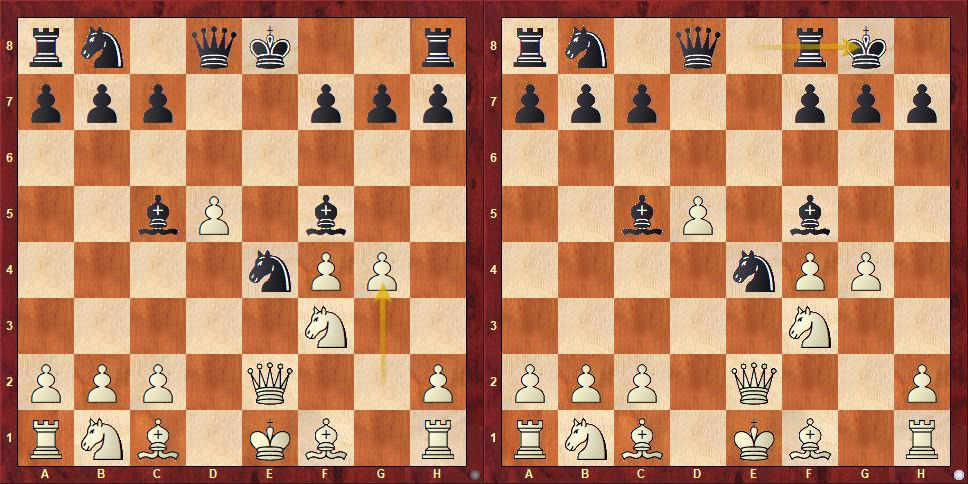
8.g4 0-0!!, new paths were sought by White. Only, how to put it... nothing much...
What followed? Tarrasch did not back down from his conviction. Even in 1931, he maintained the view that the Falkbeer Counter-Gambit refutes the King's Gambit.
Counter-Gambit on the Throne and the Butterfly Effect

Thus, in 1923, the King's Gambit fell ill and took to its bed. However, its condition was gradually stabilised, at least to the extent that the acute illness became chronic. Even after being reinforced by natural development, 8.Be3
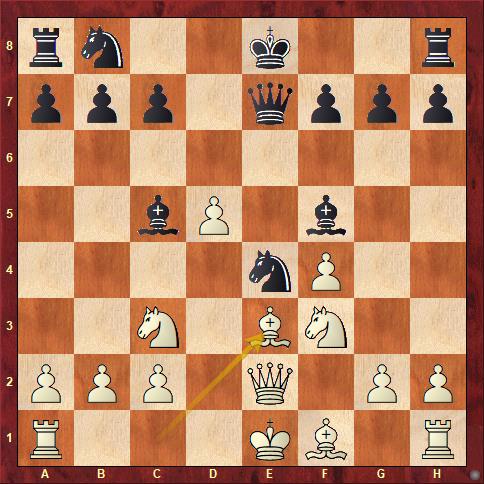
according to some monographs, White was supposed to be glad just to maintain equality at all. Let us look at one such verdict:
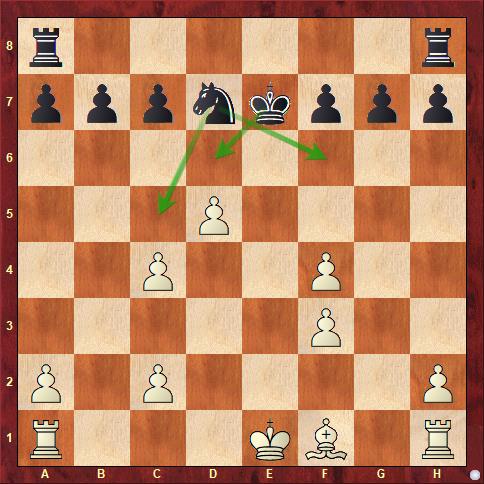
Before us stands perhaps the most famous final position of theoretical analyses from the 1940s and 1950s. Here – or a move later, after 15.Bd3 Kd6 – Max Euwe (1941), Paul Keres (1955) and Luděk Pachman (1959) all concluded their analyses.
The last-named writes here: „Despite the extra pawn, White can achieve at most equality in the endgame.“
The reign of the Falkbeer Counter-Gambit seemed unshakeable! And yet it would have taken so little for chess history to leap forward by almost forty years. The butterfly effect would have taken care of the rest! Let us look at the following game, which will clarify much for us.
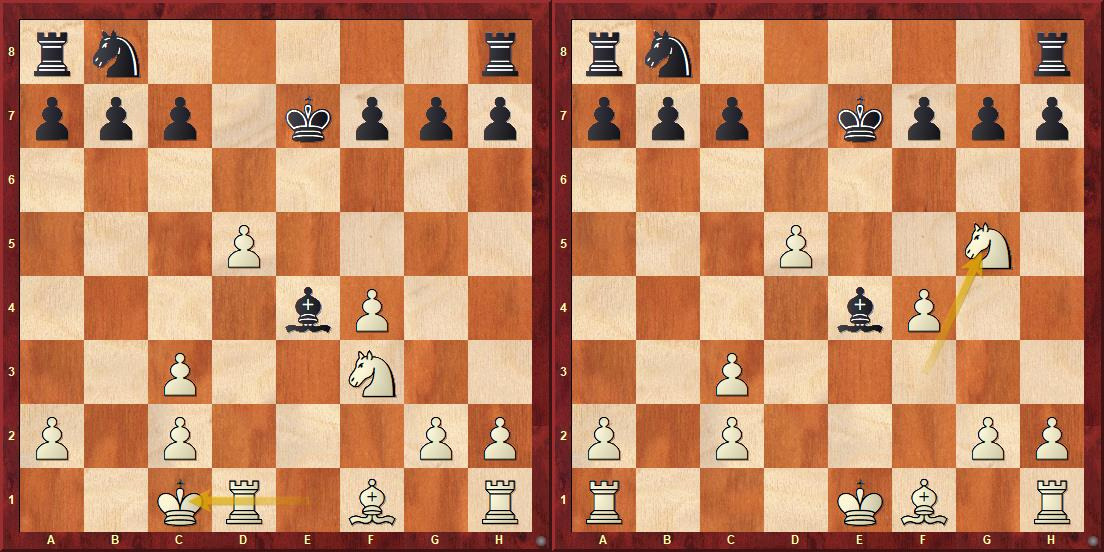 13.0-0-0?= (1932) 13.Ng5! (1932) (1970)
It is in this very game that we can play a little with the idea of the butterfly effect. All it would have taken was a slight flutter of a butterfly's wings – the move 13.Ng5! – and the history of the King's Gambit might have started to take a different course. Had Stoltz won with this move, theorists would almost certainly have begun to examine the whole line leading to this position much more closely. And who knows? Perhaps they would have discovered what chess theory had to wait almost another four decades for.
But the butterfly did not flap its wings that day. Stoltz played 13.0-0-0?, the game ended in a draw without much excitement, and the remarkable idea remained hidden beneath the surface. Thus, the King's Gambit continued to lie on its sickbed for nearly those four decades, while the Falkbeer Counter-Gambit could continue to walk the world healthy... and admired!
Falkbeer Deprived of Magic

One of the first monographs I got my hands on was Keres's „Dreispringerspiel bis Königsgambit“ (Berlin 1971) with an editorial deadline – and this is important – of 31 July 1970. At primary school, German was then taught as an optional subject, and so – albeit reluctantly – I had to admit my father was right this time: „You'll need German!“ he used to say.
With a dictionary in hand, I threw myself into translating the text that accompanied the Falkbeer Counter-Gambit. Over time, however, one circumstance simply wouldn't leave my mind – an inconsistency...
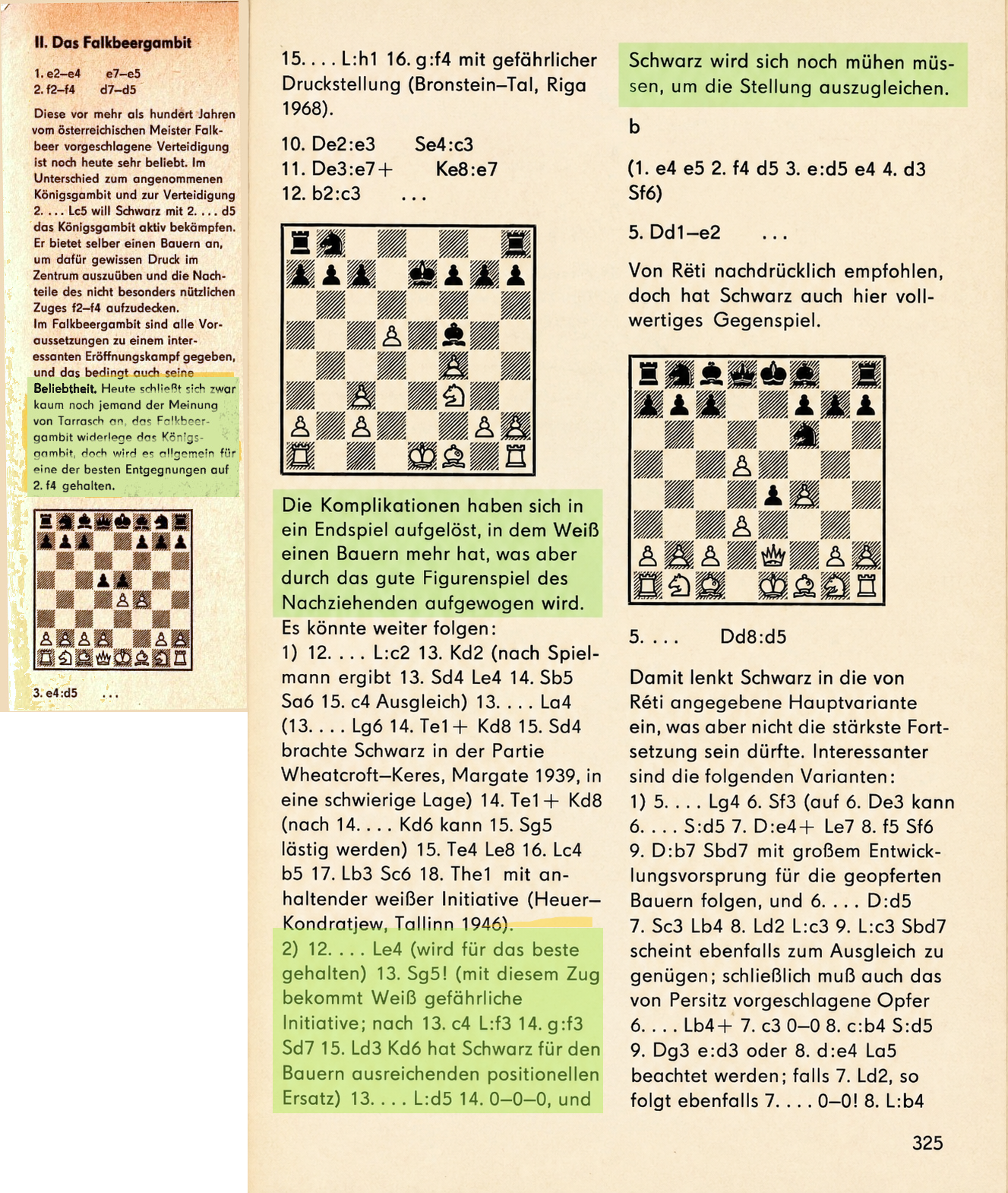
At the beginning of the chapter, Paul Petrovich, among other things, writes: „In the Falkbeer Counter-Gambit, all the prerequisites for an interesting struggle are present right from the opening, which is also the reason for its popularity. Today, hardly anyone still agrees with Tarrasch's view that the Falkbeer Counter-Gambit refutes the King's Gambit, but it is generally considered one of the best replies to 2.f4.“
On the contrary, at the very end of his analysis, Keres evaluates the main line after 12.bxc3:
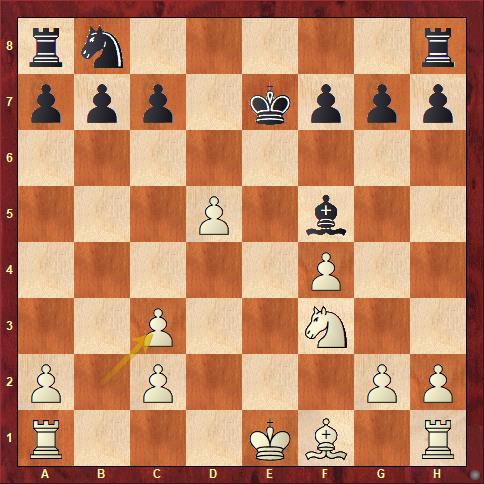
12...Be4 (considered the best move) 13.Ng5! (with this move, White gains a dangerous initiative) 13...Bxd5 14.0-0-0
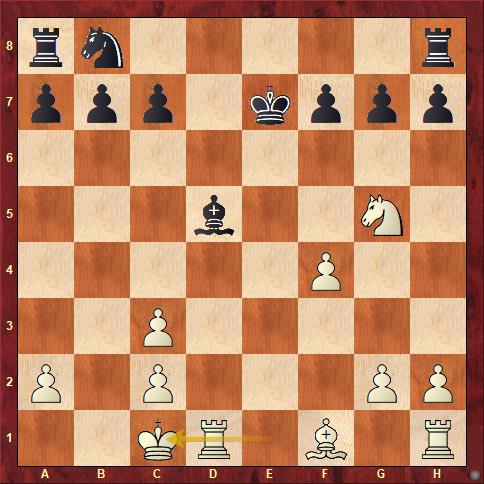
and Black will still have to work hard to equalise the position.
However, we must treat Black's position much more strictly. Here, White actually has a large advantage! And in practice? In the online CB database we find roughly a hundred games. White scores around 80% of the points...
The development of the line according to Keres's analysis, with minor additions, as well as a subsequent new analysis including White's main alternatives, are available in two examples.
Opening theory and the Timoshchenko book affair
„And why is the author actually showing us analyses that are over half a century old?“ an impatient, most likely young reader might even ask indignantly. „Surely it's obvious that almost everything in the book will be wrong!“ And yes, we have to admit he's partly right!
Nevertheless, I would like to argue against such a view – that extracts from old books are simply useless. Leaving aside the fact that my article is also a historical excursion, or rather an exploration of the development and in fact still ongoing battle between two gambits, one can actually find much of value in Keres's monograph. We will demonstrate this in the following analyses.
In this context, we could discuss the development of theory and later the advent of engines almost endlessly. The problem could not even be fully covered in a separate article. In fact, even a thick book would not suffice to address the questions of the influence of engines on opening theory.
So here I will limit myself to just two interesting points. Both are very instructive, but while one is a thoroughly witty summary of our current situation regarding opening theory, the other is a cautionary example of how pride (and the desire to harm a colleague) comes before a fall.
Let us begin with the sadder case, when in the end – as we might say – Caïssa herself had to raise a warning finger.
The year is 2016 and the co-creator of the Chelyabinsk Variation, Grandmaster Gennady Timoshchenko, publishes his life's work Сицилианская защита. Челябинский вариант. The book has around 650 pages and the author states that he worked intensively on it for more than three years. He had at his disposal an exceptionally powerful computer for his time...
Yet as you read, you can't shake the impression that the book's primary aim was not (just?) to prove whether White can maintain an advantage in the Chelyabinsk Variation! It seems above all to be about devaluing Yevgeny Ellinovich Sveshnikov's contribution to the famous variation, arguably the greatest chess discovery of the 20th century in the field of openings.
In the book, the author almost move by move seeks out and analyses Yevgeny Ellinovich's analytical errors. He thus tries to tear Sveshnikov's famous monograph from the 1980s to pieces!
After all, even Kasparov writes in the book's foreword: „The author's criticism of Sveshnikov's book may be a little too harsh...“
Indeed, others have also noticed Timoshchenko's obsession with refuting manual analyses using what was then a powerful machine. To give just one example, IM Dirk Schuh: „The book was published in 1988!! And of course, it's easy to use an engine to refute individual lines it contains.“
And why did the author go after Sveshnikov so much in the book? Why was he, or rather his book, so obsessed with him? In my view, a significant role was played by the fact that west of our borders, the variation is called the Sveshnikov! After all, we know that the English and Americans tend to prefer opening and variation names that include surnames.
Well, more experienced chess players know that even here, „B thirty-three“ (the index of the variation is B33) has simply come to be called the Sveshnikov. Moreover, Yevgeny Ellinovich remained loyal to his invention all his life, whereas Gennady Timoshchenko turned away from it relatively soon...
A Caïssa's punishments were not long in coming! Gennady Anatolyevich did expect that engines would become stronger, but he probably didn't anticipate that progress would not proceed in small steps. So today, if we open his book, set up almost any position at the end of an analysis or side line and run an engine, we learn some interesting things... 🙂
However, the greatest blow to the book—and for me, I admit with some schadenfreude, a real delight—is the following episode. But here we need to bring in a diagram, that is, the game viewer.
More experienced chess players already suspect what error the author made. But those whose memory goes back a few years will already be well entertained!
Two years after the book was published in the original Russian, and in the same year as the English edition, the World Championship match Carlsen vs. Caruana took place. In six classical games with White, Fabiano opened with the Sicilian three times and three times chose... 7.Nd5! So we might note: „In the eighth, tenth and twelfth games, Caruana deliberately gave up half the advantage that the opening guaranteed him!“ 🙂
Well yes, theory has always evolved and continues to do so, regardless of whether, and if so, how strong engines are.
Opening theory from the perspective of Daniil Dubov
Daniil Dmitrievich, who has a wonderful gift for saying everything essential in one or two sentences, summed up the problem of opening theory in his own way. And there is some truth in it! For when I look through my old databases, which I prepared for my students, or even those I published and sold years ago, I am amazed.
When AlphaZero was introduced to the chess public with great fanfare in December 2017, and a year later, during the World Championship match Carlsen vs. Caruana, was once again in the spotlight, it became clear that the combination of „raw brute force“ with neural networks could bring about a huge leap in performance. And indeed, in 2020, neural networks in the form of NNUE became part of Stockfish.
And a few years later, Dania declared (paraphrased): „All books published before 2018 belong in the wastepaper bin!“
The Modern Falkbeer: Cured, but at what cost?!
I don't need to have years of coaching and analytical experience or a master title to judge how most readers will react to the resulting previous main line. „Falkbeer“ rather resembles a patient just discharged from hospital: he may be healthy, but he still has to stick to a strict regime. Otherwise, he could find himself back in a hospital bed very quickly!
After 17...Bc8
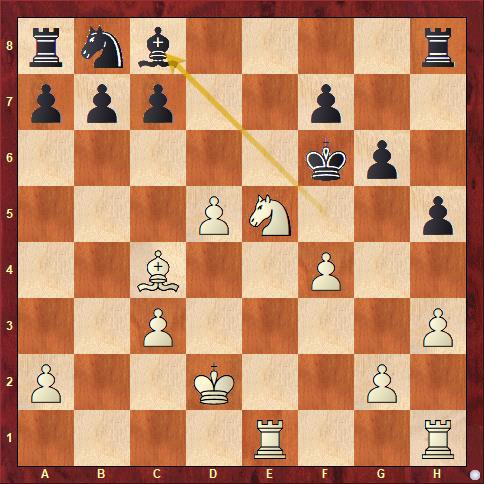
We are probably looking at an objectively balanced position, but I understand that many would find it torture to play on as Black in their own game. Well, more experienced and stronger chess players can see that Black has static factors in his favour. Of course, more can be found in the analysis above.
„No, not like this! I couldn't go on like this! I'd rather give up the entire Falkbeer Countergambit!“ many readers might think.
However, as we could see in the same analysis, for the main line that's not the case today! The crossroads where Black can choose a more practical option comes in the main line after 9.Be3.
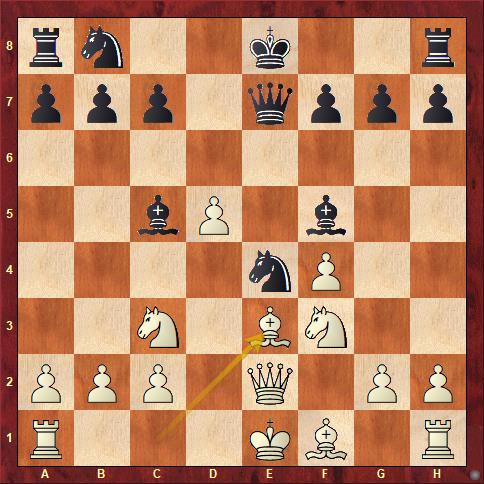
The optimal solution here is 9...Nxc3 10.Bxc5 Qxe2+ (not only strong, but in fact the only correct one) 11.Bxe2 and now 11...Nd7!
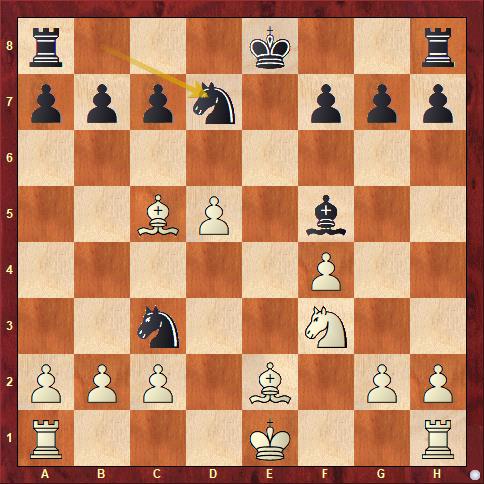
As the main analysis below shows, the result is – though to a lesser extent than in the previous chapter, but still – again two perspectives on how the position may develop!
Theoretical view: Let us note that here too, the position is in objective (theoretical) equilibrium.
Practical perspective: In practice, Black must (perhaps as proof) deliver a truly high-quality performance. Indeed, White, of course, cannot simply coast along, that is, „play anything“; but his minor mistakes, which often lead straight to the safe harbours of a draw, are somehow tolerated.
Let us therefore summarise the current state of the main line of the Falkbeer Countergambit. Objectively, it promises equality for Black. On the other hand, we find ourselves in positions that not every supporter of the countergambit would wish to defend. Especially when we look at the endgames to which some lines or deviations lead. Well, there's no accounting for taste, as the saying goes. Judge for yourselves, dear readers.
Official theory: don't trust authorities!
We left official theory at the moment when perhaps the greatest expert on open games of the third quarter of the 20th century, Paul Keres, found himself in an unpleasant situation. One cannot fail to notice a certain dichotomy between the assessment of the Falkbeer Countergambit at the start of the chapter and the evaluation of the final position at its end.
It would certainly be interesting to know how he dealt with the problem a few years later, in the revised edition. I do not have this book at my disposal, but the work of his successor Alexey Suetin clearly shows that „Falkbeer“ was then in deep crisis!
So, in the 1970s to 1990s, it seemed that Falkbeer had once again returned to the sickbed! Yet theoretical research continued, and in the following decades new paths began to appear that restored hope for Black. Did this mean that the countergambit would after all achieve a full recovery?!
For example, the Encyclopaedia of Chess Openings from 2006 and its „miniature“ version from 2010 do offer Black ways to equality, but... following their recommendations means losing the game outright! And while in older editions the authors of individual openings were listed, in the 2006 edition their names are no longer to be found...
Perhaps it is worth recalling that it is not for nothing that people say: „Follow the money!“
Summary and résumé
There is a lot of information, so it is certainly appropriate to recall the entire historical development of the battle between the two gambits! Their fluctuating state of health is, after all, quite vividly illustrated by our two pictures: both patients have taken turns on the hospital bed! 🙂
Let us therefore look at a brief overview of the historical development up to the present day. And let me emphasise once again: this concerns the development of the main line, not a forced sequence of moves for both sides!
A hundred chess players, a hundred tastes
„In every opening, almost every variation, it is possible to avoid stereotyped, bookish continuations and still achieve results that are no worse, if not even better.“
Mikhail Ivanovich Chigorin
„There is no one in the world who can please everyone,“ wrote in the introduction to her Babička Božena Němcová. You simply can't please everyone – and it's no different with chess variations. Some people like one, others do not.
Up to this point we have almost exclusively dealt with the so-called. the main line of the Falkbeer Countergambit. Among other things, we have tried to show that Black – although current theory does not give him an easy life here – has nothing to fear with accurate play. In other words, there is no need to take to your sickbed again!
For some, this realisation is quite sufficient. They are happy to take the main road with Black, knowing that according to current theory and our analysis, it leads to equality. They are willing to accept either a transition to the endgame or the need to defend a demanding position precisely.
Others, however, are not so tempted by this prospect. They don't want to head for the endgame, or perhaps don't wish to tread (or even drag themselves 🙂 ) along a well-worn path, allowing their opponent to simply recite memorised moves. So they start looking for less explored continuations.
And inquisitive readers, who – like the author – most enjoy sampling Time from the three components of chess and love Madame Dynamism, have probably long had the question on their lips: „But does Black really have nowhere to deviate? Must he head for bloodless endgames against a well-prepared opponent?“
Not at all! And thank goodness for that!
What's more, we can even choose among quite promising sidelines. After lengthy analysis, I'm no longer even sure whether Black's methods in the main line are really the best! At the very least, from a practical point of view, some alternatives offer livelier play and richer possibilities than those long, theoretically equal endgames.
Such sidelines can be especially useful against opponents who are weaker on paper, but also in rapid or blitz games. Mere surprise, however, is not enough: the chosen path should not only be unusual, but also sound and theoretically correct. And I insist on this condition!
So we can reassure the supporters of „Falkbeer“. There's no need to venture into long forced lines. Even against well-prepared opponents, there are several ways to throw them off track. And I repeat: it is certainly not the case that these are objectively much weaker continuations, or even just one-off alternatives!
And so, dear readers, in this final chapter of our journey through the history of the long-standing duel between two gambits, I shall present no fewer than three different options, for avoiding the main lines.
The problem – or for many, rather good news – is that these variations have not yet been sufficiently explored!
1.e4 e5 2.f4 d5 3.exd5 e4 4.d3 Nf6 5.dxe4 Nxe4 6.Nf3 c6
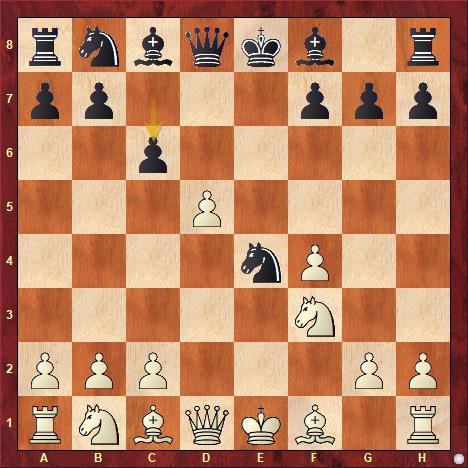
An old attempt by Boris Maljutin from a game against Alapin, St Petersburg 1905/06, which he later rehabilitated in modern times and recommended as a repertoire weapon recommended grandmaster Boris Alterman in the book The Alterman Gambit Guide: Black Gambits 2 from 2012. At times, the analysis of the games contains surprisingly many inaccuracies – it almost seems as if the author did not have to hand, for example, Kasparov’s classic work „My Great Predecessors“ (2003) – but these are balanced by many interesting insights.
The main commentator of the following game is the English IM Andrew Martin (*1957), an experienced chess coach, writer and author of numerous instructional videos. In 2000, he commentated on the famous London match between Kasparov and Kramnik for the world championship title! Interestingly, Martin enjoys teaching children the King’s Gambit, which he apparently considers an excellent school of attacking chess. And while he shows young players how to attack with White, here we are mainly concerned with how to counterattack as Black and answer the gambit… with a countergambit! Well, we each stand on a different side of the chessboard! 🙂
Whereas after 6…c6 the resulting positions are similar in character to typical Falkbeer Countergambit situations, the same cannot be said of the other branch. For those seeking original and little-known positions and complications, the following continuation is just the thing.
1.e4 e5 2.f4 d5 3.exd5 e4 4.d3 Qxd5
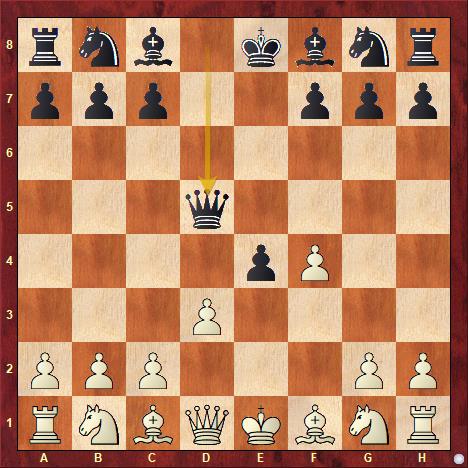
No great surprise! This line can already be found in the eighth edition of Bilguer’s Handbuch from 1916, the relevant section of which, as we know, was written by Rudolf Spielmann himself. In fact, the whole variation had already appeared two years earlier in the game Spielmann vs. Schlechter, Baden near Vienna 1914.
After 5.Nc3 naturally follows 5...Bb4 and then 6.Bd2 Bxc3 7.Bxc3 Ne7!
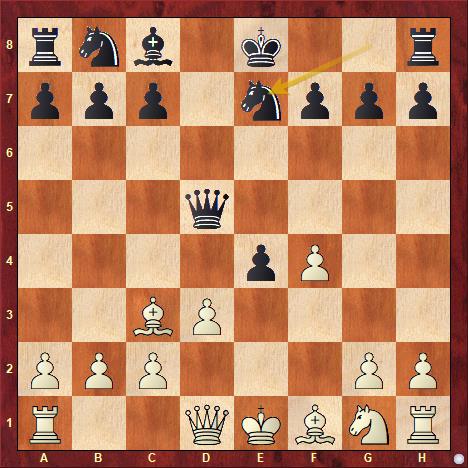
So this gambit continuation was – to my surprise – already known by the end of the 19th century! In the 1916 Handbuch, Spielmann even marked it with an exclamation mark.
Black's aim is to rapidly develop the queenside and castle long. If White bites on the g7 pawn, Black brings the kingside rook into play with tempo and, as a bonus, gains an open g-file!
End of the story – less is sometimes more
In the discussion above I also touched on the question of chess players' styles. And it's true that from a didactic point of view, it would be more logical to arrange Black's three alternatives differently, because the last one returns to the position before Black's 6th move.
But I liked the last alternative so much that I decided to offer it to you, dear readers, at the very end, as a dessert. At first glance a modest developing move, it actually contains so much „practical poison“ that even a death cap mushroom would be envious.
After the moves: 1.e4 e5 2.f4 d5 3.exd5 e4 4.d3 Nf6 5.dxe4 Nxe4 6.Nf3 Black replies 6...Be7!?
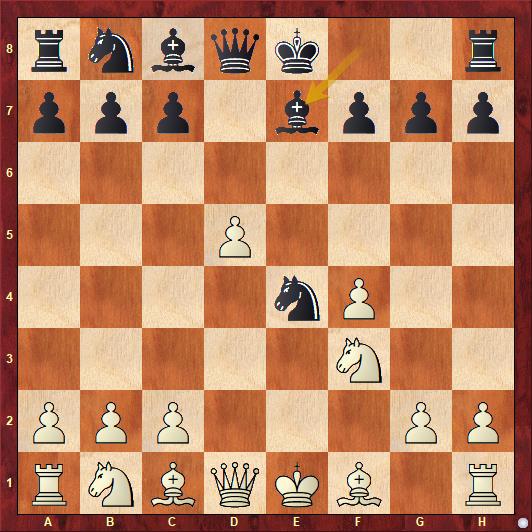
„On the one hand, it's been known for quite a long time, and on the other, it's unnecessarily passive!“ a strong player, probably a master, might immediately object. Allow me to respond to this hypothetical critic: „More modest – or if you prefer, more passive – certainly! But Black has no reason to exchange pieces, especially when it's clear that the bishop won't linger long on the open file.“
The second objection White's supporters may raise is more concrete: there is a double threat available 7.Qd4,
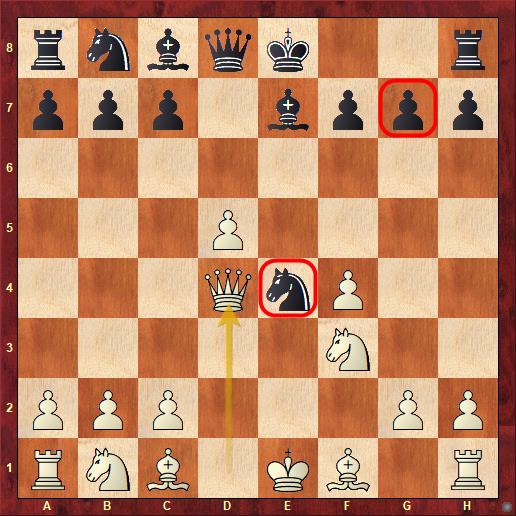
which at first glance doesn't look very pleasant for Black. Well yes, Black doesn't lose material, but still!
So let's finally look at the variations you need to know if you want to include 6...Be7 in your repertoire.
Note for study: The following two examples contain rather intricate variations, in which it is not always easy to find your way. Therefore, I would recommend that readers who wish to study the analysis in more depth download the relevant PGN files, the links to which can be found below the article. They can then conveniently study the games in one of the chess programs (such as ChessBase), or possibly import them into analytical environments like Lichess or Chess.com. In fact, this recommendation applies to most annotated games and examples throughout the article.
Let’s take a peek into the opponent’s kitchen
I was just about to conclude our long journey through the history of the clash between two gambits when it occurred to me: couldn’t I at least offer the readers a single video at the end? And if so, why not look at the Falkbeer Countergambit through the eyes of our hypothetical opponent?
The vast majority of instructional videos devoted to the King’s Gambit quite understandably focus on White’s possibilities. And if a chess player decides to include this opening in their repertoire, nowadays they probably won’t reach for a specialist book first. Sometimes I feel that a good 90% of the younger chess generation prefers videos to books! On the internet, anyone can easily find a suitable teacher, choose from the available courses, and even pay for one if they wish.
I must admit one thing, though: to this day I haven’t quite understood how it’s possible to achieve truly comprehensive study of complex chess variations through videos. Imagine, for example, a long instructional video in which the author gradually works their way to the third or fourth sub-variation. How can viewers reliably find their way through such a labyrinth without losing the thread? And how does the presenter avoid getting tangled up themselves? I still haven’t found a satisfactory answer to this question! 🙂 ) But let’s leave my doubts aside for now.
So let’s imagine that our hypothetical opponent, a devotee of the King’s Gambit, chooses as his mentor IM Miodrag Perunović. What will he learn from him? What continuation will he recommend against the Falkbeer Countergambit? And above all: what should we be prepared for when we actually sit down at the board with such a well-prepared adversary?
So let’s see what’s cooking in the opponent’s kitchen!
I have set the following video to start right at the point where Perunović reaches the position we are interested in…
So what do you think, dear readers? Imagine you thoroughly study all the examples in our article and, based on them, prepare your own repertoire against the King’s Gambit. And then, in a tournament game, you face an opponent whose preparation relied mainly on the very video you’ve just watched.
Who would surprise whom? Him you, or you him?
Of course, no one knows how the actual game would turn out. But what do you think about the outcome of the clash between two different approaches to opening preparation?...
Final check-up: Both patients healthy!

Our long journey through the history of the clash between two gambits is drawing to a close. We have witnessed rises and falls, great discoveries, forgotten ideas and their later returns to the stage. At times it seemed that one of the opponents could no longer hold out. Yet chess history has repeatedly shown us how misleading categorical judgements can be, especially when it comes to openings!
Do you remember our two patients? Once it was the Falkbeer Countergambit that found itself in a hospital bed, another time the King’s Gambit itself. And sometimes it seemed that one or the other would never leave the hospital. 🙂
So how did their long-standing duel end? With a notional draw! Or more precisely – equal chances. Our analysis has shown that the Falkbeer Countergambit is a fully sound opening, which need not fear even thorough analytical scrutiny. That does not mean, however, that Black will always have an easy life. Especially in some lines of the main variation, the road to a draw can be thorny. After all, we have more than once reached endgames that, in practical play, can go either way. And it is Black who must show greater accuracy!
That is precisely why we have also looked at alternatives. It has turned out that the supporter of the Falkbeer Countergambit need not obediently tread a single, well-worn path. There are several interesting continuations to choose from, which can surprise the opponent and lead to lively, as yet not fully explored play.
I am convinced that the Falkbeer Countergambit deserves a place in the repertoire not only of young, moderately advanced chess players, but also of experienced players who favour an active, attacking style. It is an opening for those who are not afraid of material concessions, because they know well that Time can be a more valuable asset in chess than material.. And that is precisely one of its greatest charms!
So we can state with some satisfaction that, as far as their mutual duel is concerned, both our patients are now cured. The King's Gambit and the Falkbeer Countergambit have both stood the test of time. And if either of them finds itself in trouble again, there may be no need to call for a doctor. A good analyst will suffice! 🙂
But our journey through the world of the King's Gambit does not end here. After all, this was only the first excursion towards discovering the ways in which Black can deal with the boldest and oldest gambit.
The Falkbeer Countergambit is therefore intended above all for those who do not hesitate to sacrifice material in order to gain a lead in development, the initiative and time. However, there is another, no less principled path: to accept the gambit and then stubbornly defend the extra pawn!
It was precisely this approach that the eleventh World Champion Robert Fischer consistently advocated. And not only did he advocate it, but in 1961 he even published a famous article whose title sounded confident, provocative, and strikingly similar to Tarrasch's claim: „A Bust to the King’s Gambit“.
Whether Fischer was right, we shall discuss in the second part of our journey. And I can already reveal that even this time, the King's Gambit will not have an easy ride!
Here you can download all the games and examples from the article in PGN format.
Falkbeer Countergambit_CZ Falkbeer Countergambit_RU Falkbeer Countergambit_EN