

The World Cup in Baku has become, apart from the World Championship match, certainly the most important event of this year. At the time of writing this article, it is not yet known who will be its winner, nor which three players (the two finalists and this time also the third place) will receive an invitation to the Candidates Tournament. There are so many interesting clashes that choosing the best among them is practically impossible.
‚So I approached the matter a little differently. I selected for the readers two games, in which at a certain moment Black – at that time the world rating number one and two (!) – committed serious strategic mistakes, but the ‚young Whites‘ failed to exploit them. This then nullified their quite significantly better position and both games eventually ended in a draw.
So first, dear readers, I will present two diagrams with a simple task ‚White to move‘, but on the contrary with a complicated solution… well, and I will add a few words about the young super talents who led the White pieces in both games.
The first example
Already in round 3, the tournament system paired together the two best Norwegian players. The former world champion certainly needs no introduction, but perhaps readers do not know much about the Norwegian number two, the young progressing grandmaster Aryan Tari.
Tari was born on 4 June 1999 into an Iranian family shortly after his parents moved to Norway. He currently ranks around 70th in the world rating list.

In the first game of the mini-match, the former world champion clearly dominated. His preparation proved impressive both in terms of play and especially psychologically. However, we want to focus on the rematch, in which the young grandmaster could equalise the score.
The reader might say: „Why analyse this particular game, when many other, probably more interesting clashes were played in Baku?“ The reason is that from the game I want to demonstrate to you, one can really learn a great deal. If Tari had adhered in the critical position to two actually parallel-acting positional principles, he would probably have equalised the match score at 1-1.
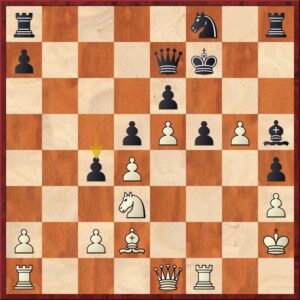
Black closed the centre with the last move 25…c4. Question: How would you continue as White?
Second example
, in which a similar phenomenon occurred, is taken from the game Praggnanandhaa-Nakamura, played in round 4. The famous streamer, and until the start of the tournament even the world's number two by rating, certainly needs no introduction, but it might not hurt to say a few words about one of the most promising players of the new generation of ‚teenagers‘.
Rameshbabu Praggnanandhaa, alongside Dommaraju Gukesh (I wrote an article about him a year ago), is one of the most promising young talents who will surely continue the successes of the evergreen 15th world champion Viswanathan Anand (his coach)! I believe the Indian team will dominate the Chess Olympiads or World Championships in a few years with such superiority as the Soviet teams did during their victorious campaigns!
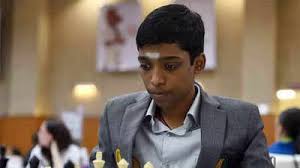
Rameshbabu Praggnanandhaa in Baku. We will look at his two brilliant games again in another article.
During the short match, which the Indian youngster (who had just turned 18 at the time) eventually won 2-0 in the tiebreak, the following position appeared in the second serious game, presenting you with the second puzzle!
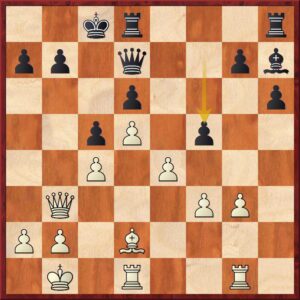
Question: How would you respond after Nakamura's move 22…f5?
Whether you, dear readers, were successful or not in this short and – it must be said – difficult test, you will find out for sure at the end of the article. However, I believe that in the event of on the second attempt one way or another you won't hesitate… if you read and replay the following text, that is, study two lessons!
It is actually two apparently separate teaching lessons at first glance. But beware! The isolation of those two topics listed below can be, from a certain point of view, only apparent… So, let's get to it!
The first principle or what a passed pawn can do

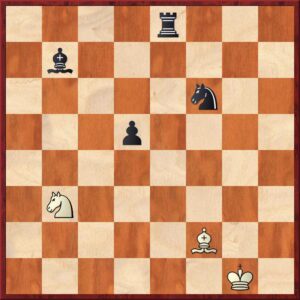
In the working diagram we see a splendid illustration of the necessity to blockade a passed pawn (1.Nd4, 1.Bd4); the diagram and explanation are, of course, taken from the famous Nimzowitsch book My System.
Aron Isajevich described and summarised the problem of the passed pawn – today we would say according to didactic principles of clarity and apt analogy – as follows: „A passed pawn is a dangerous criminal who must be put behind bars: milder measures, such as constant surveillance, are not enough!“
If we do not directly blockade the pawn, but only watch its movement from a distance, we may encounter a phenomenon which the author already called kinetic energy. In our working diagram, this means that the villain would potentially (even gladly) sacrifice his life to enable his accomplices to enjoy a luxurious life. Kamikaze d5-d4 opens the longest diagonal for the bishop, the rook gains an open file, and a beautiful central square d5 is prepared for the knight! If we were to mechanically sum up the accomplices‚ benefits, we would get an image of their wealth in life, but not on the chessboard. There, it is not just about ‘adding cooperation', but by combining (harmonising) the pieces, their wealth grows exponentially!
The following examples, I believe, faithfully illustrate both the strengths of passed pawns and the necessity of their blockade, as well as the special respect that the pieces holding such a villain behind bars deserve.
Second principle or the fact that bishops on opposite colours have venom to spare
The issue of bishops on opposite colours in the middlegame.
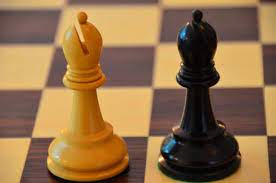
forms a separate strategic chapter. To better understand what this is about, let us first look at the following diagram from the game Ardiansyah vs. Portisch (ol) Thessaloniki, 1988.
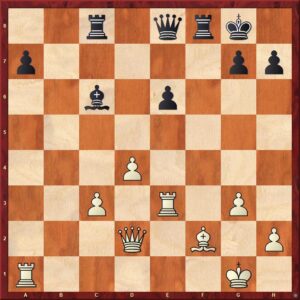
Black was to move, but first we want to evaluate the position! We see that, apart from the heavy pieces, there are bishops on opposite colours (hereafter also OC bishops). (In some languages translated as ‚different-coloured‘, in Czech both the Russian and German equivalents are used.)
The first thing we should engrave in our memory is the fact that their existence in the middlegame creates an ideal breeding ground for a sharp and uncompromising clash! Logically, it is because each side reigns on ‚its own‘ colour complex, while the squares of the opposite colour are controlled by the opponent. A large number of weakened squares (holes) then leads to uncompromising clashes, especially if they occur near the king.
Many years ago, when I was creating a large database of suitable examples and ‚typing‘ them from books and magazines into the computer, including notes often by renowned players, I could not help but notice certain similarities. This then gave rise to a rule that helps to evaluate a specific position without having to embark on often very demanding, if not inhumanly complex, calculations of variations. I believe that we often come out better from the situation thanks to deductive perception of the position (from general to specific). The rules rely on two evaluation factors.
- Which king is more safely hidden? (Pawn cover, number of defensive and attacking enemy forces around it.)
- Which of the bishops is more active? (Controls open diagonals but is also willing to cooperate with other types of pieces in the arsenal.)
Returning now to the diagram above, we must state that (in sporting slang) Black leads 2-0! His king is much better secured and the devilish light-squared bishop could be the subject of legends (and as we will see, probably were told after the game). In total, Black had a huge advantage, which he quite quickly converted into a win, as we will see in the example.
Let us now look at several examples in which bishops of opposite colours clash on the chessboard, but at the same time some examples will again feature isolated pawns as if imported from the first topic…
Combining acquired knowledge, analytical-synthetic thinking
The ability to perceive, analyse, then synthesise and use acquired knowledge in this way elevates every person in any field of mental activity. In our beautiful game this happens after several years of study and readers will probably understand that the exact ‚moment of the leap‘ cannot generally be determined even approximately. It depends on diligence, intelligence, talent and of course age.
I myself sometimes give as an example of synthesis of knowledge (specifically in children) this or a similar hypothetical example.
Let us imagine a maths lesson. The teacher writes the following text of a word problem on the board: „In the regional town of Klatovy a chess tournament is being held. Participants must register by 10 o’clock at the latest. A player A must cover a distance of 50 km by road to the venue. He sets off from home at 8.30 at an average speed of 50 km/h. The chess player B however must cover twice the distance to the tournament venue. He therefore sets off at 8 o’clock at an average speed of 60 km/h.
Question: Is it enough for both participants to register for the tournament?“
Smart children, young chess players, would certainly have no problem solving the task. But it is about that synthesis of information. After all, at school the mother tongue and history are still taught (at least I hope so). A sufficiently assertive pupil should therefore tell the teacher that: 1/ the town of Klatovy is not a regional town, and especially (2) that in the word ‚šachysta‘ she made a gross spelling mistake (he can also add an explanation about the word stem and suffix; by the way it is incredible how many even university-educated people write the letter ypsilon in the word).
The pupil thus merges information. During the maths lesson the brain is able to apply knowledge from other subjects…
Synthesis of information, knowledge!
Let’s get to it
Now, armed with two new pieces of knowledge, let us finally start analysing the games, and you, dear readers, will be able to compare your solutions; to find out whether you were successful.
Moreover, we will find that at certain moments they forgot in unison with the two positional principles of the game we formulated all four grandmasters!