


„What kind of end of the year and celebration of the new one would it be for us chess lovers without some kind of New Year's Eve or New Year's blitz tournament or another exercise for the brain's folds?“ I ask myself. What to prepare for the readers? Certainly something original, preferably unknown to them, which will require a greater dose of imagination and will force the neurons to mobilise a little differently than is necessary for the game itself, let alone the New Year's Eve celebration itself. The following three tasks will therefore require precisely this kind of concentration.
I have already dealt on my pages with so-called retrograde tasks (logical deduction tasks). The point is that to successfully solve the task, we have to somehow go back into the past. To find out not only what will be, but what was. To look back at the past (how apt, especially for today's world).
So, dear readers, whoever has the time and desire to practise in this field and to have the same happy feeling of success as the famous Dr Tarrasch in the quote on my pages, can – perhaps instead of consuming treats – get down to solving.
I have arranged three retrograde tasks according to difficulty, and in the second part of the article you can then check your opinion.
Retro one – a „warm-up“ 🙂
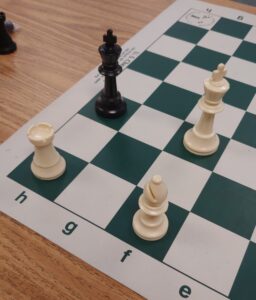
Black king is in checkmate. But what was White's last move? Can the position in the diagram even arise?
Retro two
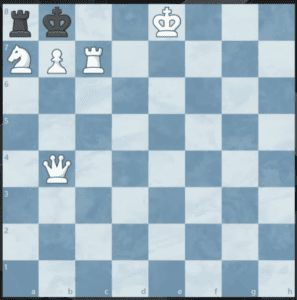
White mates immediately with his 1st move!
Retro – third treat
While the previous tasks did not require a particularly long statement – but careful reading 🙂, in the last task, reminiscent of a truly sharp pepper canapé, we cannot avoid a somewhat longer legend. (I kindly ask significantly younger readers to look up for themselves what it was about and how the interruptions of games took place...)
In a club tournament, one of the games was interrupted in the position of the diagram.
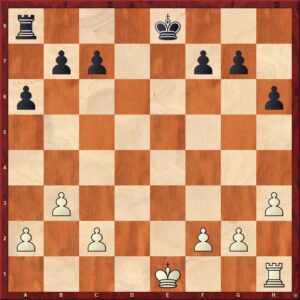
Black sealed 41...0–0–0 and White therefore already in the resumption of the game replied 42.0–0.
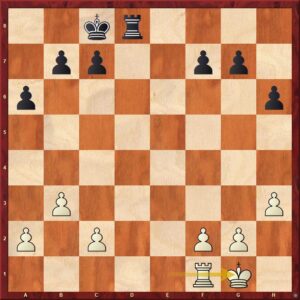
Followed by 42...Rd2 43.Rc1
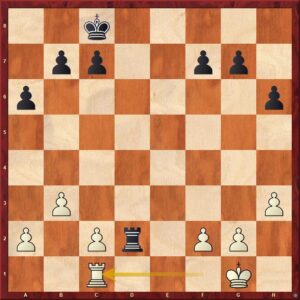
and the opponents agreed to a draw. „So what?“ the reader might say. But beware, we are going into final!
This was followed by a protest from a member of the arbiter commission, who although did not know the course of the game before the interruption, labelled White's 42nd move, that is castling, as an illegal move!
Task: Was he right or wrong, and why?
Whether you, dear readers, have exercised your neurons enough and successfully solved the tasks, you will find out below.
Retro one – solution
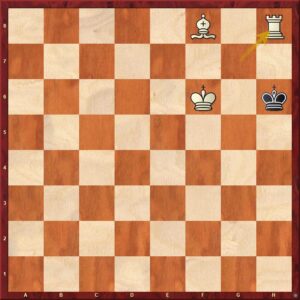
The author of the contribution acted cleverly by cutting off a large part of the chessboard in the picture. The solver must, of course, also orient themselves and find out on which squares the pieces actually stand. White's last move must have been gxh8R (which black piece the pawn captured on h8 is irrelevant).
Retro two – solution
White mates immediately with his 1st move!
If we read the task carefully, we find that it is actually not clear who is to move in the position! If White is to move, he cannot mate in one move, and if we consider the usual convention in move numbering, then if Black moves in (any) position (1…), White's first move is already numbered 2.
So the crux lies in the task formulation. This must be expressed succinctly in Czech, but without giving a hint to the solver! (From experience, I know that the task cannot be given to trainees in training, because after their logical question „who is to move“ it is impossible to answer or remain silent; any reaction or non-reaction is a hint 🙂.)
The puzzle itself, however, lies in the fact that retrograde analysis must come into play! It reveals that it is Black to move! Or put differently: it cannot be White to move, because there is no legal move that Black could have made previously. The solution and beautiful checkmate patterns can be found by the reader in the video below.
Retrograde third – solution
Retrograde analysis from practice (Troickij,A; Bílek,J; Maršálek,J)
Let us briefly repeat the task once more. The game continued with sealed moves: 41...0–0–0 and the finish proceeded 42.0–0 Rd2 43.Rc1
and the opponents agreed to a draw. However, a protest followed from a member of the arbiter commission, who, although unaware of the course of the game, declared White’s castling to be an illegal move. Was he right or not, and why?
The problem that Troickij devised concerns the issue of retrograde analysis as if from practice. The position was published in the magazine „Rigasche Nachrichten“, later reproduced in the magazine of Czechoslovak chess players under the title „A Difficult Case“.
Josef Maršálek: In the interrupted position, White and Black are missing all pieces except one rook each. None of the pawns on the board could have captured anything. Therefore, White must have captured a Black piece with his last move – or even before the pawn moves b3 and h3 – so the king or rook must have moved, at least 3 moves back, and White’s castling thus violates the rules.
In my opinion, Josef Maršálek’s explanation is flawless, but for further clarification I would like to mention a few details: 1/ we must of course assume that Black’s long castling was not illegal in itself (a sealed illegal move would have lost the game). 2/ The simplest explanation is a practical test (a kind of distant analogy to Einstein’s theoretical physics problems – simply imagine…): what could White’s last move before 41…0-0-0 have been? What could White’s penultimate move have been? And finally: what did White play before that? Neither side’s existing pawns on the board could have captured anything. (Troickij even invented the story about the game played in a club championship simply brilliantly, because such a text gives solvers a feeling of authenticity.)
Once again here we can be convinced of the truth of Tarrasch’s immortal quote!
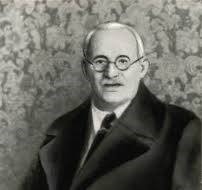
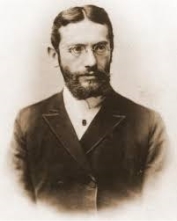
Alexei Alexeyevich Troickij (1866-1942). One of the greatest chess composers of all time. Among other things, he strengthened the link between composition chess and practical play.
Dear readers, dear chess friends. I wish you all the best for the New Year: health, happiness, love and of course many successes at the chessboard!
Well, after this I think I'll quit chess! I didn't even make a move.
Hi Svato, Honza and I enjoy retrogrades. So I solved all three, though it took me some time. Especially the second task, which also requires linguistic understanding. The explanation of the third task is correct. However, in retrogrades, all possibilities should be considered, including that a sealed move was impossible. I don't remember sealed moves very well, but the final position was just set up, meaning the game was not replayed from the start. Therefore, if the arbiter did not know the course of the game, he should have rather proposed reconstructing the game, as he suspected that at least one side made an impossible move.