
The report from this year's UzChess Cup Masters could be given a headline a metre long, and it still wouldn't capture all the interesting and important events that took place in Tashkent. The organisers invited not only a strong but also a generationally balanced lineup, and they really had a lucky hand in their selection! After all, how often in life do we watch a strong tournament ultimately won by the youngest participant with by far the lowest rating? Nevertheless, I would hesitate to report on a tournament without players from the world top ten if it weren't for a sharp generational clash not only on the chessboard but also in views on how far chess etiquette or even ethics extend, even though everything happened within the rules.
The tournament offered countless beautiful and instructive moments. This time, however, I would be most interested in readers' opinions on the widely discussed dispute after the game between the oldest and youngest participants! We naturally devote a separate chapter to this clash…
Clash of Generations
Indeed, seasoned readers may object: „Nowadays, chess generations clash almost permanently!“ Certainly, but in Tashkent it was truly something extraordinary, rarely seen at this level.
Let us look at the tournament lineup from the oldest participant to the youngest:
| Player | Country | Rating | Born | Age |
| Shakhriyar Mamedyarov | Azerbaijan | 2717 | 1985 | 41 |
| Jan Nepomniachtchi | Russia | 2729 | 1990 | 35 |
| Vidit Santosh Gujrathi | India | 2708 | 1994 | 31 |
| Hans Moke Niemann | USA | 2742 | 2003 | 22 |
| Arjun Erigaisi | India | 2751 | 2003 | 21 |
| Nodirbek Yakubboev | Uzbekistan | 2689 | 2002 | 24 |
| Nikolas Theodorou | Greece | 2635 | 2000 | 25 |
| Nodirbek Abdusattorov | Uzbekistan | 2780 | 2004 | 20 |
| Shamsiddin Vokhidov | Uzbekistan | 2637 | 2002 | 23 |
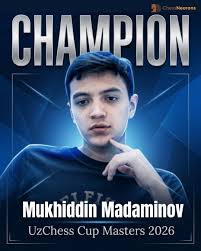
| Mukhiddin Madaminov | Uzbekistan | 2586 | 2006 | 19 |
More generationally clear:
On one side:
- Mamedyarov (1985),
- Nepomniachtchi (1990),
- Vidit (1994).
On the other:
- Erigaisi (2003),
- Niemann (2003)
- Abdusattorov (2004),
- Madaminov (2006).
Not only knowledgeable readers who look at the list of participants might wonder how a nineteen-year-old Mukhiddin Madaminov. could get into the tournament. After all, it is not exactly common for a grandmaster with a rating under 2,600 to start in the main event!
I have mentioned the likeable young man several times in articles, but always in connection with his role as a second. We saw him alongside the winner Javokhir Sindarov both at the World Cup in Indian Goa and at the Candidates Tournament. After Sindarov became Gukesh's challenger, he had to adjust his tournament schedule, and so Madaminov replaced him in Tashkent. Moreover, it is hard to talk about any kind of „protection.“ Just look at the Uzbek rating list and assume that the forty-six-year-old former FIDE world champion Kasimdzhanov probably no longer wants to play. No one else is rated higher.
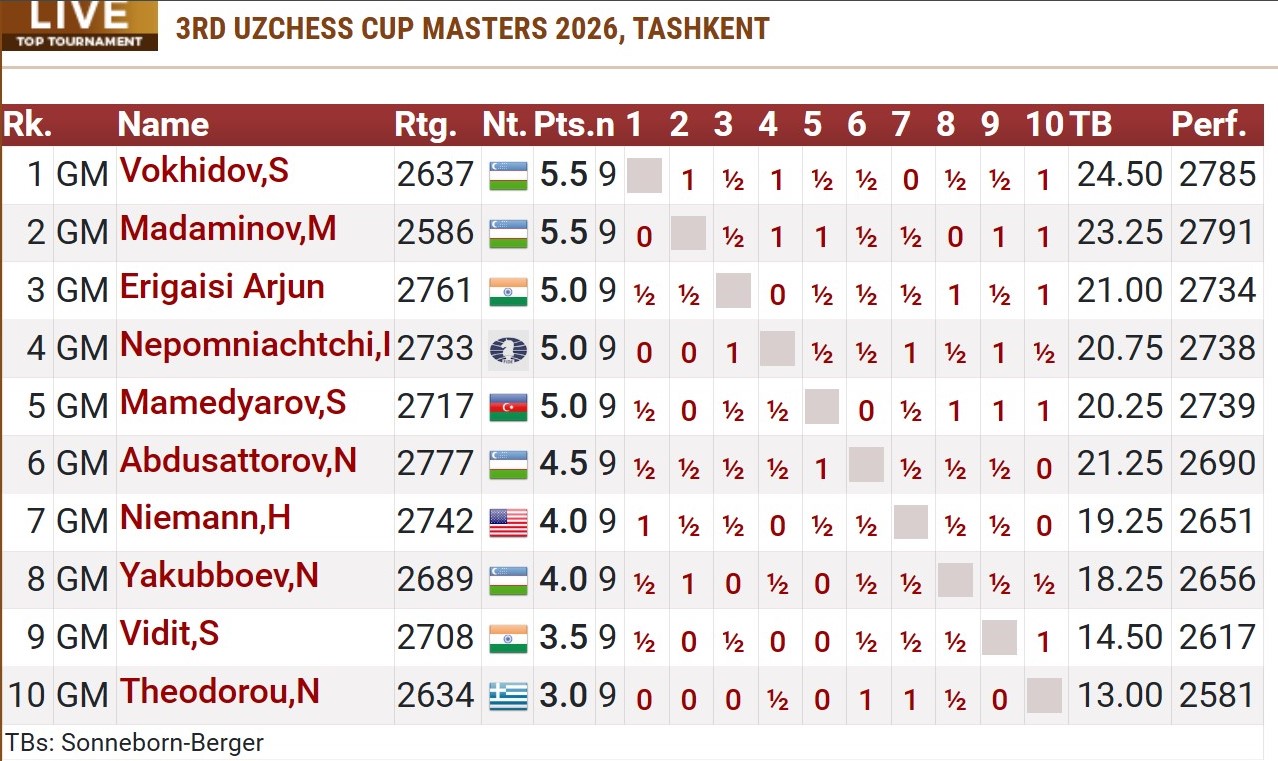
The final table on live.chessbase.com shows that the victory was shared by two Uzbek grandmasters. As is almost the rule nowadays, the ultimate winner was decided by a supplementary blitz tiebreak over two games. Madaminov won it 2–0!
Where are the limits of Madaminov's possibilities?
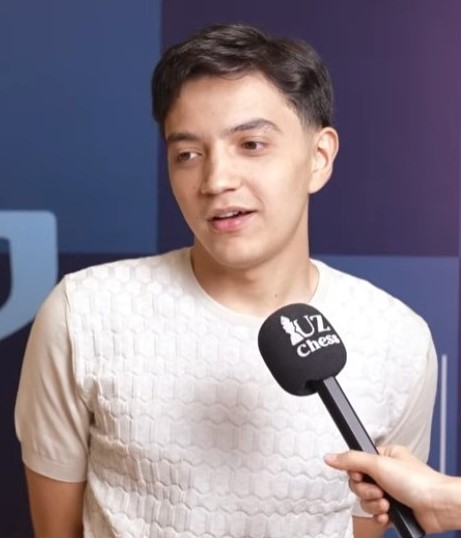
„The “incredible twists„ – as many probably characterised the victory of the tournament's youngest player of category XVII – will be the subject of further chapters. However, everyone could see Madaminov's abilities and also how unclear the answer to the question “Where are the limits of his possibilities?" was in round 6!
Madaminov started the tournament with two unexpected wins. However, he then lost in the next two rounds, so I was certainly not the only one thinking that everything was returning to the old ways.
His true abilities, however, Madaminov showed in the game against Vidit. After 23.g3
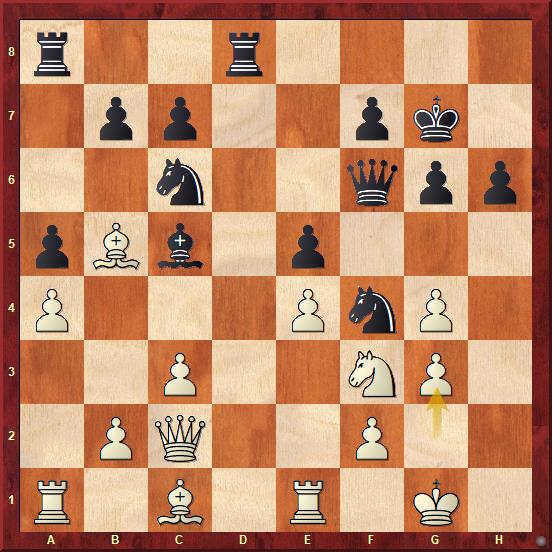
he faced a difficult task against the experienced Indian grandmaster. Where to retreat the attacked knight? Should he choose 23...Nh3+, 23...Ne6, or use the „little tactic“ 23...Nd3? (The move 23...h5!? is analysed separately and will not be the subject of our considerations here.)
Let us first look at how Black should have continued. The correct move, maintaining approximate equality, was 23...Ne6.
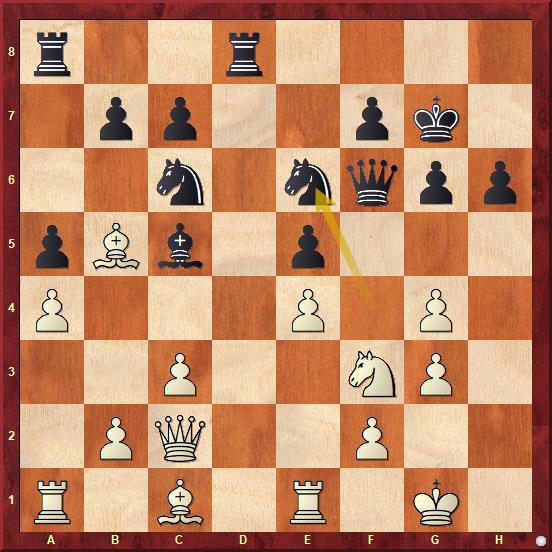
In the post-game interview (see video below), Madaminov also mentioned this moment! After the retreat, the knight hangs.
Which of the moves would you choose in the game: 24.Kg2 or 24.Qe2?
After nearly twenty-five minutes of thought, Black chose perhaps the most tempting but actually the worst continuation: 23...Nd3??
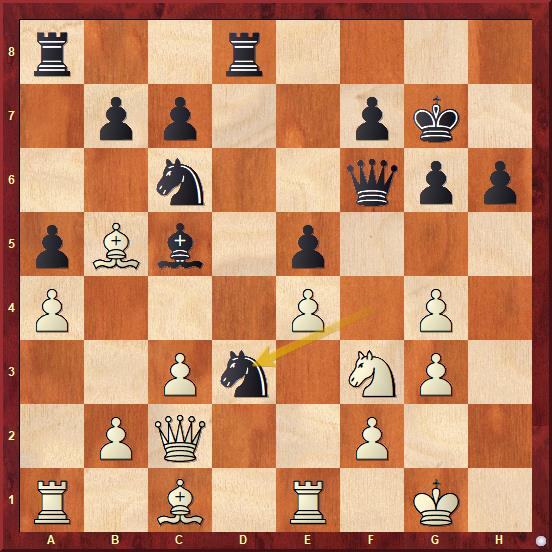
he certainly calculated 24.Bxh6+! Kg8
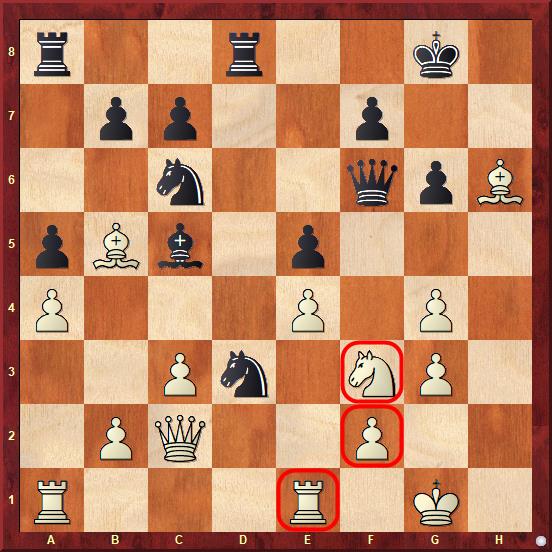
and perhaps thought something like: „White simply cannot play, everything hangs for him!“ But the move that followed belongs to those we see from geniuses. Or after it, Black falls off his chair as his vision literally darkens – and it must be said, not only his! What followed was 25.Kg2!!
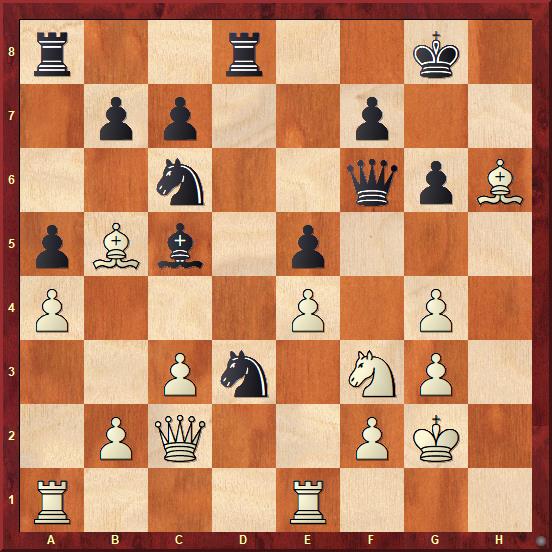
Amazing imagination! Not only does he leave his royal rook to its fate, but he does so with check! Such a move could adorn textbooks of tactics or calculation skills.
As usual, let us prefer the abbreviated notation if available. After all, even the great Sagar Shah is not a superhuman!
A very nice, albeit short, post-game interview with Madaminov on Chess24 immediately after the game. Here he analyses the moment after 23.g3!
A brilliant performance, you might say. After six rounds played, Madaminov had four wins and two losses to his name. However, now we must go back one round and look at his previous victory. That one is… well, of a different kind!
Rules. Etiquette. Ethics
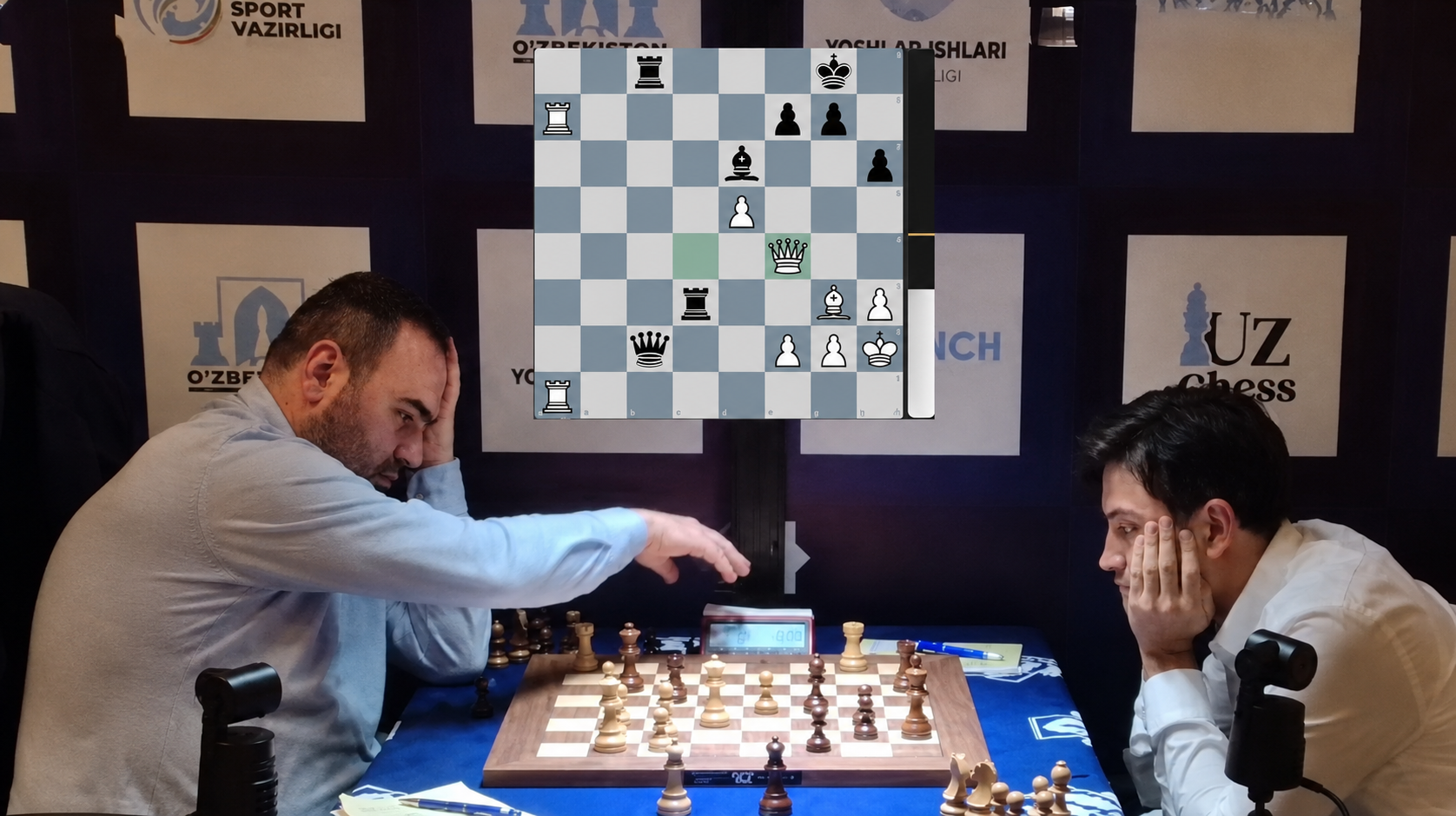
About what happened in the game of round 5 Mamedyarov (2717) vs. Madaminov (2586), but especially about the subsequent dispute, when the former world number two Shakhriyar Mamedyarov did not shake hands with his opponent after resigning, which could be endlessly debated.
I would really appreciate it if readers of my website also expressed their opinion!
But first, let us return to the whole history of the dispute. In the position after 32...Rae1 33.Rd3!
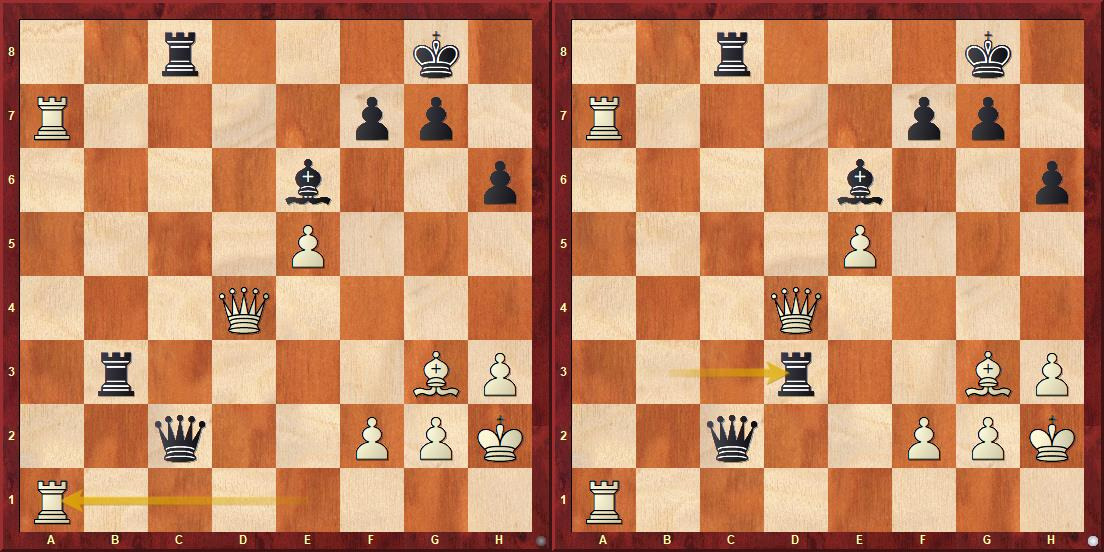
White actually has an extra pawn, but given the remaining material on the board and the „bleached“ queenside without pawns, the position is in full theoretical balance.
After about fifty seconds, however, Shakhriyar continued with an unbelievable blunder 33.Qf4??
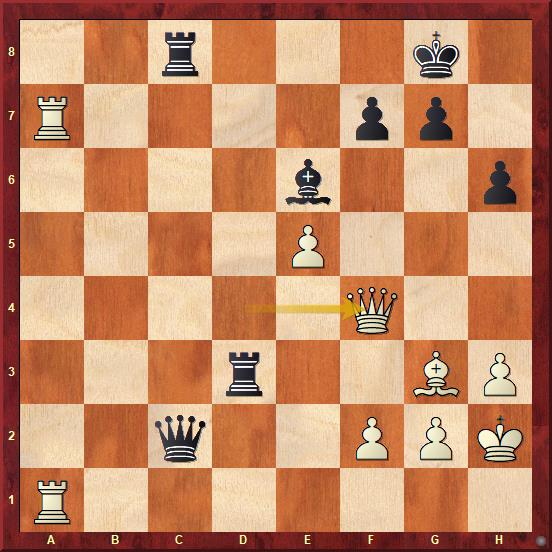
and after 33...Rc4
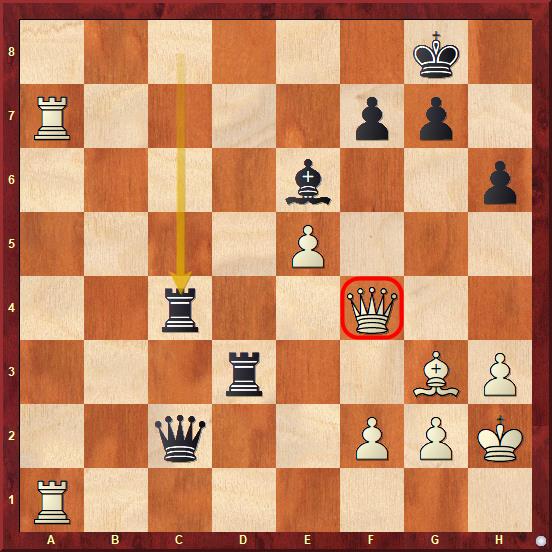
he resigned after another four moves!
The following approximately seven-minute video does not explain everything by far, but it shows the end of the game and an angry Mamedyarov (angry not only at himself). So let us first look at what actually happened.
Shakhriyar's post-game statement and another recording of the incident can be watched here:
Dispute
After watching the end of the game, Mamedyarov's interview, and the whole game in the viewer, it is time for a short reflection. The dispute between the two grandmasters can be viewed from several angles. Some will judge the whole situation exclusively according to the written FIDE rules. Others will believe that, besides the rules, there are also unwritten principles of chess culture, mutual respect, and sporting honour. It is precisely on this borderline that heated discussions have developed on social media and under most videos dedicated to the whole affair.
Let us therefore try to set aside emotions and sympathies for both protagonists and look at the whole dispute from three different levels. First, from the perspective of chess rules, then from the perspective of chess etiquetteand finally we ask the question whether it is even possible to speak of an ethical problem.“
Rules
Let us start with the simplest – the FIDE rules. They quite precisely specify how a draw offer should be made. The player first makes their move on the chessboard, then offers a draw to the opponent, and only afterwards presses the clock. From that moment the offer is valid and the opponent may accept it, decline it, or decline it by making their own move.
The current FIDE rules no longer specify a maximum number of draw offers nor a minimum time interval between them. However, if a player repeatedly offers a draw or clearly disturbs the opponent in doing so, the arbiter may consider such behaviour as unacceptable harassment and intervene. Compared to the rules valid several decades ago, there is thus more room for the arbiter’s discretion in this area.
At the tournament in Tashkent, a milder variant of the so-called Sofia rule applied, according to which it was not possible to offer a draw before move 30. As is evident from the fragment of the video recording, the offer was made after the move 30...Qc2.
And now an interesting point. From the incomplete video recording it even seems that the young Uzbek addressed his opponent at the moment when Mamedyarov’s clock was already running. However, since I was unable to find a recording capturing the entire incident, it cannot be determined with absolute certainty whether the draw offer was made before pressing the clock, as prescribed by the FIDE rules, or only afterwards. We will therefore proceed on the basis of the „presumption of innocence“ and assume that Madaminov did not violate the rules.
In such a case we can draw a fairly clear conclusion. From the perspective of the FIDE rules, Madaminov committed no offence. The draw offer was made in accordance with them and there is no indication that the arbiter should have any reason to intervene in the situation. If a dispute arose between the two grandmasters, its cause must be sought not in the FIDE rules but on another level.
Etiquette
If from the perspective of the rules the situation is fairly clear, the area of chess etiquette offers a considerably wider scope for discussion. Unlike the rules, it is not about binding norms but a set of unwritten customs that have developed in the chess environment over decades. Their observance cannot be enforced by the arbiter nor sanctioned, yet they are considered by many players to be a natural part of chess culture.
Just as social etiquette regulates many situations between people – for example, who offers a handshake first – the chess world has created its own set of unwritten customs. These naturally differ according to environment, traditions and individual generations.
Here the cultural environment can also play an important role. Azerbaijan and Uzbekistan belong to a region where the relationship of younger people to elders is traditionally more formal than in most Western European countries. Respect for age, life experience and achieved results is understood here as a natural part of social life.
At the same time, however, it cannot be overlooked that even in these countries a new generation of chess players is growing up, shaped (not only) by the global environment of the internet, online tournaments and professional chess, who may perceive similar situations much more pragmatically than their predecessors.
In our case, moreover, it was not just a difference of twenty-two years. Mukhiddin Madaminov faced a former world number two by rating, a player with more than twenty years of experience at the absolute world elite and approximately 150 Elo points higher rating. These circumstances could have created in Shakhriyar Mamedyarov's eyes a natural chess hierarchy, in which the initiative to offer a draw should rather come from the more experienced or stronger player, if he really wanted it. (And we are not taking the specific position into account here!)
On the other hand, it should be added that such expectations are nowhere codified and there is no unified opinion among chess grandmasters either. The younger generation often understands a draw offer merely as one of the means allowed by the rules, while some of the more experienced players still see a certain social dimension in it. It is therefore not surprising that the question of chess etiquette sparked a much livelier discussion after the game than the FIDE rules themselves.
It is therefore not difficult to understand why Mamedyarov could have perceived Madaminov's draw offer as a breach of the unwritten rules of chess etiquette, even though it was perfectly permissible under FIDE rules.
Ethics
We can use the following position as a standard to explain one of the logical attitudes towards draw offers during the game, in my opinion.
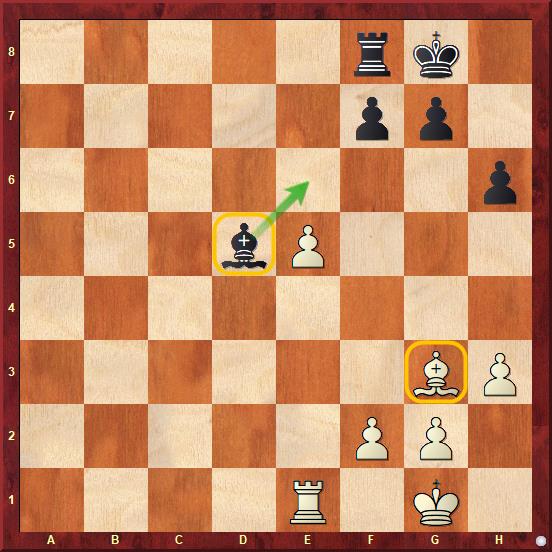
Before us is a formally (theoretically) balanced endgame. If Mamedyarov had not made a gross mistake and the game had continued normally, this or a very similar position could have arisen. It is quite believable that in the game there would have been an exchange of queens and one pair of rooks.
And now, dear readers, imagine that this position stood on the board. We have Black. Do you think it makes sense, or on the contrary completely lacks relevance, to offer a draw for example after the moves 33.f4 Re6
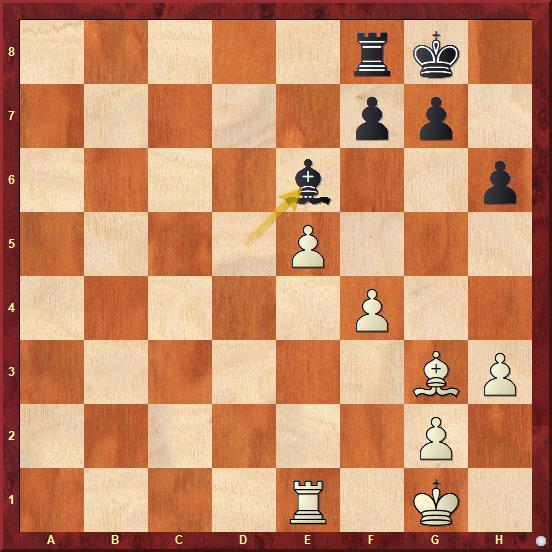
? Of course, we have the right to do so, but what matters to us at this moment is the sense of the offer!
Without taking into account the rating difference between the two opponents now, simple logic dictates: If White does not want to play this endgame – played, as they say, for two results – any further, he logically offers a draw himself!
So what sense did Madaminov's offer have? Why did he actually offer a draw?
This very question was asked by many commentators and viewers on social networks after the game. The answer is not at all simple.
If we start from the logic of the above-mentioned endgame variation, one consideration suggests itself. Black has one pawn less, less time on the clock and faces an opponent with a significantly higher rating and huge experience. If, on the other hand, White did not want to continue playing and was content with half a point, he could have offered a draw himself.
One possible explanation is that the young Uzbek grandmaster really believed that the position was objectively drawn and offered a result he considered fair.
A second possible explanation, which was heard in many internet discussions, is much less pleasant: the draw offer could have been a deliberate attempt to disrupt the opponent's concentration in an extremely sensitive phase of the game!
Let us admit, however, that none of these explanations can be proven. We cannot see into the mind of Mukhiddin Madaminov, and only he knows his true motive.
Nevertheless, one fact cannot be overlooked. Every more experienced chess player knows how extraordinarily fragile concentration can be in the fourth or fifth hour of the game. Sometimes it is disturbed by an unexpected sound, other times by a conversation in the next room, or it may be enough for the opponent to start unpacking a snack at a crucial moment (who among the veterans would not know hard-boiled eggs or schnitzels).
An offer of a draw is, of course, a completely legitimate part of the game. However, if it were used not with the aim of reaching an agreement, but only as a means to unsettle the opponent psychologically, it would no longer be a matter of rules or etiquette. Such behaviour could be described as a breach of fundamental ethical principles.
Was this exactly the case? Today, we cannot answer this question with certainty.
Conclusion
Was the draw offer from an opponent twenty-two years younger and significantly less experienced in this situation merely a breach of chess etiquette, or already a sign of disrespect, thus an ethical problem? Or do you, dear readers, believe that moral questions do not belong in this dispute at all and that the only decisive boundary is the firmly established FIDE rules?
The dispute between Shakhriyar Mamedyarov and Mukhiddin Madaminov will subside. However, the question remains. Should we assess similar situations exclusively according to the written FIDE rules, or do unwritten principles of respect, tradition and sporting honour also have their place in the chess world? Each reader will have to find the answer for themselves.
And what is your opinion? I would be glad if you share it in the discussion below the article.
On the very edge of human calculation
I was completely captivated by the combination in the game of round 6 Nepomniachtchi vs. Erigaisi! Immediately after I downloaded the games on Friday evening and began to go through them, I stopped at the following position.
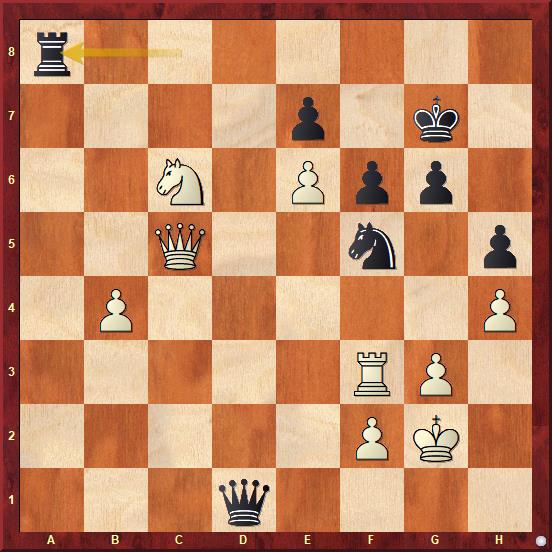
Well, and when I also saw that Jan Aleksandrovich spent 41.Nxe7 (it does not look like it at first, but this is the beginning of a very complicated combination) a whole 9 minutes on the following tactical strike, it was as if a claw got stuck in my brain. And it did not let go!
This was followed by a forced 41…Nd4
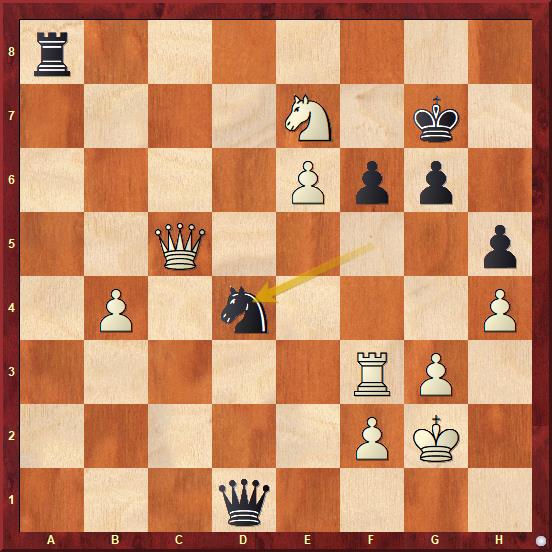
and after 50 seconds a brilliant 42.Rxf6!!
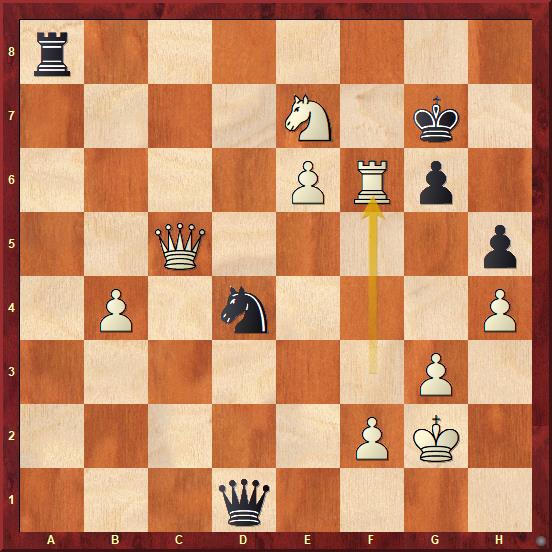
From the perspective of pressure on the imagination – the combinational instinct, finding such a tactical strike is certainly not very difficult, after all, a rook sacrifice threatens „almost anyone“. The problem lies elsewhere – in the extraordinary complexity of the calculation that White had to carry out actually before the 41st move.
Before us stands the true and genuine „Kotov's thicket“!
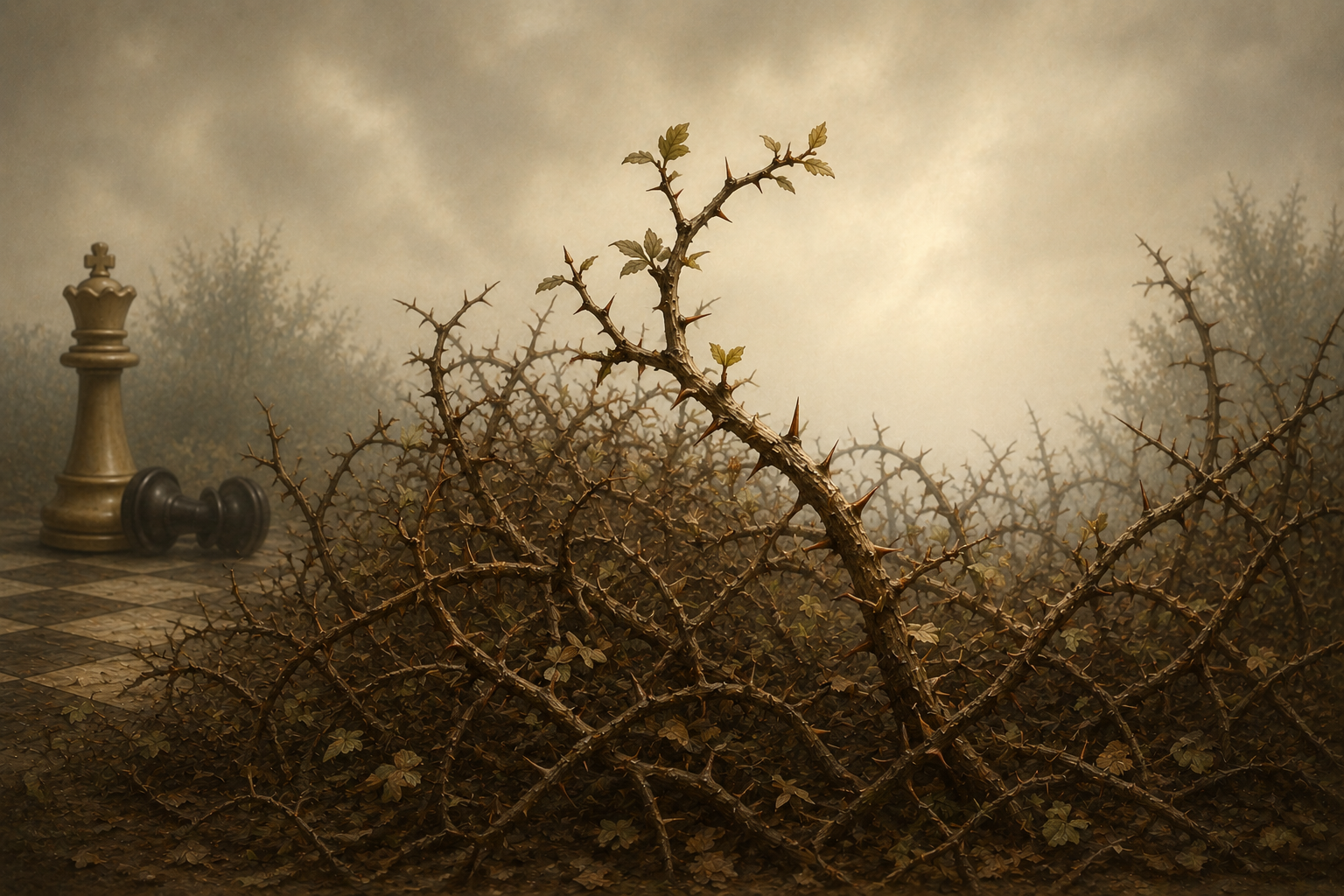
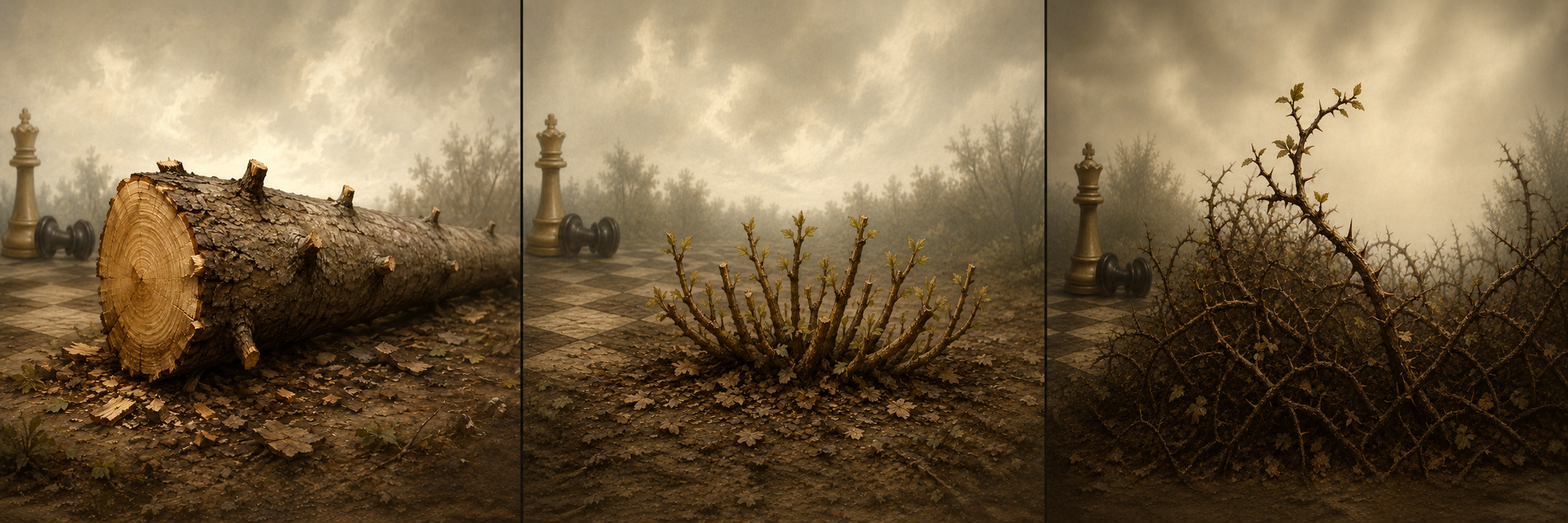
To readers who have undergone classical education, having grown up on books, I will probably only remind that Alexander Alexandrovich Kotov divided positions for calculation – the calculation tree – into three main groups: trunk, bush a thicket (sometimes also aptly called a branching tree).
The parameters for dividing into groups were depth of the manoeuvre (i.e., the length of calculation expressed in number of moves) and breadth (the degree of branching of the calculation, the number of branches).
If we denote a deep (long) calculation by the sign + and a short calculation by the sign –, while expressing large and small breadth of calculation in the same way, the individual types of positions can be defined very simply; without a long verbal description, to which not only Kotov resorted, but also many authors after him.
A bare trunk indicates the parameters: depth + breadth –
The Bush on the other hand reversed: depth – breadth +; a simple example: if we suffered from complete amnesia and forgot all opening theory, then the bush would become the starting position! Twenty candidate moves, but let's admit: „We won't count much then“! 🙂
The Thicket then naturally has the measures: depth + breadth +
Everything looks straightforward in the form of a table
| Type of position | Depth | Width |
| Trunk | + | – |
| The Bush | – | + |
| The Thicket | + | + |
Nepomniachtchi also gave me great joy by publishing a video analysing his games on his YouTube channel a few days after the tournament ended. The video analysis of the game against Erigaisi is exceptionally valuable because – thanks to Jan's openness – we learn, among other things, how the grandmaster calculates variations!
And what should be appreciated even more? Jan Alexandrovich admits that before the combination began, he thought the position was decided in his favour! But it is not! Not only will we see in the viewer that the position is objectively balanced!
After 42...Kxf6 43.Nd5+!
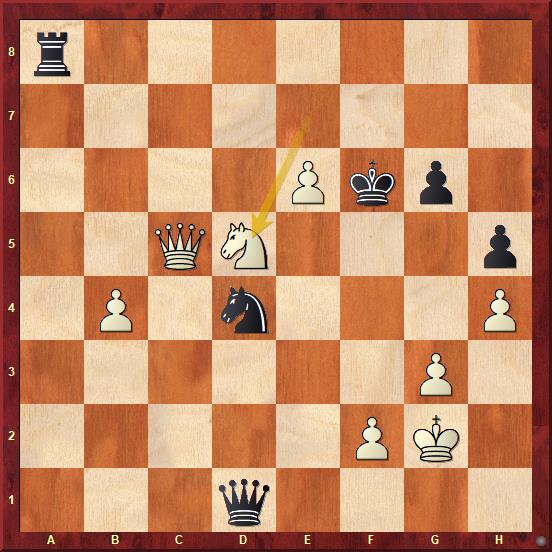
however, Erigaisi already took the wrong path at the first crossroads. After nearly fifteen minutes of thinking, he captured the pawn with the move 43...Kxe6??, while only 43...Kg7, which was the only move saving the game, maintained objective balance.
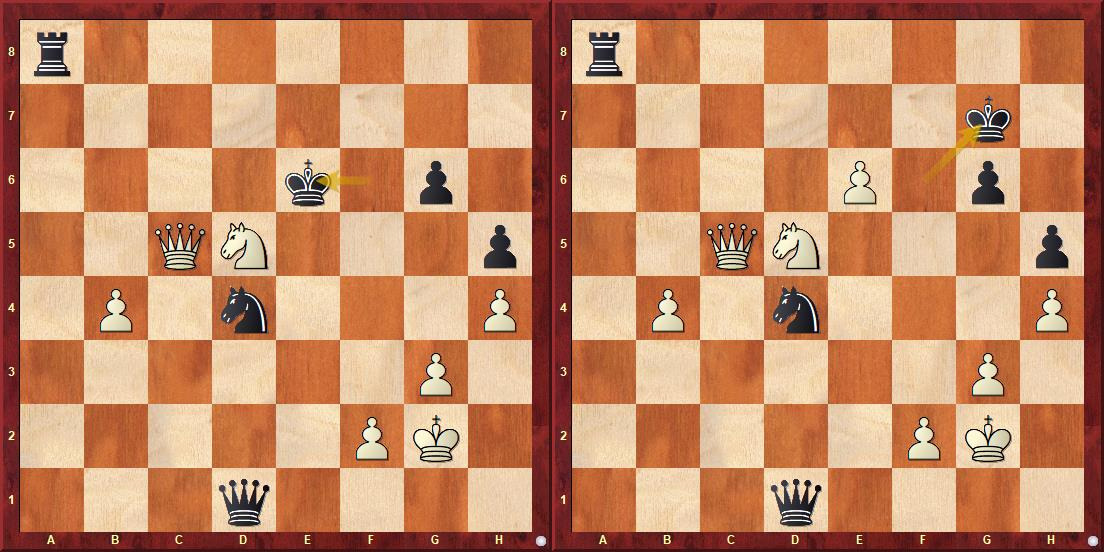
43...Kxe6 move from the game 43...Kg7□ it was supposed to be played
Let us admit – and readers will be able to judge for themselves – that the calculation of this thicket is definitely not a walk in the park. What's more, it is extraordinarily complex. Some variations are as long as 16 or 17 moves!
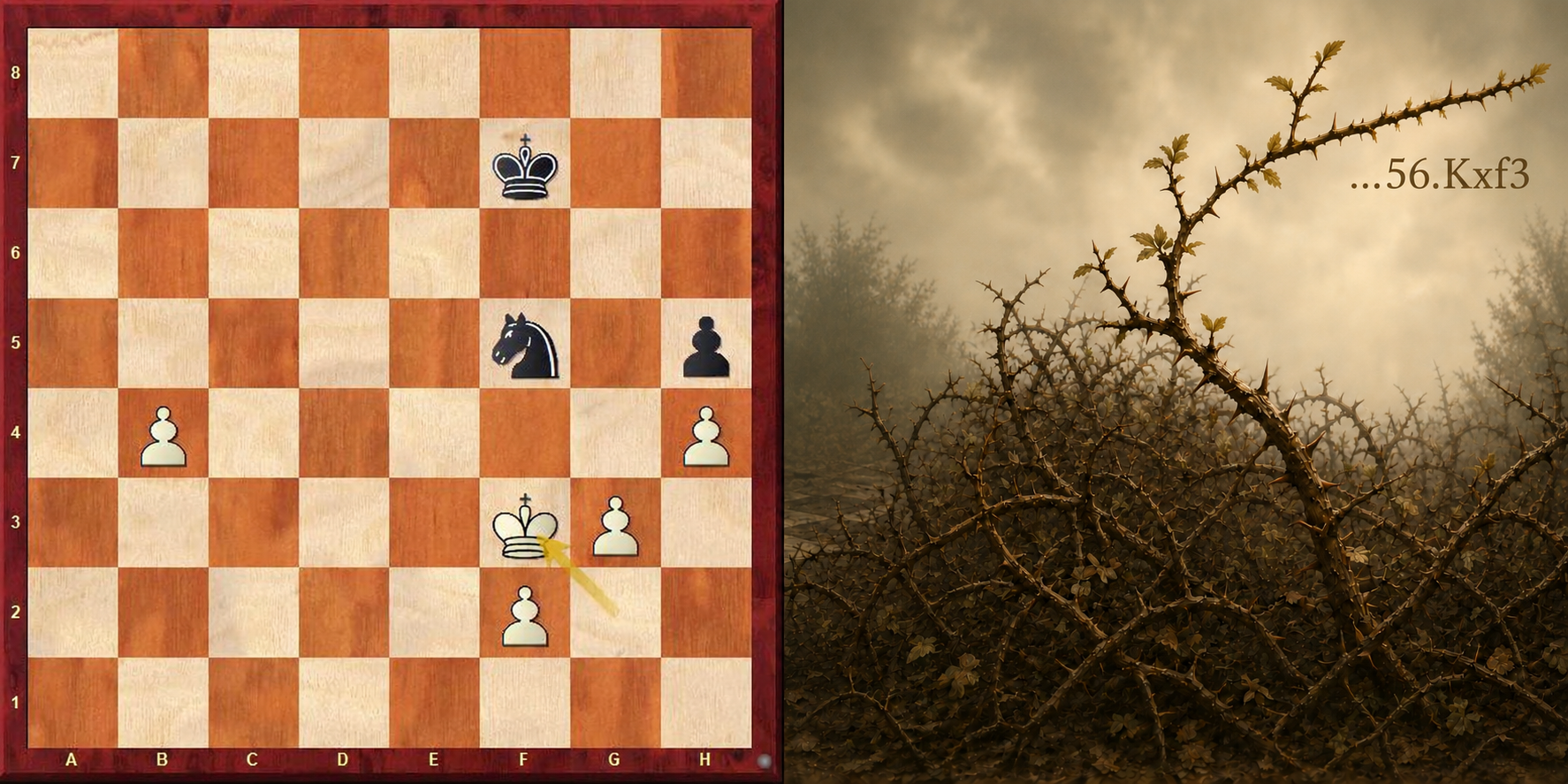
...56.Kxf3; the conclusion of one such „thicket variation“ is shown in the diagram (each branch of the thicket represents one variation). Apparently, Nepomniachtchi reached this point in one of the calculated variations!
How would you evaluate the chances of the sides after 56.Kxf3?
And perhaps one more piece of information that may surprise even more experienced readers. The end of last year and the beginning of this year marked a certain breakthrough in the field of eight-piece endgame tables. Although I will most likely dedicate a separate article to this breakthrough – and at the same time a brilliant achievement – it is appropriate to provide at least some information now.
The concept of the OP1 databases (positions in which at least one pair of pawns face each other on the same files) was created by the German mathematician Marc Bourzutschky (Mark Burcucki), one of the world's leading experts on endgame databases. In cooperation with the German programmer Niklas Fiekas, these databases were made publicly available via the lichess.org server in 2025–2026.
Let us return to the game, however.
Dear readers, I cannot resist sharing perhaps a heretical thought: While today – as we will be able to verify in at least two cases – the entire calculation is beyond the powers of super grandmasters, in times when chess players still did not forget to analyse, and thus also train calculation of variations, the world elite would have been able to do this! And perhaps not only them. At least two names of chess players come to mind who officially never belonged even to the wider world elite, but in my opinion would have fought their way through the thicket: Rashid Gibiatovich Nezhmetdinov and Ratmir Dmitrievich Kholmov. Both could be considered specialists in calculation, and thus also in „thickets“!
So, dear readers, I hope you understand that one of the first thoughts that crossed my mind when I grasped the true complexity of the variations of this thicket was a memory of Erigaisi's almost two-year-old interview. He gave it then to the Russian monthly Обозрение 64 (Obozrenije 64). Here is a short excerpt:
Who was your main role model when you were 12–13 years old?
Undoubtedly Anand! He was a true idol in India, everyone tried to imitate his style, his way of playing. But of course I followed Carlsen, I studied his career and games.
And what about older generation chess players – Kasparov, Karpov, Fischer?
No, I did not look that far back. I must admit right away that I do not know much about chess history or classical players in general. After all, let's be objective, today the level of play is much stronger.
I cannot fail to add this: Yes, openings and typical middlegame positions are better prepared today, where especially thanks to engines many new strategic plans have appeared and many previous opinions have been reassessed. However, as far as tactics and calculation technique are concerned… I have mentioned this more than once in my articles!
Let us now, as is traditional on my pages, first look at the shortened score of the entire game.
I have inserted the whole thoroughly commented game into the player, but also the combination itself – that is, the thicket of variations. For readers who are bothered by the larger number of side variations or comments during study, I remind you of one useful option. In newer versions of ChessBase (from 15 or 16) it is possible to collapse individual side variations as needed, or hide all of them with one command. The notation becomes much clearer and one can focus only on the main variation of the game.
Here you can watch the above-mentioned Nepomniachtchi video analysis.
The honesty of Jan's confession about how he calculated variations – and even that he forgot one of the ideas he had previously discovered during calculation and had to find it again – is truly unprecedented! Well, and the theorist and analyst in me cannot remain silent: Jan's remarks about returning to previously calculated variations not only turn the whole old Kotov theory of the „ideal calculation“ (which, among other things, strongly warned: „Never return to an already calculated branch!“) upside down, but repeatedly completely refute it.
In fact, it is quite the opposite: if you have enough time and energy in a complicated position, returning to already calculated variations and re-examining them is actually highly desirable!
Erigaisi charges Büttner's guns!
Epigraph: Chess is everything: art, science, and sport. (Anatoly Karpov)
Chess is everything: art, science, and sport. (Anatoly Karpov)
Motto: Chess is everything: art, science, and sport. (Anatoly Karpov)
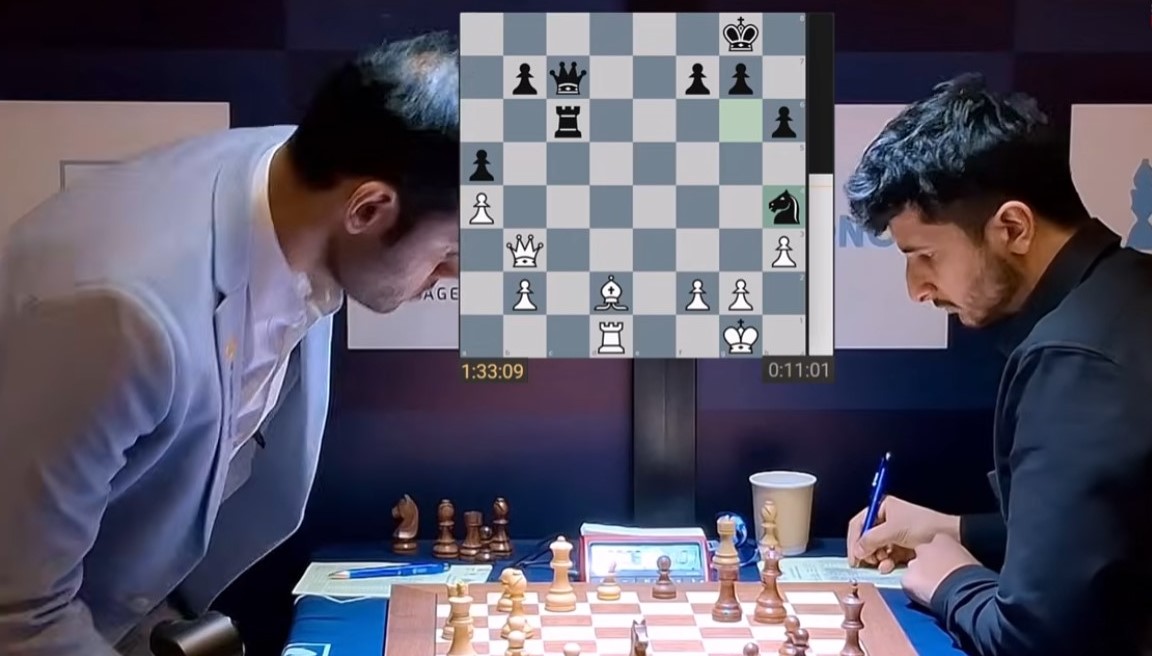
On the agenda is round 4 of the tournament, a game between well-known Indian super grandmasters Erigaisi vs. Vidit.
The Italian pianissimo has been played with c3+d3 (a variation still known for the idea that understanding the core of the position is more important than rote memorisation of variations; the lines are certainly not forced). Erigaisi has just played 27.Qb3
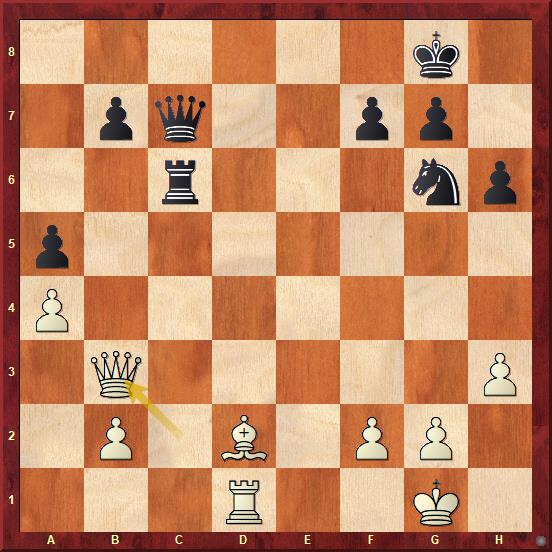
and the engines predict the expected threefold repetition. I would have left the game unnoticed, especially since it ended in a draw after move 46.
However, the clocks show that after move 27, Erigaisi „had left“ 1:33:06! Yes, you read that correctly: one hour, 33 minutes, and several seconds.
Up to this point, Arjun had been playing according to his preparation! So he had more than 3 minutes more on his clock than at the start of the game! He apparently used most of that half-minute increment on long walks around the tournament hall and returning to the board after Vidit played his move following lengthy consideration. (At the same moment, Vidit had only 18 minutes left on his clock, and after the next move, just 11 minutes!)
And I repeat: a quiet Italian game was played, which has a reputation as a variation with considerable freedom of moves (and later plans) for both sides. I do not know whether the two creators or rediscoverers of the Italian pianissimo with d3 – Sergei Makarychev and Sergei Dolmatov – were aware at the very beginning what their idea would cause several decades later. I would rather think not.
The variation became for a long time a very welcome assistant especially for White due to the character of the arising positions, which in many ways resemble the closed Spanish game (with the difference that Black does not have to enter it at all). Of course, with precise play Black cannot feel any problems. But on the other hand, both players are required to have a deep understanding of strategic plans, which are constantly being improved. So you have to stay constantly up to date!
I admit that for many years – seeing this variation – I fled to other examples. I am probably not alone! If I remember correctly, former FIDE World Champion Rustam Kasimdzhanov once commented on the variation roughly as follows (paraphrase): „I admit that I simply do not understand the arising positions at all. I feel like I am alone in the middle of a jungle without a compass and map.“
However, Arjun's memory capacity is apparently such that he is able to memorise an incredible amount of variations and branches! Will the Italian pianissimo gradually become just a memory duel? Personally, I do not think so. I believe we rather witnessed some kind of fluctuation.
Let us now look at a shortened video recording of the game (the game itself starts at about 2:40).
But who, seeing this game, probably had the greatest joy?
Jan Henric Büttner – a German billionaire and promoter of so-called Fischer Random Chess, also known as Chess960 or recently freestyle chess. In short, it can be summed up as I already stated in the chapter heading.
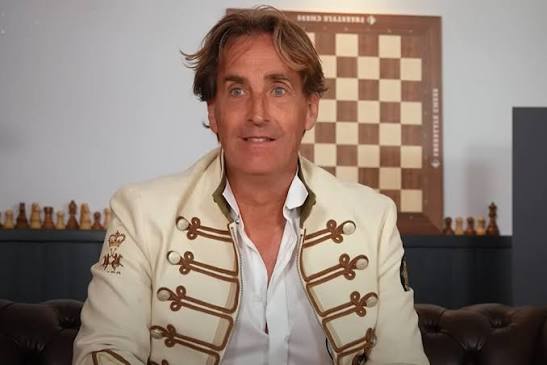
I vowed to ignore Büttner's promotional extravaganzas, the tournaments he organises, and the entire championship systems as much as possible. Well, yes, the whole „circus“ is probably only possible thanks to the support of Magnus Carlsen… and with him, I hope „Freestyle“ will gradually die out. (Notice that even the name evoking freedom was invented and chosen very carefully!)
I do not like Fischer Random Chess for several reasons and apart from a quite good mathematical exercise to check whether and why there really are 960 possible starting positions, I see nothing inspiring in it. In my opinion, it lacks some logical and strategic aspects of chess (the natural logic of piece placement, the fight for the centre…), not to mention that even after decades of training in my beloved game, I do not know how teaching this sport should look. Although, of course, I do not disdain a nice ending or combination…
„Chess for lazy people, in which out of the three areas that our beautiful game – as almost the only activity in human life – covers: sport, science and art, only competition remains today!“
Just sport – that is how Büttner's promoted beloved game could be called. At least that is how I view the current freestyle chess.
Here is Büttner's short biography available: Jan_Henric_Buettner_profile
A few days ago, we could read that this somewhat eccentric billionaire intends to run for FIDE president. His possible election (those who remember know how Kirsan Ilyumzhinov repeatedly won elections) would not hit me as hard as if Hans Moke Niemann became world champion 🙂 (he is said to achieve this by age 26), but I certainly would not feel good about it.
And so I wanted to end the chapter perhaps jokingly by writing: Arjune, don't overdo the memorising of variations. Rather study the classics and calculation… And as if by a curve, we return back to the previous chapter and the game Nepomniachtchi vs. Erigaisi… 🙂
End of the game Erigaisi vs. Vidit is not very interesting, but still… You know the "what if"… After 43.Kf7
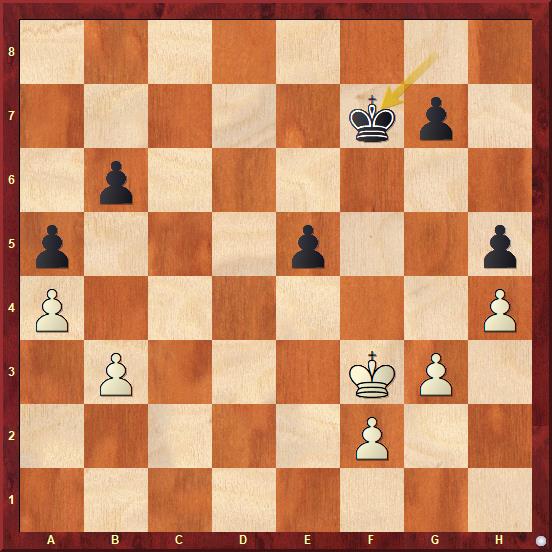
White had a better pawn structure, which often has a decisive significance in pawn endgames. Nevertheless, stronger players know – or should know – that a position with an isolated pawn in the centre ends in a draw. However, I cannot resist giving a typical example on the theme „how it ends when you want too much!“ 🙂
I will add that I sometimes present to my students an analogous situation, which we will see below in the test, from the game Barrera vs. Schatzle, Argentina 1975, although the same motif can also be found in some studies.
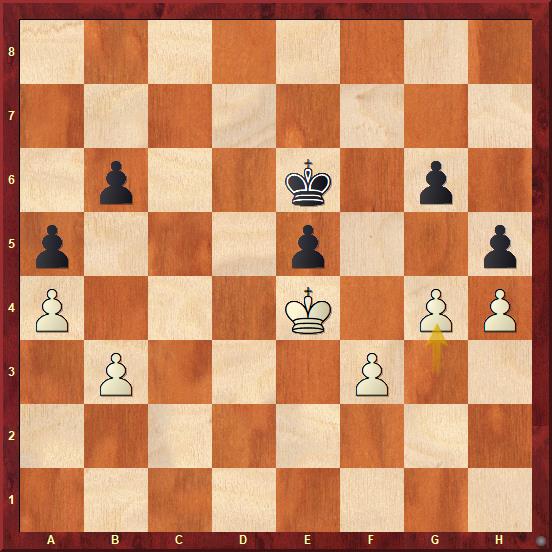
Erigaisi responded in the game 44.g4 and after 44...hxg4+ the opponents agreed to a draw after a few moves. However, a much more interesting situation for spectators and readers would have arisen after 44.Ke4
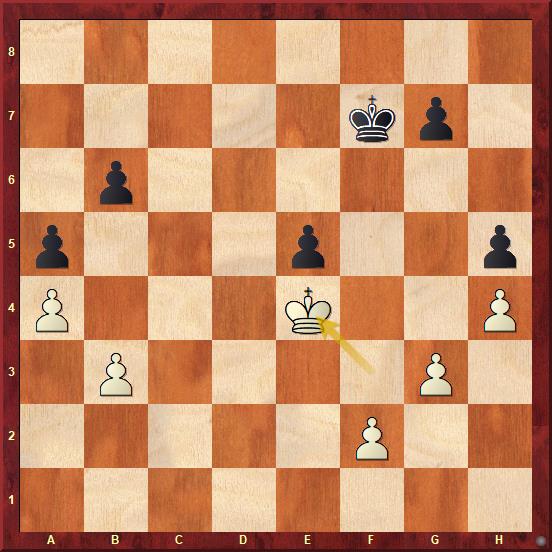
44...Ke6□ 45.f3 g6
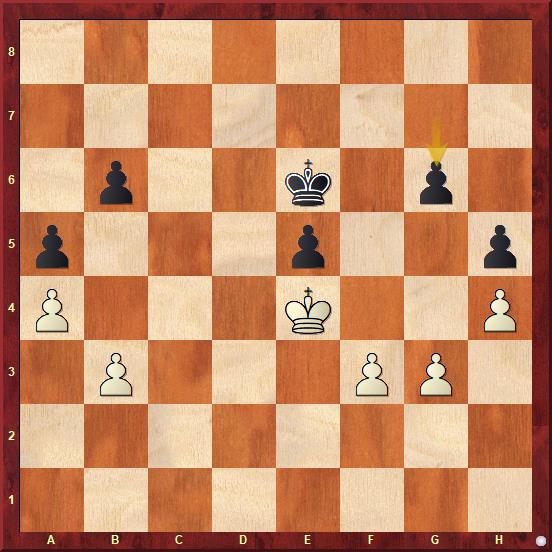
Let's now do some calculation and activate the first pillar of correct calculation technique – counting ahead! That is: JWhat would have happened in the complications after 46.g4?
From joke to tragedy
Jokes? They will pass!
A proverb would suit the last chapter and examples well: „Every bird eventually flies home.“ Fate played a nasty trick on Abdusattorov:
- in the fourth round a confident young man who, after saving a lost knight endgame, allowed himself a dance with his heroic knight,
- four rounds later the same player, broken by a single moment of inattention.
Let's first look at how Nodirbek toyed with his knight at the end of the game against Nepomniachtchi, in other words: „How the bird first flew.“
Such a creation – as is often the case – provoked more reactions on social media than Nepomniachtchi's gigantic combination and long calculation like a thicket in the game against Erigaisi. But that probably surprises no one today?
And the reason? It was probably not primarily about entertaining the spectators. In Nodirbek's defence, I will write only this: „Let's remember what we were up to at twenty-two!“
Below we can view the game in abbreviated notation, followed by Jan's analysis of the entire game (the video is set to the 50th minute).
I offer a didactic view of the endgame in the player.
Every bird eventually flies home
one would like to add! After a principled win with White in the second round against Mamedjarov, a long series of draws followed. Nodirbek just could not break through. Therefore, everyone probably expected that in round 8 he would try – even with Black – to break the resistance of the Greek grandmaster Nikolas Theodorou. After an unexpected win in the first round against Niemann he managed to lose four games by then and thus naturally occupied the bottom of the table for some time. And yet at that moment it was already quite clear that a mere +2 could very well be enough to win the tournament!
In the game Theodorou vs. Abdusattorov however, the Greek number one put up fierce resistance and the maximum Nodirbek could squeeze from the position was a rook and opposite-coloured bishops endgame with an extra pawn, but theoretical equality. Who could have guessed that after 48…Ke6
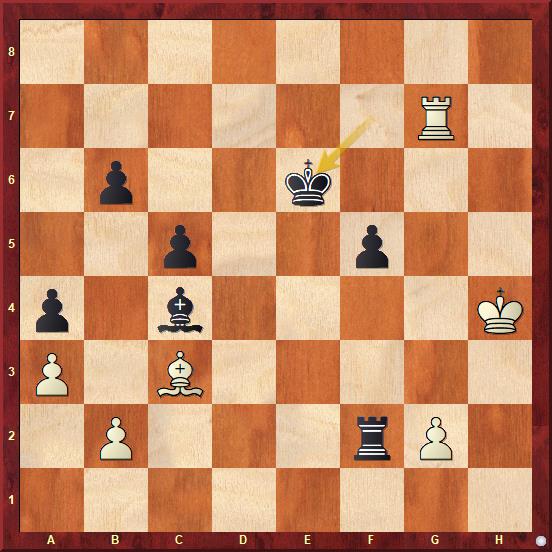
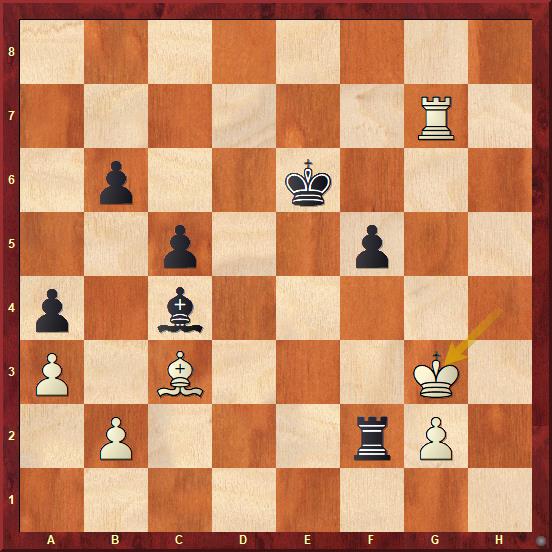
the game would end on the next move – and now pay attention – with a decisive result! Not at all. Nodirbek did not run out of time, he did not forget the clock, on the contrary – he had more than an hour in hand! What followed was 49.Kg3.
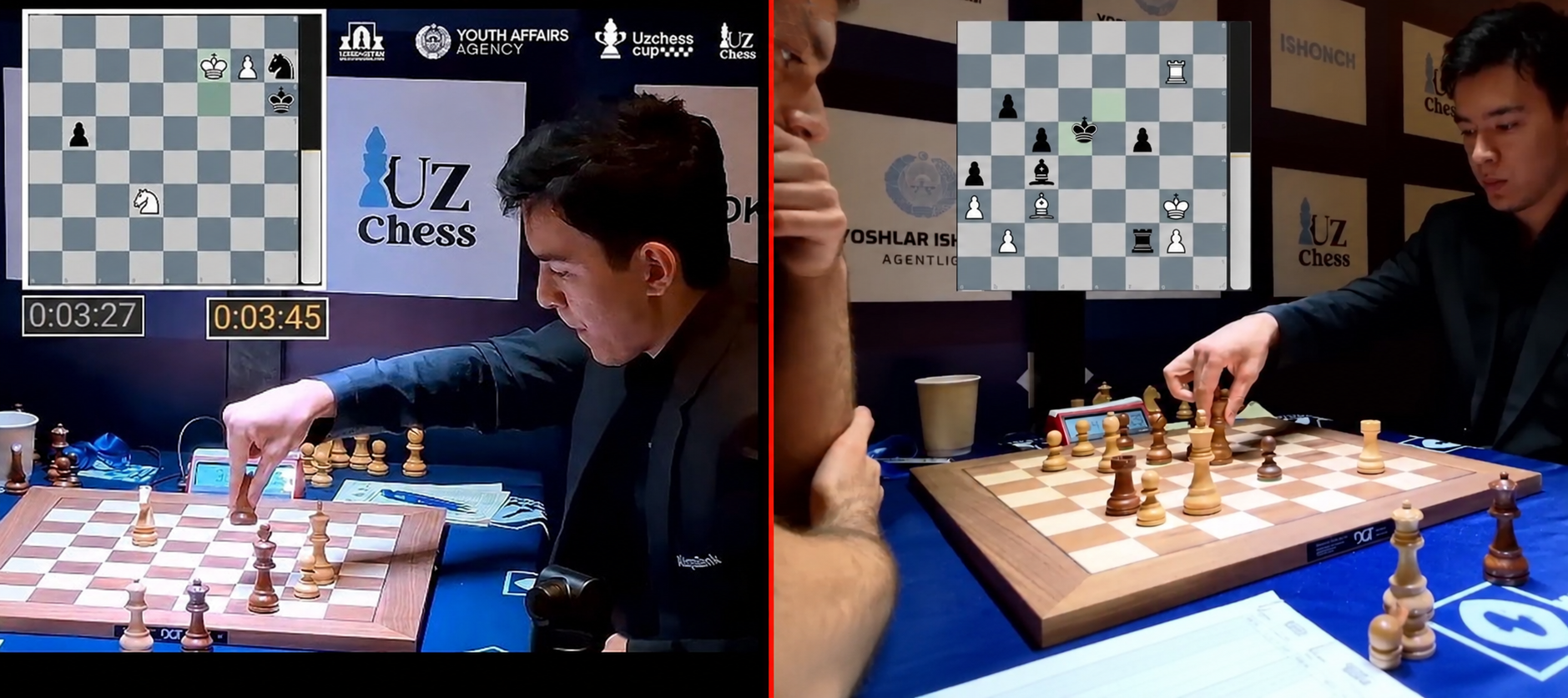
Now let's watch a short video:
In the fourth round Nodirbek Abdusattorov could afford several playful „excursions“ with his knight across the board. Four rounds later, however, came the moment when a single moment of inattention decided not only the game but perhaps the entire tournament. No, I am not claiming a direct connection between the two events. Nevertheless, I would show these two games side by side to my young pupils. Sometimes a coach says more with two diagrams than with ten minutes of preaching.
Looking back now at this year's UzChess Cup, I realise once again what an exceptional tournament we actually witnessed. A tournament that turned the paper expectations almost upside down. It was won by a substitute, the youngest participant and at the same time the player with by far the lowest rating in the starting field. On the other hand, many players rated in the 700s did not do very well this time.
On one hand, we admired Nepomniachtchi's fantastic „combinational thicket“, which once again reopened the question of the true (current) possibilities and abilities of variant calculation. On the other hand, we witnessed two serious blunders, such as are still seen only rarely at this level. And in the midst of all this, a quiet generational duel was taking place. Not only on the chessboard but also in the approach to preparation, psychology, etiquette and perhaps even the future of the royal game.
That is why, for me, this year's Tashkent will remain associated above all with a single game – Mamedjarov vs. Madaminov. Not because of a serious blunder, but because of what followed it. An offer of a draw, an unoffered handshake, the public's stormy reactions and questions that the rules themselves cannot answer. Where does the player's right end and etiquette begin? And where does etiquette end and ethics begin?
If it has been possible to open at least some of these questions and prompt the reader to their own reflection, then the article has fulfilled its purpose.