


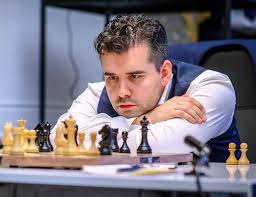
Jan Alexandrovič Nepomniachtchi maintains a narrow lead halfway through the tournament. Will he manage to win the Candidates tournament for the third time in a row?
In Canadian Toronto, half of the round-robin tournaments for men and women have been played. However, I believe that this time we cannot use the cliché „don’t count your chickens before they hatch“! In a way, we already know what the finish of the men's competition will bring. No, it is not that the tournament lacks a huge amount of dramatic clashes and brilliant ideas and performances. I mean „what FIDE has done again!“ This time, ironically, they have pulled off quite a daring stunt. In the men's event, they introduced a new, hopefully experimental, time control. And the result? A multitude of extreme time scrambles, 180-degree reversals of positions, blunders chasing blunders before the time control. It is therefore almost certain that as the finish approaches, and thus the players’ nervous systems are under even greater strain, time trouble incidents will only increase…
FIDE decided (only in the men's tournament?!) on the following time control: 40 moves in 2 hours without increment, then half an hour to the end with the usual 30 seconds increment per move! Older readers may of course object, that without the so-called Fischer clock they experienced at least half his of active chess life. I am an example of that myself.
The problem, however, is that players have become unaccustomed to playing without increment and the younger generation hardly remembers it at all. They take the increment as something natural, ingrained in their subconscious. Well, and the experiment of adding increment only in the last half hour? What is that supposed to be? A mongrel?

No comments are needed here!
In an ongoing tournament, I believe it is inappropriate to evaluate players’ performances, so apart from a few examples, tests, one similarly annotated game and the current standings table, I would like to highlight three novelties, which in their own way characterise the present day:
- The tournament currently has no clear favourite!
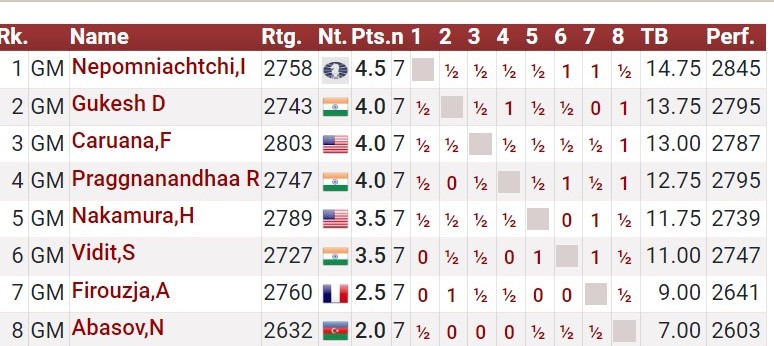
We see that between the leader Jan Alexandrovič and the sixth in the standings there is only a one-point difference! Alireza Firouzja is two points behind, so far he has attracted the most attention with his golden-rimmed glasses and green jacket worn over a blue shirt 🙂, but given that what is this young man is capable of I would not even rule him out of the fight for victory…
- Most players fall into time trouble or severe time trouble in about every second game. For example, Firouzja and Gukesh may have lost 1.5 to 2 points that way.
- A separate chapter are Nakamura's statements. In my opinion, the psychopathic character of the oldest participant in the tournaments has already become quite clear to us. On his stream he stated that more important than winning the world championship title for him is… streaming. Why all of a sudden? You don't have to be a psychologist, in the case of this American rather a psychiatrist, to reveal that Hikaru is primarily creating an alibi for possible failure or even the psychopathic character of the oldest participant in the tournaments. On his stream he declared that more important than winning the world championship title for him is… streaming. What suddenly? One does not have to be a psychologist, in the case of this American rather a psychiatrist, to reveal that Hikaru is primarily creating an alibi for possible failure or even . Well, even the American chess community, probably also under the impression of its superiority over the rest of the world, would, I think, forgive him any failure 🙂.. Well, even the American chess community, probably also under the impression of its superiority over the rest of the world, I think would forgive him a possible failure 🙂 .
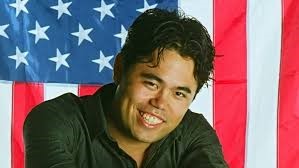
Christopher Hikaru Nakamura (*9 Dec 1987, Osaka)
Let's count
Every chess player who is interested in and follows the Candidates tournaments has probably chosen a suitable platform. Therefore, I judge that it makes little sense to analyse many games at this moment, but I have prepared diagrams for readers of the type as if. These are possibilities and interesting moments from the games. Training of calculation focuses on – as I call it – the first pillar of correct calculation, namely the so-called. principle of calculating variations to the end. (Never stop calculating if there is a forcing move in the position: check, capture, strong threat!) The solution can of course be found in the viewer below. So let's get started!
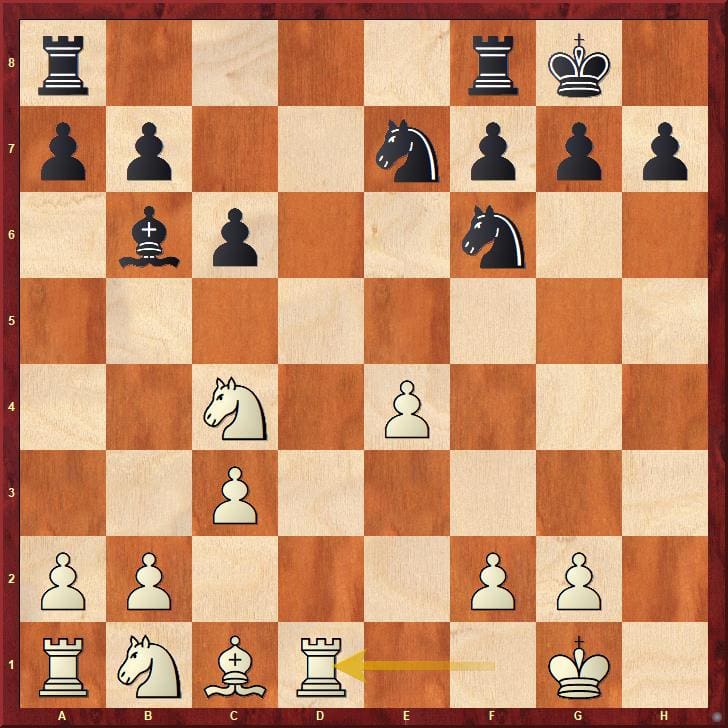
Would you take the central pawn 15...Nxe4? Yes or no? Support your opinion with chess evidence – that is, concrete variations.
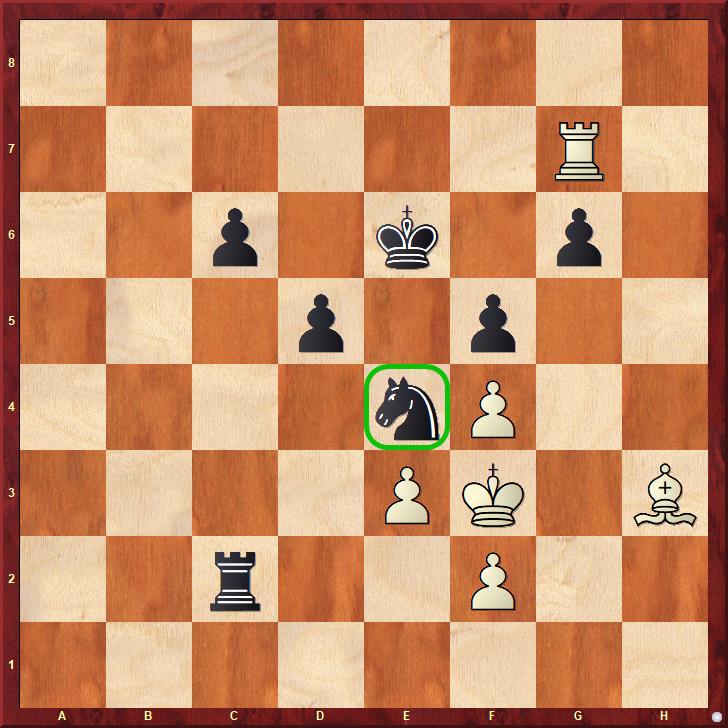
Well yes, White threatens mate, but... calculate the consequences of the variation 51.Rxg6+ Kf7 52.Bxf5.
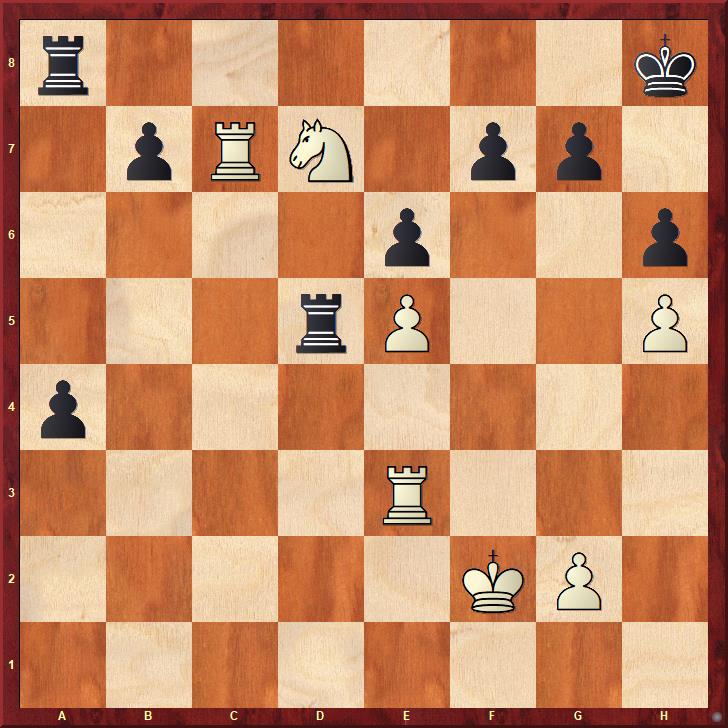
What were the consequences of the move 26...a3? Calculate… and watch out!
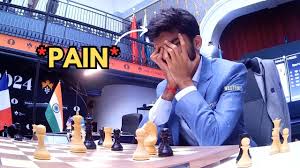
Dommaraju Gukesh after (due to severe time trouble) losing the game against Firouzja. Cynically one could say: „The clock is not just for show!“
Where can you watch the highest quality game analyses?
In the Russian-language version, Levitov Chess with Grischuk’s post-game analyses clearly dominates in my opinion! Alexander Igorevich came up with a new analysis algorithm and I believe he found the ideal way. Indeed, the time has come to strictly separate human analyses from computer analyses. Giriščuk's method will very likely soon be adopted by other commentators as well, but I still have some doubts. Exceptionally high-quality analyses (truly study materials!) surely take a huge amount of the author's energy and time, and this is not very common today even among chess coaches or analysts anymore. Eight to ten minutes is enough 🙂 .

To which type of person would you compare your potential coach or favourite streamer? 🙂
One example: Giriščuk's analysis of the games from round 6.
The prize for beauty so far goes to…
… the game Vidit vs. Praggnanandhaa. Although it is certain that this game will be commented on many times again, most likely even by the winner himself, I will still present it to readers. The extent of Pragg's memory and abilities is truly admirable. Well, since we do not find a single decisive or combative game in the tournament without mutual mistakes, in my opinion the following incredible battle deserves today’s, sadly only fictional, prize for beauty!
The clash of the thirty-somethings against the rising generation (this is one way to understand the most important tournament of the year) will surely intensify, and we can look forward to more dramatic battles and beautiful moments in the second half of the tournament. Dear readers, do you have a regular favourite? Or have you changed your mind after the first half? Well, by 22 April at the latest, we will know the names of the winners and, in the case of the men, the challenger to the 17th world champion…
Those readers who prefer the classic player will find all the examples below in a condensed form as well.
Very good work, I like how current and full of information it is, thank you.