

Another young Uzbek player achieved a remarkable feat at the recently concluded Isle of Man qualifying tournament. An elite American grandmaster with a rating close to 2700 got lost in the catacombs of the accelerated King's Indian and resigned after just 23 moves! Two winners and qualifiers for the Candidates Tournament are known, but even in the second example I have (honestly, disappointed by the play and result according to my most talented chess player of the 21st century, Alireza Firouzja... well, no pain no gain) preferred to choose a truly beautiful miniature rather than, for example, the notoriously often replayed games of the leading players of the tournament on video platforms after this or that round. So, dear readers, let us see how a super grandmaster is defeated with Black, in a closed game, by a mating attack in 23 moves, without him making an obvious mistake...
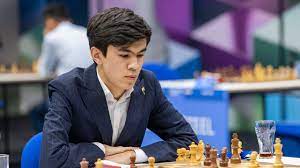
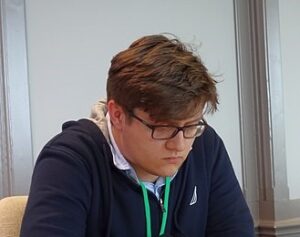
Javokhir Sindarov at the chessboard
Solid pawn structures
Before we move on to the game itself, a bit of classical strategic schooling might not hurt. If I teach or ask younger players today what the ‚Small centre‘ is, they usually have no idea what I mean. However, there were times when the basis of strategy was not individual moves but plans! (Listen sometime, dear readers, to the 14th World Champion Vladimir Kramnik!) These, as is well known, often arise in the opening and middlegame based on so-called solid pawn structures in the centre. The most classical example, which used to be almost mandatory in the literature, was the so-called ideal pawn centre. One example is shown in the diagram below.
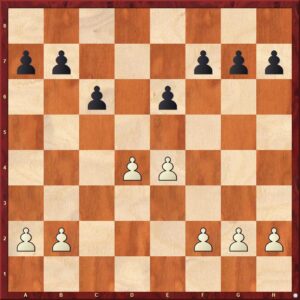
Today, not only experienced chess players surely retain an awareness 🙂, of what, for example, an isolated pawn in the centre means, including the plans of the respective sides, but the term small centre I must admit I have not seen or heard in instructional videos, broadcasts, magazines or books for a long time. Yet even according to this solid (that is, more permanent) pawn structure (which we will sometimes abbreviate as SPS in the following text) it is necessary to choose strategic plans!
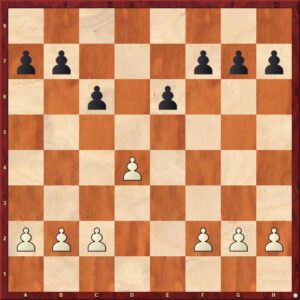
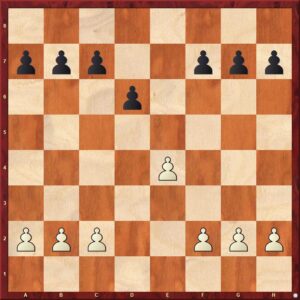
Both working diagrams depict the SPS situation called the small centre. Regarding the first diagram with the pawn on d4: Since childhood I have remembered one Nimzowitsch insight! It is based on the fact that White's plan, who controls the small centre and thus has a spatial advantage, is often to achieve the breakthrough d4-d5 (with the help of c4). The Black pawns placed on e6 and c6 were called by Aron Isaevich the „saw formation“. Why? He explained (paraphrasing): „Although the position with pawns on e6 and c6 looks passive, they can, in case of the opponent's attempts to play d4-d5, show their sharp teeth!“ just like an apparently harmless saw!
How the small centre is broken down
Let us now focus on how to fight against the small centre (MC) of the opponent. According to the classics of strategy, there are generally three ways to fight. The examples below I have taken from the King's Indian Defence, where the main role is played by the pawn on ‚e‘. This is exactly what fascinates us in the brilliant game.
So what strategic methods do we have at our disposal?
1/ encirclement of the small centre (its main architect, the pawn on e4)
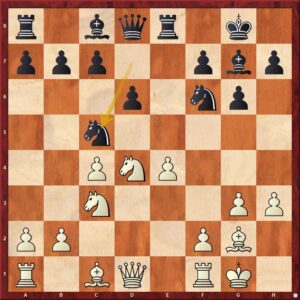
Let us add that from a general point of view in fighting against the MC, it does not matter whether White's pawn on ‚c‘ is in its original position or – as in the following examples – on c4. If we were to consider, again in a more general sense, the advantages and disadvantages of this pawn's position, we would probably easily uncover what they are. For example: the more ambitious position with the pawn on c4 controls (and may help to cover in the future) the d5 square, but permanently weakens the d4 and d3 squares...
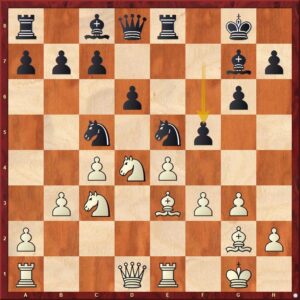
2/ 13...f5 a flank strike against the small centre. After 14.exf5? follows Nd3! with the threat, among others, 15...Rxe3! (the reader will learn much more about the linchpin of White's position, namely the dark-squared bishop)
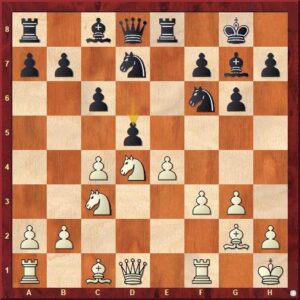
3/ 11…d5! = a central strike; generally the most radical and often the most effective liquidation of the small centre. Here, after the double capture on d5, follows Nd7-b6 and in a moment there will remain at best a memory of White's small centre, at worst a number of weak squares in the centre of the board, a weakened a7-g1 diagonal and an unfortunate king's bishop preparing to file a complaint against... the pawn on f3 🙂
From our game: Black liquidates the small centre with a central strike 9...d5!
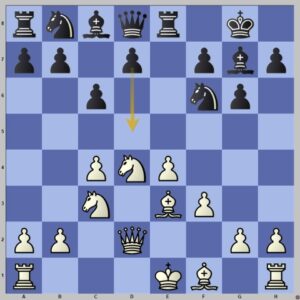
A miniature that will/circled the world
Round six of the tournament, 30 October 2023, Douglas, Isle of Man. An elite American grandmaster, Samuel Sevian, not very well known to us, takes his seat at the board...
Because, of course, apart from careful but still brief preparation for the game (there is not much time left at the tournament), he knows well that Chess Uzbekistan is primarily the former FIDE World Champion and one of the world's best trainers Rustam Kasimdzhanov, and the young players he trains or has trained open with 1.d4 the Grünfeld Indian Defence! He therefore decides to play one of the forms of the so-called anti-Grünfeld.
The first example can be enjoyed by the reader without unnecessary ‚distracting‘ digressions in the opening and finally also in the miniature itself; the second is intended, for example, for those readers who might like the system used by Sindarov. In such a case, we must of course be prepared for various digressions already in the early phases of some of our future games...

„Yes, the accelerated King's Indian! You forbade me the Grünfeld, and although I also play the King's Indian, I tried something less conventional, newer!“ such a ‚debate‘ we might have recorded, if it were possible to read thoughts 🙂
And what did the happy winner himself, strikingly reminiscent of the young Garry Kimovich, say about the game?
The wonder child

UZREPORT TV 17 October 2018: 12-year-old Javokhir Sindarov fulfilled his third GM norm at the international „First Saturday GM“ tournament in Budapest, entering the list of the youngest grandmasters in the world.
Tournament results
For readers who did not have the opportunity or time to review the final results, I am attaching them here as well.
https://skolasachu.com/wp-content/uploads/2023/11/Isle-of-Man-2023-finals-results.pdf