
Eight-minute blitz analyses…
Just look on YouTube. Short analyses of blitz games – often barely eight minutes long – gather tens of thousands of views. Fast action, simple evaluation, immediate result. In contrast, videos devoted to chess studies, thoughtful and often artistic compositions, attract at most a few hundred viewers.
The difference is enormous. And it makes you think.
Where has the depth gone?
Is it the fault of today’s rushed world? Laziness to think? Or perhaps the desire for quick success without effort?
Maybe it’s simply a change in values. Increasingly, I feel that for some young people, „beautiful“ means little more than a new smartphone – not a deep idea, combination or the aesthetic value of a chess work.
Fast formats win. They are convenient, undemanding, do not require long concentration. Chess studies, however, demand the exact opposite – patience, depth, the ability to immerse oneself in a position and seek its hidden logic. And that is apparently a scarce commodity today.

The gift of studies
Nevertheless – or perhaps precisely because of this – chess studies have an irreplaceable significance for a true chess player.
A touch of beauty
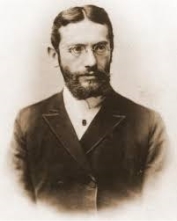
Studies are not just exercises. They are sometimes artistic gems. They can evoke the same feeling of aesthetics as music, poetry or film art. It is no coincidence that I placed the famous saying of Siegbert Tarrasch on my website: „Chess, like music and love, has the power to make a person happy.“
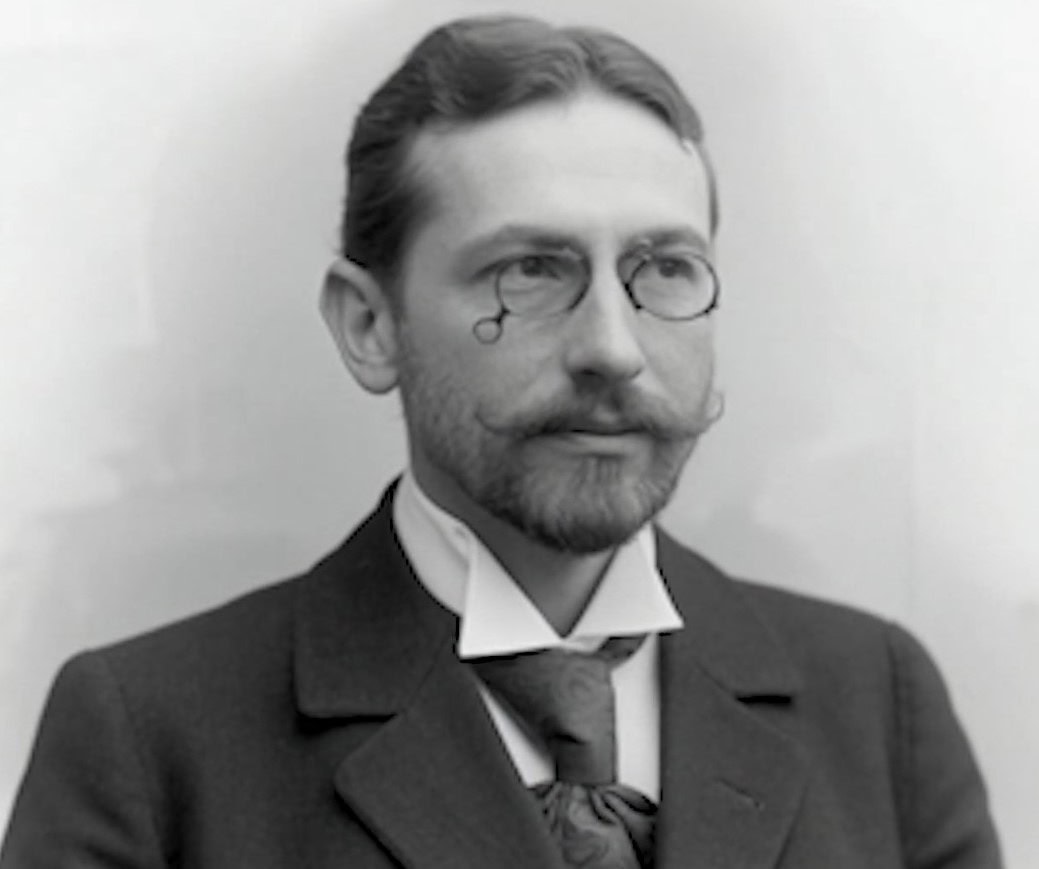
Siegbert Tarrasch (Hastings 1895)
And it is precisely in a good study that this idea is fulfilled abundantly. Anyone who has ever discovered a hidden point in a composer’s work knows what I mean.
It may be that I grew up on Russian and Soviet chess literature, and so in my opinion the most beautiful studies were created by the same faces of the past:
Alexei Alexeyevich Troitsky,
Genrikh Moiseyevich Kasparyan,
Nikolai Dmitrievich Grigoriev,
Vitaly Alexandrovich Chekhover,
Vasily and Mikhail Platov
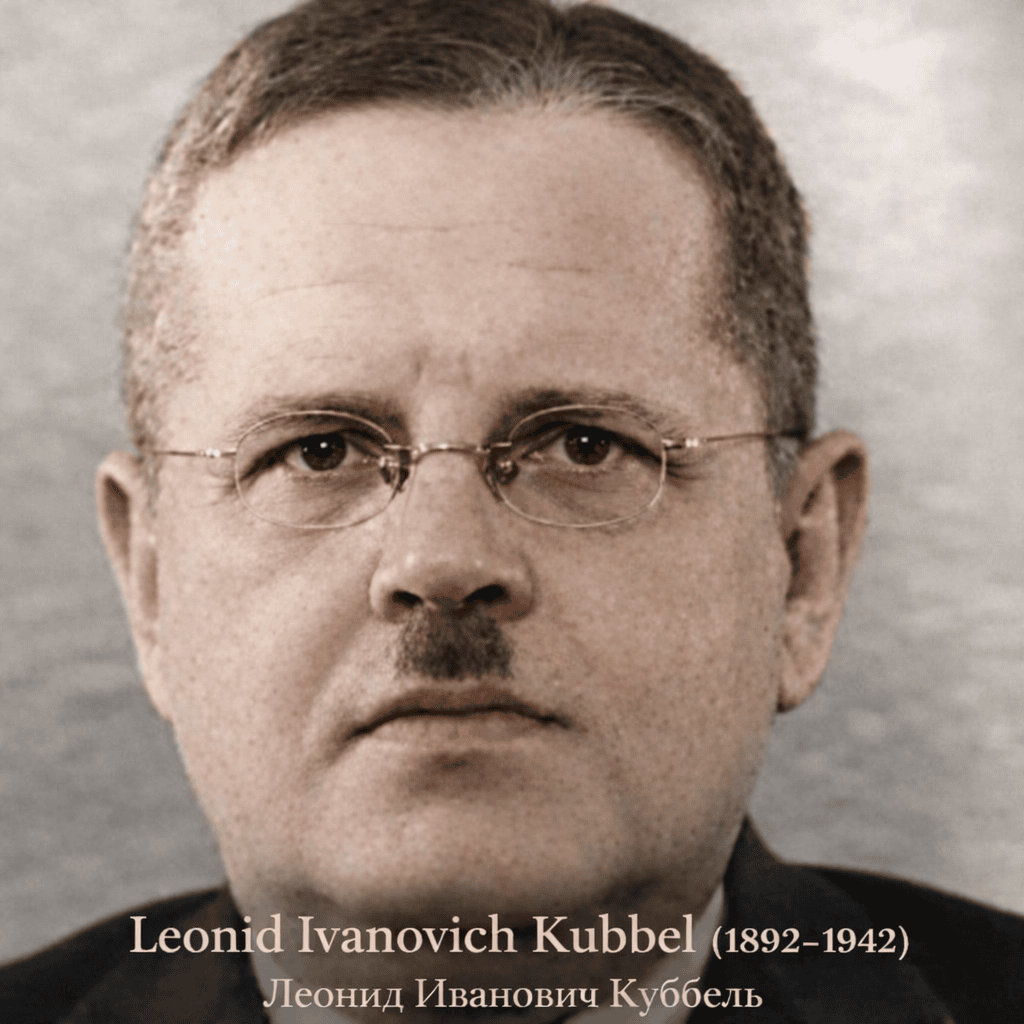
and finally my probably greatest favourite Leonid Ivanovich Kubbel (1892–1942).
It may be significant that this genius of chess composition was born in the same year as Alexander Alexandrovich Alekhine!
While in my youth and junior years I approached studies rather as training – that is, it was impossible not to solve at least one, even if it took several days – gradually I began to perceive their true beauty. And who has always been among my greatest „idols“? Precisely the latter.
I know quite a few Kubbel studies. However, I do not know why, this particular one either escaped me or I forgot it. Believe me, dear readers, it is worth it.
A bridge between study and game
Studies are not just an aesthetic matter. They also have a very concrete practical significance. They develop imagination, teach precision, the ability to calculate variations and to find unexpected resources in a position.
It is no coincidence that the importance of studies for chess growth was also emphasised by the legendary coach Mark Izrailevich Dvoretsky. In his books – for example in the work Школа будущих чемпионов - Книга 1“ (Методы шахматного обучения) 1997 – he devoted a whole chapter to the issue of using studies in training. He showed how they can help improve calculation of variations, endgame technique and overall chess thinking.
This is precisely their greatest strength: studies teach you to think. Not mechanically, but creatively.
Warming up before the study
Before I share with you, dear readers, that gem, I would like to present two diagrams. The first is also a lesson for less advanced players, the second contains my own „study“, which I devised during a night without a chessboard. However, it is based on an idea from a Kubbel study, which I discovered a few hours earlier on YouTube.
If anyone were to doubt the practical benefit of studies, my training contribution might just change their opinion a little.
Let's get to it – although initially rather „lightly“.
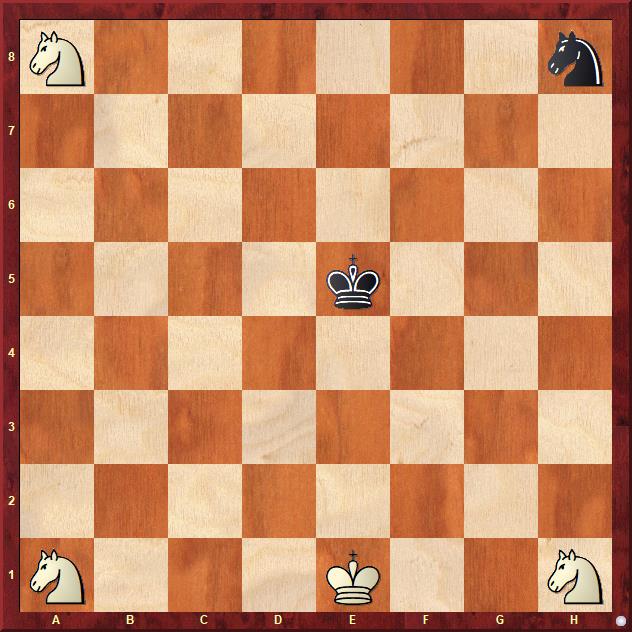
Two knights alone cannot cope with an enemy king – unless he wants to commit seppuku 🙂 – but what about the rare case when there are three knights against each other, and the king is helped only by the last piece – its own knight? Is it still a theoretical draw, or does the weaker side lose?
Well, and here I present my work. Of course, I was duly proud that I created the study attempt blindfolded. More experienced readers probably understand the tension with which I sat down at the computer the next day to verify the correctness of my position.
I naturally mean not only correctness as such, but also the question of whether the position has only one solution or not.
A study – despite everything written above – belongs primarily to chess art, and so there are actually two ways to possibly refute it. Complete incorrectness equals a common refutation, but even a „creative incorrectness“ counts. One somewhat brutal example for all: for example, two different openings cannot lead to the goal!
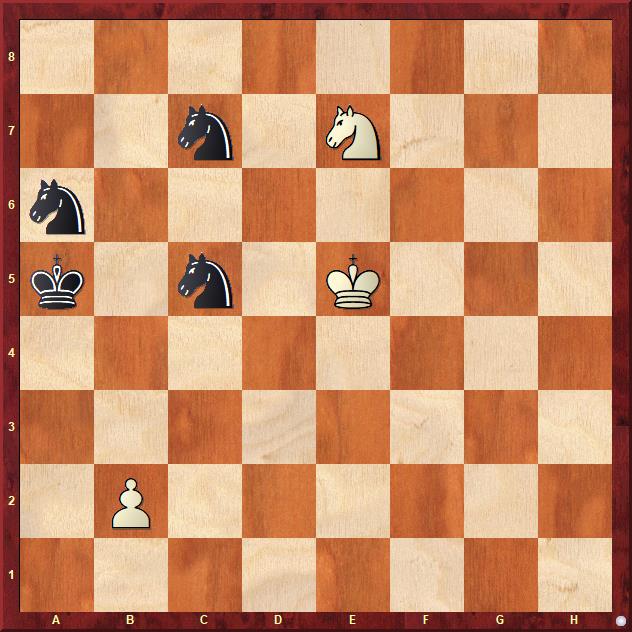
White to move. Can you find a way to a draw?
Kubbel's work
Well, and here at last I present that gem!
Kubbel,L and Herbsmann,A 1937
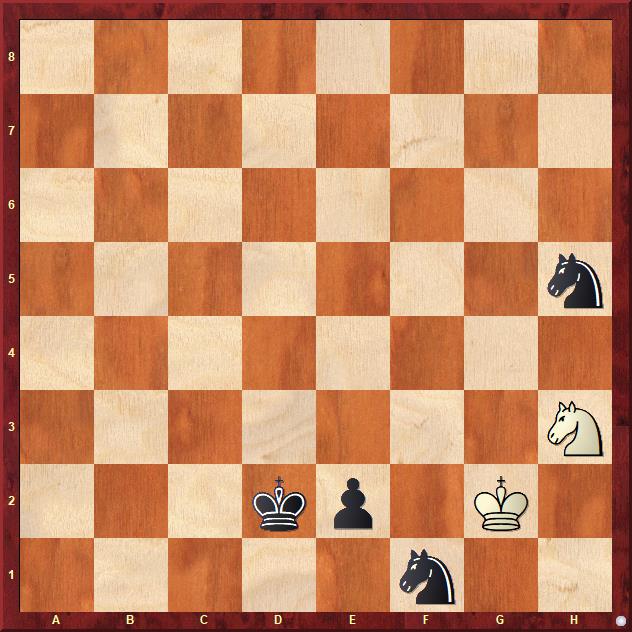
White to move draws.
The study and its solution can be viewed on the channel Beautiful Chess.
The necessary information, all examples with solutions, are available in the player below.
The difference in viewership between short blitz game analyses and deep studies is a sad but telling reflection of the times. Speed triumphs over depth, superficiality over patience.
Nevertheless, I am convinced that anyone who takes chess seriously will sooner or later find their way to studies. They offer something that no eight-minute video analysis (the second part of the word could also be debated…) can give – a sense of beauty, improvement of chess thinking and – as AI might say – an intellectual adventure!
And also a bit of luck, about which Tarrasch spoke.
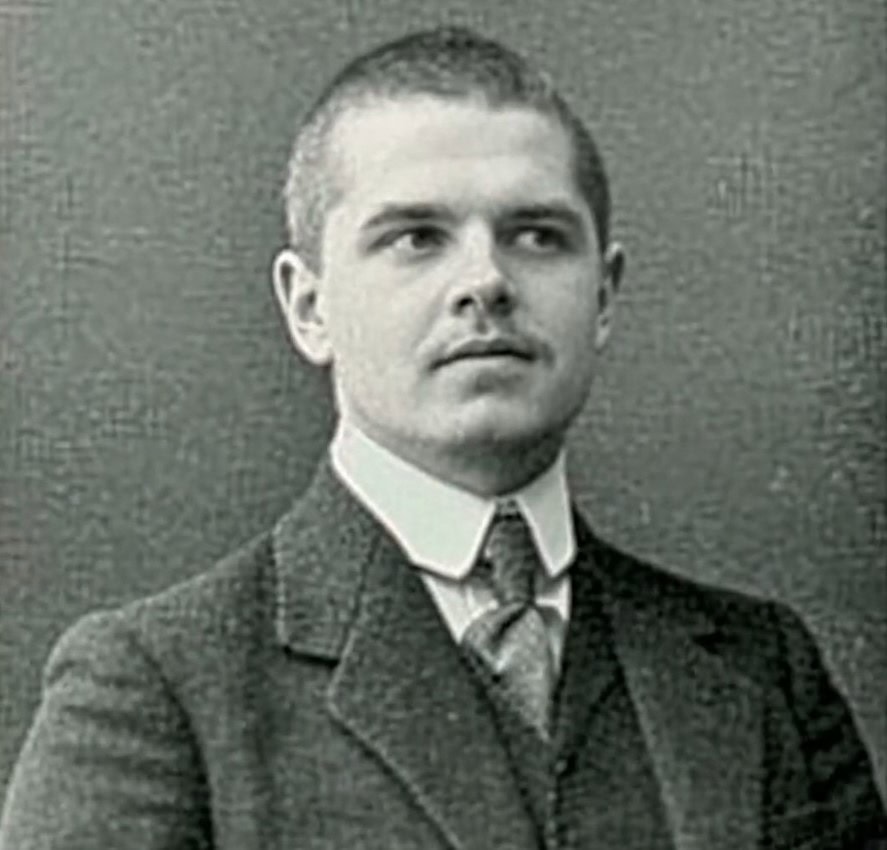
Leonid Kubbel around 1911