
On the 105th anniversary of the Capablanca–Lasker match (Havana 1921): In official lists of world champions, we still encounter the claim that Emanuel Lasker reigned from 1894 to 1921, a full 27 years. This figure is repeated so naturally that it has gained the status of an axiom. However, on closer inspection, it is a simplification, if not a factual historical error. Based on contemporary documents, it is convincingly proven that in 1920 Lasker formally resigned in writing in favour of Capablanca. If we accept this act as legitimate, then Lasker’s reign did not end in 1921 after the lost match, but already a year earlier – after 26 years.
Prologue: Brilliant psychologist – and master of calculation
Emanuel Lasker: „On the chessboard, it is not important to find the best move, but one that the opponent cannot refute.“
This quote not only characterises Lasker’s nature perhaps more than anything else. Personally, I deeply disagree with it – it goes against my conviction and the maximalist conception of chess. But here it is about something completely different!
If I read between the lines correctly, this quote shows us how firmly Lasker clung to his title! Why else would Karl Schlechter have to win the match by a full two points in 1910? And why did Siegbert Tarrasch have to wait for „his match“ until 1908, at the age of 46, long past the peak of his strength?
Lasker got so used to his title that he would have preferred to remain world champion forever. But the crafty psychologist did not have it nearly so easy with Capablanca…
One of the most respected historical chess researchers Edward Winter (about whom I write more below) quotes Lasker’s letter to Capablanca from June 1920, in which he explicitly states: „I therefore resign the title of the world’s champion in your favour… You have earned the title… by your brilliant mastery.“ That is: „Therefore I resign the title of world champion in your favour… You have earned this title by your brilliant chess strength.“
This document cannot be easily bypassed. It is not an indefinite gesture nor a later interpretation, but a direct, explicit expression of the will of the reigning champion. Nevertheless, historical tradition has leaned towards a different interpretation: Capablanca is mostly counted as world champion only from 1921, when he defeated Lasker in Havana. This „retrospective standardisation“ simplifies the chronology but at the same time obscures the real complexity of the transitional period of 1920–1921.
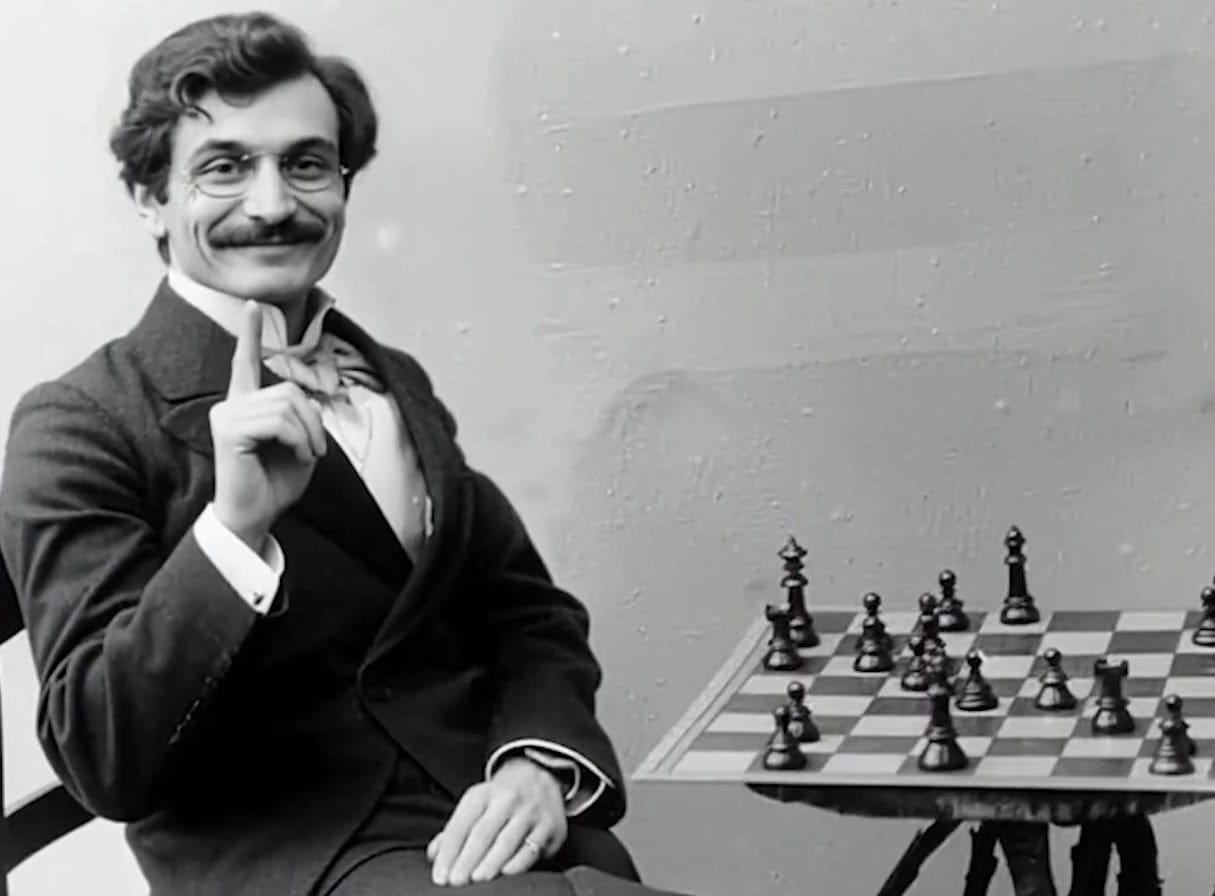
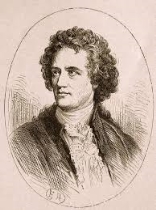
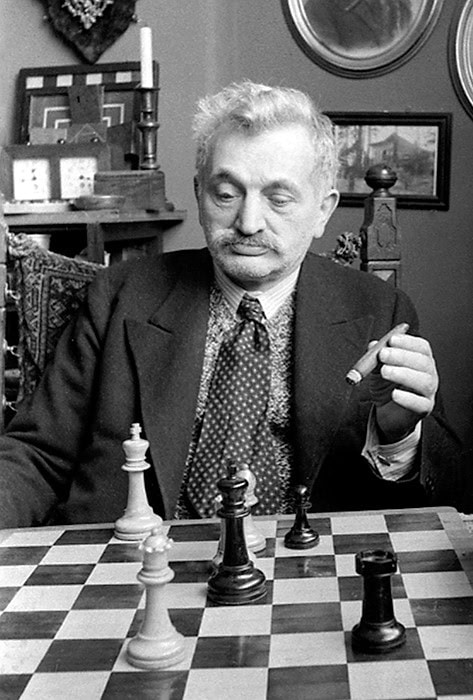
Emanuel Lasker in an AI-adjusted concept
Abdication versus appointment of a successor
The key to understanding the whole situation is to distinguish two steps that Lasker took:
- Abdication – that is, renouncing the title as such
- Appointment of a successor – that is, an attempt to pass the title to a specific person
The first step is unproblematic from both a historical and logical perspective. The reigning world champion undoubtedly had the right to relinquish the title. In this sense, Lasker's decision can be compared to modern cases of voluntary abdication (e.g. Magnus Carlsen in 2022). If Lasker had stopped at this step, his decision would hardly have caused major controversy. Not only children in schools and clubs would have learned that the second world champion reigned from 1894 to 1920.
The second step is, however, considerably more problematic. Lasker did not merely attempt to „stop being world champion“; he also tried to determine who should be the champion. And this is where he met resistance from the contemporary chess public. As Winter shows, the press and commentators questioned whether the champion had the right to „pass on“ the title, as if it were personal property. In the eyes of many, it was impossible to bypass the fundamental principle: the world championship title must be decided in a match.
It is therefore not surprising that the interpretation prevailed that Capablanca became world champion only after defeating Lasker in 1921. History chose a simpler and institutionally cleaner solution 105 years ago – even at the cost of suppressing inconvenient facts.
If Lasker had written only: „I renounce the world championship title,“ he would have changed history!
The year 1921: world champion or challenger?
Another remarkable moment that Winter points out is Lasker's attempt in 1921 not to appear as the reigning world champion, but as the challenger. After securing the financial conditions for the match in Havana, Lasker agreed to play it, but insisted that the title already belonged to Capablanca. The Cuban accepted this formulation.
This fact is extraordinarily significant. It means that at least from the perspective of both participants in the match, the title had already been transferred before it began. The match would then not have been a defence of the title, but an attempt by the former champion to regain it. However, such an interpretation was not widely accepted and remained more of an episode than a definitive interpretation.
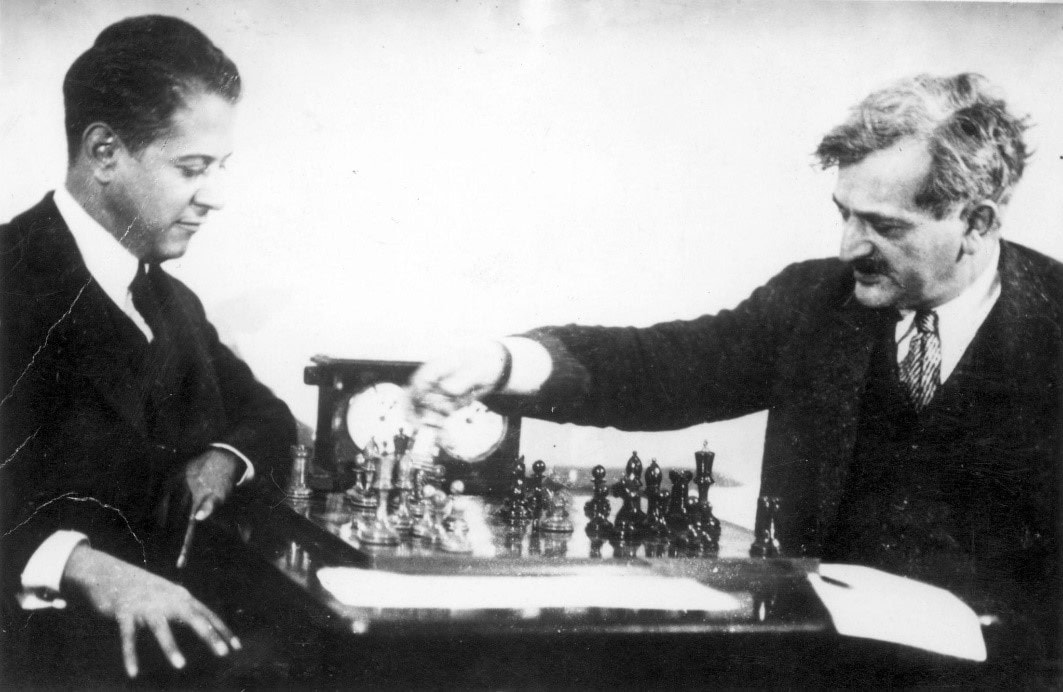
The 1921 match brought another remarkable circumstance: the defeated challenger received a higher financial reward than the winner. Lasker received 11,000 dollars, while Capablanca only 9,000 – and that regardless of the match result. I remember the years (and mostly the results) of all the World Championship matches – of course except for the „Ilyumzhinov“ FIDE matches –, but for the defeated challenger to be „compensated“ with a higher amount? I really do not recall that. Well, Lasker was Lasker…
I couldn’t resist and let AI „recalculate“ Lasker’s reward in 1921 and Gukesh’s in 2024. The current world champion earned approximately „only“ seven times Lasker’s reward back then!
Lasker as a strategist: play beyond the chessboard
And here we finally come to the polemical, but in my opinion justified, interpretation of Lasker’s conduct. Emanuel Lasker was not only a great chess player, but also an exceptionally sharp thinker and psychologist. It is therefore hard to believe that he did not realise the consequences of his „two-step“ decision.
Several circumstances must be taken into account:
- After the First World War, he lost a significant part of his property and was in a very difficult financial situation.
- In 1921 he was 52 years old, while Capablanca was twenty years younger and at the peak of his powers.
- Lasker had rich experience in negotiating match conditions (Steinitz, Tarrasch, Schlechter) and was not naive in these matters.
In this light, the „two-step“ appears as a potentially deliberate and I would not hesitate to say cunning move. Lasker knew how the public would react! And moreover:
- By abdicating he could avoid the role of a dethroned champion.
- By appointing Capablanca he tried to frame the transfer of the title as an act of his own will, not defeat.
- By accepting the match as the „challenger“ he could maintain a certain psychological and symbolic advantage.
This interpretation cannot, of course, be proven. There is no document in which Lasker openly formulated his intentions in this way. Nevertheless, in my opinion, it is more than likely that he was fully aware of the consequences of his actions. To label him merely as a victim of unclear circumstances would be to underestimate his intellect and experience.
A sharper hypothesis can therefore be formulated: Lasker did not merely try to step down from the throne, but attempted to control the manner in which he left it. And it is precisely this attempt – not the abdication itself – that caused the historical „confusion“ of the entire situation.
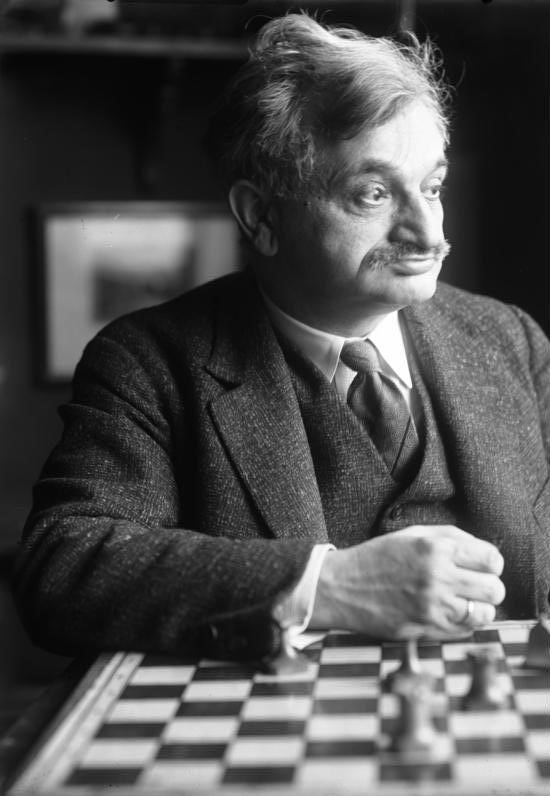
Lasker knew how to enforce what he wanted!
Why the „27 years“ version prevailed“
So why does the traditional figure of 27 years of reign persist? The answer is simple: it is a compromise between historical accuracy and institutional simplicity.
Accepting the year 1920 as the end of Lasker's reign would mean:
- acknowledging the legitimacy of his abdication,
- but at the same time rejecting the legitimacy of his right to appoint a successor,
- thus admitting the existence of a transitional period without a clearly defined mechanism.
On the other hand, the year 1921 offers an elegant solution: the title passed in the standard way – by victory in a match. The price for this elegance, however, is a simplification of reality!
The final act: Havana 1921
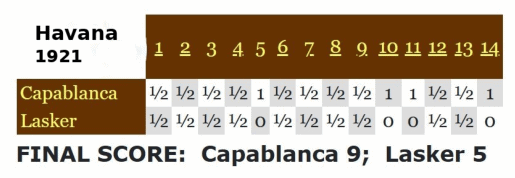
The match itself left no doubt as to who the new king of chess was!
The Lasker–Capablanca case shows that the history of chess is not just a sequence of moves on the board, but also a complex network of legal, psychological and social factors. Edward Winter, through his meticulous research, revealed that the period of 1920–1921 cannot be reduced to a simple chronology.
It is therefore appropriate to cautiously correct the established notion:
Lasker was not world champion uninterruptedly for 27 years. If we take his own act of abdication seriously, his reign ended already in 1920, that is after 26 years.
And perhaps an even more important insight: Lasker remains a psychologist not only at the chessboard but also beyond it. His last „game“ for the world championship title was not played with pieces, but with words, letters and interpretations – and its outcome is still a matter of dispute.
What kind of historical excursion into chess school would it be without at least one example from a match? (The fact that the former world champion „earned“ his $11,000 also by simply resigning the match after the 14th game I leave without further comment – although even that perhaps says something.)
A few years ago, a whole series of analyses of this Havana match was published on the YouTube channel – Agadmator’s Chess Channel. The reader has the opportunity to see and assess to what extent Capablanca outclassed his opponent in every respect. For him, „psychological tricks“ no longer worked...
Here, for example, is the first game of the match available:
Many years ago, I saved the following analysis of a fragment of the 11th game of the match, which I slightly edited at the time. Thematically, the example can be classified as a fight between bishop and knight in the middlegame. It was provided with excellent notes by Grandmaster Alexander Nikolayevich Panchenko, who studied this issue extensively and introduced several new concepts.
I remind you that even on my pages we devoted considerable attention to this topic in February and May 2024 in the articles „Bishop or Knight? Computers put the finishing touch on a number of well-known positions... and coaches got wrinkles on their foreheads.‚ From Panchenko’s analyses and observations, one can learn a lot even in these texts...
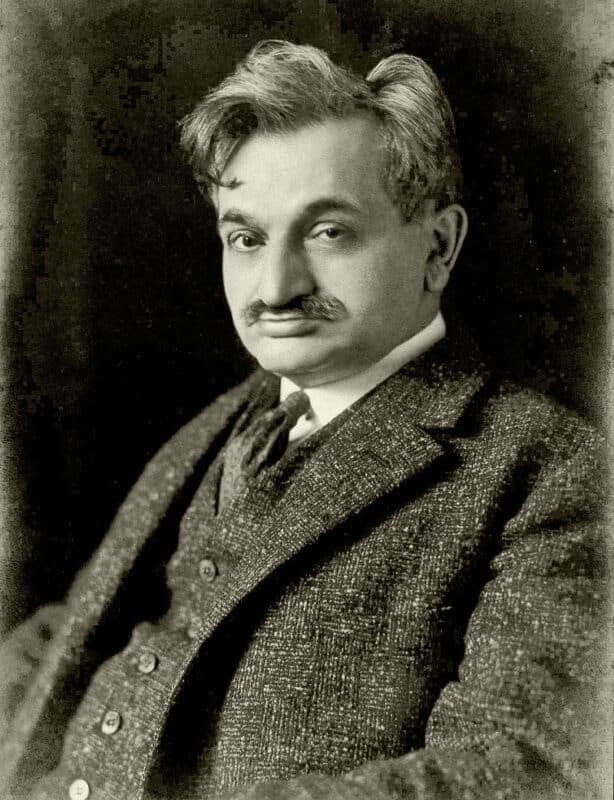
Who is Edward Winter
Edward Winter (*1955) is a British chess historian and one of the most respected researchers in the field. He is best known for his long-term project Chess Notes, in which he systematically analyses historical sources, verifies quotations and uncovers inaccuracies that have been passed down in chess literature for decades.
His work is characterised by extraordinary precision and emphasis on primary sources (contemporary press, letters, archival materials). In chess historiography, he has a reputation as an author who is not satisfied with traditional claims and rigorously distinguishes between documented fact and later legend.