

In the previous, actually unfinished article, we praised Carlsen's long, truly Alekhine-like, calculation of variations. However, his very next game brought an unprecedented debacle in the opposite camp! Losing with White in twenty-three moves in one of the quietest Caro-Kann variations can hardly be described otherwise. Why can chess players like a former world champion or, for example, two-time challenger Jan Nepomniachtchi manage to lose with White in a miniature under 25 moves? After all, this never happened to true chess geniuses, which they undoubtedly are! Is it due to lacking self-discipline? Inability to concentrate? A world gone out of control?
All bad things are good for something: the second miniature game can also be used as an extremely difficult test of theoretical knowledge, logic and mental flexibility…
„The author is obviously making it up! Many other world champions and brilliant chess players had their weak moments and lost in miniatures!“ I expect such a reaction not only from experienced readers or tournament veterans. Because I remember only many things and not all such accidents of world champions, I preferred to use databases for help.
Capablanca or Alekhine, whom I often mention in articles, I think never experienced a similar fiasco with White pieces (simultaneous exhibitions and casual games, today all kinds of blitz, of course, are not counted in the statistics).
We even know that Capa from 1916 to 1923, that is during 8 years, did not lose a single game! Let us take another pair of great rivals. The twelfth and thirteenth world champions Anatoly Karpov and Garry Kasparov. Can you find or recall where and when they lost a game with White pieces within 25 moves?
Nobody is infallible
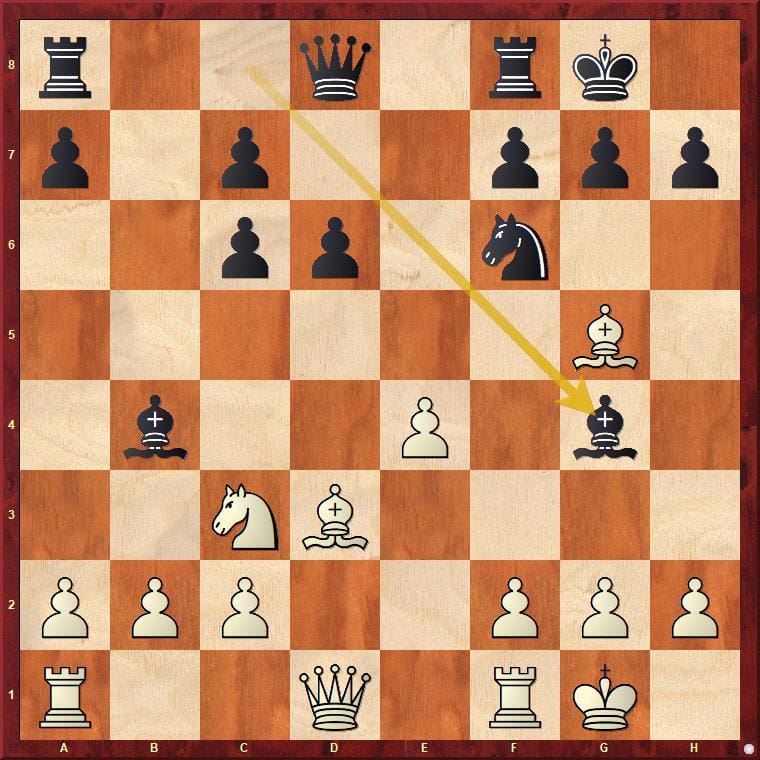
At the beginning of the school year, I prepared for readers first a set of easier tests, truly rather puzzles, composed of failed games or glaring oversights (sometimes punished, sometimes not) of world champions or ex-world champions. I did not consider the time control or the importance of the game.
The last move is marked on the diagram with an arrow and you need to find the correct answer.
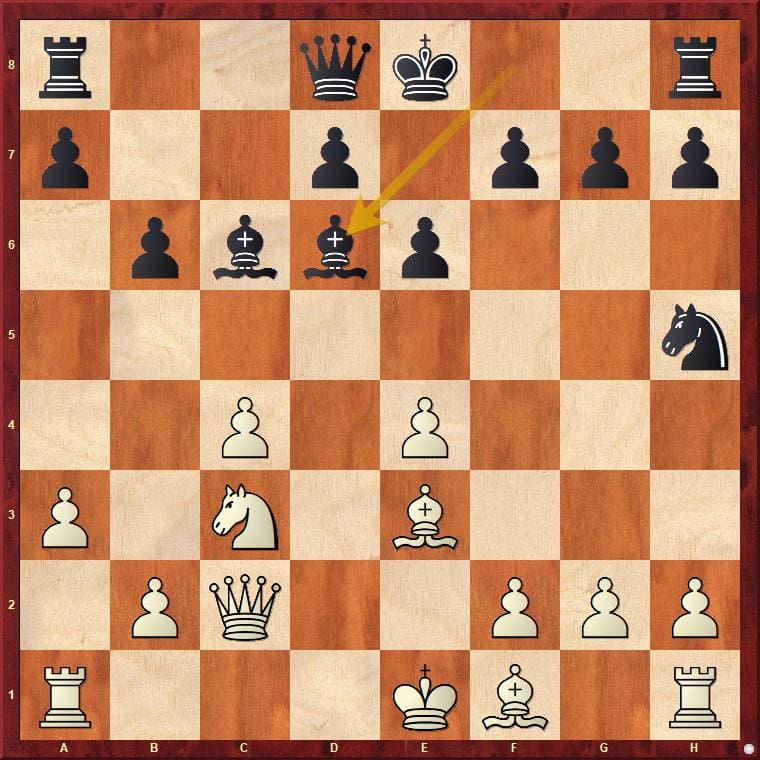
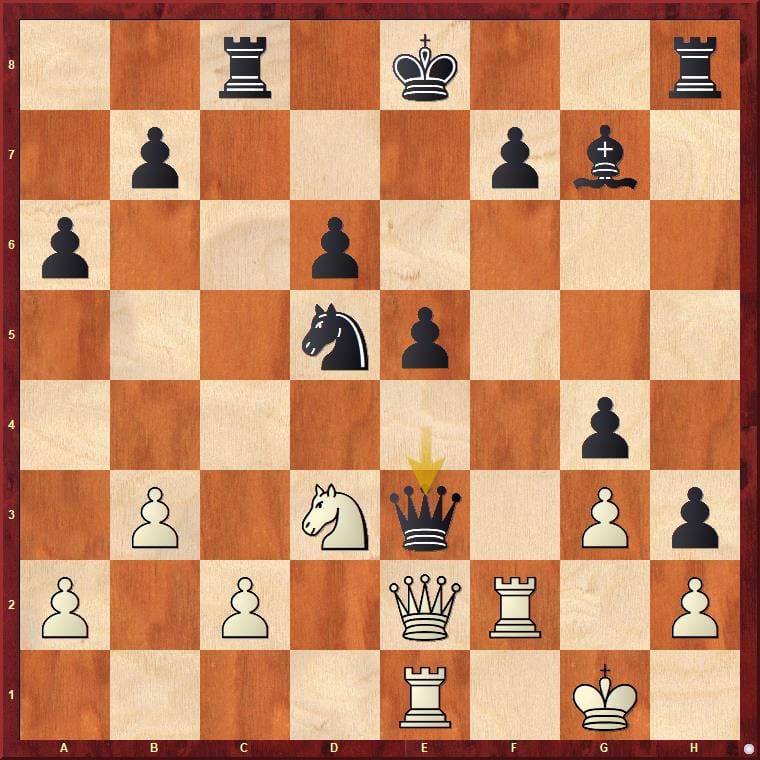
The memorable moment of the drama was captured on video.
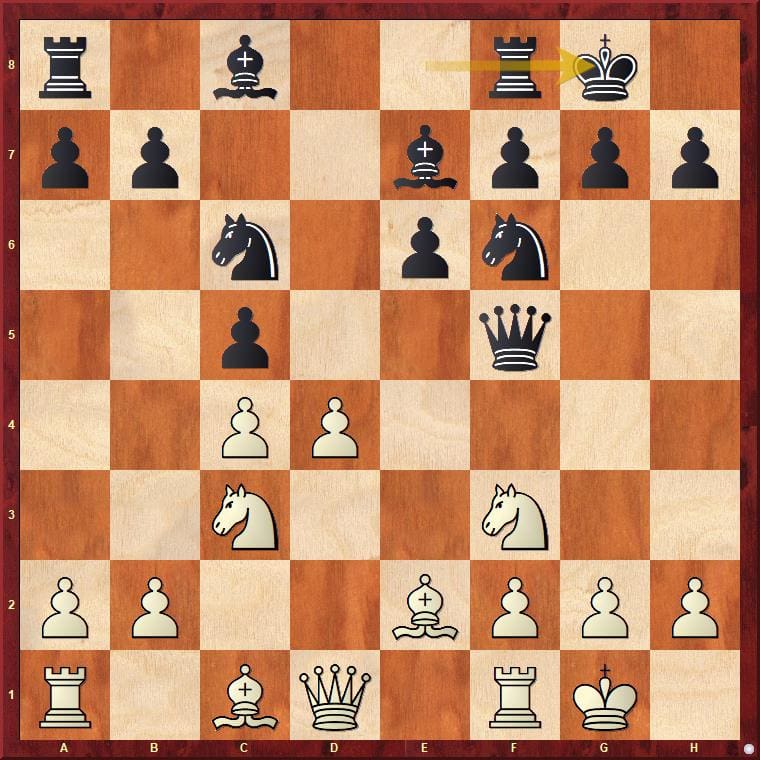
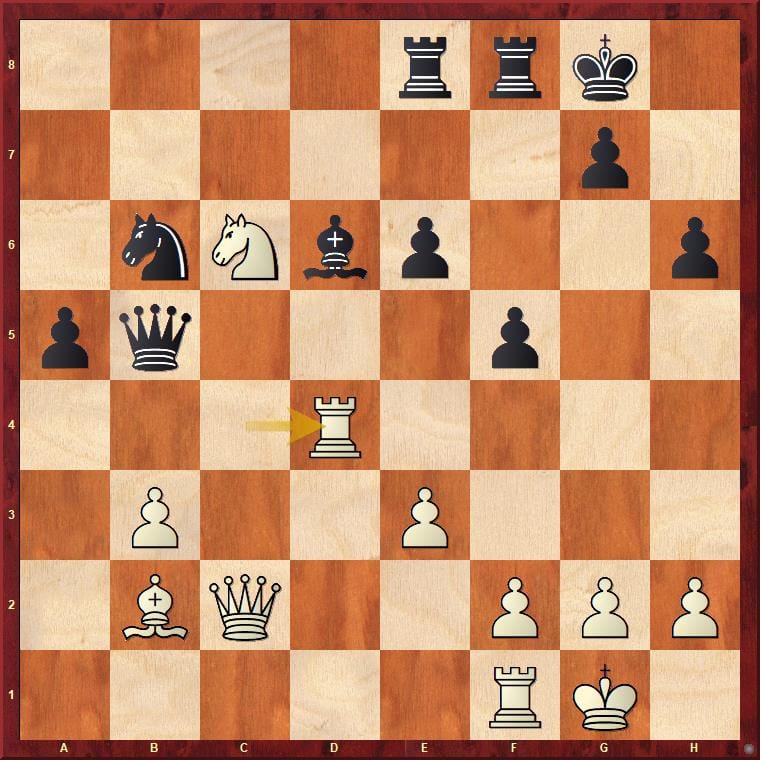
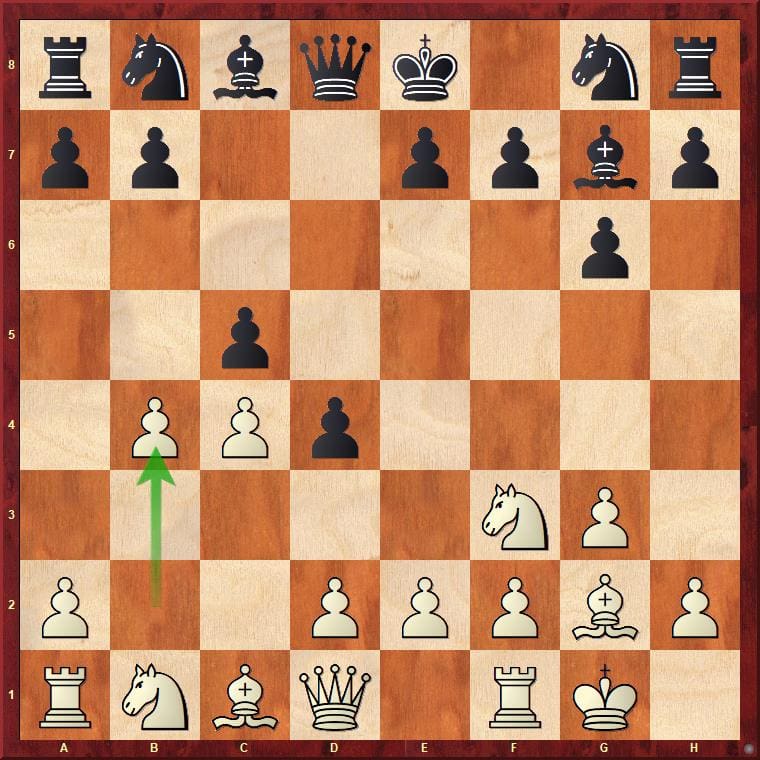
Solutions to simpler tactical turns after blunders, as well as certain interpretations explaining why they occurred, can be found in the player below.
Well, in simultaneous exhibitions, blitz and sometimes even rapid, many things can be forgiven, but...
Don’t count your chickens before they hatch, or shock number two
In the first miniature, we also return to our previous contribution.
The World Team Rapid Chess Championship was played at the usual time control of 15 minutes + 10 seconds increment. In round 4, Magnus faced an old familiar opponent, the dangerous 28-year-old Richard Rapport. Well, what happened in this game is something that probably not even the former world champion will easily forget. If in the previous game he set a personal calculation record, then in the following one it was certainly a kind of record as well. Judge for yourself.
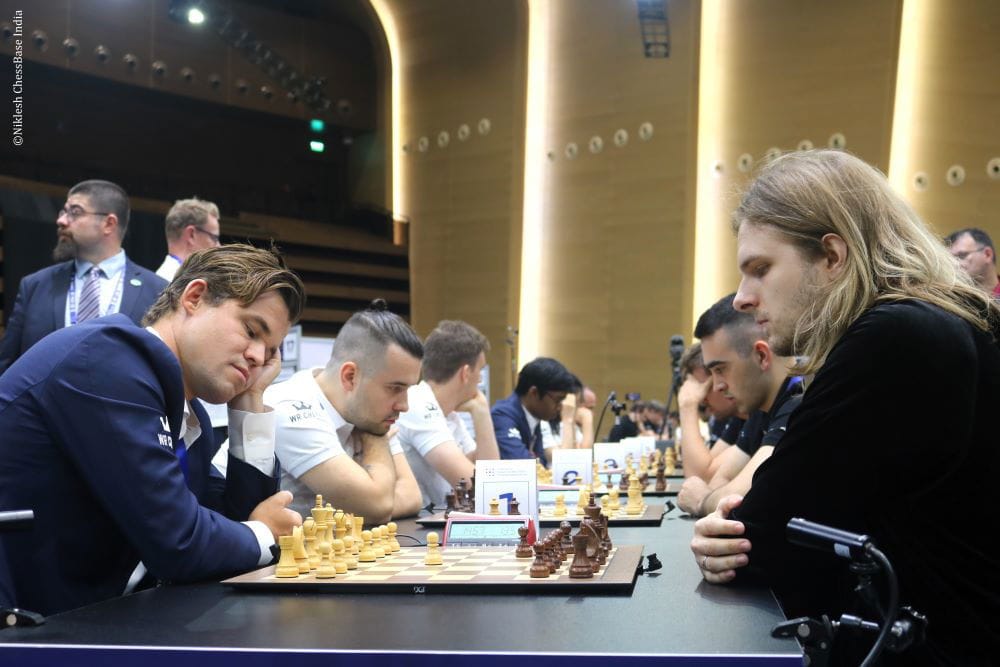
the game Carlsen vs. Rapport has just started
The end of the game is shown in the following short video.
Some readers will surely be curious about the live broadcast of the game itself and thus the footage of the players during the battle!

This photograph reveals everything even without commentary! If Jan Alexandrovič had not become a professional chess player, he might very well have made a living in Hollywood 🙂
Besides the fact that the twenty-three-move game practically calls for inclusion in books and databases on the topic of attacking strategy against the king in the centre (classic attacking tools were used – the king’s file ‚e‘ and the king’s diagonal a6-f1), nothing demonstrates the weaknesses of the former world champion better than this game! I’ll put it like this: If the 13th world champion Garry Kasparov repeatedly called his greatest chess weakness the lifelong overestimation of dynamic factors at the expense of static ones, with the 16th world champion it is exactly the opposite.
I will express a heretical thought: If the whole array of players did not panic the moment they sat down against Carlsen, and another group of them did not think only about a draw (a rescue), we would see a halved Magnus; his results would not be called miraculous. „The king is naked!“ perhaps even such a headline we could read from the pen of some audacious person...

But as I often write, fearless fighting spirit, courage and fighting without respect for great names awaits the next – today nineteen-year-old or twenty-year-old – generation of chess players!
The ups and downs of Jan Alexandrovič in Saint Louis
We might return to the very strongly contested traditional tournament in Saint Louis sometime in connection with a joyful event, namely the return of the French fashion design student 🙂 Alireza Firouzja back into Caissa's embrace.
Jan, apart from the opening rapid section did not do well in this last series of the Grand Chess Tour, but what he showed in the game against Anish Giri (actually also a miniature, although formally the fight lasted longer) I think I have never seen in my entire chess career!
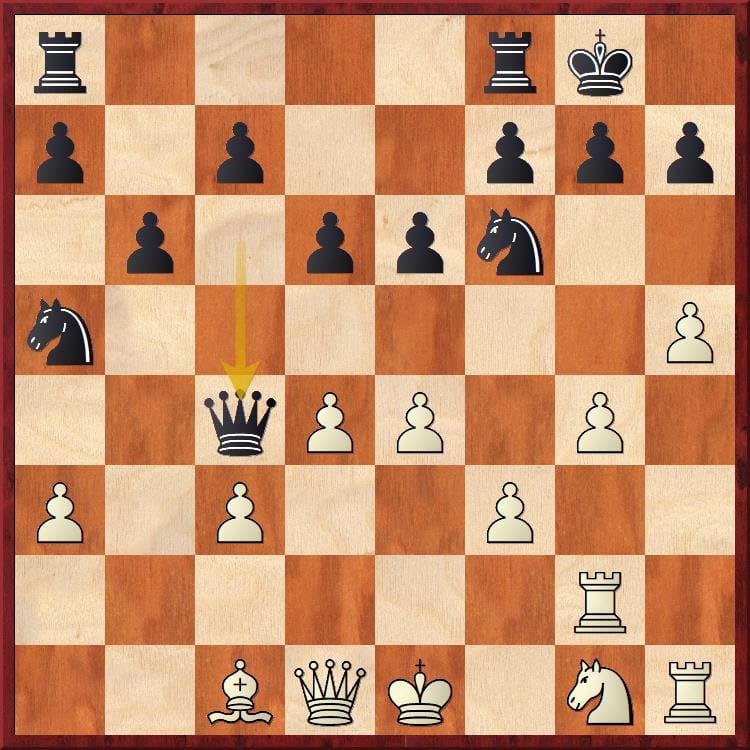
Position after 14...Qxc4. Dear readers, have you ever seen anything like this? I would like to ask the question: Since childhood, we have been used to dividing a chess game into opening, middlegame and endgame. Are we facing an opening or a middlegame position?? 🙂

And how did it all unfold?
Fans of the American Samurai will surely enjoy watching the English version!
Such creation, an unforgettable clash that only confirms Tarrasch's quote on my pages, can only be boasted by a genius chess player! Jan's choice of variation in the game was, of course, not accidental. All participants of these supertournaments know each other perfectly. They know the weaknesses and strengths of their opponents, and psychology plays no marginal role here. It is well known about the Russian-Nepalese-Dutch grandmaster that he masters a high technique of play, but is much less comfortable in sharp, dynamic positions that require precise calculation!
I add that Nepomniachtchi played the entire third round rapid game at a fast pace, which, alas, is often a harbinger of his further acceleration of play in the following rounds!
The toughest theoretical test!
Here I finally dare to present to the readers the first and immediately extremely complicated test!
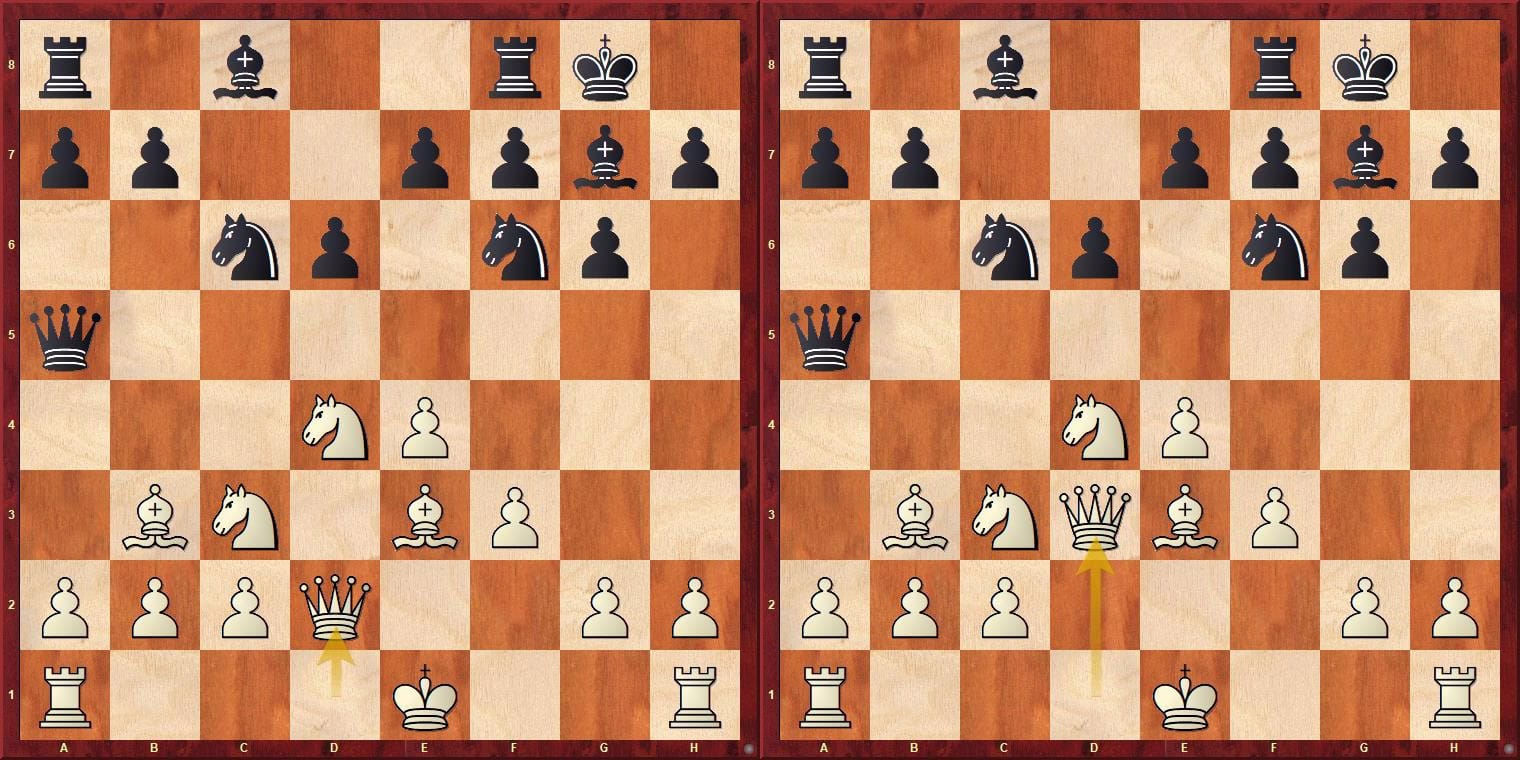
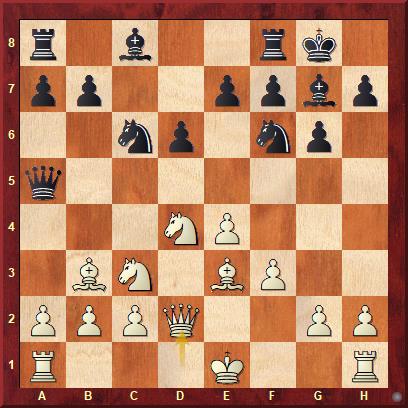
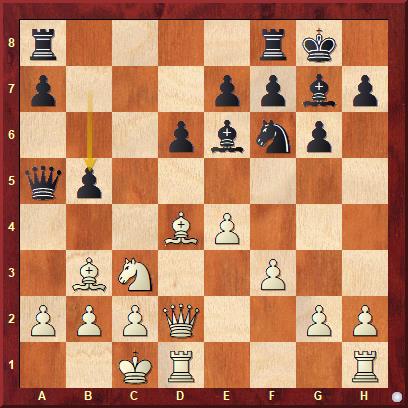
On the left diagram White played 10.Qd2, and on the right 10.Qd3.
- How would you continue if you were playing White? Or would you choose a different approach?
- Which of the two moves do you think is objectively stronger?
More experienced readers or stronger players will of course suspect some kind of trick!

In a way, it is actually about a kind of psychological trap for the reader. In the game Nepomniachtchi vs. Caruana, played in round 6, White actually played a move gaining a tempo 10.Qd3.
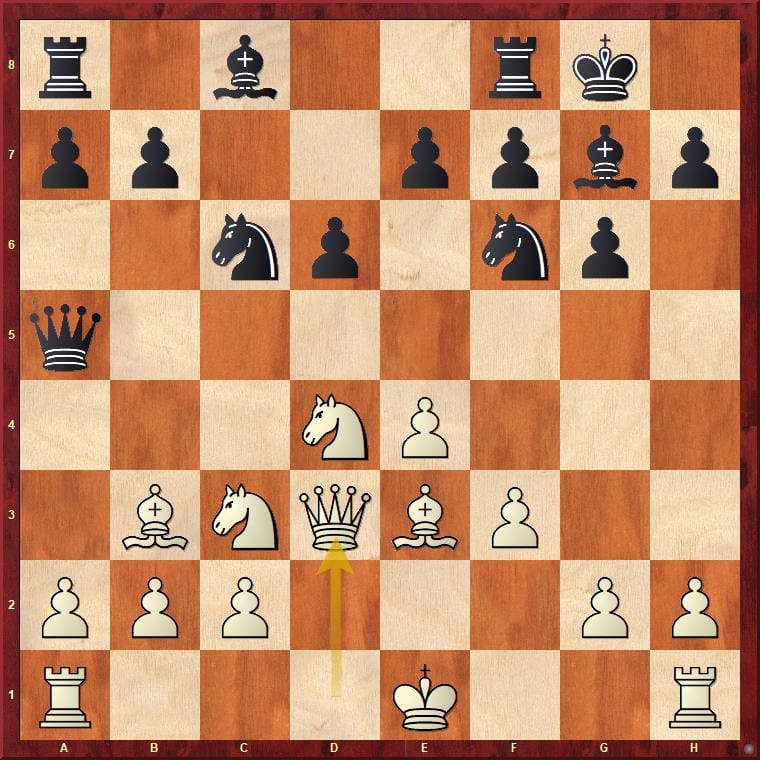
„What nonsense is this? Some kind of computer mumbo jumbo!“ most experienced, seasoned and strong players will ask themselves or rather think, especially if they have ever approached the Dragon Variation, specifically the most dangerous weapon against it, the Rauzer Attack. And this applies to both White and Black.
Regarding this move, I have watched many videos in which almost all streamers, including titled players (honour to the exceptions), were unable to satisfactorily explain Jan's choice. In fewer cases, they admitted that 10.Qd3 was unclear to them and even asked viewers for an explanation (thus wanting to start a discussion), but some labelled the move as a computer invention and thus indirectly called Jan Alexandrovich an incompetent fool. Finally, as one of my friends wittily remarked: „If the game were played online, we would probably suspect Jan simply clicked the wrong square!“ 🙂
I will present just one video example of such misunderstanding by a Kazakh coach Askar Nurumbetov.
On the Ukrainian-Russian YouTube channel Шахматы ето круто I have already tried to explain briefly and simply, at the author's request to the viewers, how the situation with the strange queen development stands: He tried precisely at the author's challenge to explain to the audience really briefly and simply how the situation with the strange development of the queen stands: …“The problem of choosing 10.Qd3 instead of 10.Qd2 can perhaps be clarified. Two years ago Giri's book on the Dragon Variation was published, where he finds a new concept of fighting against the Rauzer Attack. He does recommend the development of Qa5 but together with the manoeuvre Nxd4 and Be6 with the fact that in one of the main lines Black plays 12...b5! (game Širov vs. Giri 2021). This plan is of course not possible with the queen on d3. The loss of tempo in the Rauzer Attack lines with the old classical Qd8-a5 (Rfc8, Bd7 and Ne5-c4) can be borne, because this whole concept is in the original version today computer-shaken. In total, this eventually resulted in an approximately balanced position.“
1.e4 c5 2.Nf3 d6 3.d4 cxd4 4.Nxd4 Nf6 5.Nc3 g6 6.Be3 Bg7 7.f3 O-O 8.Qd2 Nc6 9.Bc4 Bd7 10.Bb3 Qa5 11.0–0–0 Rfc8 (diagram on the left) with the intention 12…Ne5 and 13…Nc4 (the second diagram thus demonstrates the plan).
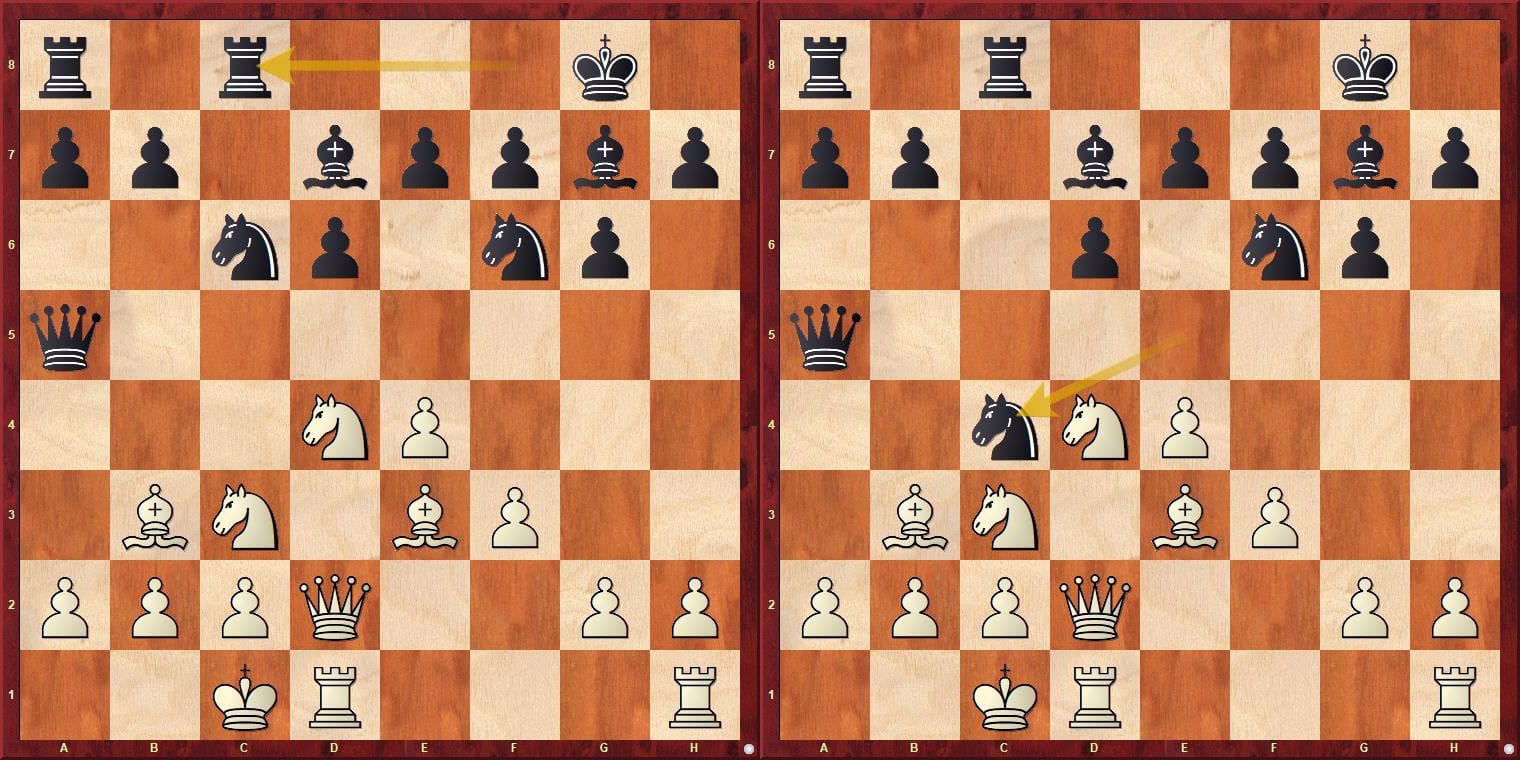
the basic position of the system with Qa5 and Black's main attacking concept
Eduard Yefimovich Gufeld, who spent his whole life with the Dragon Variation (but especially with his favourite fianchettoed king’s bishop), in his book from the turn of the millennium about the position after 10…Qa5 writes: „Introduction to the complex plan of defence and counterattack, to which V. Simagin, P. Dubinin and G. Veresov made a huge contribution… „
I add that it became extraordinarily popular in the 1960s, when it even served as the primary weapon against the Rauzer threat.
Around 2013 and 2014, I spent several months studying the system to possibly include it in the repertoire of some of my more talented pupils. I remember that my biggest problem at first was to divide the variations into logical groups!
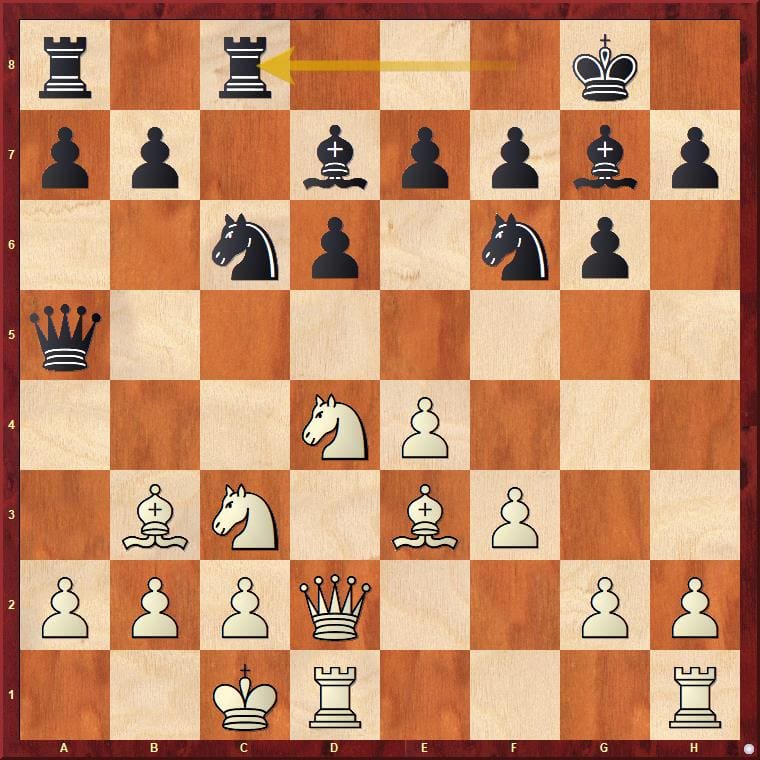
In the end, I dealt with the problem by sorting the variations according to White’s responses rather than the move order. It is clear that White has no other universally valid functional plan than to advance the ‚h‘ pawn, so I divided the chapters as follows: KGH meant that White plays prophylactic Kb1 and g4+h4. The system GH = White despised prophylaxis Kb1 and plays g4 and h4 immediately or vice versa; 2H (this variation is cited, for example, by Gufeld as the first and fundamental one) meant that White does not care about material and aims for an uncompromising attack h2-h4-h5, etc.
My efforts to teach the system to some pupils more or less ended when I realised that (even then) not even the best among them (medallists of the national championship, i.e. representatives) were able to digest the fairly extensive database. Hours and hours of study are required, and that was already too much about 10 years ago.
At that time, of course, I was surrounded by many other newer materials and could not shake the appealing concept with Qa5 and Rfc8. (I add that the English approach, i.e. systems with h7-h5 after h4, never appealed to me, although only in this way can the old concept perhaps be defended.)
Today, however, the situation is different and the classical model, which we see in the diagram above,… well, it limps on both legs!
But theory does not stand still and in 2021–2022 the same Anish Giri, or rather his powerful engine 🙂, came up with a new concept of fighting the Rauzer Attack in the Yugoslav variation (i.e. with the development Bc4-b3).
Širov,A (2673) - Giri,A (2774) 2021
In the position after 1.e4 c5 2.Nc3 Nc6 3.Nge2 g6 4.d4 cxd4 5.Nxd4 Bg7 6.Be3 Nf6 7.Bc4 0–0 8.Bb3 d6 9.f3 Qa5 10.Qd2 (the order of moves here is not important)
Black continued 10…Nxd4! 11.Bxd4 Be6 12.0-0-0 b5!=.
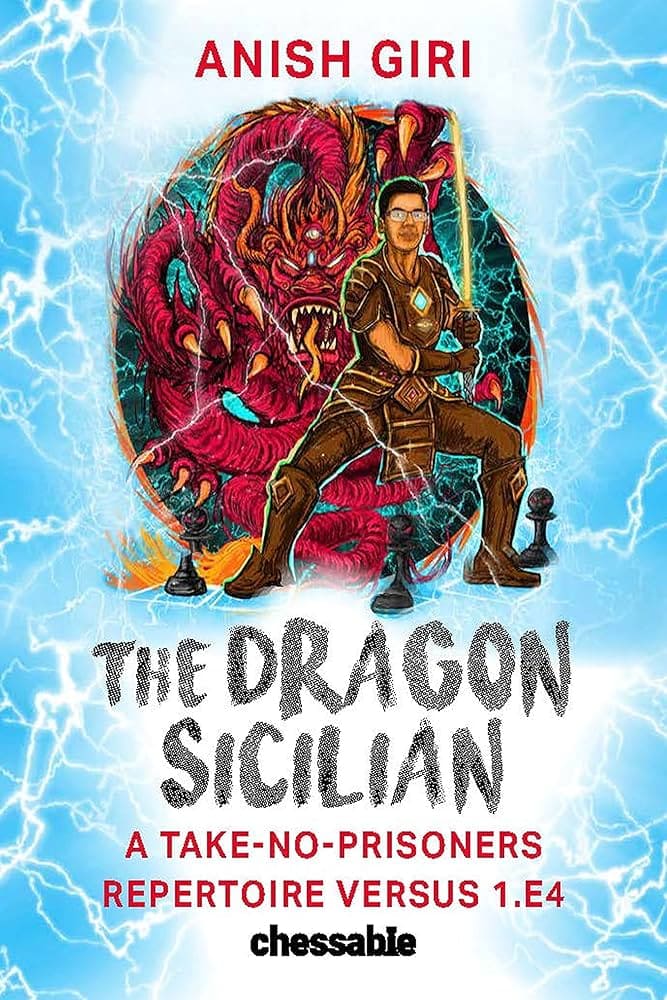
Not only one of the most visually successful books on the market thanks to coloured diagrams and clear printing. The Dutch grandmaster presents in a simple and clear way the evidence that in the Dragon everything is a little different and no extremely demanding memorisation of variations may be necessary. For devotees of the Dragon variation it is simply mandatory reading!
video advertisement for the book:
video 2022 (our problem is discussed at about minute 41)
In other words, 10.Qd3 it is, among other things, a measure of timely prevention, an early prophylaxis, although the main effect that White wanted to benefit from after Caruana played a personally very rare Dragon Variation was surprise! Of course, we will learn more in the analysis.
A splendid multifunctional miniature that will enter the textbooks
Nepomniachtchi's intention might have succeeded if his old and probably incurable illness had not made itself known. He cannot stop in time and check his decisions before making the move! Jan clearly confused the move order in the further course, and what came out of it all?
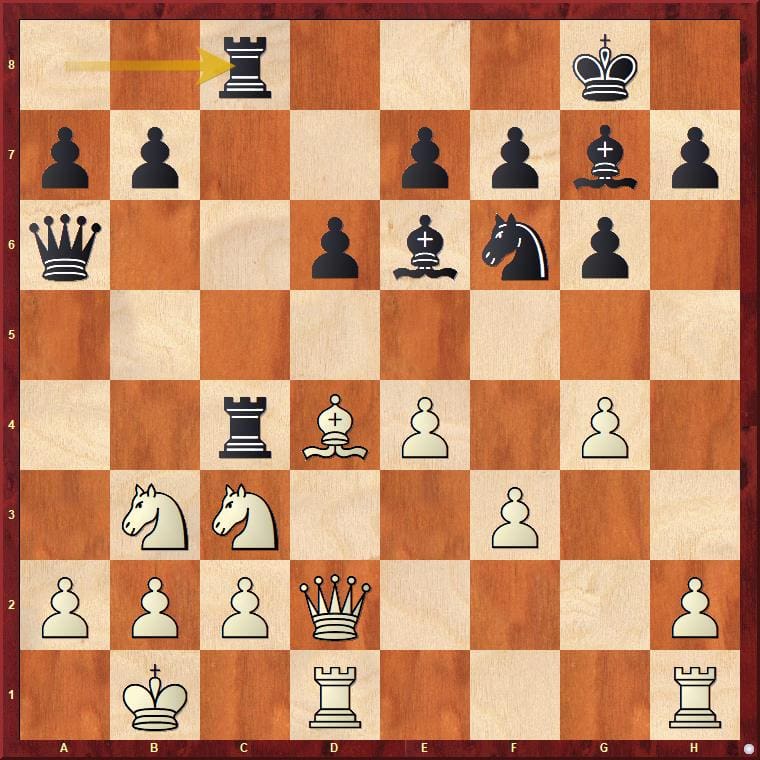
After 17...Ra8 before us, despite White's not inaccurate play, stands a sharp position with approximately equal prospects. After 6 seconds (!) of thinking, with almost 1.58 on the clock (sic!), Jan Aleksandrovich played 18.g5
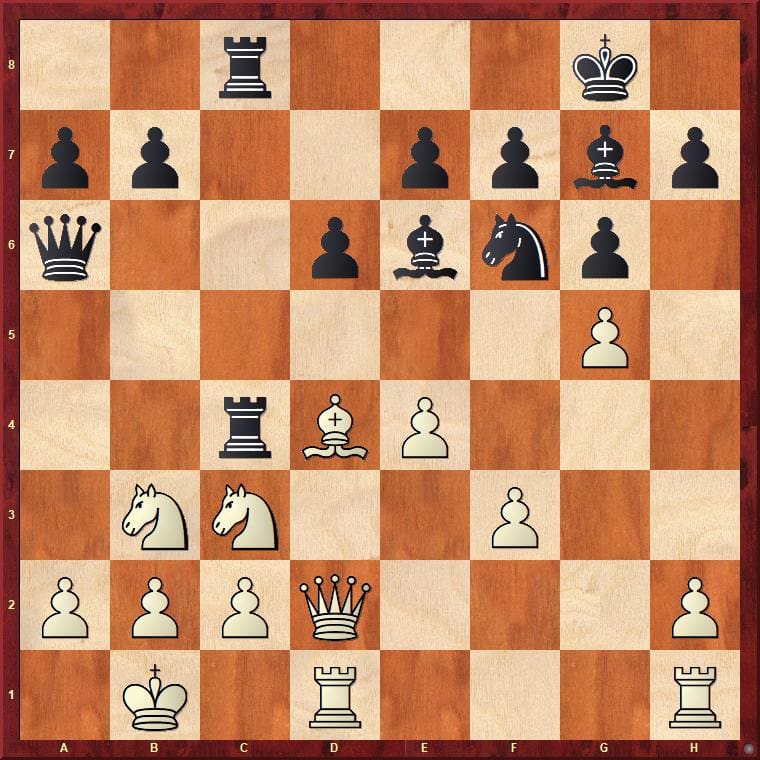
, only to resign on move 25! A truly spectacular miniature was born, which will adorn not only textbooks!
Dear readers, if at the beginning of the school year you have the desire, enough peace and especially time, reflect for 15, 20 or 30 minutes. I hint that Fabiano calculated a forced win within 19 minutes!
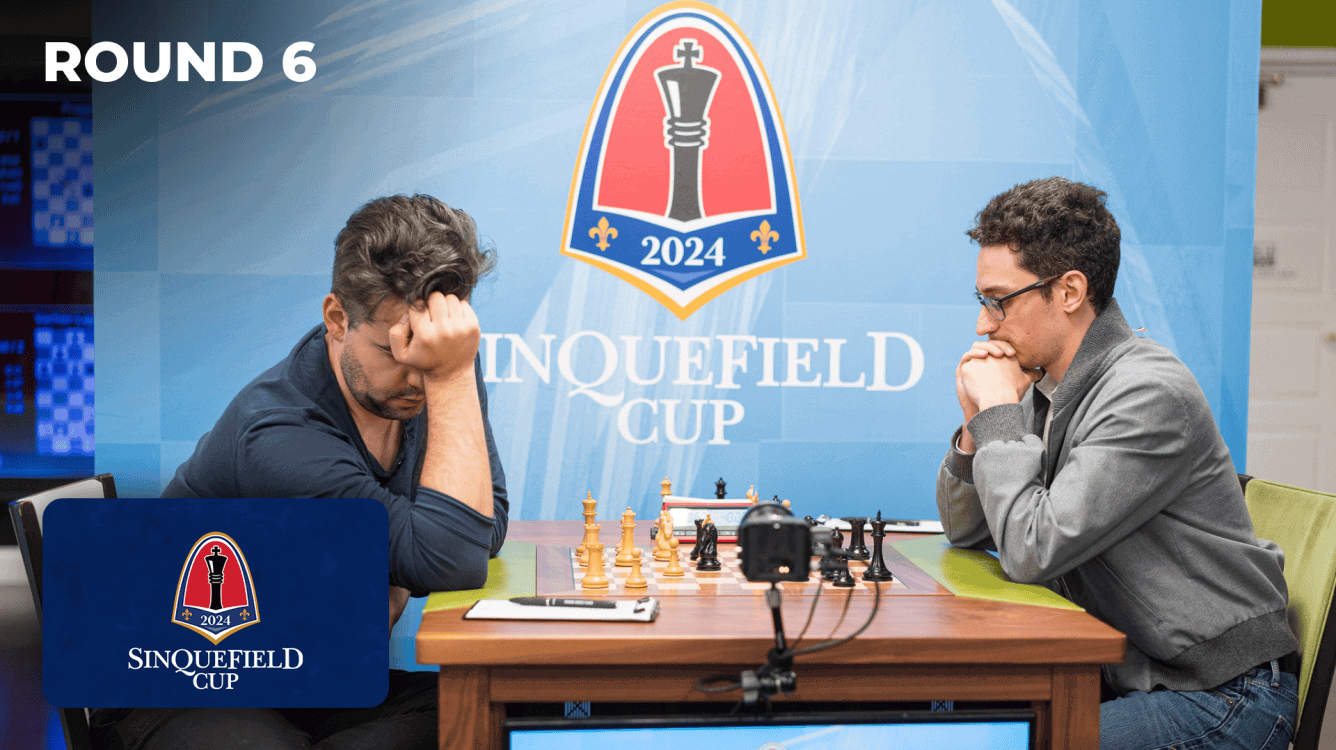
And here it is! A miniature is born. We teach even small children: „Distinguish between blitz games and serious games with notation!“ At the moment of the critical mistake, Jan's clock showed 1 hour and 58 minutes!
Finally, let us see what Fabiano Caruana himself said about the game at the press conference immediately after the game.
Below you can always find analyses in CB format: