

Dragon Variation with sharpened teeth
It is not entirely clear whether the increased interest in the classical Dragon with 2...d6 was caused by the coincidental publication of several books by very important authors or the suddenly improving statistics based on several computer discoveries in the Rauzer Attack. In any case, it does not seem that such theoretical aces as Michail Marin, Gawain Jones or recently Anish Giri published their analyses in the form of books or databases (not to mention instructional videos) roughly at the same time purely by chance.
For all the new ideas, I will mention one preferred by Anish Giri in his book! After the moves 1.e4 c5 2.Nf3 d6 3.d4 cxd4 4.Nxd4 Nf6 5.Nc3 g6 6.Be3 Bg7 7.f3 0–0 8.Qd2 Nc6 9.Bc4 (Yugoslav Attack)
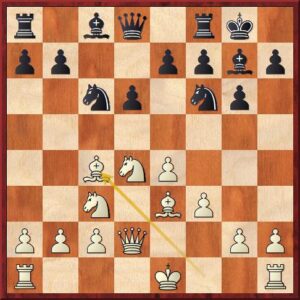
the Dutch super grandmaster recommends the manoeuvre 9...Nxd4 10.Bxd4 Be6 or 9...Qa5 10.0-0-0 Nxd4 11.Bxd4 Be6 not fearing the exchange Bxe6 fxe6. Simply put, doubling pawns on the ‚e‘ file was previously conceivable for example in lines with 9.g4 Be6 10.Nxe6, because after opening the ‚f‘ file there arises, among other things, a weakness for White in the form of the f3 pawn.
Unlike the example below, Giri's concept seems to me more than playable. (Of course, you won't find a true novelty today; only the online CB database shows that this was played already in 1938 in the game Panov,V-Pogrebiskij,J semifinal of the USSR Championship, Kiev /10.Bxe6/ and even Fischer,R-Larsen,B interzonal tournament, Portorož, Yugoslavia, 1958 /11.Bb3/.)
I just hope that some reader who has gone through classical chess education will also ‚manage‚ the following new idea: 1.e4 c5 2.Nf3 d6 3.d4 cxd4 4.Nxd4 Nf6 5.Nc3 g6 6.Be3 Nc6 7.f3. Now a move that has started to appear and is shocking to many 7...h5.
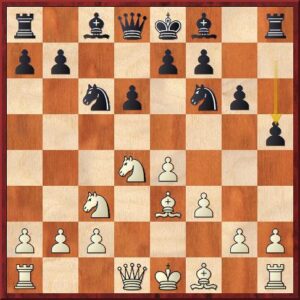
This was, for example, used twice by the Hungarian super grandmaster Richard Rapport at the World Blitz Championship (Warsaw 2021). Originally I did not believe that a book could be published about this ‚system‘ of play, but it is so. The author Junior Tay calls the system the ‚Hungarian Dragon‘. The advance of the ‚h‘ pawn, which was the subject of our previous investigations, naturally also makes sense here. What kind or even which ones? I will leave that to you, dear readers! So how do you think Black will use the 7th move after the seemingly natural 8.Qd2? I will just add that you can learn more about the Hungarian Dragon on the pages of the most popular chess website chess.com.
Stafford Gambit
Today's contribution mainly focuses on the (gambit) variation of another opening. Alongside the revived Dragon, its popularity has sharply increased due to the huge number of blitz games online.
I quote from the source below: Stafford Gambit is named after Joseph Stafford, an American chess player who used the gambit in 1950 and won a correspondence game in six moves: 1.e4 e5 2.Nf3 Nf6 3.Nxe5 Nc6 4.Nxc6 dxc6 5.e5 Ne4 6.d3 Bb5 and White resigned. Curiously, the first to play the Stafford Gambit according to the Mega database was Howard Staunton himself (one of the strongest masters of the 19th century) in a simultaneous exhibition in 1857.
https://www.chessable.com/blog/stafford-gambit-how-to-play-as-white-and-black/
The basic position of the revived Stafford Gambit arises after 1.e4 e5 2.Nf3 Nf6 3.Nxe5 Nc6 4.Nxc6 dxc6.
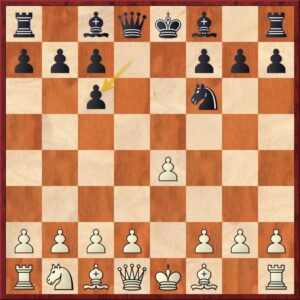
An experienced and stronger player at first glance at the diagram will probably have two fundamental remarks: 1/ Black's compensation lies in open lines for all black pieces – so Black has a certain lead in development. 2/ The gambit can hardly be completely sound, because in the analogous position after 1.e4 e5 2.Nf3 Nf6 3.Bc4 Nxe4 4.Nc3 Nxc3 5.dxc3
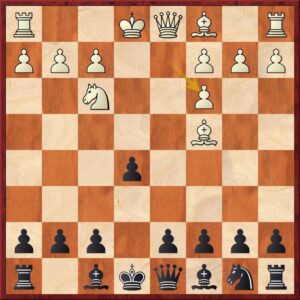
the basic position of the so-called Boden-Kieseritzky Gambit arises (with our pupils we always used the name Russian Gambit). Here the gambit side itself, that is White, has one more tempo in developing the bishop to c4, and yet it is not entirely clear whether White has sufficient compensation for the small material deficit. A more educated theoretician or player might object again (let's return to the first diagram): „But where is it written that the king's bishop is best placed on the c5-f2 diagonal? If the opponent defends with the ‚f‘ pawn, that is f3, then after the knight jumps from Nf6 to Nh5, intending Qd8-h4, it can also thrive on the d6-h2 diagonal!“ Even through the prism of more general theoretical considerations, we see that the situation is not entirely clear. All in all, White really must play very accurately and certainly know something about the variation…
The gambit has returned from the archive among the living openings not because of its objective quality, but thanks to the attacking character of the position. As we will see, precisely the lead in development, the possibility to continue it literally at lightning speed, and of course primarily the exposed f2 square, place considerable demands even on stronger players. While with enough time a strong player will probably refute the gambit over the board even with modest knowledge of the main lines and recommendations for White, blitz games 5 on 5, or better yet 3 on 3, not to mention bullet, give Black excellent practical chances.
I cannot fail to mention that a whole range of players are most attracted to using the gambit by a nice series of miniatures and conducting sharp attacks against the White king (even after it manages to castle), while the Black monarch feels almost luxurious in almost all variations, whether it stays on the queenside or its own wing. Even after repelling the first wave of pressure, Black often still has enough active pieces to create threats. These are often more transparent, but the opponent’s clock has also run down! A typical example of such development is the blitz game Gabrielian,A (2472) vs. Caruana,F (2758) Titled Tuesday internet open 27. 9. 2022 in the chapter Second wave of pressure.
Furthermore: often the heroic ‚h‘ pawn is used in the attack on the f2 or h2 square. This phenomenon, but also by itself phenomenon is a chapter in its own right…
Although the author's intention turns rather for White, I recommend that all readers replay some (not only) miniatures. And we will begin our exploration of the Stafford (Staunton) Gambit with spectacular miniature games in which White makes a gross blunder!
Miniatures
In the Stafford Gambit, we find an almost inexhaustible number of traps and miniature games. A strong point of the gambit is also the type of position. In some openings, there is almost no way to get checkmated immediately after the first major mistake, but here it is a completely common phenomenon. I believe that when dear readers replay several of these gems, many will try the gambit in their own practice. Here I also rely on contributions from many readers under some training materials in the form of videos. Let’s get started!
Theoretical refutations
After refreshing with miniature games, we now change into white clothing. Because objectively the gambit is far from sound (you can of course immediately object: „Who cares nowadays?“), there are several ways to gain almost decisive advantages. However, the point is that objectively won positions should be played by White in a way that is also pleasant in blitz or rapid! What does the author mean? Limiting typical attacking attempts by Black and at the same time choosing systems where Black himself must solve problems from the very first moves. When choosing the optimal system to refute the gambit, I also adhered to the idea of greater freedom in the choice of our moves. If as a theoretical quasi-refutation of the gambit we choose a system where we have to find the only correct move against every attacking attempt maybe 5 times in a row, and moreover not an entirely obvious move, then we are on the best way to choose badly.
Well, readers will surely judge for themselves according to their style which methods of developing White’s forces represent a greater luxury for them.
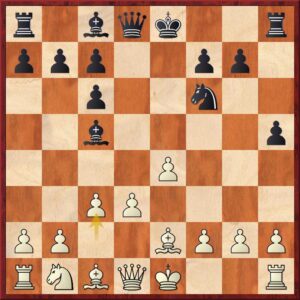
In my opinion, the strongest and most promising way to refute the Stafford Gambit is this: 1.e4 e5 2.Nf3 Nf6 3.Nxe5 Nc6 4.Nxc6 dxc6 5.d3 Bb5 6.Be2 h5
(This was always how my peer, classmate, friend and opponent, the great tactician Jirka Karlík, continued in blitz games. Here it seems he anticipated the importance of the 'h' pawn at least a quarter of a century ahead of his time, but above all he correctly sensed the needs of the gambit more than 45 years ago! /sic/)
Before us stands a position on which I have spent many hours or rather days for the above reason!...
Next comes 7.c3! Readers will of course learn more in the (first) analysis.
Declined Stafford Gambit
Can the gambit be declined? After all, the vast majority of gambits allow ignoring material gifts! „Yes, it exists!“ is the correct answer. And besides the psychological advantages such a decision brings, it also plays a role that the decline itself is strong enough!
The second wave of attack
In the Stafford Gambit, White can theoretically win the theoretical battle and achieve a significantly better position, but from that position, victory can still be far away. Thanks to the king being well protected in the vast majority of cases and good piece play, Black naturally does not give up. Especially in cases where the stronger player leads Black, a kind of second round begins to unfold. After all, Magnus Carlsen almost daily, even in serious games, demonstrates true magic in positions that the computer evaluates around 3 or more to his disadvantage. Many more games can be seen, for example, in his sporting incarnation in online rapid games. The secret of success, of course apart from the immense practical strength of this chess player, also lies in the appropriate tactics of fighting in endangered positions. We can observe: 1/ speeding up the game and trying to push the opponent into time trouble; 2/ choosing candidate moves that the opponent usually does not expect; 3/ constantly maintaining maximum activity of all forces and their mutual protection. (Here I recall what I have written several times – Carlsen’s divine mana lies in the centre and centralisation!)
Unfortunately, the current world champion, as far as I know, has not encountered the Stafford Gambit and does not use it with Black. Instead, we will replay a game of another super-grandmaster. In a blitz game, his opponent safely repelled the first assault and thus was not a victim of a miniature, castled long, and maintained some advantage. But how to realise it when Black can gradually intensify the attack against the White king even on the queenside? In my opinion, the last example beautifully demonstrates the ‚second round of assault‘ in the Stafford Gambit. I remind you that this game is also limited by the word blic.
Miniatures and battles
What kind of article would it be if the author did not present some spectacular miniatures?! Although the article deals with refuting the gambit or rather gives the reader a choice, many chess players simply like it with Black (as evidenced by the number of videos available online about this gambit). Below, readers will find charming, spectacular miniatures, but also more complex ‚Stafford duels‘.

One more gambit!
In the pages of the Soviet press sometime in the late 1970s or early next decade, an extensive interview was published with the then 12th world champion Anatoly Evgenievich Karpov. The title of the interview was: „The possibilities of chess are inexhaustible!“ At least until today, this remains true and chess is still a mystery even for supercomputers, that is, a so-called imprecise mathematical equation, if you will, an equation that has no solution.
At the end of the article, I will present a diagram of yet another gambit. It also arises from Russian play, Black also sacrifices a pawn on the third move and is also quite a suitable weapon in games with shorter time controls. Although the gambit has, of course, appeared here and there before, the signature under it certainly belongs to the brilliant Georgian chess player Baadur Jobava. The gambit arises after the moves 1.e4 e5 2.Nf3 Nf6 3.Nxe5 d5!?
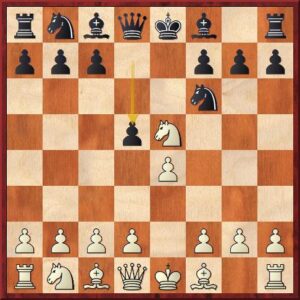
, but perhaps about that some other time…