

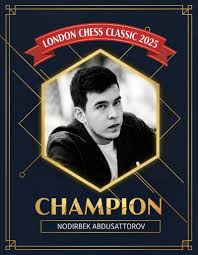
Nodirbek like a bull in a china shop!
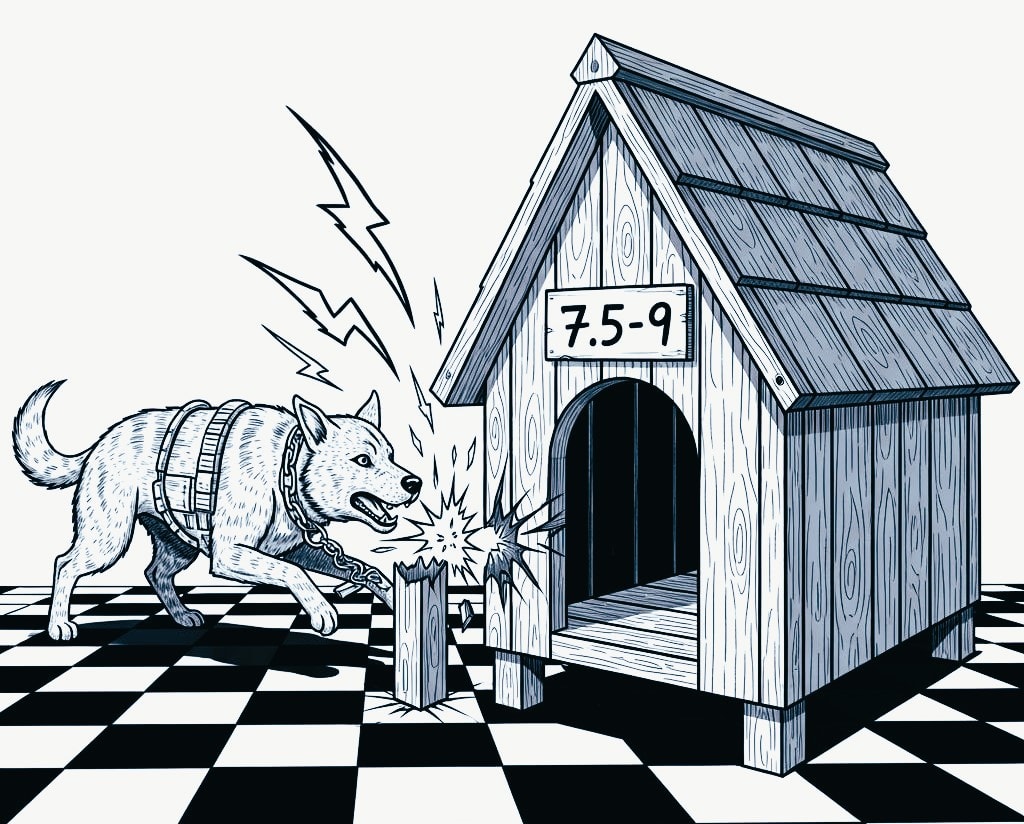
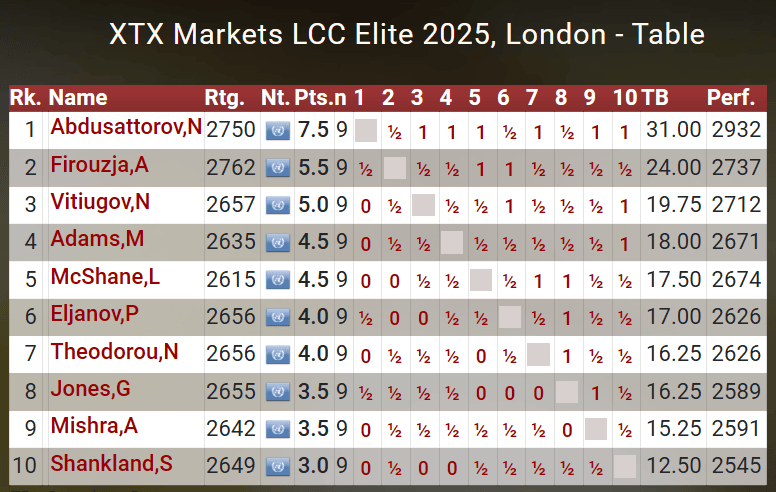
Looking at the table and Nodirbek Abdusattorov's games from the London Classic tournament, this idiom comes to mind! After weaker results and missed chances to qualify for the Candidates Tournament, Nodirbek appeared in London in full force. Not only did he win the closed nine-round tournament with a two-point lead over Firouzja, but he also achieved another astonishing feat: six wins in a row!
Just like in Prague 2024 (I wrote about that tournament on 13 March 2024 in the article „Abdusattorov in Prague 2024 like Alekhine in San Remo 1930“), the comparison to Alekhine's performances from 1930 and 1931 came to me again. But this time we cannot even talk about „some“ luck. Nodirbek outplayed his opponents in every respect!
Let us first look at the final results:
And yet it „all started innocently“ with a draw. True, with Black against the excellent theoretician Gawain Jones.
In the game Jones,G vs. Abdusattorov,N The Caro-Kann Defence was played. It's hard to call it a surprise, because from time to time Nodirbek chooses this defence, although in serious games we might... well, suffice with lower mathematics. It's hard to say who surprised whom, but from a practical point of view the English grandmaster was satisfied with the opening development.
In the Panov Attack 1.e4 c6 2.d4 d5 3.exd5 cxd5 4.c4 Nf6 5.Nc3 Nc6 6.Nf3 (in the game with a slight transposition of moves) Black played the fashionable today
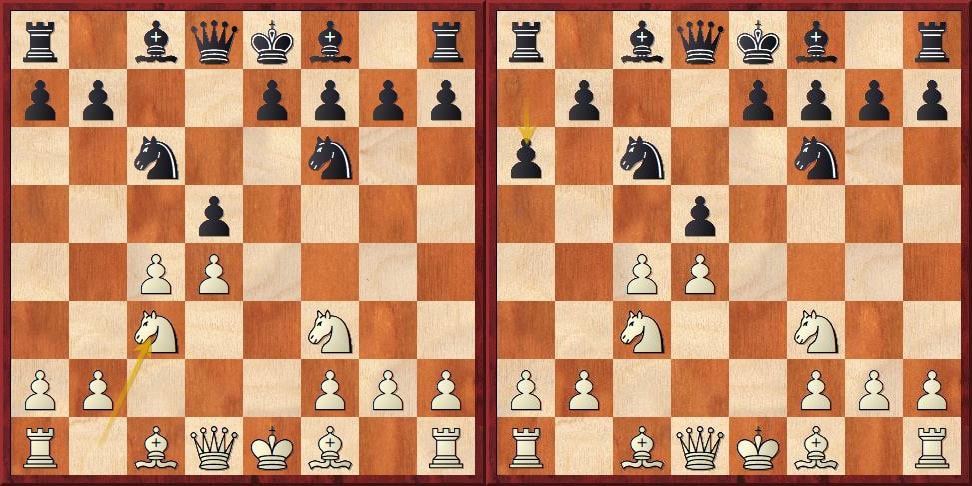
6...a6. Modern, but not new; databases even contain a game by Karel Opočenský from ninety years ago (sic!). I might add that the traditional 6...Bg4 has not been refuted, or rather „nothing has refuted it“ 🙂, but many Black players simply do not want to play the resulting positions. For obvious reasons, as we will see in the viewer. After 7.cxd5 Nxd5 neither player could be surprised by
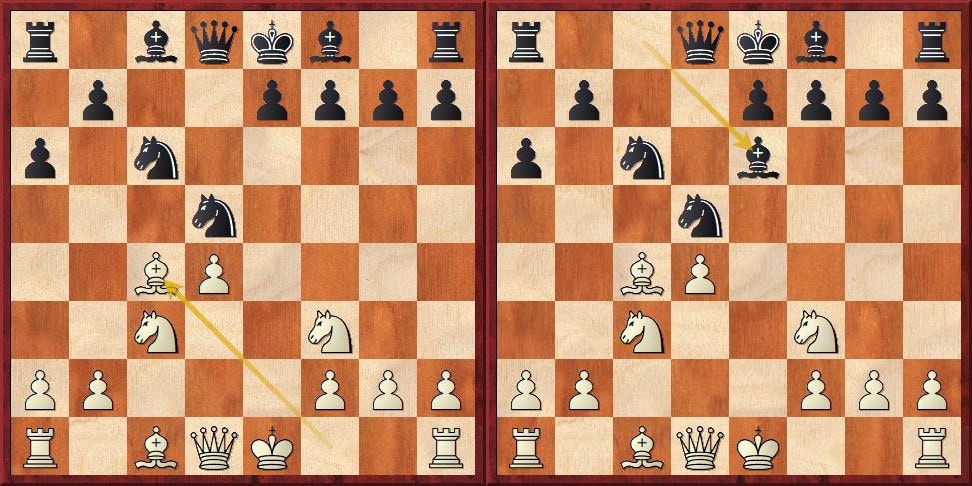
8.Bc4 Be6 (with the threat of the retreating attack 9...Nxc3). Judging by the frequency of occurrence, this is probably not just Nodirbek's favourite way of development. However, from a practical point of view Black seems to have „missed something“! What followed was 9.Ng5!?
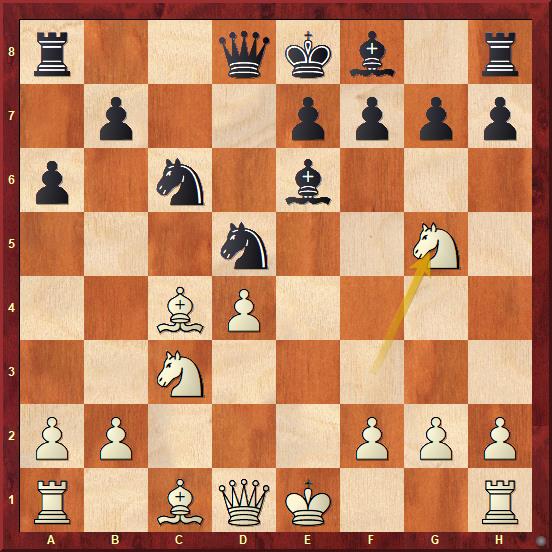
„What is that supposed to be?“ you might say after a moment's thought. And when we also glance at the clock, with Black spending more than 25 minutes on the forced reply, everything might seem even more shrouded in mist!
The haze will, however, dissipate and clear the way for the hurricane. What followed was 9...Nxc3 10.Bxe6!! (at the same time the only one) 10...Nxd1 11.Bxf7+ Kd7 12.Be6+
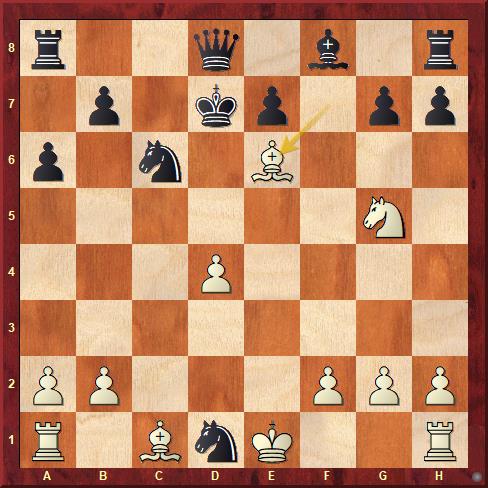
We see that at this moment White has only a pawn for the sacrificed queen, yet the opponents shook hands after a few moves to signal a draw. How are we to understand this?
Allow me to pose a question: how would you continue if you were Black?
Let's jump straight to round 4, to the game Adams,M vs. Abdusattorov,N. The Rossolimo system in the Sicilian Defence was played. I think there are very few spectators or readers who would not pause at the position arising after White's 11th move!
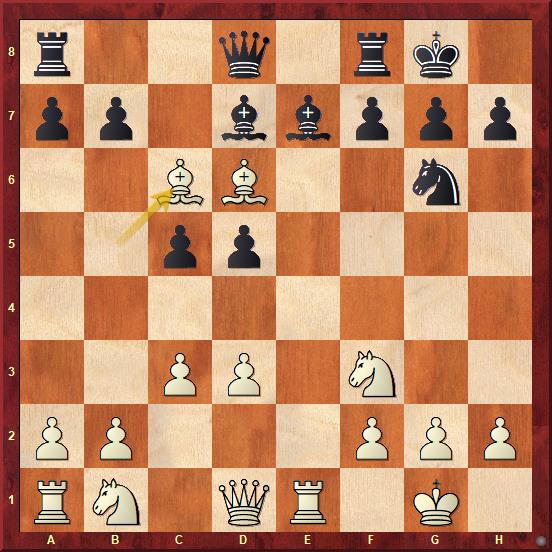
Looking at the diagram position, one can indeed deduce many unexpected things. For example, the nature of a person. Or rather, the approach people have to chess. Primarily practical? Mostly analytical?
My first thought, probably distorted by my profession as a coach and analyst, was not about the answer to the question „what would I play,“ but rather, how such a position with lively bishops could have arisen.
Black chooses from three candidate moves. How would you most likely continue your game?
In the further course, Nodirbek completely outplayed the „English legend.“ From the diagram below we can observe how Black continued on that 11th move, but we do not yet know whether his decision was optimal...
White has just, admittedly already in a dubious position, made the last mistake by playing 28.Qh5?

Can you calculate Black's winning line? Or at least: how would you continue if you were in his place?
The round 5 game Abdusattorov,N vs. Theodorou,N I would not hesitate to call it a real treat! How many games do we see sacrifices of the strongest pieces on both sides, which moreover differ like day and night! It is precisely these sacrifices that perfectly demonstrate the difference between a real, that is positional, queen sacrifice on the one hand and a combination with a queen sacrifice, i.e. a forced manoeuvre, on the other.
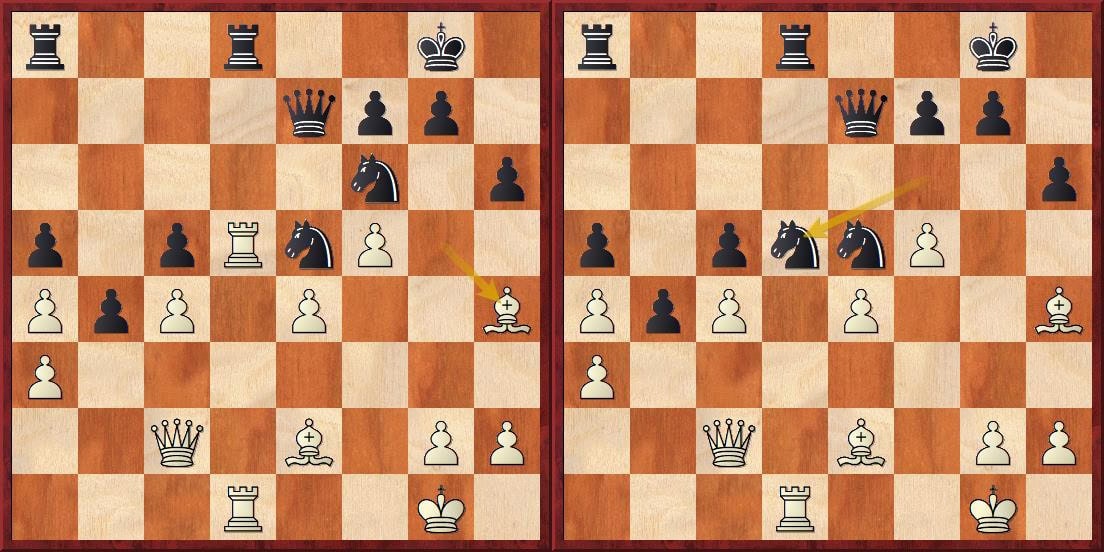
The combined diagrams demonstrate Black's positional queen sacrifice. Let us consider how much material Black gains for the queen and what its compensation consists of. And of course: in your opinion, was the Greek grandmaster's bold decision correct?
A lesson and a small hint: after Black's 29th move, the following position arose on the board!

An interesting video, in which we can also see Abdusattorov's analysis of part of the battle immediately after the game at the end, I found on the CHESS-ThanhCong Online channel. Also present in the studio is the excellent British theoretician, Grandmaster Stuart Conquest.
Round six and the fifth consecutive win! In the game Shankland vs. Abdusattorov Nodirbek literally swept the American off the board in the middlegame. Despite the spectacular conclusion of the game, I was unable to find a suitable tactical or calculation test here, because White's weak resistance always offered several equally strong solutions at critical moments...
Instead, I resorted to a strategic question and also a small lesson, an enrichment in the opening. The Scotch Game was played 1.e4 e5 2.Nf3 Nc6 3.d4 exd4 4.Nxd4 Bc5, where White has recently chosen the fashionable
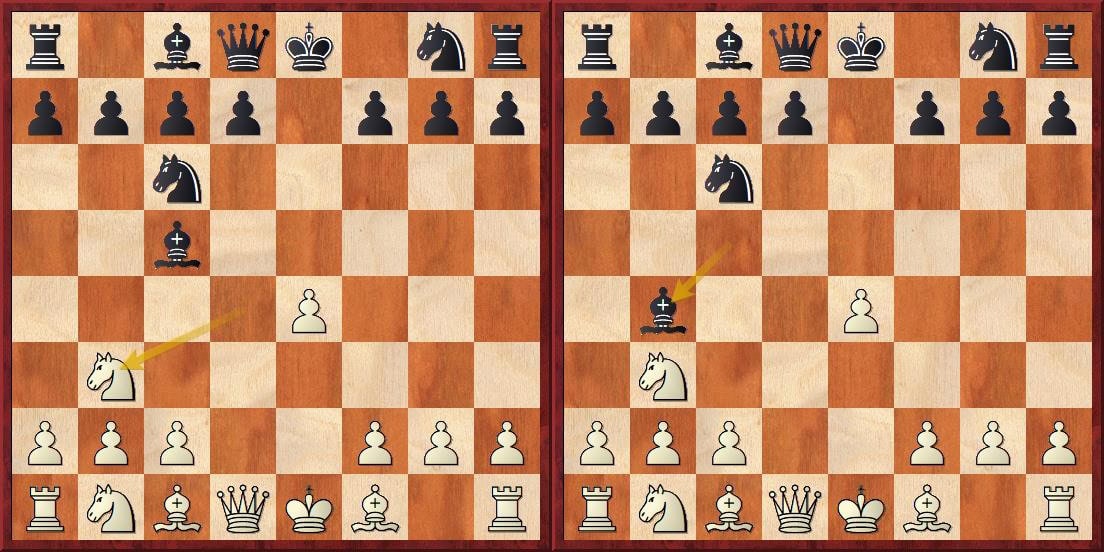
5.Nb3. Nodirbek chose at first sight the unusual 5...Bb4+!?; statistics reveal that it is indeed the second most played continuation, but at the same time more than an order of magnitude less popular than the usual 5...Bb6.
What could a „revenge chess“ 🙂 mean?
In the notes to the game I wrote this: „A weapon of Grandmaster Oleg Mikhailovich Romanishin, one of the most creative chess players of his time. Databases reveal that the variation probably underwent its first serious test in the first half of the seventies, in several games Beljavsky vs. Romanishin. Black naturally wants to at least somewhat unsettle the opponent's preparation, but „dragging the bishop“ is certainly not mindless. He wants to introduce a certain disharmony among the opponent's minor pieces.
Shankland's advance probably became a theoretical novelty in the game 12.exf5.
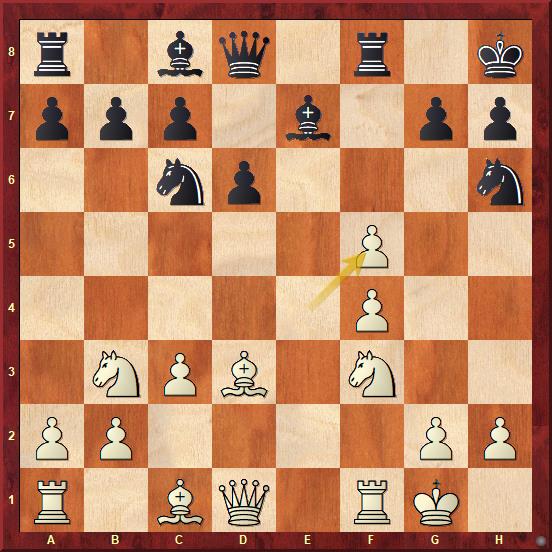
Here I will add the promised „strategic test“, but rather a question that will also verify your ability for more general considerations! After all, it would also be suitable as a question that ultimately can assess the quality of a coach. So I ask:
- Would you now capture on f5 with a bishop or a knight?
- What are the strengths and weaknesses of both possible continuations? Could you describe and explain them?
A small addition: I couldn't resist and under the watched video I wrote this time:
„Regarding the understanding of a dynamically charged position and calculation ability, we see that there is not just a 100 Elo point difference between Abdusattorov and Shankland. I would compare the difference to the performance of a master against a second-rate player! One of the best coaches in the world, Mark Dvoretsky, might have classified this example among the strategic phenomena he discovered. He called them ‚lišnaja figura‘ (extra piece). Let us notice throughout the game the „activity“ of the originally kingside knight, which found itself on b3 and then on b5. If White had exchanged one knight with 16.Nxc6 (video time about 2:15) following Alex's advice, he would not have had such problems...
After today's further win, Nodirbek's performance begins to remind me of Alekhine's performances in San Remo (won by 3.5 points with 16 players) and Bled (victory by 5.5 points in 26 games).“
Grandmaster Daniel King analyses a very dynamic game very nicely.
Later, a short analysis by the winner himself appeared on YouTube:
Before the penultimate 8th round game, Abdusattorov was already leading by two points (at that moment with a performance over 3,000!), but a tough battle awaited him: he faced the only serious contender with the black pieces – Alireza Firouzja.
„Nodirbek has finally solidified,“ I thought to myself when, in the diagram position, after Alireza's 30.h3
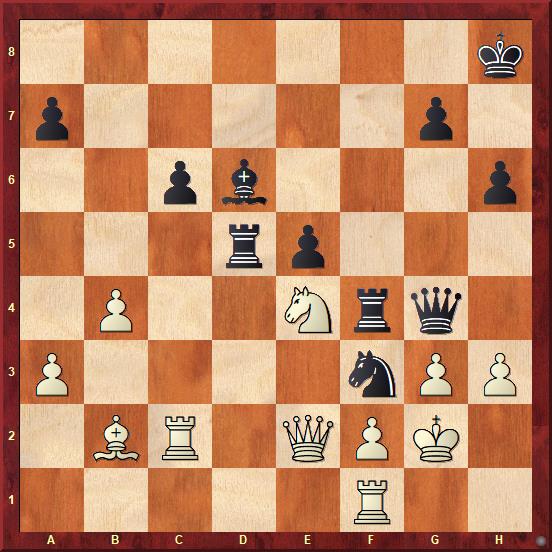
he drew the game by perpetual check 30...Nh4+ 31.Kh2 Nf3+ 32.Kg2 Nh4+ (thus securing victory in the tournament), although he certainly saw 30...Qg6! with an objectively large advantage, that is significant winning chances, but also a rather complicated tactical skirmish!
Why do I speak of „solidification“? Nodirbek about half a year ago somewhat refused to take tournament situations into account. He played for a win „always and everywhere“. The game that stuck most in my memory was his game against Praggnanandhaa (UzChess Masters, 6/2025). Before the last round, he led the tournament by a whole point, had White, and yet he attacked his opponent recklessly. It is not excluded that this „lack of understanding“ ultimately cost him participation in the Candidates Tournament. However, I will not develop this speculation further...
Let's look at the important penultimate round game in the video.
At the time of writing this article, the complete line-up for the 2026 World Championship Candidates Tournament is already known. The last qualifier was Praggnanandhaa thanks to the best results this year, that is within the so-called FIDE Circuit 2025.
Nodirbek will have to wait two years. Well, no tragedy at twenty-one…
To conclude, I offer a short post-tournament summary video, spiced up with one special statistic.