

This article was inspired by a recent rapid game between Alireza Firouzja and Wesley So, in which, in my opinion, the most talented (though, alas, not the most hardworking) chess player of our time sacrificed his strongest piece without the possibility of precisely calculating the consequences. Such material sacrifices are commonly called real dynamic or intuitive sacrifices. Calculation of variations takes a back seat, and instead the most important thing is the correct evaluation of the position. To complement this masterpiece, I then present two famous intuitive queen sacrifices by the genius Rashid Gibiatovich Nezhmetdinov…
A bit of theory: imaginary versus real sacrifice
„Imaginary, apparent, fictitious material sacrifice? What is that supposed to mean?“ the reader might think. „Either I sacrifice material in a game or I don't!“ Nevertheless, the concept of an imaginary, apparent or – if you will – fictitious sacrifice is part of the entire theory of sacrifice as developed by Rudolf Spielmann (The Theory of Sacrifice, 1936), and in the early 1970s in the excellent booklet ‚Sacrifice in Chess‘ by then Soviet Grandmaster Leonid Shamkovich.
To help the reader understand why we talk about an imaginary sacrifice, I will start with an example that is hopefully known (or should be known – let us not forget that the Czech Republic is becoming a developing chess country at a fairly rapid pace) to anyone who has opened a chess tactics book at least a few times in their life.
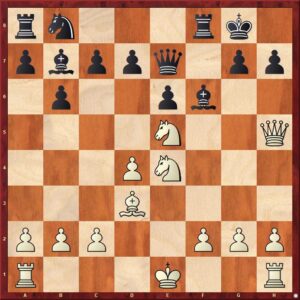
White to move. Why can we, from the point of view of sacrifice theory, understand the queen sacrifice on h7 here as fictitious, apparent?
Time travel and calculation
I will use an analogy from sci-fi or deeply theoretical quantum physics (the so-called Laplace's demon 🙂 ). Suppose that we have the ability to look into the future – the following day. We move to the most famous Monte Carlo casino and watch a roulette table where the highest stakes are played. At a precisely defined time: 25 November at 20:17:10, the number 14 will come up. We thus have information: with one hundred percent certainty we know what will happen tomorrow at the stated time. From our point of view, that is the next day, all that remains is to ensure that before the roulette wheel is spun, we bet the maximum allowed sum on number 14, and 36 times the stake is ours!
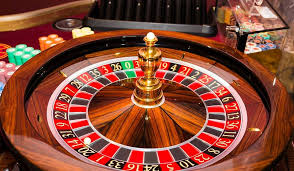
What a surprise, number 14 just came up 🙂
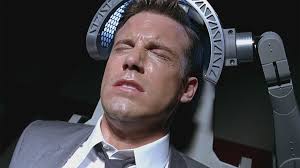
Ben Affleck in the sci-fi film Paycheck, based on a story by Philip K. Dick. Using a complex device, it is possible here to look into the near future.
Analogously: if we are thus able with 100% certainty to foresee what will definitely happen, what kind of sacrifice is it? What kind of risk is involved? And that is why Shamkovich in his work called a combination (a forced manoeuvre with a sacrifice, let us stick to Botvinnik's simplest definition) a false, fictitious sacrifice. We know with certainty what will happen in the future, we are able to mathematically prove this variation, to see it through to the end, to look into the future!
Real sacrifice
On the other side of the imaginary axis there exist so-called. real sacrifices. These are characterised by the fact that we are not able to calculate their consequences and so all that remains is to to use (to a greater or lesser extent) evaluation algorithms often only shorter variations at the end.
Leonid Aleksandrovich then divided, similarly to Spielmann 35 years earlier, real sacrifices into those made in the opening (developmental, king-chasing, sacrifices to prevent castling, blockade sacrifices…) and in later phases of the game. There, real sacrifices must be divided according to the key into dynamic (attack, initiative) and strategic (positional advantages).
Dynamic, intuitive sacrifices
Here our excursion into one of the theories of sacrifice ends. (Let us not make the same mistake as many not only fools but also reputable incorruptible scientists or thinkers today, and present theories as the only true facts!)
It is obvious that the group of intuitive sacrifices of the strongest piece on the chessboard always first attracts the attention of spectators, then analysts, and finally authors. At the same time, it is a demonstration of top chess mastery! As the classic said: „Real sacrifices are more complicated than ten bishop sacrifices on h7!“
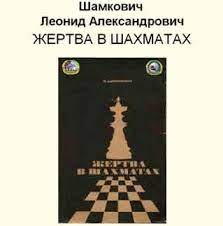
Šamkovič's excellent booklet ‚Sacrifice in Chess‘ (1971) contains these words: "A true sacrifice involves a radical change in the character of the game, which cannot be carried out without foresight, imagination and willingness to take risks."
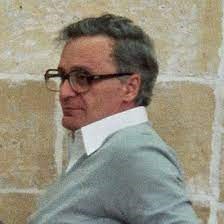
Leonid Aleksandrovich Šamkovič (1923-2005), Chess Olympiad, Malta, 1980.
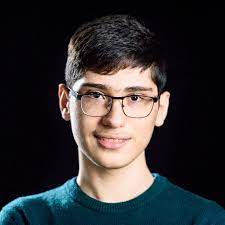
The phenomenon of Alireza Firouzja
When the young Iranian grandmaster appeared on the world scene four years ago, I must admit that after some time I was again amazed… by his ability to sense the true needs of the pieces in sharper positions. They are happiest when they can cooperate, and if the young chess player has an obvious gift for listening to their demands (Kasparov calls this ability a specific intuition in his works) and is boundlessly in love with chess, thus willing to work many hours a day, it is a winning combination.
The World Rapid and Blitz Championship in December 2019 in Moscow only confirmed to me that we probably have the most talented chess player of the 21st century before us.
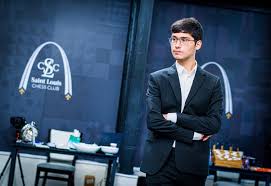
Firouzja (unfortunately in my opinion) changed federations, moved to France, to achieve further significant successes after the covid period. True, he overestimated his strength in the Candidates Tournament in mid-2022 (it was clearly not yet ‚his cycle‘), but by then he had occupied the second place in the world rating list for half a year, having crossed the 2800 ELO points mark. Even last autumn he shone at the traditional tournaments in Saint Louis… only to disappear from chess life for several months.
No pain, no gain!
My hope that he was training intensively at that time faded, and information about his new interests and business ventures did not bode well for chess. Of course, today even the most intelligent young people at 20 do not think as they used to, and the degrading Western civilisation does everything to make youth generally dumber rather than studious. Nevertheless, I cannot understand what a young man with an IQ surely around 180 ‚sees‘ as interesting in the field of fashion design…
In any case, Alireza's results logically deteriorated significantly and the fiasco at this year's qualifying tournament on the Isle of Man was, in my opinion, a clear warning that Firouzja's career may be heading in the same direction as that of the Chinese Wei Yi a few years ago…

No comment!
Without the queen, but in his element
At the time of writing these lines, the annual series of rapid and blitz tournaments is again taking place in the main chess city of the USA, Saint Louis, culminating in a serious classical tournament. So far, Alireza's play has not made any particularly brilliant impression on me (true, don't judge the day before the evening)... except for one rapid game. That game would certainly have gone down in history if its result had been decisive.
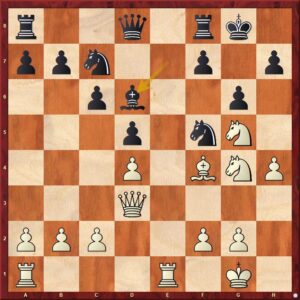
How would you continue as White?
In it, Firouzja, in the style of the old masters, most reminiscent of Rashid Nezhmetdinov, about whom more will be said below, intuitively sacrificed the queen. I now offer this gem to readers for amusement, reflection, and possibly serious study.
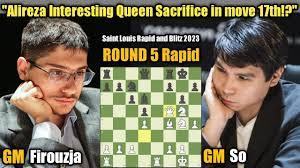
In the style of Rashid Nezhmetdinov
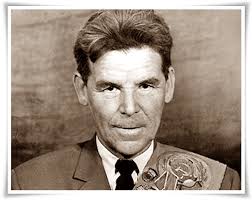
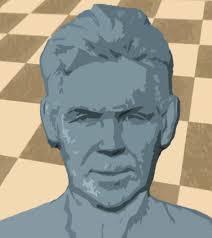
Rashid Gibiatovich Nezhmetdinov (1912-1974)
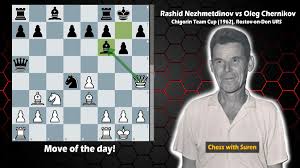
About my great chess favourite Rashid Gibiatovich Nezhmetdinov, I wrote a whole work about eight years ago, so I will not repeat even a brief biography here. I will focus only on the topic of this contribution. Both of his intuitive queen sacrifices have gone down in history, yet I believe that at least one of them will not be known to most readers. The second example – a battle against the future multiple Candidates Tournament participant Lev Abramovich Polugaevsky – is so complex and extensive that I had to present it twice again: in an abridged form, and then for those interested, the full version with complete commentary.
First, however, I will again present the diagrams from both games and leave the dear reader space for their own ideas:
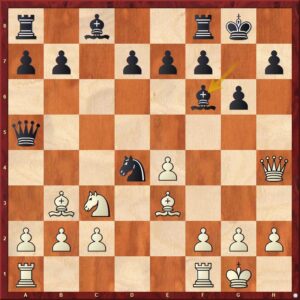
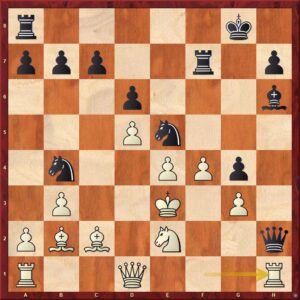
In the first diagram White to move, in the second Black to move.
Comments on the game would certainly not be complete without recalling the reaction of the other players in the tournament hall. Most of them 'forgot' about their own games and practically all gathered around the table where this game was taking place. Perhaps the most qualified spectator, David Bronstein, did not lift his eyes from the position for about two hours! Maybe at those moments he envied Nezhmetdinov...