Fifty years ago, on 2 November 1973, I apparently stood at the threshold of my chess journey. I had only really known how to play proper chess for about two years (before that, my sister and I had been playing with somewhat modified rules), but like many other young chess players, I was literally kicked into action by the match for the chess crown that the whole world – not just the chess world – was watching with bated breath. In the summer of 1972, the defending champion Boris Spassky met challenger Robert Fischer in Reykjavik...
After that, I just devoured chess! Before the summer of 1972, the head of the school chess club, Mr Ing. Adámek, ‚forced‘ me to join Pionýr so that he could register me in the autumn and I could play competitively.
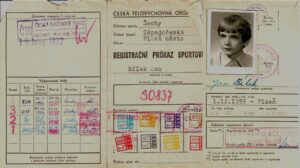
Today, when twelve-year-olds earn grandmaster titles and ten-year-olds become masters, it may seem almost amusing to include a reproduction of my registration card, from which it is clear that at the time of this game I held (as it was then called) 2nd performance class. To such sceptics, I would like to remind them of the situation back then. There were no national ratings yet, Czechoslovakia could boast only four or five grandmasters at the time, and in the entire West Bohemian region there were only slightly more candidate masters. It was then a title that, in my opinion, had roughly the same weight as the international master title has today in the Czech chess environment.
A year passed like water, and I had learned almost by heart the 3–4 books I owned at the time. One of them will be mentioned below, but my favourite was Keres’s 1971 monograph Dreispringerspiel bis Königsgambit, which was most often found in bed under my pillow.
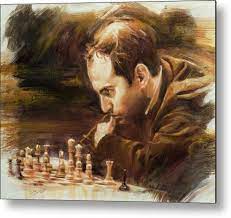
Simultaneous exhibition with Tal
I do not know exactly which officials came up with the idea to organise international blitz tournaments every year in Pilsen during the celebrations of the Great October Socialist Revolution, but it was a brilliant initiative! They were called The Red Flag Tournament and the inaugural edition was held precisely on 3–4 November 1973.
As was customary, a day or two before the tournament, the most famous participants travelled around the West Bohemian region to play a number of simultaneous exhibitions. Fortunately for us young Pilsen hopefuls, we got the most famous and significant of them – former world champion and then world number two Michail Tal!
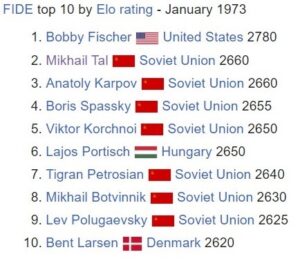
Note: 1/ The attentive reader will notice that the rating list is dated January 1973. This is because in the early years when the brilliant invention (the scoring system was devised by Professor Arpád Elo, a Hungarian-American statistician) saw the light of day, the ELO list was published only once or twice a year! 2/ Many attentive readers will be surprised by Robert Fischer’s overwhelming lead, which is still ranked 21st in historical lists even after more than 50 years. This is because in the fight for the world crown Fischer achieved results that few will ever repeat. He won an incredible 20 games in a row! 3/ The intelligent reader will also surely know or guess that over the years ratings have suffered significant inflation comparable to the fall of the dollar. This continues to this day. More and more points enter the system nowadays, for example due to various development coefficients (youth 40, world elite 10, and so on).
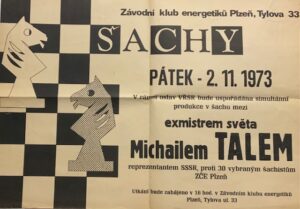
I learned that I had been selected among 30 participants in the simultaneous exhibition against the 8th world champion about 14 days before the event. By that time, Keres’s book had been slid back from under the pillow into my bookshelf. Next up was Suetin’s monumental work Lehrbuch der Schachtheorie, which I got my hands on sometime in September 1973. The book had over 500 pages (it contained all openings), so even with my ‚quite decent‘ eidetic memory, I obviously could not absorb all the opening pages that interested me.
Sometime in mid-October, my choice in the book fell on the Spanish Game with Black, specifically the Marshall Attack. I replayed some variations, but mostly just read them. The exception was a sub-variation marked in the image below.
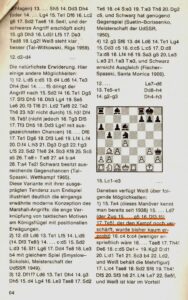
Note: unfortunately, the scanned page does not come from the original book but from the so-called ‚stark bearbeitete Auflage‘ published in 1975. The original had been too much affected by the ravages of time.
Fate or luck?
The simultaneous was about to start soon! Michail Nechemjevich expressed the wish that the strongest, older players on paper should sit at the head of the rectangle. Of course, he wanted to focus more on those. The labels of all the others were – I believe – placed more or less randomly.
Well, the reader probably guesses, what appeared on my chessboard!
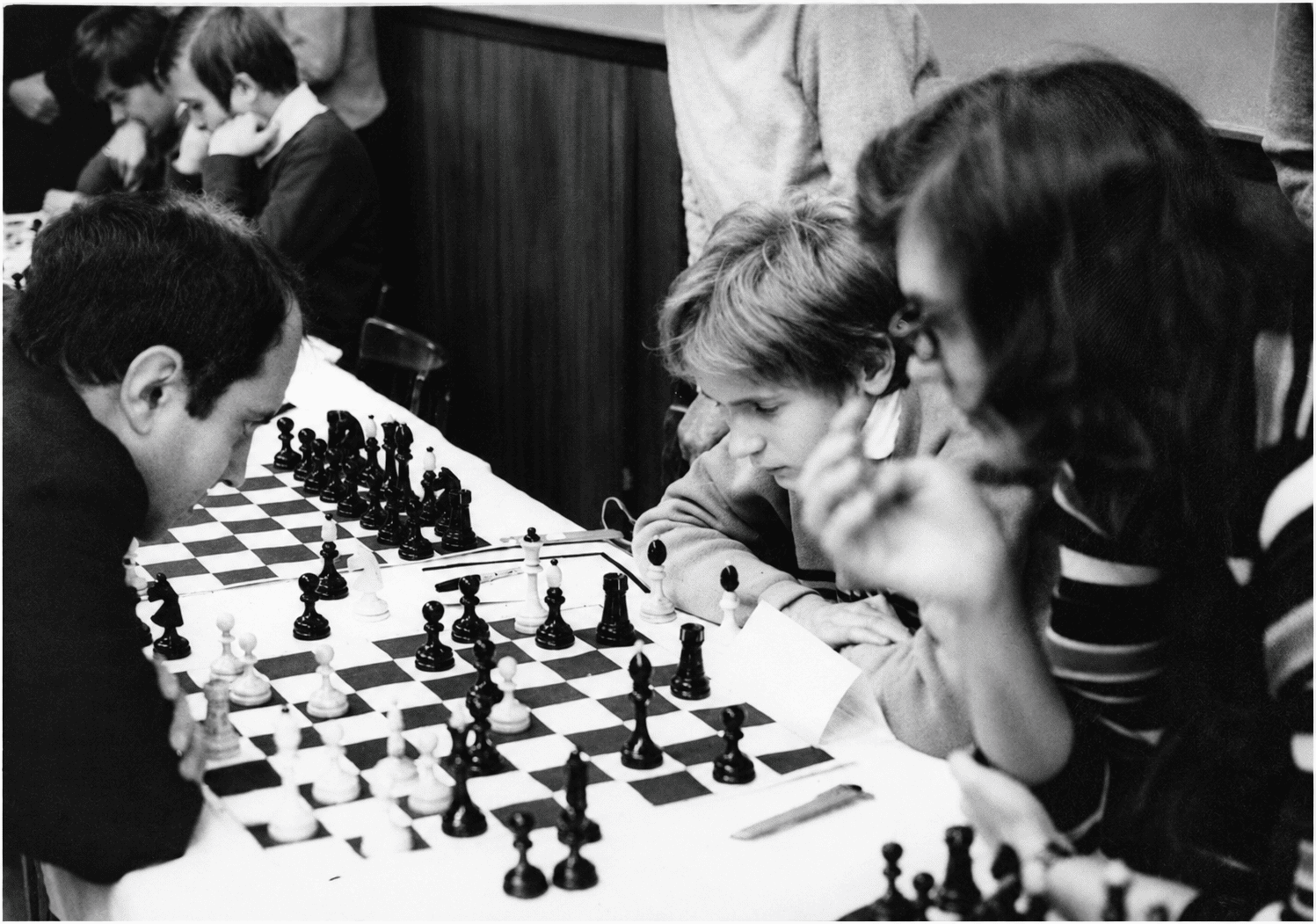
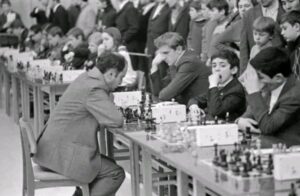
A memorable photograph. Mikhail Nechemievich is about to play 27. Rd1-d4.
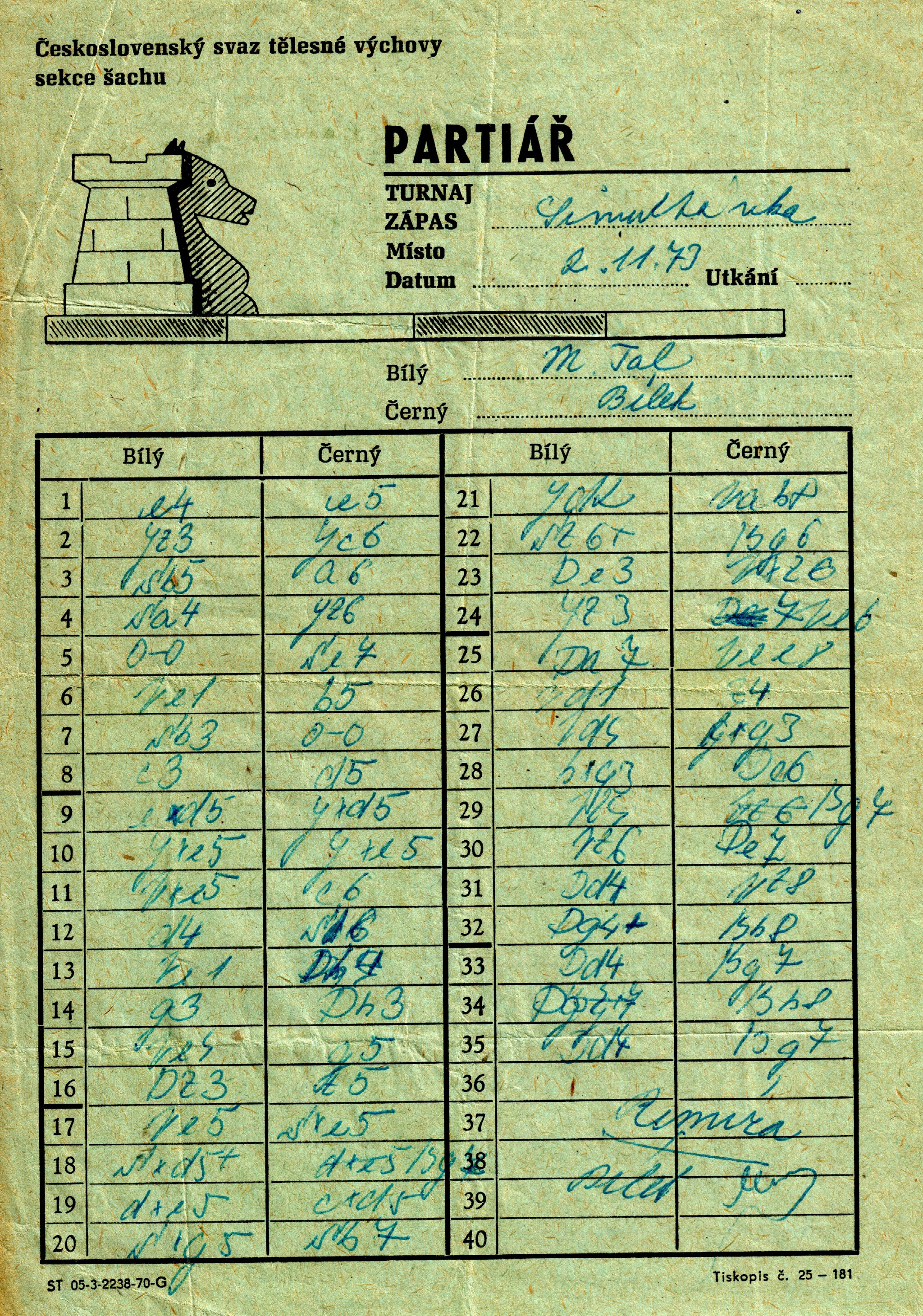
And here, of course, the memorable game score with signature!
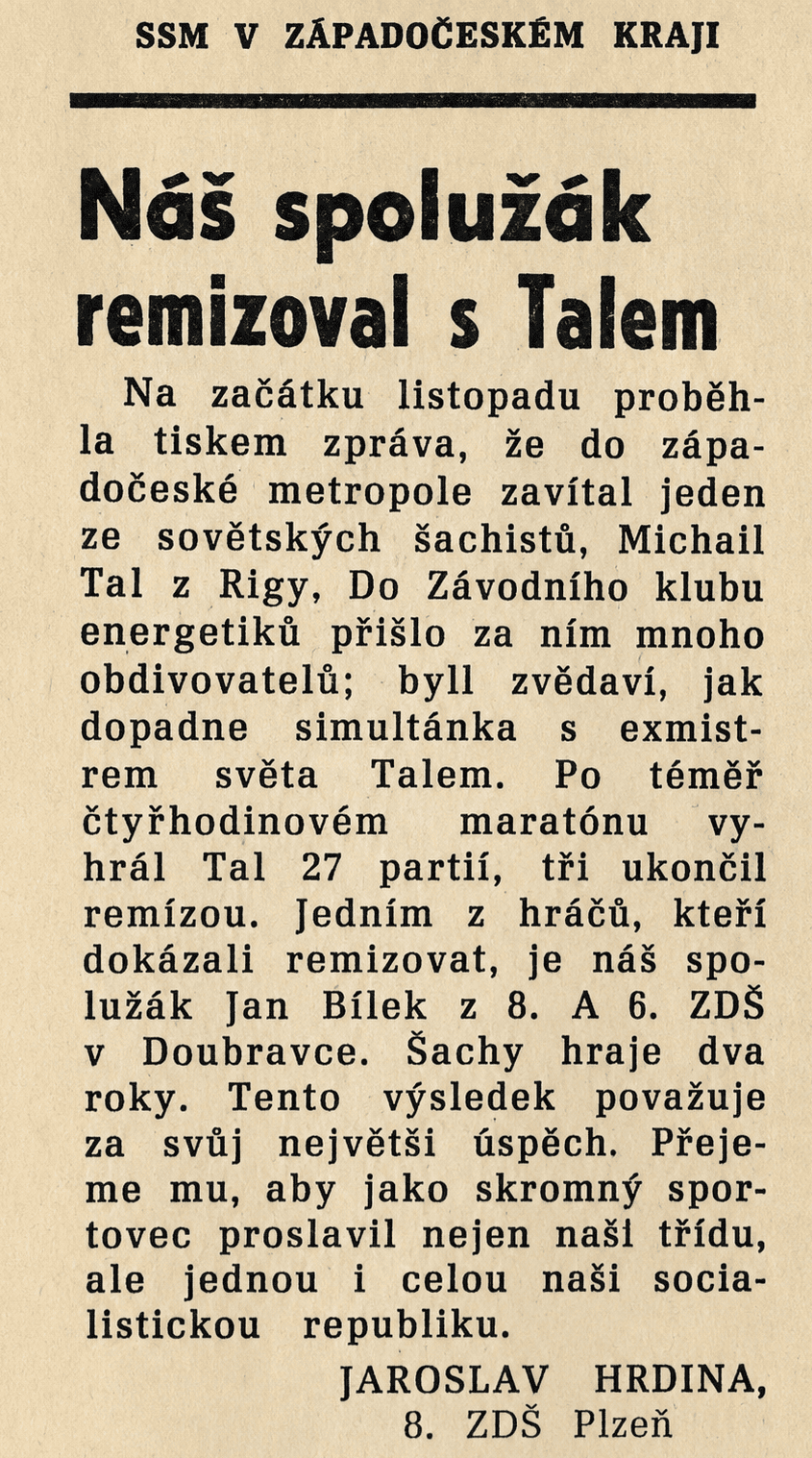
‚I even got‘ into the newspapers. Due to the reduced quality of the photographs, I only present this short article by my schoolmate. I remember that sometime in mid-November, a comrade inspector visited our old school, which in 1945 suffered an Allied air raid on the Škoda factories. I was summoned to the headmaster’s office. „Comrade inspector, this is the pupil who drew with Tal!“ the headmaster boasted, evidently assuming that the controller from the ministry or the relevant department of the Central Committee of the Communist Party was familiar with the name of the famous former world champion. However, the comrade inspector was not impressed at all by this information (probably because... he was not an avid crossword solver, where the clue ‚chess player for three‘ perhaps still appears today). „Mainly whether he studies well.“ (or similar wisdom) replied the inventive mind of that visit...
Insert
Just before publishing the article, I remembered what I read about 10 years ago in Kasparov’s book „My Great Predecessors“. Well, and surprisingly I found a somewhat similar photograph!
Final of the All-Union Pioneer Palace Tournament (Moscow 25 - 31 May 1974). Facing Tal sits the almost eleven-year-old Garry Kimovich Weinstein (Kasparov). Let us read what Kasparov writes about this encounter: „On the very first day I experienced a huge shock when I found myself face to face with the living legend – Mikhail Tal! I could even shake his hand! I had heard about his terrifying hypnotic gaze, which literally drilled through his opponents. However, Tal did not need that to defeat me...
Perhaps little Garik should have concentrated better, kept his mouth shut, and watched what was happening on his own board. 🙂
What a genius can do!
After the simultaneous exhibition ended with the result shown below
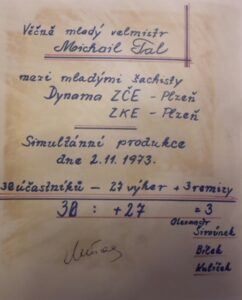
a party was held in the same building of the Energy Workers’ Club. Tal’s fondness for alcohol and tobacco was legendary (in the latter case, during the approximately 2.5 hours of the simultaneous exhibition, he could smoke two or three packs of cigarettes, which also burned simultaneously in about 10 geometrically precisely arranged ashtrays next to the boards), and accordingly, he looked the way he did the next day at the blitz tournament itself.
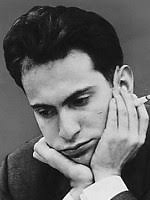
That tournament was eventually won by the then unofficial USSR champion Vladimir Tukmakov.
What happened at the banquet I write of, of course, second-hand, and the reader will surely forgive some narrative licence... 🙂
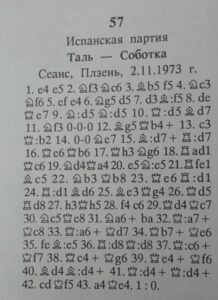
„Mikhail Nechemievich, which game would you highlight and which pupil would you praise for their game? And could you possibly replay it for us and briefly comment on it?“ our officials asked (of course, at that time they all spoke Russian at least reasonably well). Mikhail Tal: „I can dictate all of them to you, but the one I liked most was the game in which the Jänisch Gambit was played. A talented boy...“ That talented boy – Ladislav Sobotka, two and a half years older than me, was later a great role model for me. And Mikhail Nechemievich apparently really remembered all the games. That game against Ladislav Sobotka even later appeared in a Russian book:
Much has been written about the eighth world champion, his genius abilities and memory. For example, I thought for quite a long time that if at the age of 13, when this simultaneous exhibition took place, I could multiply three-digit numbers in my head within about five to ten seconds, I was something special. Well, in classes or schools (but not at university) I was the only one. But later I read that Tal could do this at the age of five!
When I was an older pupil or teenager returning home from blitz tournaments, it was my habit to lie down a little earlier in the evening and write some blitz games with important opponents from memory into a notebook. Tal, however, could have produced not just 30, but I believe even 60 from his sleeve…
The start of my career
A draw with Mikhail Tal eventually led me to the thought that chess is and will be the most important thing in my life. When, at about 17, the vocational teacher asked me, as he did the other pupils, what I wanted to be in life, I answered without hesitation: „I will make a living from chess!“ The teacher went pale and I think he didn’t sleep well that night…
I have spent over 50 years at the chessboard and my life is actually arranged quite symmetrically, probably like Tal’s ashtrays during a simultaneous exhibition - always in threes or fours of chessboards: I was born 15 years after the war, lived 30 years under socialism, 30 years under capitalism, and the remaining years, it seems, I will live under the yoke of fascism…