

Below you can mainly familiarise yourself with the solution to the 'Dubov' challenging problem, which I posted on the website a few weeks ago. In the text, I will also recall the fantastic retrograde analysis problems of the brilliant German composer Werner Keym. Those of you, dear readers, who again have the desire and time, are not currently persistently searching for goods that we will probably need in autumn or winter, or are not following the chess Olympiad so intensively, with the absence of at least two not only chess-strong countries, reminiscent of the 1984 Summer Olympics in Los Angeles, can immerse themselves in solving it.
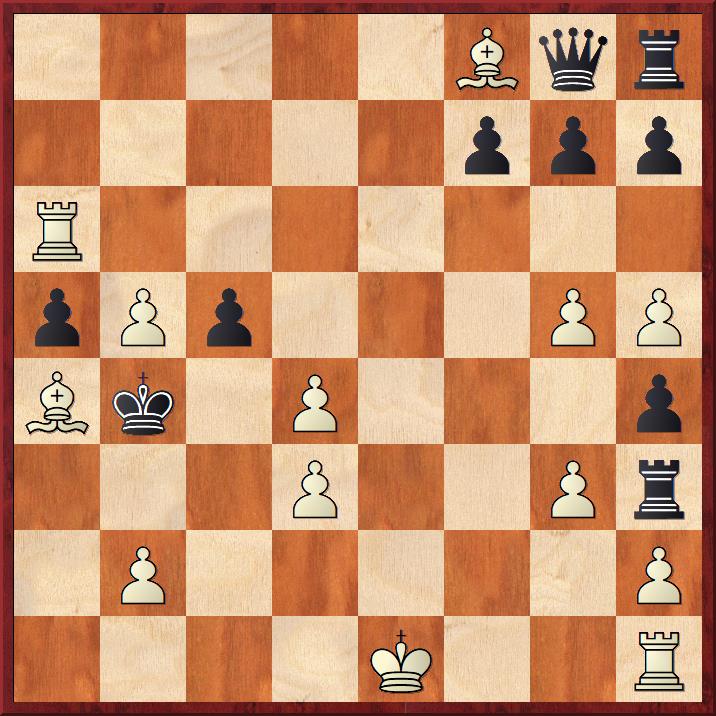
Let us first repeat the task: Has Black created a fortress or not? Can White win? If yes, then how?
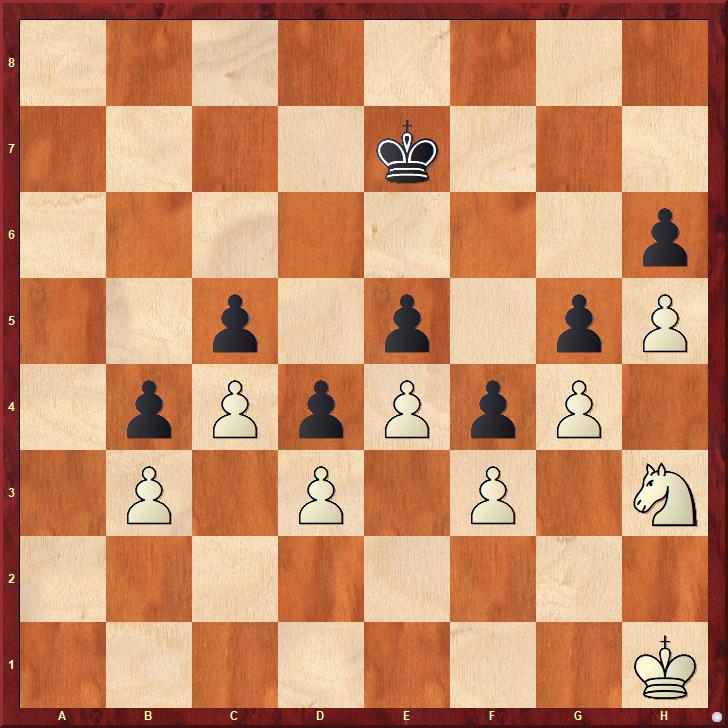
Solution (consideration, retrograde analysis, psychology)
1/ After a moment of thought, we should arrive at the initial consideration: White wins only and exclusively if the knight penetrates to the square f5 and then captures the pawn on h6! (Black finds himself in zugzwang with the king on h7!)
How to achieve this? The knight can jump over the bridge a4 to the nice square d5, but that alone is not enough to gain the key square f5, and thus the pawn h6, because Black’s king will guard squares e7, d6, not to mention g7. (We also naturally reject the idea that sacrificing the knight on b4, f4, d4 or g5 could suffice with correct defence.)
The above-described attempts ‚to jump through from above‘ to the pawn h6 via f5 or g8 are therefore false, although...
But the knight can reach the key square f5 by another route - from the front. Via the square h4! In such a case, it is indeed a combination, Black can capture the knight, but the ensuing pawn endgame is hopeless for him. Again, positions of disadvantage of the move arise.
"We have the solution!" might shout a less experienced and probably young, somewhat hot-headed chess player who is 'done with everything immediately'. But no! We have only reached the first point of consideration!
2/ Our key bridge is thus the square h4! But how to transfer the knight to h4 in the limited space of White’s camp? „It’s impossible!“
Here geometry and retrograde analysis must help us (although, admittedly, of a different kind than some incredibly complex retrograde problems and considerations of the German problemist Werner Keym)
3/ The knight must pass through the opponent’s camp not only to try to penetrate to f5 (after Black’s mistake), but... to jump to the square a3, thus creating another combination. If our king stands near the square a3, the limited space does not bother him and he ‚likes to stroll on the queen’s wing‘, then the knight will jump: a4-b6-d5-c7-b5-a3), accepting the sacrifice will again lead to a winning pawn endgame.
4/ The knight and king will move back to the king’s wing, White will use his dreamed-of bridge h4, the knight will jump to f5 (via c2-e1-g2-h4) and... the task is accomplished!
Without long comments, just with the movement of pieces on the board, White could continue to achieve the win, for example, like this. (The order of White’s moves does not matter, the travelling king must go to the queen’s wing and back anyway, so if he does not feel like it, he can rest on the way and let his officer ‚jump around a bit‘ meanwhile.)
Below I give the 'human' and 'computer' solution. If you have a stronger 'engine' at home, you should come to the conclusion that White mates no later than on move 43...
The entire retrograde analysis also hides a tricky psychological aspect, it can even be called a bluff! Many solvers will certainly find the knight’s transfer via a4, but then they will vainly try to break through to f5 'from above'. At first glance, the work seems done, but then it encounters a problem, and even though in reality we are at the beginning of the correct path, we hesitate whether to abandon it, as often happens when you are searching for something on foot or even by car and it seems to you that it is taking too long. You begin to doubt! Many experienced chess players give up the whole project and start trying other, but of course, as we already know, false solutions!
Let us repeat once more that Daniil Dmitrievich is not the author of this retrograde analysis problem; he constructed the position in the study from memory and the pieces may therefore stand differently in the original. I would be grateful to readers: if you know the true creator, please let me know. Thank you in advance.
At the beginning of the solution, I once again mentioned on the pages the German genius chess composer, teacher and musician in one person, Werner Keym. Would you like to reflect on his (also retrograde) study?
White to move wins.