

In the Qatari capital, the world elite gathered after nine years to once again compete in rapid and blitz chess. Over 250 players participated in the World Championship! After a one-year „New York denim break,“ Magnus Carlsen won both titles again, effectively reigning over world rapid and blitz chess for fifteen years.
We may have many reservations about Magnus's behaviour, we may admire him boundlessly, but two of his main qualities, which have long made him a legend, cannot be denied: the character of an exemplary Alekhine-style fighter and a brilliant, almost Capablanca-like intuition.
The only other two-time World Championship medallist, Arjun Erigaisi, declared a few years ago: „It is clear that today’s play is better than in the past.“ On the contrary, I believe that the quality of the game itself – and this is especially evident in blitz – is gradually declining. Rapid and especially blitz are primarily entertainment for the spectators, and this time they really got their money’s worth!
A more serious account of the dramatic battles with analyses and demonstrations of key moments can be approached in several ways, but if the reader is to learn anything, we simply cannot avoid the basic division into rapid and blitz. I know that today is a „different time,“ but still… I dislike analysing blitz games. I prefer to leave the enjoyment of blunders, which inevitably accompany „hitting the clock,“ to others 🙂. Nevertheless, I would like to start somewhat unconventionally…
Fingering and piglets
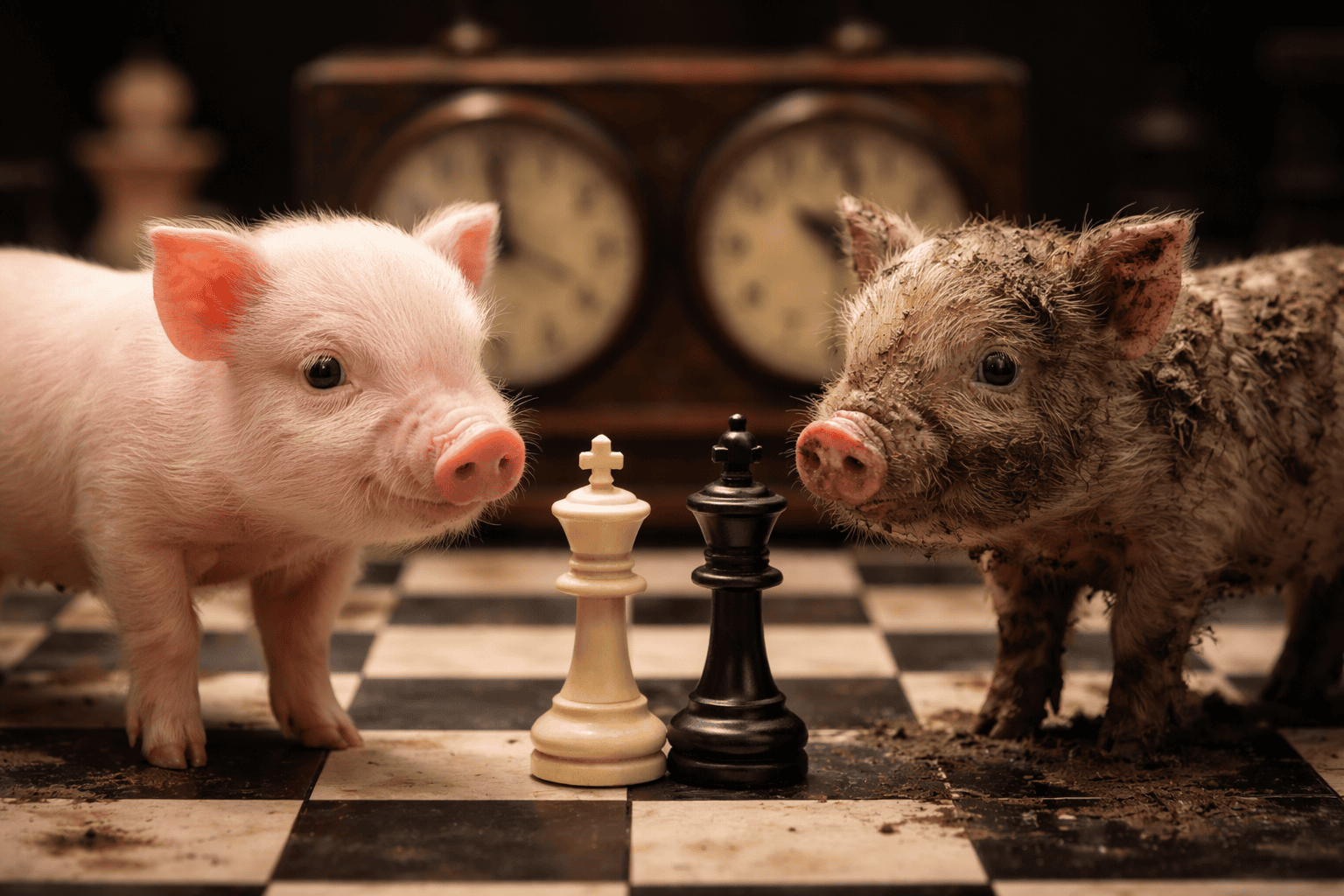
In the critical time trouble of blitz, it is important not only to keep a cool head and board awareness, but also, if possible, not to knock over pieces „every other move“. I have seen a lot in my life and of course it is true that – even though I tried my best – I did not always have my day. However, I have seen excellent blitz players with my own eyes, who were a joy to watch. Even in the most severe time trouble – literally on the flag (back then blitz was played 2x5 minutes without any increment) – they managed to place pieces in the centre of squares!
As their direct opposite, there existed, to put it mildly, so-called „piglets.“ I divided them into several groups. The so-called „pure piglets“ at most shook the table, knocked over (sometimes even deliberately) pieces, or even the clocks themselves fell to the floor! You may ask why I used the adjective „pure.“ Well, because there was also the exact opposite. Of course, I will not name names. Tricks like the move king to king in lost positions I have not only seen but also experienced personally.
What was it about? In a lost position in severe time trouble, the opponent makes an illegal move (the king moves to your king). If you notice it, you have won anyway. If not, the opponent claims that you made the last move illegally! Of course, the appropriate conditions must be met for this. For example: spectators are either not present, or… the „dirty piglet“ is watched by like-minded friends.
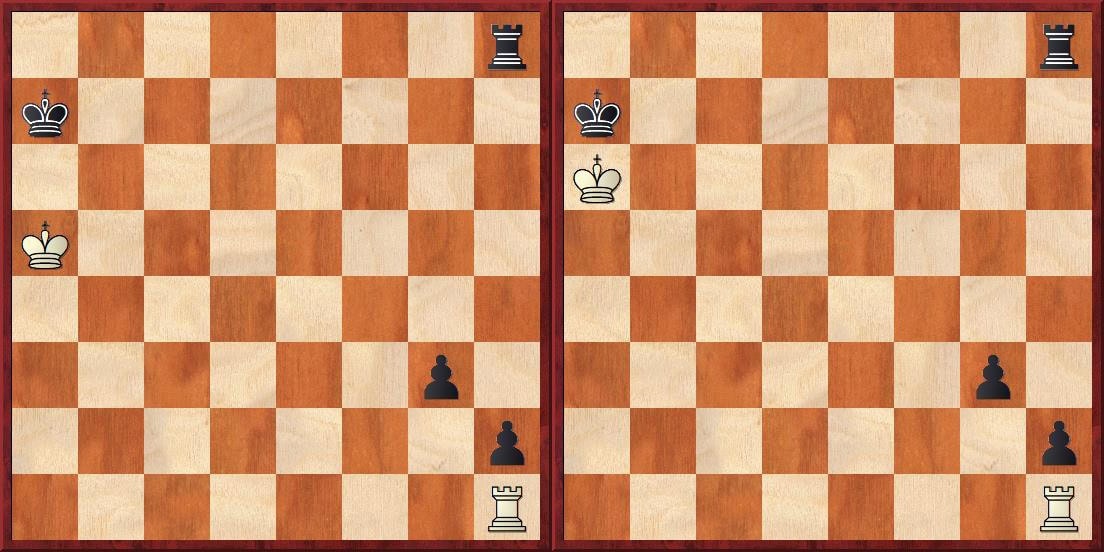
Diagrams – schemes illustrate the practices of the „dirty piglet.“ White plays Ka6. In reality, there were usually many more pieces on the board, which made the situation much more confusing. And also, playing without increment on mechanical clocks was a different kind of drama than it is today!
Decades ago – in the immediate post-revolutionary period – it was also common practice to bring your own equipment to tournaments. I saw modified mechanical clocks on which 5 minutes passed in 3.5 minutes!
A much more widespread vice of the second group of „piglets,“ however, was the unjustified pressing of the clock. But with this, we move from the past into the present.
Let us look at two very short videos:
Well, admirers of chess Messi Faustino Or will excuse his behaviour due to his age (in my opinion, it deserves at least a few slaps), while Magnus's supporters will have a „sufficient“ explanation for the clock pressure: „It was simply a reflex. It happens.“ or „The rules do not forbid it, that's what the arbiter is for, to penalise the players.“ Well, something like the famous Maradona hand...
Arjun Erigaisi, who – if the tournament had been played more or less normally as before 2023 – should actually have won the World Blitz Championship, also had his share of trouble in the game against Carlsen.
By the way, Arjun's even better results are hindered – and I fear this will be a lasting phenomenon – by terrible nervousness.
The battle between Carlsen and Erigaisi was truly full of mistakes, but let us follow Carlsen's „finger slip“. The final extempore with the „flying queen“ is really just the cherry on the cake. And the banging on the table, which no one else would dare, only further illustrates Magnus's character...
Carlsen was preparing to capture a pawn with 46.Qxa5, but he was betrayed by that very „finger slip“. So – as we can see in the videos, which became a hit – a dangerous projectile in the form of a white queen flew through the air, while the poor black pawn took a shorter trajectory. Magnus's outburst of anger even took the table with it – again, just like in Stavanger.
However, do not expect any reprimand from the arbiters. If they dared to do so (this time justifiably and logically, unlike the „jeans case“ from the previous championship), they would at least not „whistle“ in Qatar...
World Rapid Chess Championship
After the second day of the championship, before the last four rounds, the standings of the top twenty players looked like this:
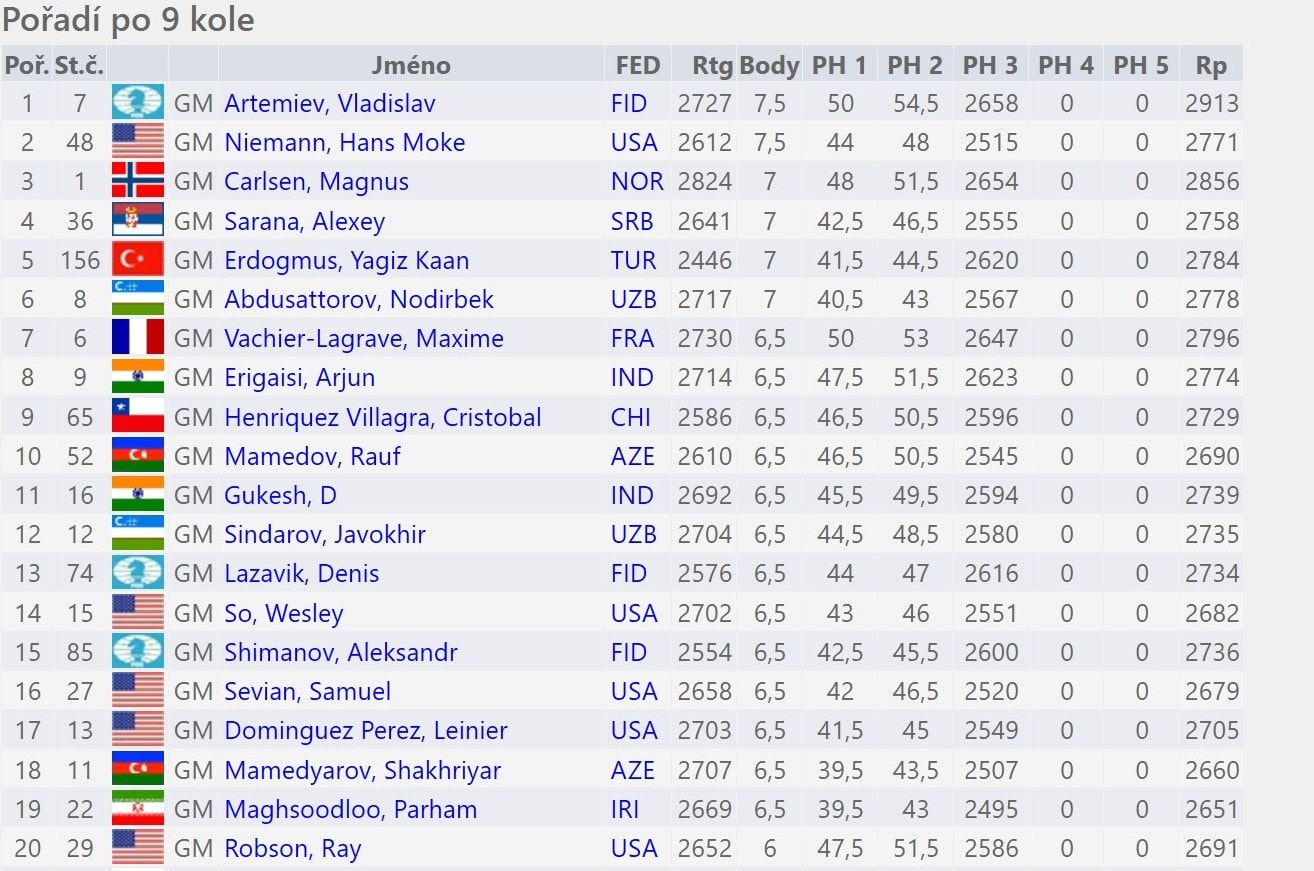
Everything was therefore open and Vladislav Artemiev, who won the duel with Carlsen in round 7, had decent prospects of victory with his tiebreak. At the same time, however, I had certain concerns because his time management was – and still is – truly dreadful! Certainly, I have long known that studying opening theory, euphemistically speaking, is not among Vladislav's hobbies. But too much is too much.
After all, dear readers, I cannot and do not want to deprive you of the record of the key game of the championship. So judge for yourselves...
The video shows that after the opening of the combination 15.e6 (as we will see – a drawn one) Artemiev had only one minute and 15 seconds left on the clock! In the notes to the analysis I made in the evening after the game, I wrote: „With such time management, Vladislav simply cannot win! Even though I would very much like to be wrong.“
Of course, Carlsen could not help but vent his frustration on the reporter who was just doing his job...
A bird in the hand is worth two in the bush...
Reality often surpasses even the wildest imagination. Vladislav Mikhailovich, who was the only one who could compete with or surpass Carlsen, simply... drew the championship from a position of strength – even with nine ten-move games!
Can one be surprised? In fact, such a decision has its logic when we look at the distribution of prize money.
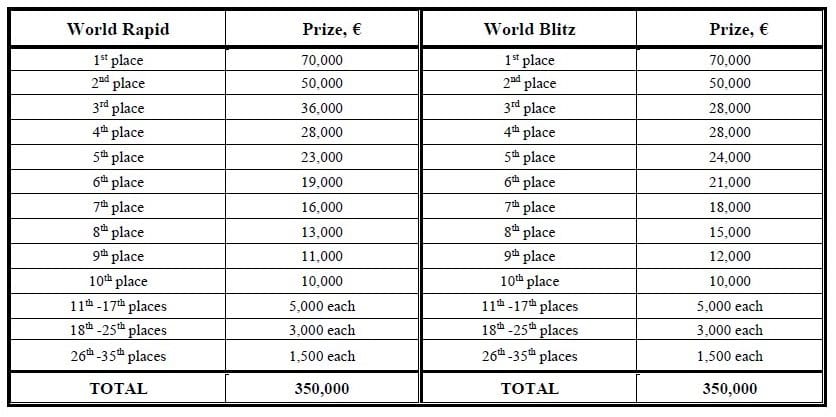
While the rewards are insignificant for Carlsen and – who knows – may not even reach the amount of his entry fee, for many other grandmasters it makes a huge difference whether they return home with €50,000 (like Vladislav), €5,000, €1,500, or no prize at all! This fact also explains the large number of draws, or even several multi-move games in the last rounds of tournaments. (Prizes in the women's categories were naturally somewhat lower, but €40,000 for the winner... well, that is not very common.)
Enough words, let us look at some interesting moments!
To the collection of miniatures
On the first day, the following miniature attracted great attention. Its victim was none other than one of the favourites, former rapid world champion and my favourite Nodirbek Abdusattorov! In the game of round 3 Bjerre vs. Abdusattorov Nodirbek covered the smothered mate mechanically – by the move 10…Qd7.
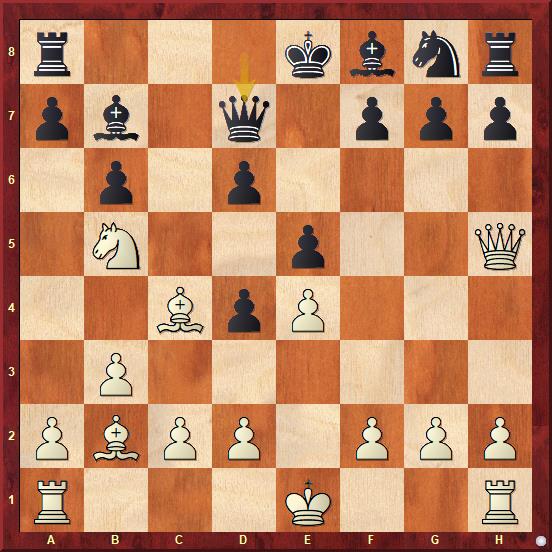
How would you continue if you were White?
„I don't believe in fortresses“
Magnus Carlsen occasionally declares. Perhaps because his opponents cannot defend precisely and patiently!
A certain counterpoint to the miniature in round 3 was the following endgame. For a somewhat different kind of connoisseurs it is truly a real delicacy! The game Carlsen vs. Iturrizaga Bonelli reached after 45…Ra8

to the position on the left diagram. Magnus – admittedly also already in time trouble – continued 46.h4??, which, however, allowed Black to actually build a fortress!
In what way could Black achieve a draw?
Below is the record of the entire game, with the critical moment occurring at around 19:30 minutes.
An excellent graduation… with the strictest examiner!
That is how Arjun Erigaisi might have felt after the end of round 5. In the diagram position from the game Carlsen vs. Erigaisi
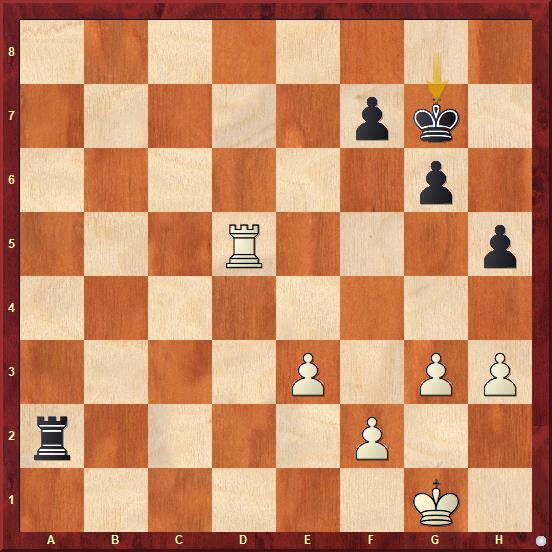
We see a theoretically drawn rook endgame, which some top players would either not play further between themselves at all or would make only a few „test“ moves. Not so Magnus, who tested Arjun for almost seventy more moves (sic)! After White's 64th move, another instructive, theoretically drawn endgame arose…
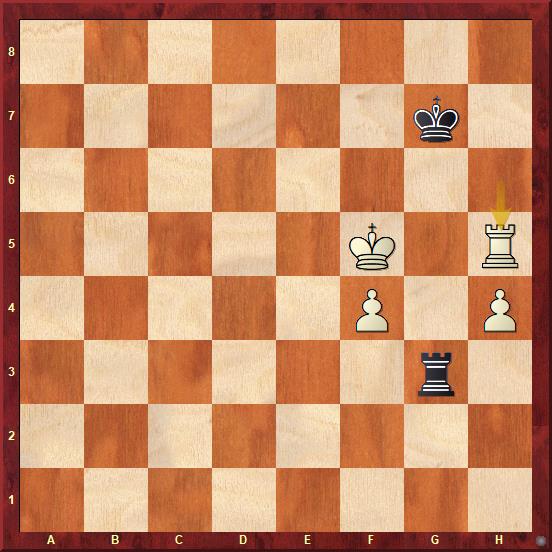
I recommend the following video recording of the game with a brief analysis to all readers who have not yet seen the game.
It is interesting that one round earlier in the game Gukesh vs. Pichot the same type of rook endgame occurred – with pawns on the ‚f‘ and ‚h‘ files, but Black did not hold it. The video broadcast of the game captures the endgame after the 15th minute.
Coach defeats Praggnanandhaa with the Ja5 sortie
That could be a headline on the pages of tabloid papers 🙂. If it were not for Erigaisi's rook endgame graduation being the hit of round 5, then it would undoubtedly have been the game Praggnanandhaa,R vs. Chanda Sandipan!
Praggnanandhaa, perhaps unsuspectingly, opened with 1.e4 e5 2.Nf3 Nc6 3.Bc4 expecting the Italian Game or the Two Knights Defence, to face 3...Na5.
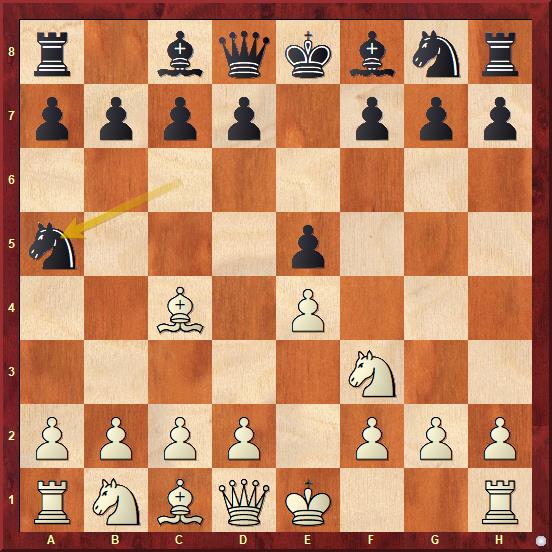
The nameless „anti-Tarrasch retreat“, which Black also plays occasionally. It is even possible to find a serious game where he continued like this in 2023 against the then seventeen-year-old Javokhir Sindarov.
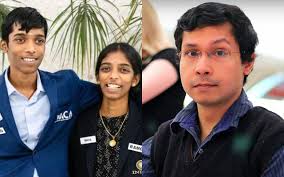 Here it is appropriate to explain the context! Chanda Sandipan is primarily a coach. According to Sagar Shah, he was the teacher of the school that Praggnanandhaa himself attended, but not only that. Last year, according to him, he was even the main coach of Praggnanandhaa's sister Vaishali at the Candidates Tournament in Toronto. The choice of an "irregular opening" 🙂 could therefore be easily explained (and justified) in this way. However, the matter is even more complicated. Chanda uses this dubious approach more often, and as we will see below, apparently especially with enthusiasm against young stars...
Before you, dear readers, enjoy the video recording of the game and can study it in the viewer or download it, I will pose a question: How would you continue in your game after mature consideration?
Where has the World Champion gone?
Gukesh expressed himself quite clearly at the opening press conference about the rapid formats and why he actually came. He wants to have fun, play nice games, but does not expect any special results. If in 2024 he overshadowed all other chess players with his performances, typically Magnus at the Olympiad – who in Budapest „escaped“ a few times by the back door –, here the situation has obviously reversed.
„Why does Gukesh actually struggle with rapid and blitz?“ Some of my pupils occasionally ask me such or similar questions. Although I have already commented on this issue, I will summarise the reasons once again.
In fact, it is quite simple if we understand the way chess players think when choosing, and thus selecting moves in a game. (We are talking about the move selection algorithm!) In Gukesh's play, intuition – a deductive way of thinking – is minimised. He tries to „calculate“ everything! However, there is not enough time for that in rapid, and especially not in blitz.
Sometimes, to better understand the difference between deductive and inductive thinking, I use mathematics as an aid.
For example: you have to multiply the numbers 5,124 × 12,111 very quickly and without any aids. In practice, most intelligent people (assuming that unlike the current Czech head of state with a university degree, we can solve the „equation“ 2+2×3 🙂) only estimate the result: „62 million and some thousands.“
However, some are not satisfied with an intuitive estimate. With varying success, they try to solve the task exactly – like on a calculator. Naturally, in the limited time of seconds or minutes, the given example is usually not solved.
This is roughly how Gukesh's move selection algorithm works. Nothing new under the sun! The young Fabiano Caruana was a similar „inductor.“ Only later did he have to modify his style – rationalise it. And just like today's world champion, he played blitz games significantly worse than serious games in his junior years.
In round 9, I followed the game of my favourites with interest Gukesh vs. Abdusattorov.
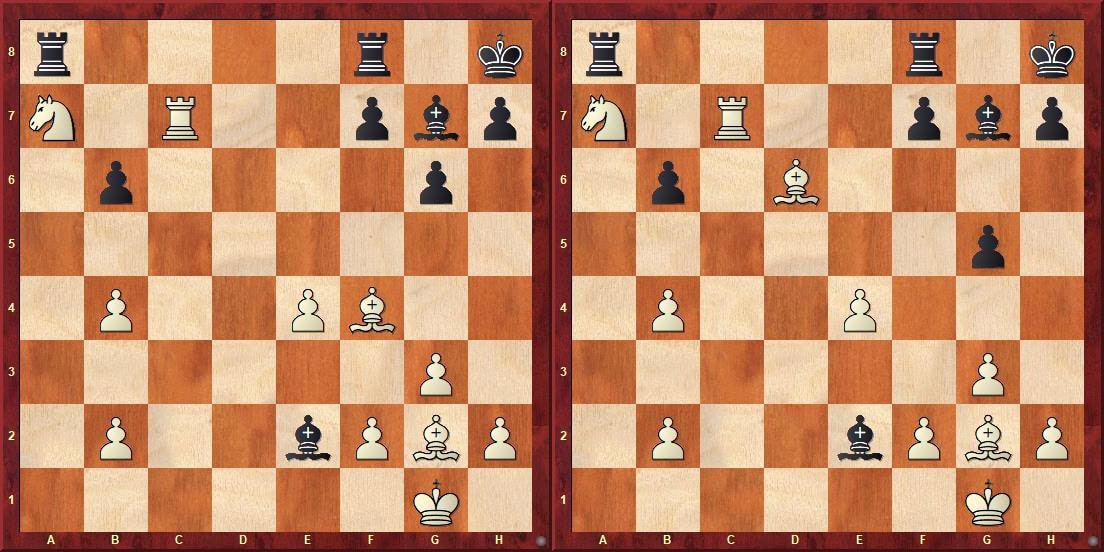
In the position of the left diagram, Black continued – perhaps I can already write a typical Nodirbekov move – 29…g5! Gukesh, who as usual was already in time trouble, replied in 11 seconds 30.Bd6.
How would you continue in the position of the right diagram?
A critical position arises at approximately 5:20 in the video.
Another Magnus training session
Where are the times when Carlsen declared that he would never sit at the board against Niemann again? He apparently stopped sulking after his lawyers advised him to end the lawsuit – Niemann's $100 million claim – by settlement. However, on the chessboard itself, the multiple world champion really rules with a firm hand!
In the game of round 11, a Carlsen vs. Niemann rook endgame with a distant passed b-pawn arose.
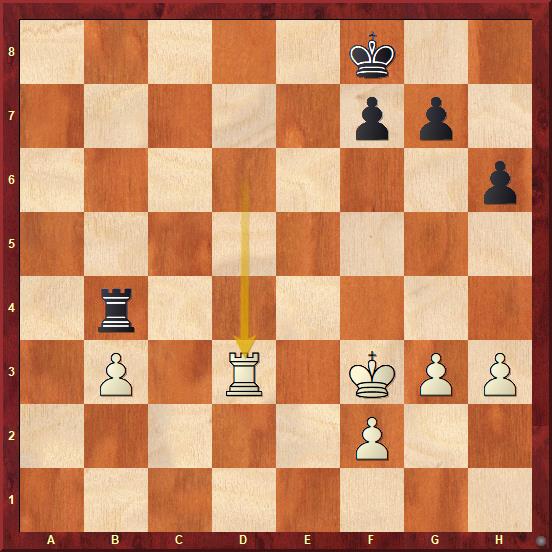
We dealt quite thoroughly with endgames of this kind on the chess school website in the article from 20 August 2025: "Endgames by the book? Divyina's series and another story of an anomaly.".
How would you assess the objective prospects of the sides?
I found a methodical and high-quality analysis again in a video by Alexey Pugachev (I remind you of the option to switch to AI dubbing in English).
Nakamura's analyses
After last year's collapse in the New York event, the world number two Hikaru Nakamura decided not to participate in this year's World Championship. However, his analyses of some games from the end of the championship are definitely worth watching…
The final standings of the World Rapid Chess Championship OPEN for the top 20 places looked like this:

Women's World Rapid Chess Championship
I only watched it with half an eye. On the other hand, it had a much more dramatic conclusion because it did not avoid a tiebreak!

Sometimes one marvels at the systems FIDE can devise for tie-breaks. Looking at the table, few logically thinking people would have thought to play a tiebreak between the top two female players in the standings when three players have 8.5 points! Moreover, the tiebreak was played as a race to win in just two blitz games!
On the other hand, this is the end of the year and rapid formats… When you listen to the FIDE president for a while, you cannot fail to see that entertainment is the top priority; for the federation itself, however, the decisive factor is the number of viewers… and we can think whatever we like about that.
The first tiebreak game was won by the Russian grandmaster. Let us look at the end of the second game. But above all, now we can really practise calculation!
Zhu,Jiner vs. Gorjačkina,A tiebreak blitz 2; White has just played 53.Kc5.
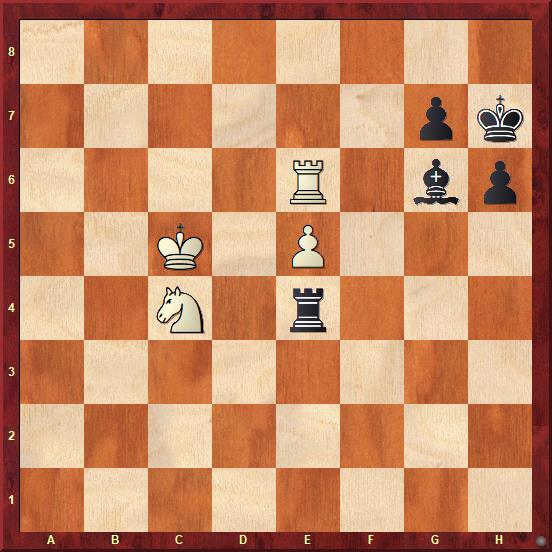
Her position was – and is – lost, but after this move it was possible to calculate with Black to a forced win! It would be possible, but not in the seconds of severe and lasting time trouble of a blitz game. Black only needed to draw to win the mini-match and claim the world champion title. She finds a tactical blow, but the game ended „only“ in a drawn harbour.
How would you continue and on which variations would you rely? Can you calculate everything to the required depth?
You can watch the whole quite long battle of the final blitz game in the video below.

At the end of the World Rapid Championship overview, I have added one more example. It should be titled: „Whoever has never had this happen in their life, let them cast the first stone!“ 🙂
World Blitz Championship
In the second part of the article, I have also prepared several diagrams and interesting questions for the readers. Besides a number of videos (much more attractive for blitz), this time the examples and answers – with certain exceptions – are inserted into a single player below.
Unlike the 2024 World Championship, FIDE has learned its lesson. Although it did not touch the spectator-friendly and attractive semifinals and finals, it „wisely avoided blitz on New Year's Eve“.
You don't have to be a seer to realise that if Magnus Carlsen reaches the final battles, his chances of winning will rise to about 75 to 80%[TP3T].
Let me ask you, dear readers: do you recall that Magnus ever lost a match in any rapid format? Personally, I don't remember. His ability to concentrate is – not only nowadays – simply unmatched! And yet, look at how the tournament table looked after the first day – that is, after 13 rounds out of the total 19 of the preliminary phase.
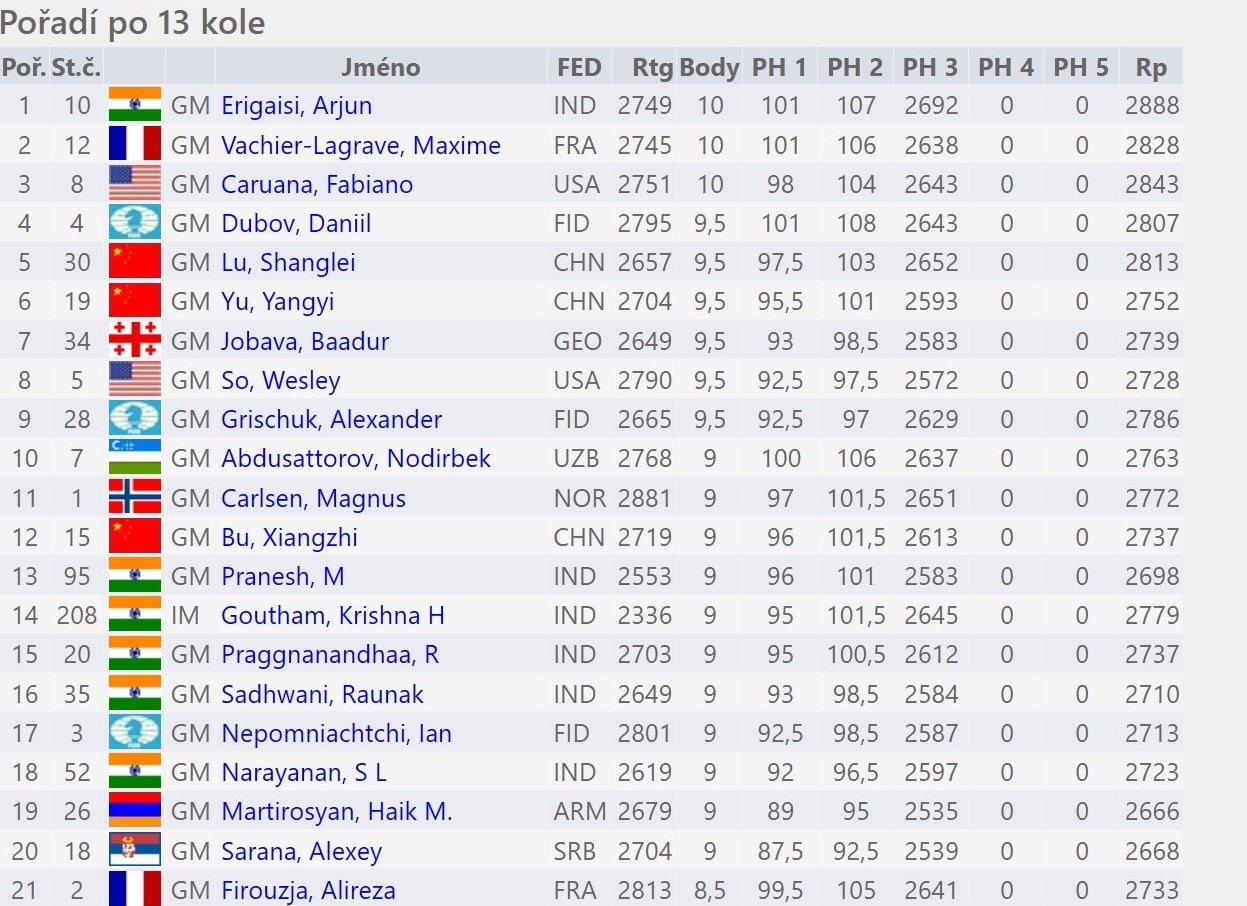
In the 14th round, the second day of the championship, Magnus also started a series with an unfortunate loss in the game against Martirosyan, when he knocked over half the chessboard with his sleeve, as we saw at the beginning of the article.
But who took points from him on the first day of the championship? Arjun Erigaisi was waiting for him.
Before we look at the game record and analysis, I present you with a diagram to ponder. It is the 9th round and two favourites are clashing at the top board – Carlsen vs. Erigaisi. We saw the end of the game above, but what about the opening?
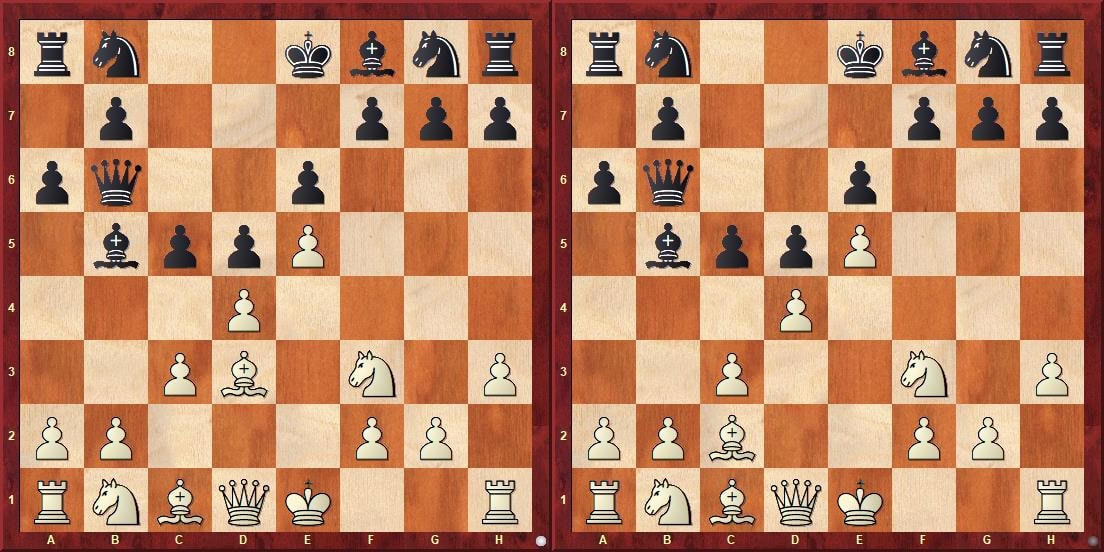
In a French Defence structure, Erigaisi chose Wade's idea of exchanging the light-squared bishops. After 7…Bb5 however Carlsen responded 8.Bc2, surely aware also of the drawbacks of such a decision – succinctly Kxe1.
How would you continue in the position of the right diagram?
The only blunder, otherwise excellence
We must logically pay the most attention to the former world champion here as well. I will join many streamers, analysts and coaches who teach their pupils using Carlsen's games. To get through his momentary lapses, let's start with an overview of game examples Caruana vs. Carlsen from round 12. Carlsen made a blunder quite unusual for him. It clearly happened due to a momentary loss of concentration (time from 6:30 in the video).
The respect syndrome
Carlsen gains many points thanks to something we might call „the “respect syndrome". I have also mentioned this in my articles before.
While against another opponent we might play many moves quickly and the game might flow smoothly, in a battle with extra strong opponents our subconscious tells us to... well, let's say, triple-check everything! There's probably little we can do about that or willpower to change it, because this is simply connected with worries, for some even fear (I could talk for hours about my pupils). But everything has its limits!
For example, the performance shown by Black in the game Carlsen vs. Murzin (the 2024 rapid chess world champion) is unworthy even of a grandmaster of any strength. Worries, worries, worries – that sums up this game in three words! It's not just about the final two blunders, but especially the management of time!
I deliberately chose an unusual game record where the actual time consumption on the clocks is clearly visible!
Lessons from the endgames

The Chinese grandmaster received further training in the knight versus bishop endgame in round 16. In the game Bu Xiangzhi vs. Carlsen arose after 44...Nd2
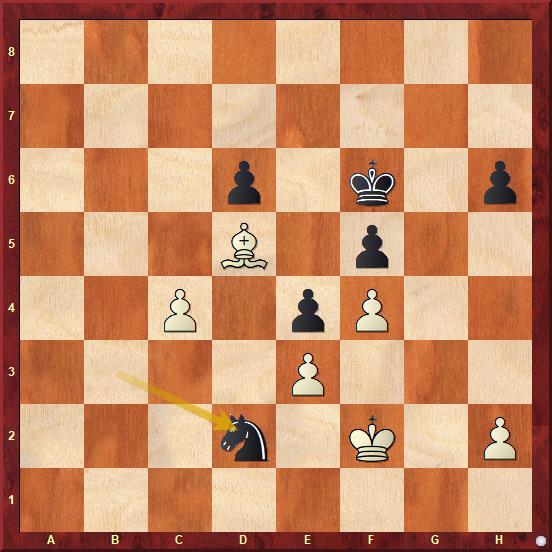
the endgame shown in the diagram. White, after 12 seconds of thinking, continued with a waiting 45.Kg2.
In the notes of the game analysis I wrote: „White, when transitioning to the endgame with an extra minute against about 15 seconds, unnecessarily loses one second after another. Why? Simply because, among other things, he apparently never studied endgames. Here we will beautifully see not only how a knight can dominate the flag in blitz, but also one of the typical methods (and reasons) for Carlsen's wins!“ His knight literally jumped through the opponent's position to victory.
Nevertheless, I ask: How would you objectively evaluate the chances of the sides in the position from the diagram?
The endgame position arises at 4:27 and again at 6:45 in the video recording.
Erigaisi's concert
As I have already mentioned, if FIDE did not want to make the World Championship primarily a show for spectators and stuck to the old proven format, the tournament would have ended like this:
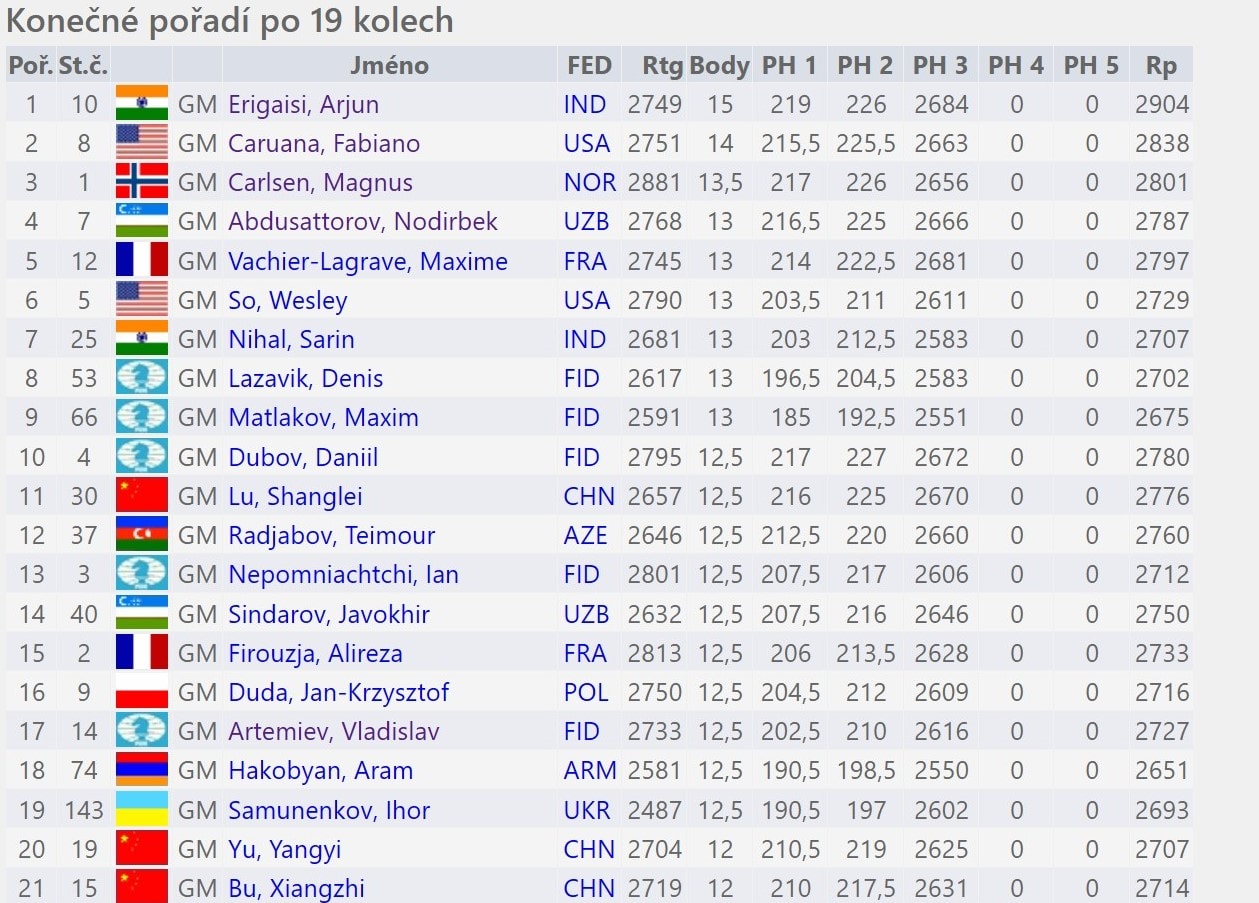
However, for the second time it was the main part of the championship, which served only to select this time four players. A bracket of 1-4 and 2-3 was created. The semifinals and final then consisted of four blitz games.
Arjun cut down one opponent after another – after all, 15 points out of 19 with only one loss in round 6 and 12 wins speaks for itself.
I liked the spectacular conclusion of the game Sindarov vs. Erigaisi played in round 17.
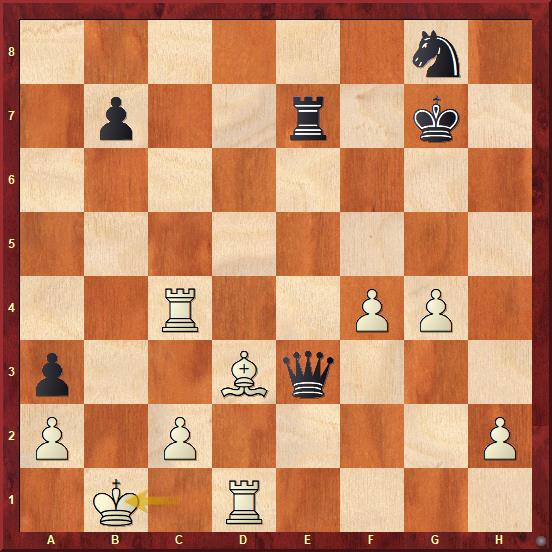
Black found the strongest move in the position, which already forces mate, in two seconds! How long will it take you, dear readers, to get your bearings in the diagram position? Can you find Black's strongest continuation?
Nodirbek as we know him
Abdusattorov fought his way through the main part of the tournament in his typical style. Occasionally he crossed the risk threshold unbearably. With four losses but eleven wins, and thus only four draws, he probably became the most combative player of the entire championship. In the semi-final he dealt quite easily with the extremely nervous Erigais.
The big final started well for him – he won the first game, but Magnus also responded with Black in the second game. Let us look at the conclusion of the third game of the final Carlsen vs. Abdusattorov.
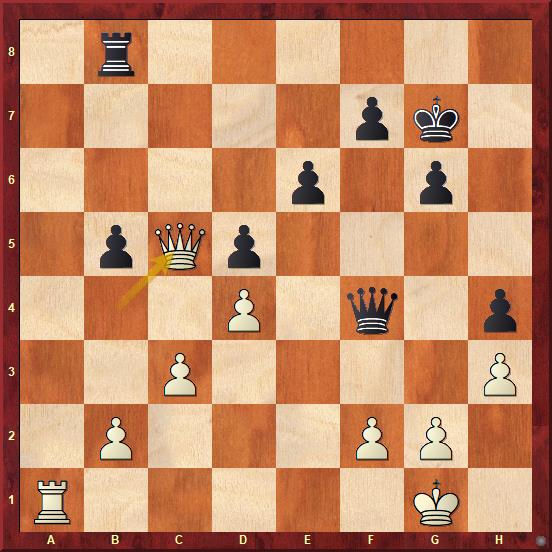
The position is objectively balanced, but Black has about 20 seconds less on the clock. How would you continue if you were Black in such a situation?
Déjà vu of Vassily Ivanchuk?
Readers may recall the previous World Championship. Vassily Mikhailovich was almost within reach of progressing to the last eight. However, in the game against the now deceased Daniel Naroditsky, he was betrayed by the clock...
Something similar happened to him in Doha. Yes, he lost on time again, but this time he completely forgot about the clock! The position – by the way, absolutely winning – interested him that much. I would not mention the game here at all if it were not a perfect gem of positional understanding. The opening of the game also somehow connects to one of the World Cup games we have already analysed on these pages. An early donkey's ear a2-a3 by White.
I will add that Vassily Mikhailovich played the entire game completely accurately, on the first or top engine line with an accuracy of 98 to 99%.
In the game of round 4 Isanzhulov vs. Ivanchuk White chose after 1.e4 e5 2.Nf3 Nc6 3.Nc3 Nf6 continuation 4.a3.
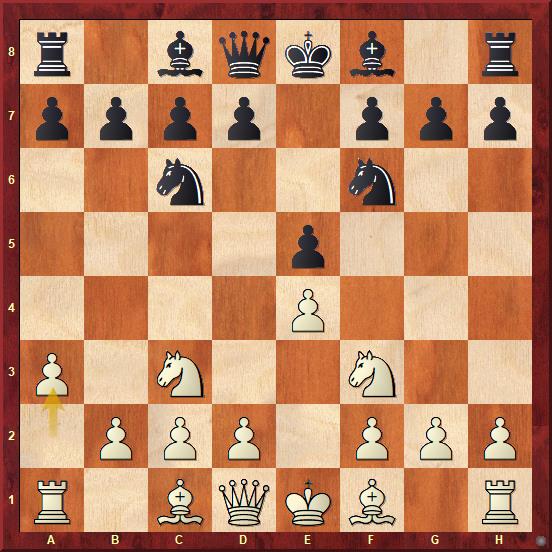
How would you continue your game after mature consideration?
The full game record is available here:
Examples, games and solutions
The Grand Final

In the video, we can watch all four games of the World Championship grand final Carlsen vs. Abdusattorov. Magnus once again owes his victory primarily to better endgame understanding in the second and decisive fourth game. We can watch that game itself in the traditional ChessBase India record:
And here is the entire course of the final battle available!
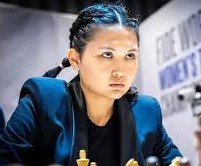
The women's final was also dramatic and was decided only in the fourth game. In it, the twenty-one-year-old Kazakh grandmaster Bibisara Erchanovna Asaubayeva.

We can also replay the decisive fourth game in the video.
The next World Rapid and Blitz Championship may not be the main event of the year-end – that will probably be the World Championship match. Nevertheless, I am really curious whether – and if so, for how long – Magnus's monopoly will continue.
History and statistics show that top-class chess players usually reach their peak performance between the ages of thirty and thirty-five (typically, for example, Karpov or Kasparov). It used to be said: „they reach the peak of their creative powers.“ At this age, experience ideally combines with still highly functional ability to decide quickly and accurately – that is, with the algorithm of move choice in concrete positions.
Of course, it also plays a role that Carlsen „still“ went through classical chess education, both thanks to quality coaches and his own diligence and systematic study of books. His „speed monopoly“ will undoubtedly end one day. And when I see the piece sacrifices and the flying queen – that is, Magnus's occasional „brutal fingerwork“ – I would guess that he will first lose his primacy in blitz.
One thing is absolutely clear: for many years we will witness his fabulous technical performances in endgames. And it is from these that – hopefully – future generations of chess players will learn.

Complete results can be found (or downloaded) here: https://s3.chess-results.com/tnr1313074.aspx?lan=5&art=0&turdet=YES&flag=30&SNode=S0
And here again are all the examples available in ChessBase format.