


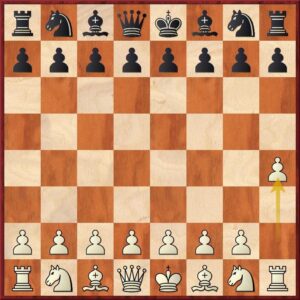
This is roughly how we can imagine the chess world in 10 to 15 years – nothing else really fits, and ... it's not exactly a joke or even an attempt at one.
Why did the author specify the year 2033 in the headline? By no means am I playing or claiming the abilities of Nostradamus or Baba Vanga. After all, even he George Orwell gave up in his (dystopian?) work 1984 from 1949!
The year of the ‚rise‘ of 1.h4! was chosen approximately; the event may happen earlier or later. (Moreover, as is known, Nostradamus supposedly predicted the Great Fire of London in 1666; well, and 2 x 33 = ?...)
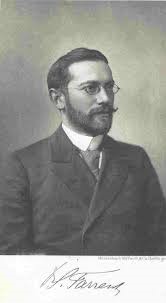
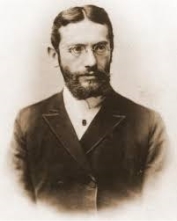
The explanation of my choice of year may be given to the dear reader by the following article, which was written wittily and lightly by Siegbert Tarrasch, and moreover somewhat refutes the claims mostly of the Russian - Soviet chess school about his tendency to dogmatism.
Pawn moves in the opening
(Tarrasch’s Chess Newspaper no. 8, 15 January 1933)
The translation from German was kindly undertaken by my former pupil Ing. Pavel Novák Ph.D., the pawn moves highlighted in bold are mine.
Every pawn move weakens the position to some extent. In the opening, therefore, one should not move too many pawns, and if so, usually only the central ones; in Queen’s Pawn openings, the „c“ pawn can also be moved. Otherwise, the position opens too much and can become vulnerable.
It is not good prophylactically to place the „a“ pawn on a3 to prevent the development of a bishop or knight to b4. However, if the opening has progressed to some extent and there are no urgent tasks, this move can be allowed here and there to prevent the exchange of a well-placed attacking bishop on d3. In this way, time is somewhat sacrificed to gain strength. On the other hand, the „a“ pawn move is often very suitable to prepare b2-b4, that is, an expanded Queen’s fianchetto, especially for Black. In the orthodox Queen’s Gambit, the pawn structure a6, b5 and c5 gives Black a completely satisfactory game. Of course, White does not have to allow this and can spoil the whole plan by a2-a4.
b2-b3 (with the subsequent Bc1-b2), the Queen’s fianchetto, is sometimes recommended, especially when the bishop finds a completely free diagonal here, for example in an attack against the Steinitz Defence of the Ruy Lopez. After 1.e4 e5 2.Nf3 Nc6 3.Bb5 d6 4.d4 exd4 5.Nxd4 Bd7 6.Nc3 Nf6 7.0-0 Be7, 8.b2-b3 together with Bb2 is a very good idea. Often an attack on the g7 square develops in this way. In Queen’s Pawn openings, White is almost always forced to fianchetto the Queen’s bishop if it was closed by the move e2-e3.
From the moves b2-b3 or a2-a3 on the first move I must discourage; in the first moves something else should be done; it is necessary to play central pawns to influence the centre. Of course, White can afford quite a lot.
Against the move c2-c3 I mentioned several warnings. It is a blocking move that deprives the queen's knight of its natural development square. After 1.e4 e5 2.Nf3 Nc6 the game is equal. However, if White now continues with 3.c2-c3, the game is no longer balanced. After c2-c3, the move d7-d5 often strikes right at the heart, and sometimes also f7-f5. In games with the queen's pawn, the black pawn does not belong on c6, but on c5. This is also a problem for the Czech Defence of the Queen's Gambit. c7-c5 is a liberating move in the Queen's Gambit! But not only c2-c3 is inadvisable. All pawn moves on the third or sixth rank are blocking; including d2-d3. Such moves should only be played if nothing better is available, namely d2-d4! If it cannot be avoided, one must accept this move.
Move e2-e3 (or e7-e6) is bad in itself, because it condemns the queen's bishop from the start to being closed in, unless it has already been developed on the kingside. e2-e3 should always be considered a precursor to e3-e4 (or e6-e5)!
Move f2-f3 or f7-f6 is even more suspicious than c2-c3. Firstly, it takes the king's knight's best square, secondly it blocks the queen's prospects, and thirdly it exposes the king. In the opening, one should never play f2-f3 or f7-f6, although the reader should remember the well-known phrase, ‚never say never‘! Steinitz nevertheless used this move in the defence of the English Opening, but in this case he was somewhat excused, since White had previously made the bad example of c2-c3.
For g2-g3 with the further Bg2, the kingside fianchetto, roughly the same applies as for the same advance on the queenside. Only with the difference that the extended kingside fianchetto h2-h3 and g2-g4 never comes into consideration, as it represents too great a weakening of the kingside and thus the king's position, since castling short is usual.
h2-h3 should be avoided in the opening, especially if White has already castled short and Black has not. Black would then use h2-h3 as a welcome sign and start a strong attack on the king with h7-h6 and g7-g5-g4. Often h2-h3 is played before the queen's bishop develops to e3; this is to avoid its threatened exchange via Ng4. An indirect admission that the bishop is the stronger piece. Later in the game, h2-h3 or g2-g3 is often necessary to provide an escape for the king, who could be easily surprised by mate on the first rank. h2-h3 is played if the opponent has a light-squared bishop, and g2-g3 if the enemy bishop controls dark squares.
When following these principles, derived from more than half a century of experience, one must keep in mind the well-known saying, that no rule is without exception.
In this respect, I had one bad experience. Decades ago I established an important rule: rooks belong behind passed pawns. After some time I received a rather harsh letter from an amateur who bombarded me with the bitterest reproaches. He had followed my rule exactly, placed a rook behind a passed pawn, but... the tempo was lost when the rook was captured with check by a knight. I replied immediately – although „immediately“ may be an exaggeration. I am not very quick at writing letters; a quality I share, by the way, with many chess players. A certain amount of laziness in writing probably belongs to good chess players. There is a well-known story about Steinitz, who after a tournament accompanied Anderssen to the train and on parting asked him: „Professor! If I ever wrote to you, would you reply?“ „I never reply!“ answered the old man in a convincing tone. "And I never write!" laughed Steinitz. So I more or less promptly replied to the unfortunate writer that he should rather hang up chess and play yo-yo instead. Which in fact means that I would have replied like this if this meaningful game had already existed at that time.
As you can see, the ageing doctor had plenty of humour. But dear readers, did you notice something peculiar? Tarrasch completely avoids evaluating the pawn advance „h“ two squares forward in the article. True, he mostly analyses pawn moves only one square forward, but still. For example, he does mention the possible attack h6+g5-g4!?
(I regret that he indirectly condemned my favourite Alapin system in the Sicilian; and Domenico Ponziani with the proposed opening 1.e4 e5 2.Nf3 Nc6 3.c3 would have been even less pleased – Tarrasch actually claims that Black stands better; let us add that even the best engines in 2022 give Tarrasch almost the truth in deep analytical lines ☺.)
The ‚h‘ pawn - the new hero of the millennium opening
Meet, Joe Black Pawn ‚h‘
I rather arrogantly thought that when it comes to innovation in chess composition by today's leading grandmasters, I had seen it all and nothing could surprise or even unsettle me. Wrong!
The fact that pawn advances on the ‚h‘ file by two squares start appearing in almost every 4th or 5th game, and moreover, systems with 4.h4 or even 3.h4 are seriously analysed? No one could have been prepared for that. Before we look at several games, I would like to point out two things.
1/ the very advances of the flank pawn by two squares are not a new discovery, it is mainly the frequency of their use recently, often by - let’s say - the 10th move of the game.
2/ surely I am not alone in noticing this phenomenon. But will a book finally appear on the shelves of chess literature sellers by an author capable of mapping the problem? True, it would be a gigantic work, which certainly (if done well) could not be hastily put together in one month. But there would be a problem right at the start of the work: what parameter to choose for dividing the material into chapters? There are many possibilities: by opening, the ‚h‘ pawn advance against the castle or ‚just like that‘. The ‚h‘ pawn in the opening, middlegame and endgame. Correct and incorrect attempts, successful and unsuccessful incursions of our ‚h‘ pawn...
Don’t overstretch the string or even the ‚h‘ pawn is just a pawn!
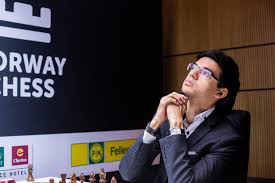
Although of course we stay on topic, I cannot help but ask: who do you think, dear readers, could shock us all? Befriend the ‚h‘ pawn perhaps a little more? Surely one of the most talented players of today, a genius but also a hedonist, a player with a capital P, who is always ready to take risks, and often even cross the threshold of acceptability. Russian grandmaster Jan Aleksandrovich Nepomniachtchi.
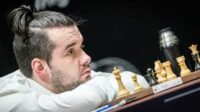
Source: www.tellerreport.com
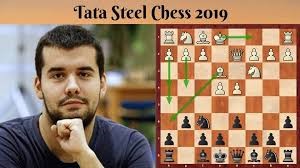
The ‚h‘ pawn is just waiting for its leader's command!
We are used to its soaring highs and deep falls! The match against Carlsen at the end of 2021 (from game 7) unfortunately belongs to the latter.
Of course, our selection will also include online games, and the initial choice fell on one of many rapid tournaments of the world elite.
The rapid semifinal match over four games from 2020 against, coincidentally, the biggest eccentric (sometimes I think a grandmaster from another galaxy) Anish Giri, was not going well for my favourite (perhaps after Firouzja and Abdusattorov), and in the third game he tried with the white pieces to equalise the short match score. How did he go about it? How did the Dutch grandmaster respond?
I think no more words are needed than the commentary on the following game. After you watch the sample with the commentator’s remarks, you will understand, dear readers, that the bold headline, which simultaneously describes and reacts to the events in the game, is not at all exaggerated! Perhaps only this: I bet you have hardly ever seen anything like this at the highest level of contemporary chess.
I will only dryly and technically point out that although the opponents’ opening is rather we have revealed, online rapid games were played at a quite normal pace of 15 minutes per game + 10 seconds per move…
We are therefore currently watching the third game of the semi-final of the first match (set).
A normal situation, in which the heroic edge pawn does not intend to draw all the attention and glory of the world solely to itself and cooperates exemplarily, will then be seen in this second example. This was played the following day, so it was the second match (set), which Nepomniachtchi won. We have also prepared a calculation test for you here.
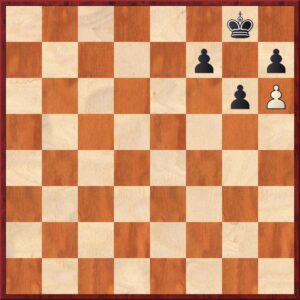
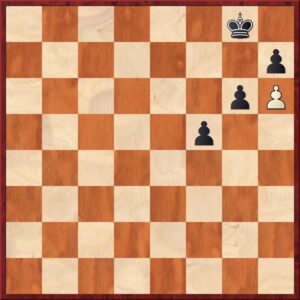
In the following game, we will focus on currently frequent situations in which our hero penetrates as far as the 6th rank (see diagrams).
We will be interested not only in his attacking potential in the opening or rather in the middlegame, but we will also focus on the endgames. „But the h6 pawn can actually prove to be seriously weak in the endgame!?“ many a thoughtful reader might argue. Certainly, but as the Russians say: „Здесь собака тоже зарыта“ (here too the dog is buried)… we will learn more directly in the comments on the amazing game.
At the end of perhaps the first article on the issue of the ‚hook‘, I have taken the liberty of presenting one of Alekhine’s games – a gem, played more than a hundred years ago. It is, among other things, a response to Dubov’s silly opinion about the modern era, world champions who, if they returned today, would become only average grandmasters, i.e. about the development of chess. As the saying goes in a modified form: „So clever as you we were long ago!“ (With all due respect to Dubov’s knowledge of chess history.)
Well, judge for yourself in this example!
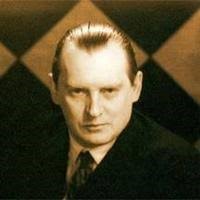
Alexander Alexandrovich Alekhine, considered by many the strongest chess player of all time!
Very interesting and entertaining reading, thank you.