
The annual World Rapid and Blitz Championship is behind us. The winners who stood on the podium took home 60,000, 50,000 and 40,000 respectively, and the spectators surely enjoyed themselves. However, this time I would like to look back not only at interesting games, consistent performances and, of course, inevitable blunders, but also at the prospects for the development of chess. Where are we actually heading? Is the current situation, for example creating special conditions for the ‚chosen‘ chess players, still acceptable and ethical? Well, and as a coach, I naturally also noticed the new young, even child faces that appeared at the World Championship... and I was shocked!
The poor organisation of the entire tournament is, as always, quickly forgotten. The online chess community in American style focuses on the ‚greatest chess player of all time and countries‘, Magnus Carlsen, who became the winner of both tournaments. At the time of writing this article, the ‚Carlsen madness‘ is somewhat subsiding, but on the evening of 30th December and the following days, one almost fears to see the former classical world champion even in a dream or to meet him at night on the way to the bathroom 🙂. .
A chess genius, but also...
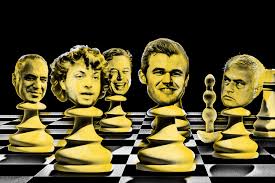
In my opinion, when evaluating Magnus Carlsen (just like G. Kasparov), we must strictly separate the chess and human sides.
O of the chess side I have already written a lot on these pages, most notably in the article ‚The Phenomenon of the Phenomenon Carlsen‘, comparing the then world champion to the reincarnation of J. R. Capablanca himself. Since then, however, I have also accepted the opinion of another world champion, Vladimir Kramnik. In one video evaluating the best chess players in specific fields, he said something like this (paraphrasing): „Carlsen's orientation in simplified endgame positions is on the edge of instinct!“ Vladimir Borisovich certainly meant that in some types of positions Carlsen finds the solution without having to... think! Simply somehow by hand. Others, even very strong players, come up with the correct continuation within a few minutes, Carlsen makes the best move in a matter of seconds. His instinct also does not allow him to play, for example, a positional mistake that is not obvious at first glance. Like a small child, he will not touch a hot stove twice; Magnus apparently does not even consider some of the available moves. Technically: his move selection algorithm is qualitatively, even by orders of magnitude, at a higher level than all his contemporaries. Kasparov called this gift general intuition and cited the Cuban genius as one of the first examples.
Somewhat with an added effect, apart from almost flawless play in simple positions, more or less ignored by dynamics, is then excessive caution of opponents. Imagine, for example, that there is a completely obvious move in the position, which a strong grandmaster would play within seconds in a game against another opponent! Carlsen will also play it, but… after a minute and a half of thinking! This then inevitably (and it must be said, almost regularly) leads especially in rapid to situations where in an objectively equal and heavily simplified endgame such a player has only seconds left on the clock, but Magnus almost always has several minutes! After all, rapid is Carlsen’s royal discipline. If we looked at his so-called average error coefficient, we would conclude that it does not differ much from serious games. An intuitive player of his calibre does not need time to think, unless… precise calculation is required! And precise calculation in sharp positions (for example) with unsecured kings is not needed, because the former world champion does not allow opponents into such situations, avoids them, and certainly did not allow them at the World Championship in Samarkand. Why?
…an equally clever businessman
Unlike approximately two hundred other participants, Carlsen was assigned a special room guarded by a security agency, where he could not only rest and refresh himself during breaks between rounds, but also had a computer at his disposal! Knowing his opponent in the next round, he could very easily decide (listen to online advice from his collaborators) which opening or variation to choose. The former world champion is also an excellent psychologist. Why wouldn’t he be, given his colossal experience? We even learned that securing a rest room was his (traditional) demand since 2016 (sic).
Certainly, starting with the organisers (which of course includes FIDE itself) and ending with ordinary internet fans, the opinion that this is a necessary measure for the popularisation of chess no longer stands out. Apparently, if Carlsen had not come to Uzbekistan, many sponsors would have boycotted. Would he really not have come? Considering that just the appearance fee paid to Magnus surely exceeds the first prize in both tournaments several times, I am not so sure! A heretical thought occurs to me: what if Magnus Carlsen demanded next year that he would enter the tournament only with… a points lead?! Do you think, dear readers, that this differs too much from the situation in Samarkand 2023? Write your opinion…
After Carlsen became the owner of the platforms Chess24, Chessable and especially Chess.com (for the less knowledgeable, this is a platform with over 10 million chess players visiting daily), FIDE no longer treats him with just sacred respect, but apparently listens to him attentively at least. With a puppet at the head of FIDE (entrepreneur, former Russian Deputy Prime Minister and assistant to the President of the Russian Federation from 2008 to 2012 Dmitry Medvedev) Arkady Dvorkovich, we cannot be surprised by such development.
The reader can learn a lot about ‚chess politics‘ in the interview with Sergey Karjakin.
Unequal conditions
So while all the tournament participants could not properly rest during the long breaks between rounds, especially in the blitz tournament, and we can certainly imagine the hive that the huge hall represented at moments when waiting for the start of the next rounds, Magnus refreshed himself and perhaps even prepared in his surely luxurious room…
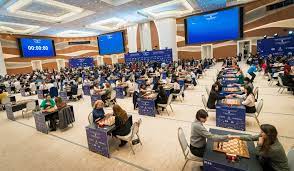
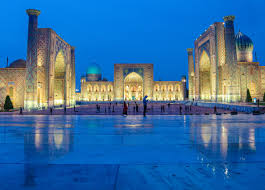
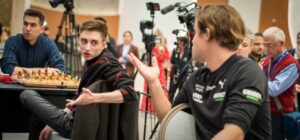
For illustration! Part of the tournament hall for several hundred participants and spectators. Where then to find peace during the long breaks between rounds?!
You can view the results of the World Rapid Chess Championship in the attachment below. Magnus’s games (it must be admitted that he played excellently, in none of the games was he threatened, nor did he seem to stand significantly worse) can be found by dear readers mainly as videos on YouTube in such quantity that it makes no sense to present them here again. However, the results indicate that despite all his advantages and concessions by FIDE and the organisers, a fierce fight took place…
Young, even younger or "the shock from Shogdzhiev"
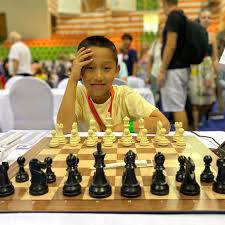
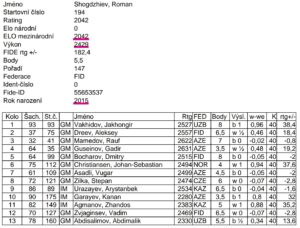
Watching live broadcasts or recordings of the World Championship on platforms, preferably with guest Vladimir Kramnik, I focused on the new young faces. Of course, I saw various children and young men, but, what what I saw in the rapid tournament took my breath away. Eight-year-old Roman Šogdžijev from the Kalmyk Republic scored 5.5 points out of 13 games, and already in round 1 he defeated a well-known local grandmaster, a member of the winning team at the last Chess Olympiad in Chennai in August 2022, where he won an individual prize for the best result on board 4, and also the silver medallist team at the World Championship in Jerusalem 2022.
The video analysis (of another game) below is truly worth watching in full, not to mention the individual results and performance!
Typical Nepo
One of the most talented players in the world and perhaps already the eternal unlucky one on the road to the highest title (à la Paul Petrovich Keres, Mikhail Ivanovich Chigorin and others), Jan Alexandrovich Nepomniachtchi probably will never get rid of his bad habits. One of them is the constant underestimation of players with a much lower rating than himself. Literally at the last moment, Jančik (as many affectionately call him, and who will be mentioned again in the article) ‚snatched‘ 🙂 a draw with a 15-year-old Kazakh boy with a mysterious rating by his last trick, but the variation chosen by the boy with Black is remarkable and instructive! As they say: „Everything new is just well-forgotten old!“
Unprecedented scandal in blitz
It is Friday 29 December 2023. The time control is 3 minutes plus 2 seconds increment per move (one round of the tournament thus lasts a maximum of 10 minutes, with some fluctuations). After about seven (sic!) hours, the last 11th round of the first day of the tournament began. The pairing brings together two top Russian representatives, who at that moment shared first place with several other players in the standings. The rest is revealed by the videos!
Both players were therefore deducted half a point for blatant childishness. Besides violating the rubber rule 11.1 of the FIDE regulations, which strongly reminded me of the notoriously well-known and frequently abused paragraph 403 of the Criminal Code of the Czech Republic (players must not commit any act that would disgrace the game of chess), microphones recorded a pre-game agreement to a draw to the misfortune of both players. On the other hand, it seems that the arbiter has the power to punish the offending players with a milder penalty than forfeiture (for example, a ‚game‘ that ended in a draw after 1.e4 c5 2.Nf3 d6 no one objected…). This step naturally disrupted the entire World Championship, as the picture below shows. The arbiter, besides the prize of 4,800$, which among other things roughly corresponds to the prize for 10th place in both tournaments (!), will surely receive some significant recognition for forfeiting two players who are also not allowed to play under their country’s flag. The same as the FIDE president’s.
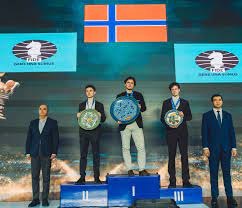
Bсему своё время - everything in its time!
Of course, we must take into account the system of play. If Daniil Dmitrievich had not been deducted that half point, he would have played the next day against different opponents, in different rounds, with different colours, but this also applies to many other participants including the world champion. Well, I would like to see a spectator who would not want to see the final of two players who scored the same number of points and shared first place; just as it was in the women’s tournament.
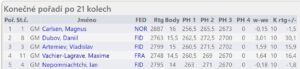
The paradox remains that Dubov in the whole tournament was the only one not to lose neither in rapid nor in blitz a single game! The final results list of the World Blitz Chess Championship thus looked like this after the tournament was disrupted by the arbiter and the appeals committee at the helm.
Who defeated whom?
Ah, that tactic
To be honest, it irritates me when some players, especially younger ones, believe that chess was not played nearly as well in the past (or even before their birth). I particularly cannot tolerate opinions about the level of play in faster time controls. Almost at the end of the World Blitz Championship examples, I decided to demonstrate to the reader, among other things, the game Nepomniachtchi-Carlsen, which was commented live by the 14th world champion himself. The blunder made by White and its possible punishment by the reigning world champion was seen by Vladimir Borisovich within seconds, and he still managed to talk about other things. What better proof do we need to stop believing that today we ‚see all the tactics‘ on the chessboard, while a few decades ago there were apparently complete fools sitting at the boards?!
Kramnik's brief analysis begins after the moves 1.e4 c6 2.d4 d5 3.Nc3 dxe4 4.Nxe4 Nf6 (A variation chosen again by Carlsen, in my opinion psychologically excellent given Jan's playing style and the current situation in the tournament) 5.Nxf6+
If the dear reader watches the video below really carefully, in the complete game record they will see hated! That is including the moments when Jan noticed his blunder in the middlegame (14.c5?), the world champion ‚learned‘ after the game about his missed opportunity, about another Magnus (missed) blunder at the very end of the game (35...Rc5??), which he immediately points out after the game, as well as the Carlsen genius in handling technical endgames mentioned earlier in the article. Notice that after the roughly 10 moves made in the game afterwards, he had a few seconds more on his clock than before starting the defensive manoeuvres!
Even to blunder badly is human... and grandmasters are human
The final series of examples of blunders, including the ‚climax‘ in the form of an eight-move decisive game, understandably comes only from rapid (26th – 28th December 2023) and I have included them in my home database, where I classify blunders into groups. Some notes may therefore seem less understandable to the reader.
The article is already quite long, so this time I have to completely omit the evaluation and examples from both women's tournaments. Hopefully next time!
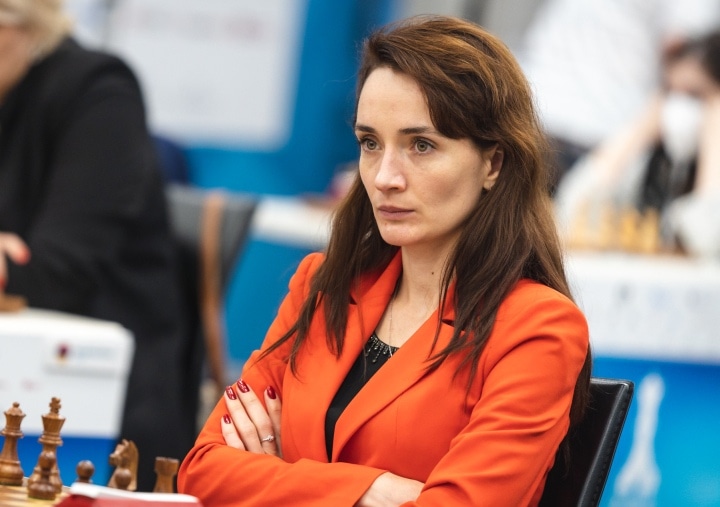
One of the most charismatic female players, among others three-time world blitz champion and world classical chess runner-up Ekaterina Lahno, this time failed to reach the podium…