

As many readers probably know, in the World Cup final the former world champion Magnus Carlsen eventually defeated the young star of today in the tiebreak and became - for those who do not believe in determinism - the very lucky ultimate winner.
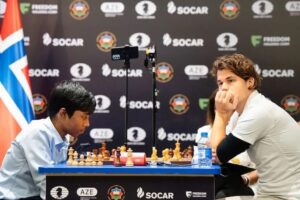
The last game of the final match | photo: Maria Emelianova, Chess.com
Former and future world champion?
However, the eighteen-year-old Indian chess genius, who fought his way to the Candidates Tournament by defeating the world number two and three, which will probably take place in April 2024 in Toronto, will have the opportunity next year to continue the fight for the highest title.
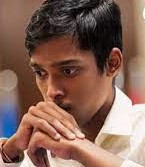
Who is Rameshbabu Praggnanandhaa? Before we analyse his two brilliant games, I will provide some biographical details and a little more for our dear readers.
Concise information, biography and a small comparison with the West
Rameshbabu Praggnanandhaa (born 10 August 2005), or rather his biography, has now of course been thoroughly researched by Western journalists and we can read the following: We have decided to provide all the information we have gathered from the internet. You can learn about his life, age, family, matches, education, etc.
The biography will probably inspire many people who want to achieve great success in their lives, but to do so they must also work hard, as this young man does on sixty-four squares.
In 2013 Praggnanandhaa earned the FIDE Master title by winning the World Youth Chess Championship under 8 years! In 2015 he won the under 10 title. Then he also earned the title of youngest International Master in history.
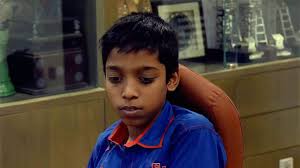
Rameshbabu Praggnanandhaa became the 5th youngest player in history to earn the Grandmaster title. Praggnanandhaa's father's name is Rameshbabu, which is why this name is added to his own. His father works as a bank manager, his mother is a housewife. Praggnanandhaa was also affected by polio at a very young age.
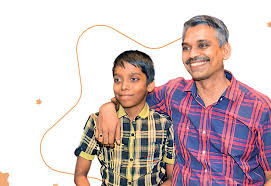
Both his father and mother have always fully supported him in chess, and thanks to this he became one of the famous Indian children.
| Article title | Rameshbabu Praggnanandhaa Biography , age, family, matches, education |
| Player's name | Rameshbabu Praggnanandhaa |
| Age | 18 years old (born 10 August 2005) |
| Place of birth | Chennai |
| Father's name | Rameshbabu |
| Mother's name | Nagalakshmi |
| Sister | R Vaishali |
| Titles |
|
Family
As his father stated, Praggnanandhaa became interested in chess at the age of three and a half. He also added that at that time it was difficult for them to pay for chess courses for his older sister. However, Praggnanandhaa watched his sister when she played and thus learned the rules.
Praggnanandhaa's father initially did not want his son to pursue a chess career due to their financial problems, but after the parents saw his interest, they encouraged him to follow his dreams.
Rameshbabu Praggnanandhaa He was born on 10 August 2005. He became a FIDE Master at only 8 years old! An International Master already at 10 years old, which was a great success for the Indians and they were duly proud of it. However, Indians are doing well in many areas today…
Grey is theory, only the tree of life is eternally green
Johann Wolfgang Von Goethe
In my opinion, Praggnanandhaa is also a living proof of how imperfect the entire ELO rating system is. Although he achieved official titles at a very young age (the acquisition of the FM title at eight and IM at ten years old seems almost unbelievable!), regarding the rating itself, at certain points in his career other peers stood ahead of him in the rankings, which is still true to this day, when even the one-year-younger Dommaraju Gukesh (born 29 May 2006) literally soared into the world elite by crossing the 2750 mark and in September 2023 reached 8th place in the world rankings! (We covered this brilliant child, now a young man, in last year's article „Olympiad in Chennai and another rising star of the East“.)
But every talent develops a little differently. It is also interesting that Praggnanandhaa was unanimously praised as India's most promising child both by Vladimir Kramnik, who worked with talented children for some time, and by his successor on the throne Viswanathan Anand (who still collaborates with Praggnanandhaa today).
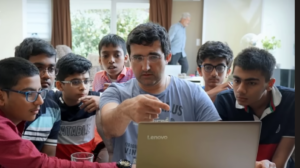
Memorable photograph: 14th world champion Vladimir Borisovich Kramnik with a group of exceptionally gifted Indian children. From the back positions, the then very young Praggnanandhaa and Gukesh are peering over the coach's shoulders.
In connection with this memorable photograph (who knows how many future elite grandmasters we see in it), I came across Kramnik's assessment of the Indian children indirectly some time ago.
Not only for coaches, the following lines will surely be interesting to read: Kramnik expressed his opinion in a lengthy interview he gave to Emil Sutovsky in 2021. Specifically, it concerns the difference in thinking between different generations: Vladimir Borisovich said that when he worked with Indian prodigies, he would set up a position on the board and ask them: "Tell me something about this position." He said these boys immediately began to ‚throw out‘ concrete tactical variations. Kramnik had to stop them and ask again: "What do you say about this position without calculating variations?“ This question puzzled the boys. They were used to immediately calculating possibilities and then drawing conclusions about the position. In earlier times, however, ‚everyone‘ learned and said that one must familiarise oneself with the position and understand its strengths and weaknesses before calculating variations. For example, it was said that here the pawn is weak, the king is insecurely placed, and so on, and that one must start from this.
For readers of my pages, however, this should be only a partial discovery! Above all, we have dealt thoroughly with this problem, for example, in the article „Carlsen's Intuition or Mathematics.“.
Young chess players have mostly tended to think inductively (from the particular to the general). In Indian children, and the current young generation in general, this is apparently in many cases taken (due to engines) to the extreme, but at the same time I believe that Praggnanandhaa's strength lies precisely in finding a certain harmony between the particular and the general. Well, time will surely tell.
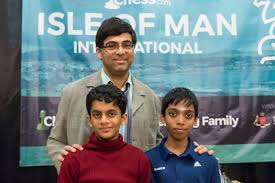
- World champion Viswanathan Anand with his pupils; to the left, one year older Nihal Sarin.
A few words not only for coaches
I will not repeat myself any longer or mention in detail again and again what I believe are the causes of the decline in the performance of children and youth in the so-called collective West (of course except for Jews). One group of problems is probably seen not only by every coach but also by an objectively minded and educated parent. Discussing much deeper second reasons in this article is nowadays even questionable if the author does not want to get into trouble with the state machinery...
For example, it can be read that both Praggnanandhaa and Gukesh train daily from a young age for 6 to 10 hours! Adding to this their IQ, natural competitiveness, courage, self-confidence, mental balance and so on, we must arrive at the results they actually have. And now let us compare the situation.
I will give an example of one of my former pupils, now 13 years old: 1/ he does not read or cannot read the verbal assignment of tasks (complex sentences are often an insurmountable problem for children); 2/ to avoid submitting tasks, he invents relatively complicated false constructions; in another case, when asked: „Why haven't you done your tasks?“ I received the answer: „I have school for a long time and I have to study!“ Well, if a child has to study daily at primary school, it would be better to devote himself to archery, for example. The rule, that the goal of shooting is to hit the target as close to the centre as possible, is understood even by a child with slightly below-average IQ. (If I remember correctly, Siegbert Tarrasch already wrote in one of his essays that he would recommend some less understanding pupils to do something other than chess... Indeed!)

Perhaps one piece of advice for my younger fellow coaches: If your, say, 13-year-old pupil is not able to follow at least some online broadcasts from the world elite levels, and it is not explicitly about financial gain for you, then immediately cancel the coaching contract with the parents! You will save yourself a lot of wasted time and nervous strain...
Examples or how young geniuses play
For readers, I have selected, at least I think, two splendid examples of Pragg's play, while the third – also a truly admirable work – I have reserved for another article. That one will concern a nowadays quite popular, old-new and revived defence against the Spanish Game.
Of course, I took the first example from the World Cup games in Baku, the second was played about two weeks later in Düsseldorf at the so-called World Team Rapid Championship.
Given that Indian children have already passed through the hands of the 14th and 15th world champions since infancy, they naturally have encoded the so-called classical chess education. In the following rapid game, Praggnanandhaa will vividly demonstrate how to respond correctly to unjustified and premature attempts to attack an already weakened king. I believe that this game is proof of the genius of this young super grandmaster, which is very clearly visible also in the attached video (black's time consumption).
An interesting fact is that it was in Germany that both Praggnanandhaa and Kramnik met (their game ended in a draw), as well as the currently highest-rated Indian chess player Dommaraju Gukesh, who defeated the former world champion! Relations between him (or rather his current coach Visnu Prasanna) and the former world champion were somewhat tense because Vladimir Borisovich did not express himself too flatteringly about Gukesh's true strength and possibilities in another interview. However, in the video below, we can see that Kramnik somewhat 'changed' his opinion.
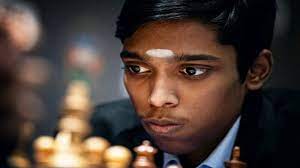
Does the sacred ash (Vibhúti) in the form of a mark on the forehead also help Praggnanandhaa in his career?