



We probably won't find an active and stronger senior chess player in our country who hasn't ‚noticed‘ that the decline of Western civilisation manifests in many ways. Of course, I will not dissect individual cases here or compare the current state with ancient Rome just before its collapse. I want to focus on an indicator of chess development in individual countries. While for many decades not only did the Soviet Union dominate the chess world, but very strong players also appeared in Europe. Just take a look, for example, at the list of participants in Candidates tournaments, Interzonal tournament results, and so on.
Today the situation is different! If we come across extra talents or – if you will – prodigies, they are either of Jewish origin or come from Eastern countries. (If someone wants to discuss strong US players, I would refer them to the not always reliable Wikipedia or other sources to find out where those American players come from, where they were born, and what their nationalities are!)
In other words: while in the new chess powers children are born who enjoy deeply pondering a problem and, of course, competing, in the USA and Europe we are more ‚preparing to deal with‘ how many times a year we can take our child to the relevant office and... officially change their gender.
After all, almost every experienced teacher will confirm the ‚change‘ in children. I myself, with over 30 years of coaching experience, am increasingly shocked both by children's laziness to think at all and by their average declining intelligence.
The new chess power India trains young male and female players according to the models of the Russian-Soviet chess school. Of course, the greatest credit for the development goes to the 15th world champion, but many Russian coaches or coaches from the former USSR work and earn their living in India.
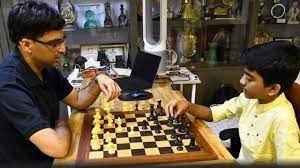
Training of former world champion Anand with the young star
In this context, it is interesting that another chess power, China, goes – as usual – its own way. The style of the players clearly shows, in my opinion, the influence of computers. Some moves (I deliberately do not say plans), which once were made in the opening, in prepared variations, by the now somewhat faded talent Wei Yi, would not even occur to 90% strong players. More or less a general phenomenon – ignorance even of theoretical endgames belongs to the same category. It somewhat reminds me of the early 1990s. A number of chess programs called Fritz were ‚invented‘. Because at that time they were obviously extremely weak engines, they were explicitly set to collect material. Hundreds of blitz games I played at tournaments in Germany proceeded very similarly. Material was the top priority for the Germans. If they encountered a sacrifice and did not see immediate gain, they honestly wondered at such courage and gobbled up the material.
But back to the Indian, now 16-year-old, prodigy. Dommaraju Gukesh (born 29 May 2006), better known as Gukesh D, was nominated for the Olympiad on the first board for the India 2 team (of course, the team was deliberately composed of young players, except for Adhiban Baskaran, who was apparently appointed as some kind of supervising captain).
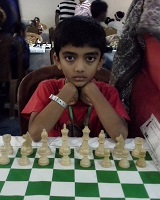
An older photo, which accompanies the official FIDE pages, or rather the rating section, speaks for itself! With such a boy, we have no chance at the chessboard! A hopeless endeavour, as if we wanted to match the famous Ramanujan in mathematics...
Let us enjoy the work of perhaps a future world champion in two games. Let's start with a beautiful attacking game from round 6; dear readers will also be able to look for a spectacular final combination.
Let's begin the study and fun with a test: White to move.
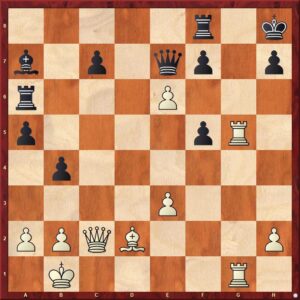
Can you calculate the winning line for White as successfully as today's super grandmaster 2700+ Dommaraju Gukesh? Below you can replay the entire annotated game with the solution on White's 25th move.
Since both the India 2 team and Uzbekistan were constantly near the top of the standings, it was clear that the two super talents would eventually face each other on their first boards! The more experienced and one year older Nodirbek (see the article from 2 August) was ultimately more successful. So let's also look at this extremely tense, unbalanced, and – it must be said – completely won game by Indem, which he actually spoiled twice. First, he missed a simple win; second, he overlooked a downright childish tactic.
It can be said that the result of the game ultimately decided the overall victory of the Uzbeks at the Olympiad and the bronze medal for the Indian team.

The battle begins!
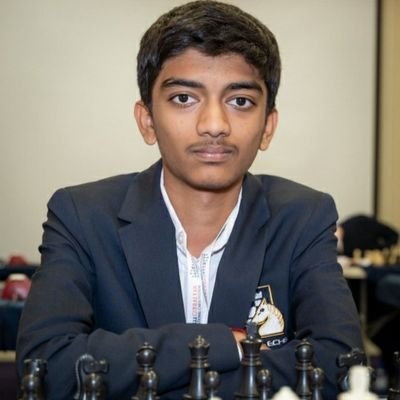
At the time of publishing this article, the 23rd player in the world

Amazing article!