
So this is how the open tournament ended. Some people are probably already bothered even by the traditional podium places; gold, silver and bronze, which have been the standard since 1904! Incidentally, in the women's competition, 2 bronze medals were also awarded. The World Blitz system also allowed many to... perfectly repeat one of the already notoriously well-known Berlin draws in the Ruy Lopez in the last rounds. And for only 300 CZK, spectators could watch the best chess players on the planet from very close proximity. But let us not be only negative. After all, we witnessed beautiful dramatic battles and extraordinary performances! We continue with the evaluation and examples of the second part of the December World Championship...

Interview with the president and freestyle chess
Start of the second part of the report from the World Rapid and Blitz Championship, which we focused on blitz, we cannot avoid starting with an evaluation of the entire event by the FIDE president Arkadij Dvorkovich himself. In the form of an interview, he (does not) answer a number of sensitive questions from Sagar Shah 🙂. I recommend readers skip the first approx. 7 minutes straight away. It is basically just self-praise and a statement about how well the FIDE leadership is managing its work. However, Dvorkovich essentially avoids fundamental answers to less pleasant questions concerning, for example, disputes over clothing, the departure of the strongest chess player in the world from the rapid championship, and many others.
So: 7 minutes of self-praise, how many hours a day Emil Sutovsky works, dress code, political speech and freestyle chess. I cannot remain indifferent to the last topic, so I will add a few words about Fischer Random Chess and my prediction mainly based on facts.
What is freestyle chess? Is it chess without rules?
In the section devoted to so-called. freestyle chess, that is Chess960 or Fischer Random Chess, the president states that FIDE welcomes all kinds of chess but would like to have them under its jurisdiction.
Many may be irritated by the very name of this discipline. Few will remember how in the 1990s there was a proposal to name rapid chess. The name active chess, began to prevail in magazines, although the main discussion was about whether to introduce a world champion title in this branch. Because back then reason and politics grandmaster and world champion on every other street corner still had to wait a few years for their star moments, only the European Championship was held, maybe also other continents' championships...
I took the trouble, overcame myself, and even though I usually already from the basic drawn starting position before the start Fischer's games makes one somewhat uneasy, I looked at the viewership of several videos from tournaments. Fortunately, I do not think that this chess was expecting a bright future. What is my prediction based on? Among other things, it is good to look again at video platforms. Dear readers, do you know which lessons have the highest viewership? Opening traps, opening theory courses, miniatures, positions with spectacular tactical finishes and several-minute analyses of games! Of course, naturally, I do not take away anyone's enthusiasm for this type of sport, which does not require a person to activate memory, I do not deny!
Nevertheless: what can have be considered chess? After all, we can modify the rules as we please. For example, I was taught chess by my sister, and for a few months we threw pawns off the board not by capturing diagonally, but also sideways :-). Vladimir Kramnik proposed and tried to play a match with rules without castling. Or will we be able to castle through an attacked square? What if we introduce the rule stalemate = win? A pawn on the 8th rank can only promote to a rook? Capablanca, at the time when he predicted the draw death of chess (later he said this was a joke 🙂), even proposed enlarging the chessboard to 10x10 and introducing a new piece.
Have you ever thought about how significantly chess strategy would change if en passant capturewere abolished? How much would this disrupt the chess we know? By the way, in my opinion, this is quite an interesting logical exercise…
There are infinite variations and the "freestyle" itself can be endlessly modified freestyle. How wonderful it would be, to see on the board from the very start of the game, for example, two same-coloured bishops later forming an attacking battery 🙂. And what about taking inspiration from the cult series Star Trek, where in several episodes we can even see three-dimensional chess!?
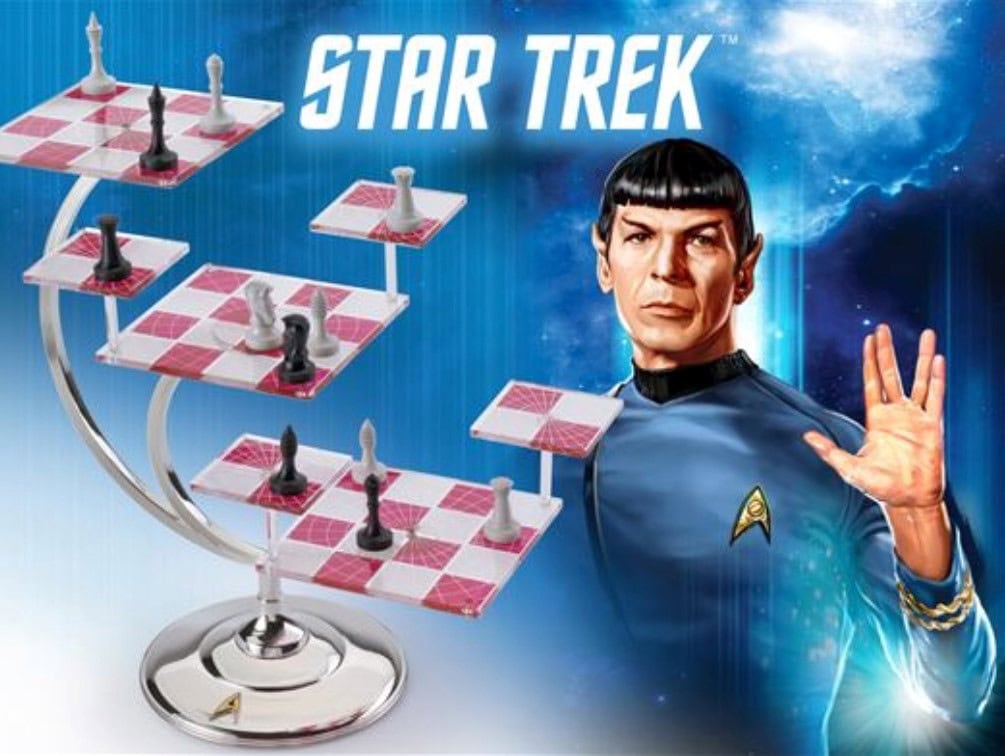
It would not be pointless to introduce exo-chess into practice, headed by a piece called the tatoš or the tempoing hedgehog!? (This piece makes a move in such a way that… it stays in place; or a cylindrical chessboard… Incidentally, even the well-known pub game with a matchbox can be modified in various ways…
Modified tournament system
The blitz tournament was divided into two parts. On 30 December, 13 rounds were played in the open tournament, with the top 8 players according to the standings advancing to the knockout stage. I will now omit, for example, what I consider a completely justified criticism and observation by Hikaru Nakamura, who in his empathetic evaluation mentions most of the players who did not know in advance whether to pay for another night's stay in certainly not cheap New York hotels from 30 to 31 December.
And did no one really think about how the games at the top places would look in rounds 12 and 13? Almost everyone can calculate that a draw in the last rounds would give them more chances both for at least some financial reward and whether and with what probability it would even move them among the 8 qualifiers.
How to remember the Berlin Defence forever 🙂
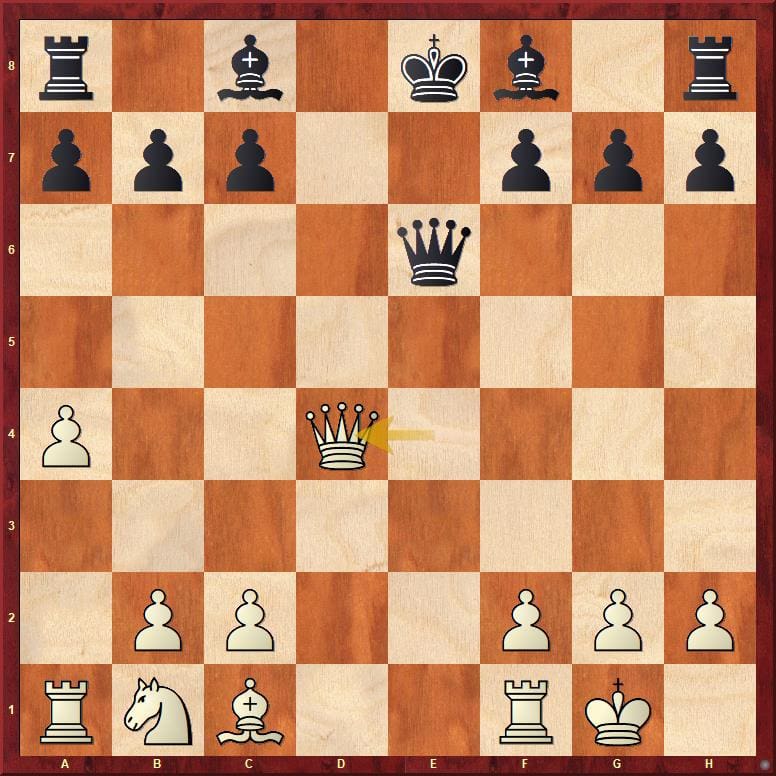
Rounds ten, twelve and thirteen, top boards: games Nepomniachtchi vs. Firouzja, Neimann vs. Firouzja, Firouzja vs. Carlsen, Nepomniachtchi vs. Niemann. 1.e4 e5 2.Nf3 Nc6 3.Bb5 Nf6 4.O-O Nxe4 5.d4 Nd6 6.dxe5 Nxb5 7.a4 Nbd4 8.Nxd4 d5 9.exd6 Nxd4 10.Qxd4 Qxd6 11.Qe4+ Qe6 12.Qd4 Qd6 13.Qe4+ Qe6 13.Qd4.
Because it is difficult to apply and monitor the Sofia rule in blitz, this game from the last round became the highlight: So, Wesley (2803) - Naroditsky, Daniel (2711) 1.e4 c5 2.Nf3 a6 3.g3 d6 ½.
Well, better a bird in the hand than two in the bush, Naroditsky probably thought. He must have suspected that his extremely poor tiebreak score would most likely prevent him from qualifying among the top 8. And so it happened.
After 13 rounds, the standings in the top 10 looked like this:
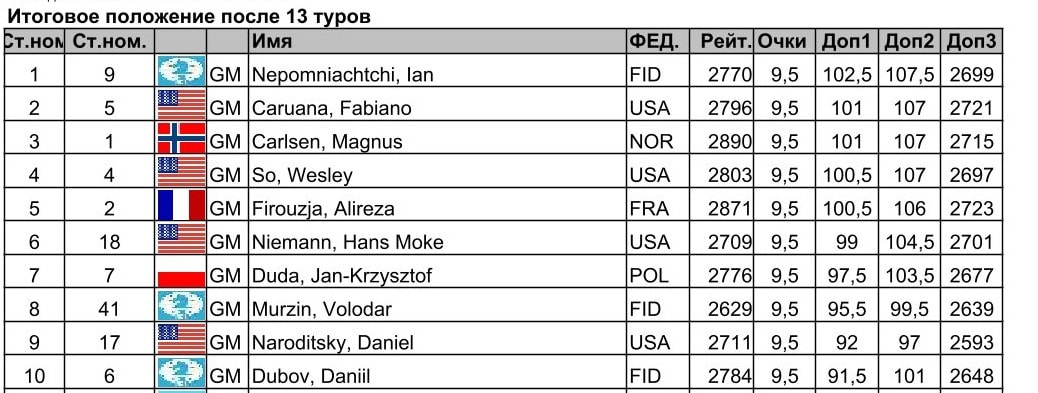
Some joked whether in this situation it would be best to play a tiebreak of 10 players for 8 qualifying spots 🙂 . A small practice final in the form of a knockout bracket. Well, and the next day they would then play for real for real.
How principled Dania lost his qualification

In the table we see that last year's silver medallist Daniil Dubov also ultimately did not make it into the qualifying eight. However, unlike the American Daniel, in my opinion Dania deserves recognition for honesty and principle. What was it about? Dubov deliberately forfeited his game against Hans Niemann in round 10. (The media explanation that he fell asleep in his hotel room before the game, i.e. during preparation 🙂, I would consider a white lie; deliberate forfeiture in the US – even though Daniil Dmitrievich is of Jewish nationality – would have risked a fine or even disqualification from the tournament. We know our Pappenheimers!)
Unlike Magnus Carlsen, who despite loud outcries we heard a few years ago that he would never play already against Niemann (he reversed his stance 180 degrees; admittedly apparently based on an out-of-court settlement), Daniil Dmitrievich behaves with principle: once a cheater, always a cheater. Or put differently: just as there is no former murderer, there can be no former cheat.
As we see, the very principled forfeiture would not have been so problematic if Dubov had not had such a poor tiebreak score at the end of the preliminary phase. Why? After all, unlike Naroditsky, he practically played at the top throughout the tournament. The reason is that a forfeiture also means that the opponent’s points are counted towards the forfeiter’s Buchholz are not counted, while here specifically Niemann is credited with all of Dubov's 9.5 points. So if, for example, Daniil had turned up for the game, played 1.e4 and then resigned, he would certainly have advanced! „Complete nonsense,“ say the Russians!
Details about Niemann's challenge to a blitz match and Dubov's response demanding that Hans first voluntarily undergo a polygraph test with the results published can be read by the dear reader, for example, here: https://sportstar.thehindu.com/chess/daniil-dubov-hans-niemann-world-blitz-championship-open-challenge-lie-detector-carlsen-cheating-chess/article69048175.ece
A chess player lives not by tactics alone
Many readers may have skipped the previous information and curiosities, but are mainly curious about the diagrams, tests and examples of specific games. I understand and fully identify with this… Elon Musk, who at the end of one interview said something extraordinarily wise: „What humanity lacks most of all is empathy.“ It truly infuriates me when, for example, a viewer on Šipov's Crestbook channel asks live at the conclusion of the last round of the Candidates Tournament: „Will there be a blitz tournament today?“ 🙂 However, such simpletons must also be respected.
So let's get to it. I did not arrange the examples according to thematic keys or difficulty. As it happens in blitz and for every player, various positions arise on the board and we must be prepared to solve a wide range of problems. In blitz tactics prevail, we like it the most, but man does not live by it alone, as we will be able to see…
In the game Nesterov vs. Nakamura the unsuspecting White played 41.Nf4??.
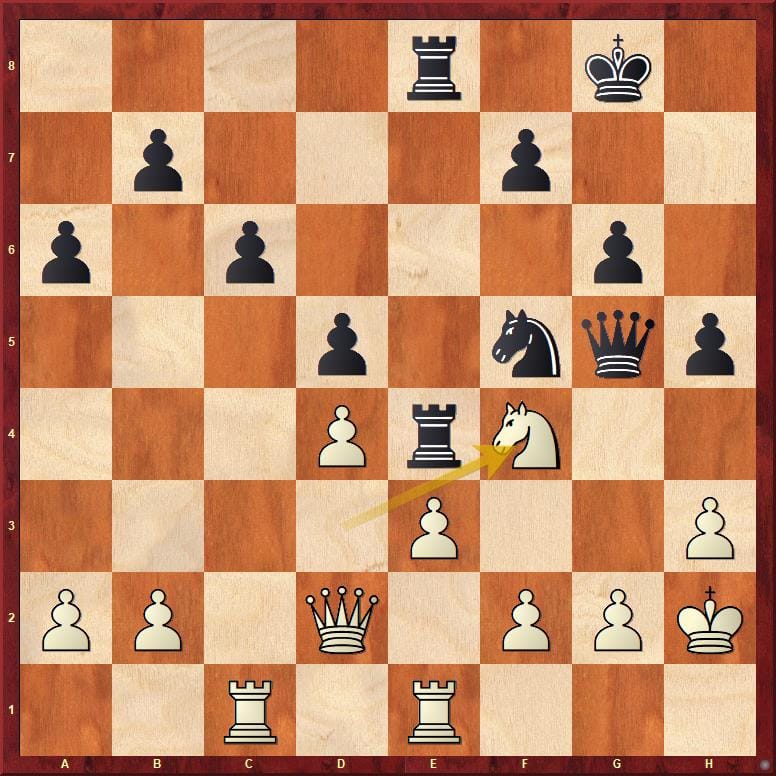
Could you punish him as Black did?
Some readers may have wondered why Hikaru did not advance to the final stage of the World Championship. Where did he get lost? Anyone who plays actively and often blitz well knows that there are days when simply we see nothing! A simple tactic that otherwise we give within seconds, at best we discover after a minute, we overlook, nothing works out. I can say, and surely I am not alone, that I have never managed to discover the laws and mechanisms that contribute to chess days fool contribute. If sufficient sleep affects performance, perception and well-being, then certainly not decisively. Nakamura simply did not succeed in any of the tournaments. The second diagram is proof of that.
In the game of round 11 Nakamura vs. Le Tuan Minh Black had just played 40...Nh5
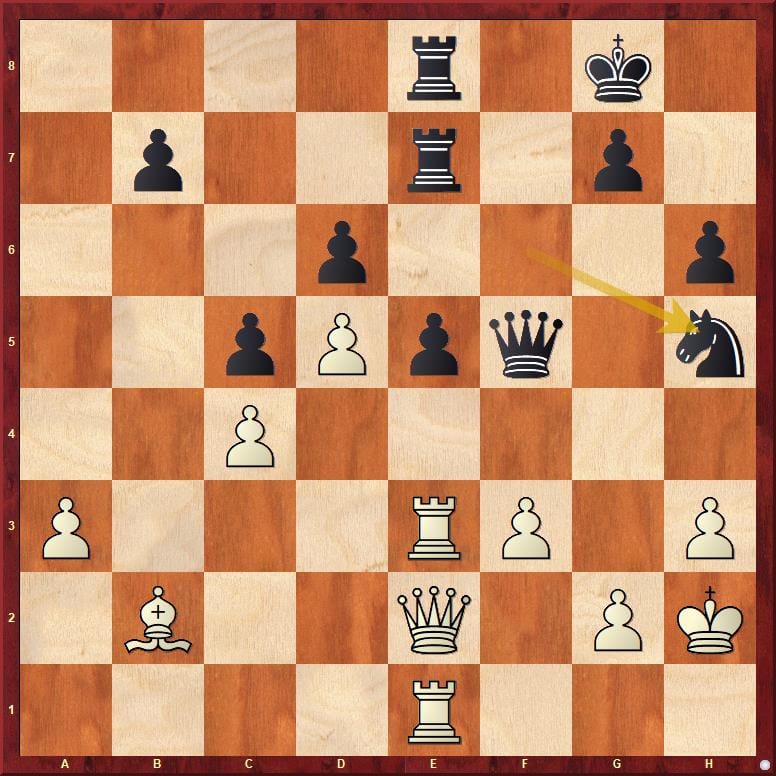
resigned to a draw by repetition after 41.Re4 Nf6 42. Re3 Nh5. However, what followed was 41.Qf2??. How would you punish one of the strongest chess players in the world for this so-called active blunder?
Nakamura, however, encountered more such and similar blunders. Someone might say: „This younger Hikaru would never have done!“ Was Alireza Firouzja (cheeky or funny, let's choose) right when about half a year ago in a live broadcast, after winning a blitz match, he stated (paraphrasing): „It's amazing that at his age he still plays so well!“ 🙂 After all, Nakamura's workload might also be to blame. Playing the World Rapid and Blitz Championships over five or six days, and still every evening bringing interesting content and news to tens of thousands of viewers on his channel? Such a workload might kill even a much younger super-grandmaster!
Now something more difficult. In the game Nepomniachtchi vs. Bortnik,M Jan managed to lure his opponent into a nice trap. After 26.Qe3
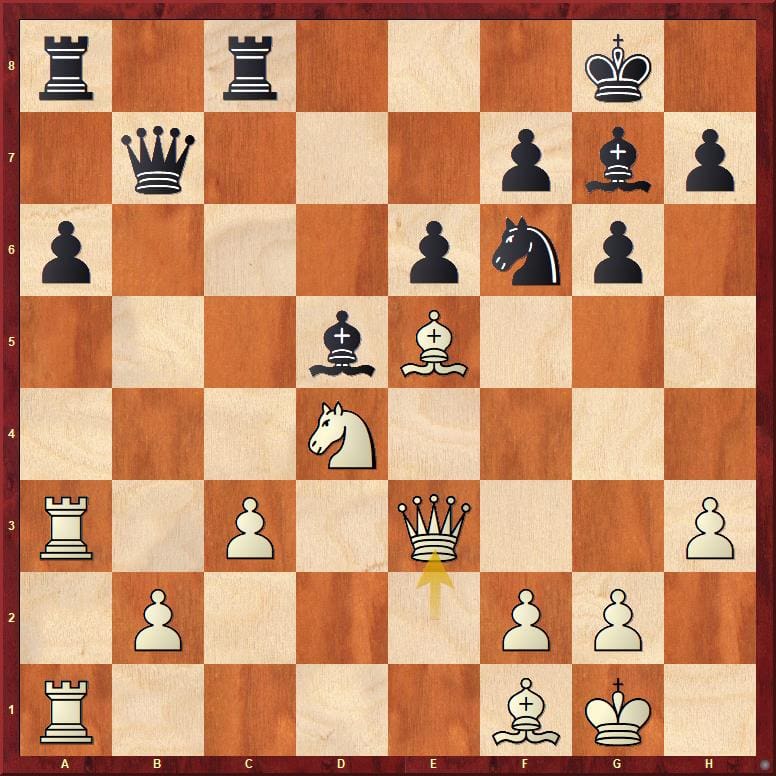
the black queen was overcome by an irresistible appetite, and so followed 26...Qxb2??. How did White continue and on which variations did he base his trap?
An even tougher test is presented by the following fragment! We might get the impression that in the mutual game of the Russian top grandmasters Grischuk vs. Nepomniachtchi there might not even be a fight and the opponents would quickly sign a draw. Especially since they had already met in round 5. Wrong! A battle to the knife broke out! Thanks to this, however, we have the opportunity to practise calculating a long forced manoeuvre, and we also have to evaluate the position at its end flawlessly!
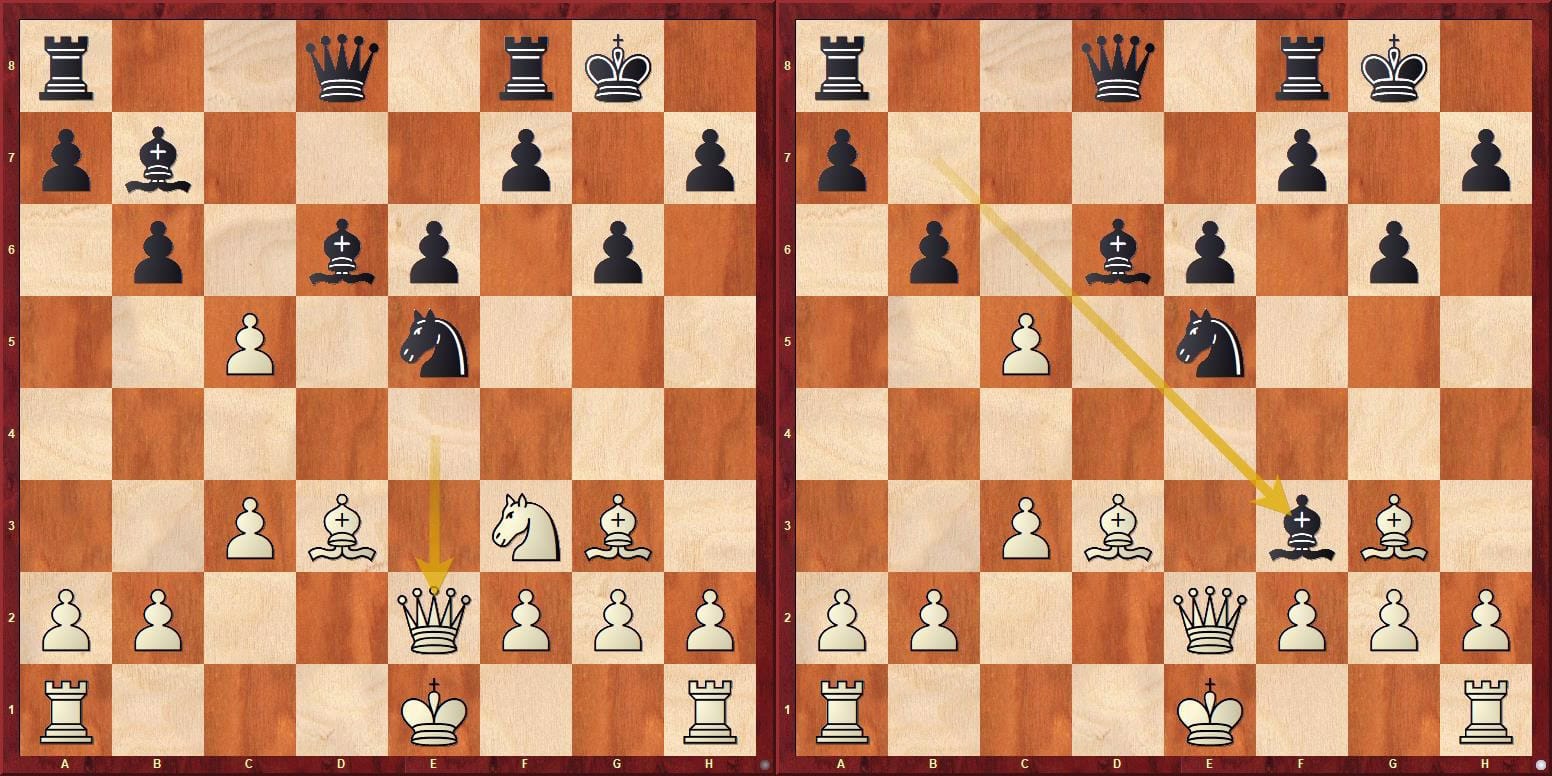
After 14.Qe2 Black decided to force the play with the manoeuvre 14...Bxf3. Can you calculate the necessary variations and decide how the position actually stands? Because in the position of the left diagram Black stands better, based on the evaluation of your final calculation position you will also determine whether Jan made the exchange on f3 (a forcing move, as he likes to say in his streams 🙂 ) well or could have played better to maintain the advantage.
Back to tactics! On my website I have already dealt with the problem of so-called. invisible moves. True, from a slightly different perspective… In the game of round 6 Mamedyarov vs. Carlsen, where it literally swarmed with blunders, the world champion played 12...Nb4.
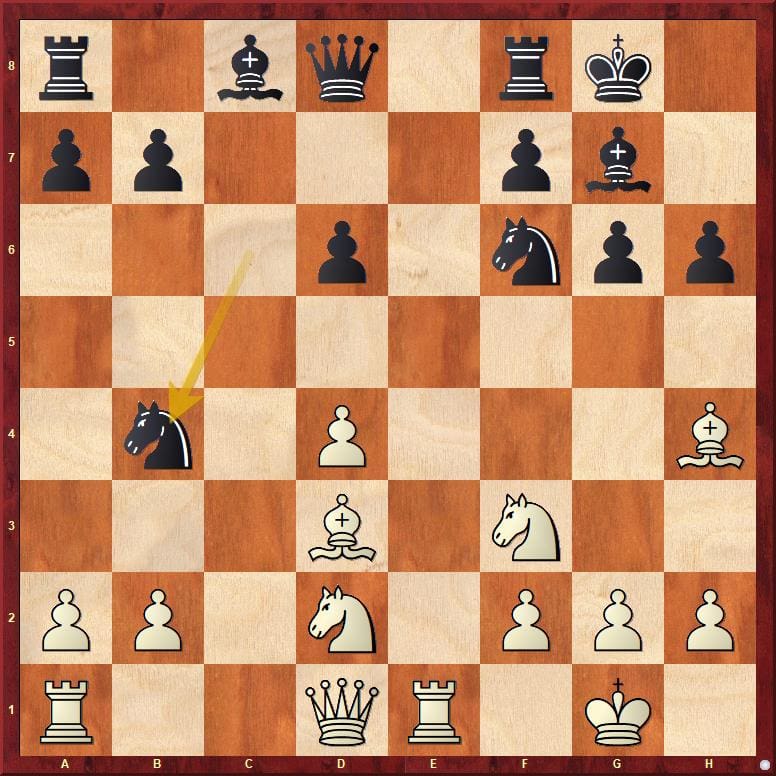
Unlike the Azerbaijani star, we are not playing a blitz game, so we can think for a few minutes! How should White have continued?
Below we can see both the game score with comments (AJ) and an analysis by one of my best short analysis streamers (RJ).
Viewers witnessed a curious ending of the game (I won't reveal more yet 🙂) in the round 3 game Bok vs. Carlsen. The world champion completely outplayed his opponent, but in the position of the diagram
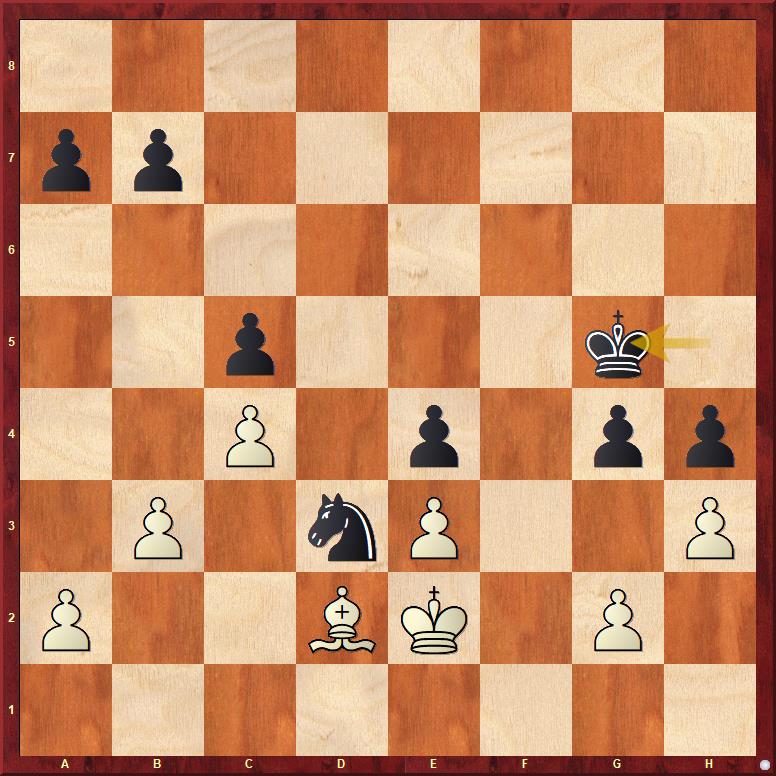
White would have held a draw anyway with elementary attention thanks to, we might say, the so-called. too blocked position syndrome. However, the Dutch grandmaster was down to his last seconds and after 36.Re1 overlooked a simple fork 36...Nc1+. This was followed by 37.Kd1 Nxa2 38.Kc2 Nb4+.
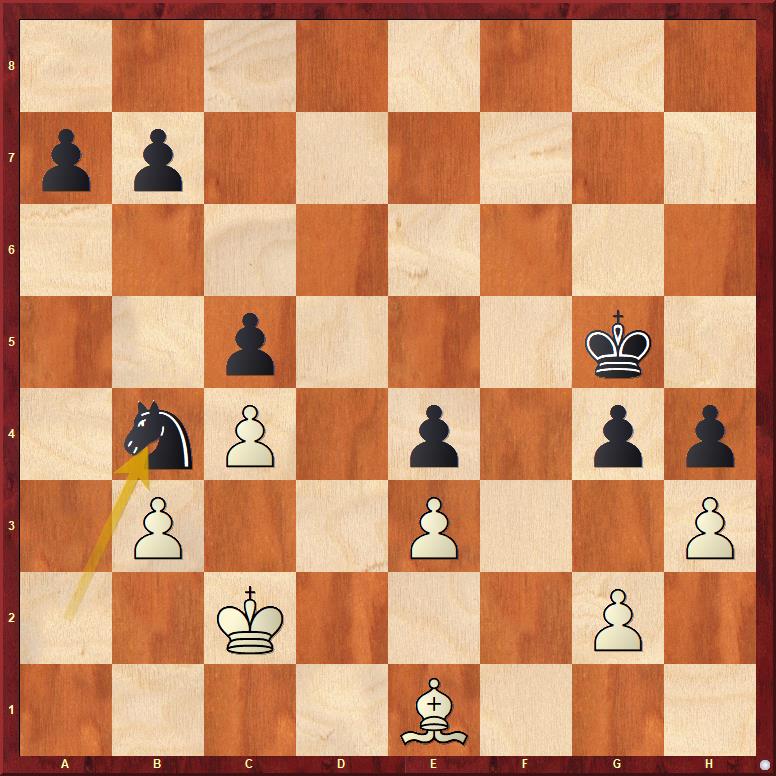
How would you evaluate the pawn endgame after 39.Bxb4 cxb4? To solve the task correctly, we probably need to call in the so-called. thinking in patterns. So how can Black try to strengthen their position? Such a strategic method can be applied in endgames, where the defending side must wait and the great master Time therefore plays no role in the position. In such cases, one can plan and see very, very far…
However, the entire game is truly worth watching!
As I mentioned above, Daniil Dubov had a game forfeited against Niemann and therefore had some catching up to do. In the last round, he had to win at all costs. The draw paired him with Praggnanandhu playing Black. Daniil gradually equalised, gained the initiative, but managed to defeat his opponent only at the flag.
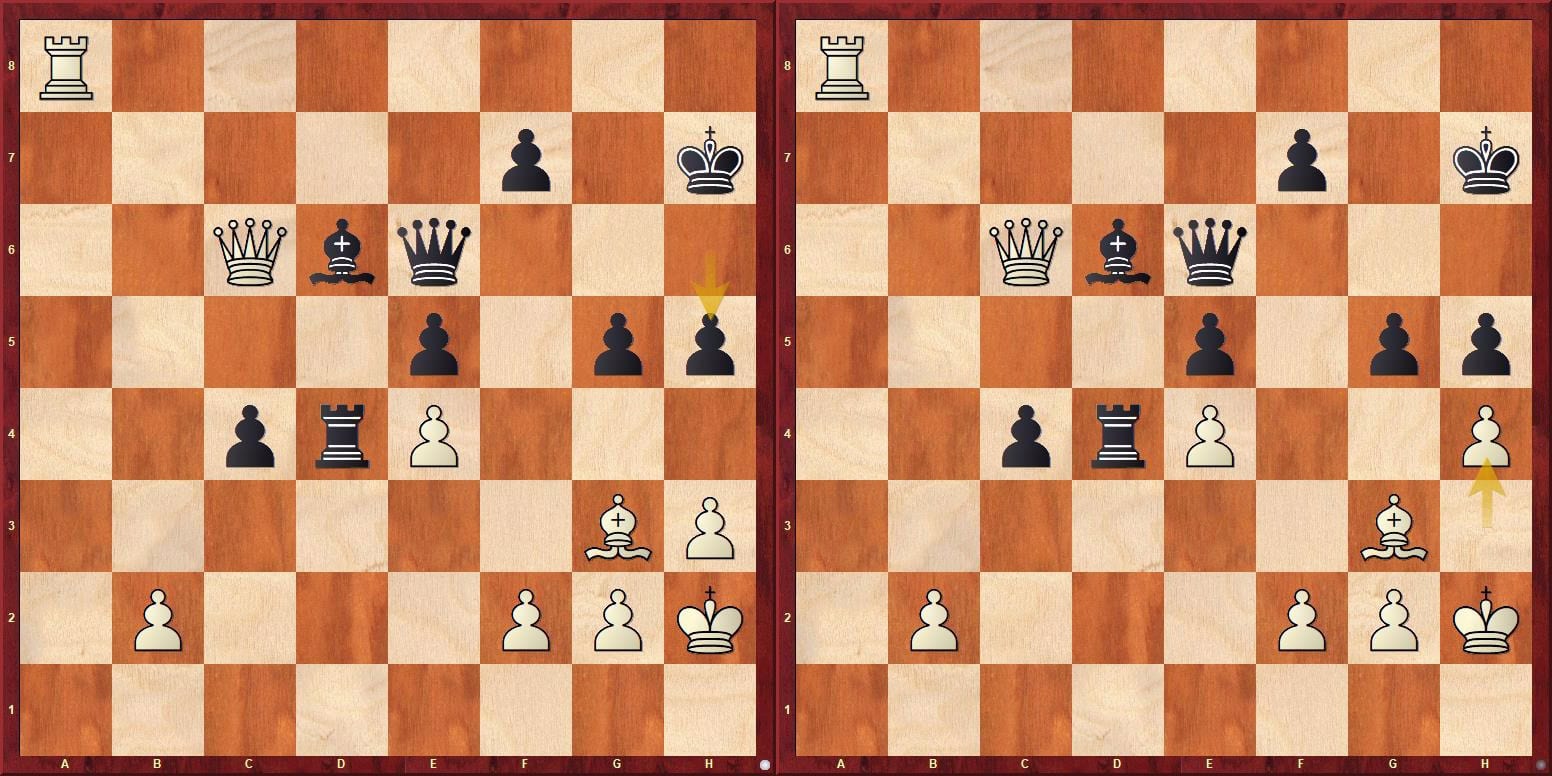
After 38…h5 Praggnanandhu replied mechanically after 4 seconds with 39.h4??. Magic AlphaZero pawns are simply indescribable! Just like the Seven Wonders of the World in history, the beginning of the 21st century, if not the millennium itself, was marked by the arrival of so-called artificial intelligence; in our beautiful game, this means engines gradually becoming significantly stronger than human players. The symbol of all this became in 2018, with the arrival of neural networks, the so-called AlphaZero pawn 🙂. Over a few years, the percentage use of the 'h' pawn in games multiplied several times! Well, here we clearly see an example, in my opinion, of an automatic reaction and... a blunder based on miscalculation of the variation.
How would you exploit White’s gross mistake? What move (instead of 39.h4) would you choose and how would you then evaluate the prospects of the sides?
At 10:15 in the video: let’s forgive Daniil for not setting up the pieces after the game this time and rushing off. He was naturally curious whether he had qualified…
A masterpiece by Ivan Zemljansky and a small digression
„Ivan Jevgenievich Zemljansky is a 14-year-old Russian grandmaster and a great hope (not only) of Russian chess. In 2024, at the age of 13, he fulfilled his last grandmaster norm. His abilities and talent are also evidenced by the fact that he simply skipped the international master title,“ I wrote in the player notes in the first part of the article. Ivan certainly did not lose his way even in blitz. 7.5 points with such a merciless pairing and a placing among players like Boris Gelfand, Shakhriyar Mamedyarov, Wei Yi or Alexey Sarana is definitely more than very respectable.
But still, I would not mention him if I had not come across a splendid example that could be directly included in a strategy book. This time it concerns the issue of cooperation between the Queen and Knight and their duel against a tandem Queens and Bishops.
We know that the knight alone is generally considered a weaker piece than the bishop (see also my work here on the Chess School website). More experienced and stronger players even know the saying „the worst bishop is better than the best knight“ 🙂. Less experienced players might therefore be surprised by what perhaps the most qualified person, José Raúl Capablanca, wrote about the combination of queen and knight: The queen and knight are generally stronger than the queen and bishop. Why is this so? The secret lies in the specifics and geometry of the pieces' movement. Let's first look at the working diagrams.
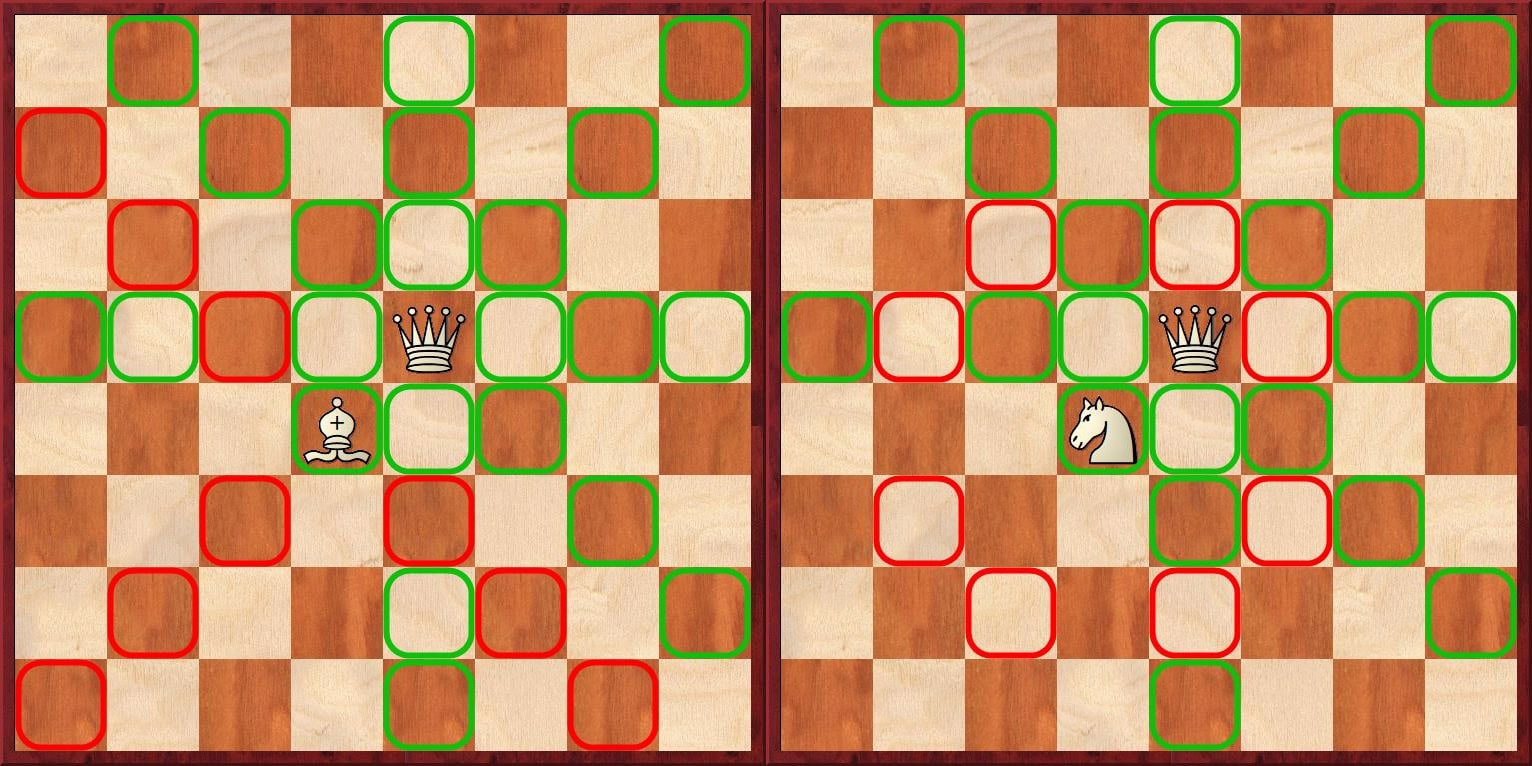
While the bishop alone controls (from the centre) 13 squares, the knight only 8. However, if we place the duos queen and bishop against queen and knight in the centre of the board and compare their abilities also by the sum (how many squares they control), we find that they are almost comparable! The secret, however, lies especially in something else! Queen with knight namely cover all three types of movement, which exist on the battlefield, namely rook, bishop and knight moves, whereas in the case of the other examined tandem there is duplication! Such duplication is rejected not only by our DNA (chromosome duplication), but it is also not ideal on the board.
More specifically: an important aspect in the cooperation and understanding between queen and knight is the ability to attack a specific weakness. Whether it is directly the king, weak pawns or squares.
A really nice study material on the topic including several examples can be found at: https://xchess.ru/ferz-kon-protiv-ferz-slon-kto-pobedit.html
Already in the second round there was a surprise. In the game Sevian,S (2693)-Zemljanskij,I (2545) Black perhaps literally savoured the endgame on the diagram!
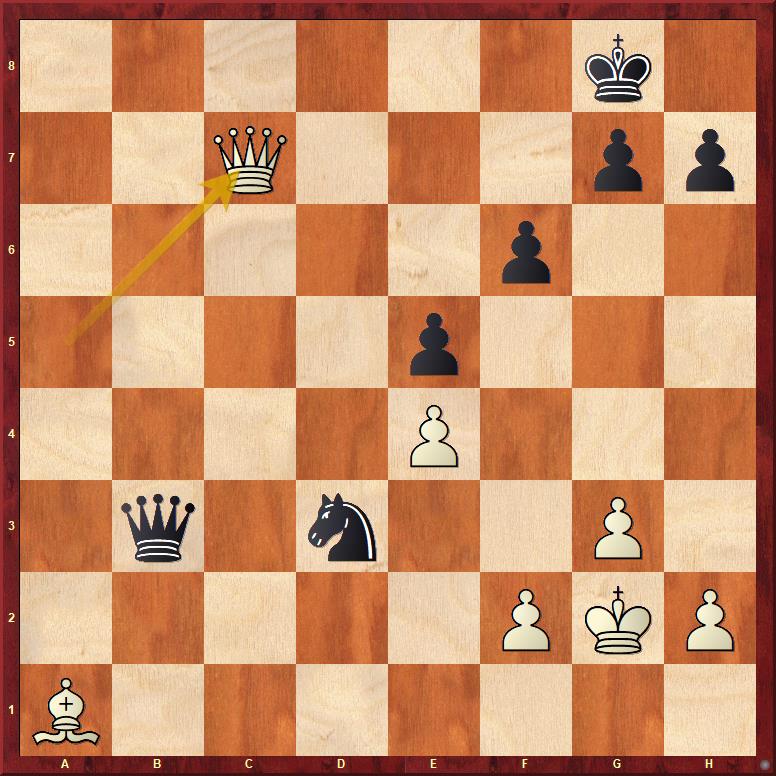
How would you why continue as Black?
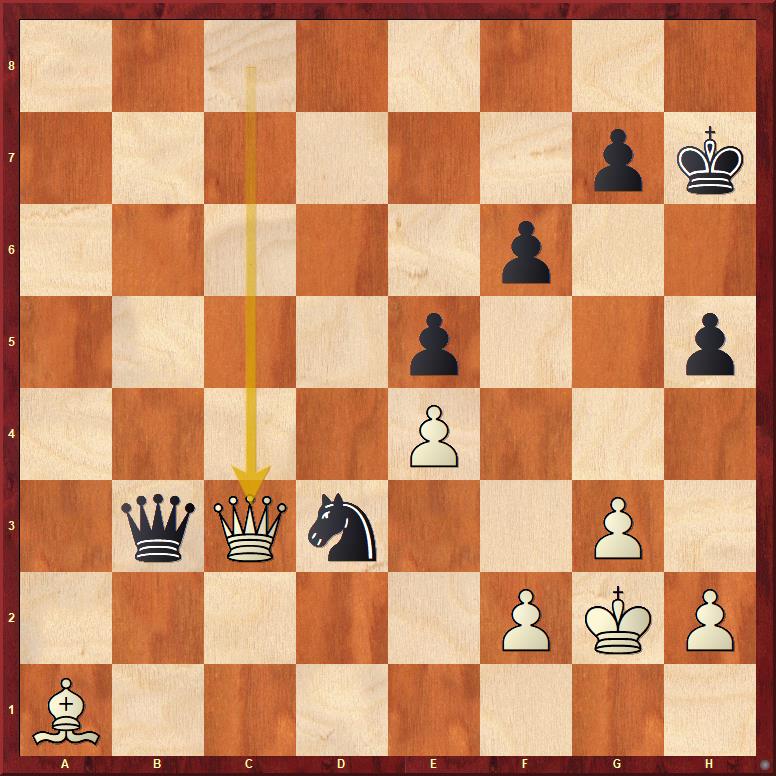
A textbook diagram! Black answered in 2 seconds according to the clock. By what method did he achieve a quick victory?
The Unrivalled Magnus
We may not like his behaviour or some of Magnus's statements, and we certainly don't have to be instantly in love with him! (Recently I is simply couldn't stand it any longer and had to clarify to a viewer obsessed with Magnus, who watches various videos where Carlsen mostly does not appear, but the contributor constantly reminds of his overwhelming performance lead, that Carlsen… recently got married 🙂 🙂 .) Be that as it may, the following blitz game is simply a masterpiece! True, in this exceptionally thematically rich game we find considerations comparing the power of the queen and knight tandem versus the queen and bishop duo, but the main content of the encounter Carlsen vs. Aronian from round 7 involves other strategic methods.
After 19...Bb4 a position arose, shown in the diagram.

It took Magnus only a few seconds to decide on a positional exchange sacrifice! 20. Nxe4!! Bxe1 21. Nc5 Qc6.
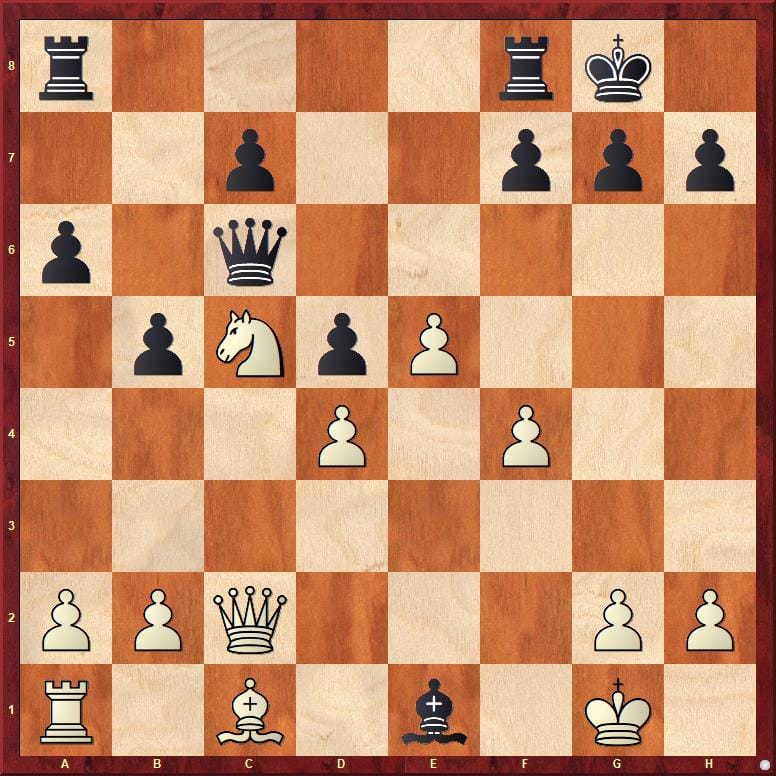
What followed was a brilliant 22. Bb2! (see the virtual diagram in the photo below).
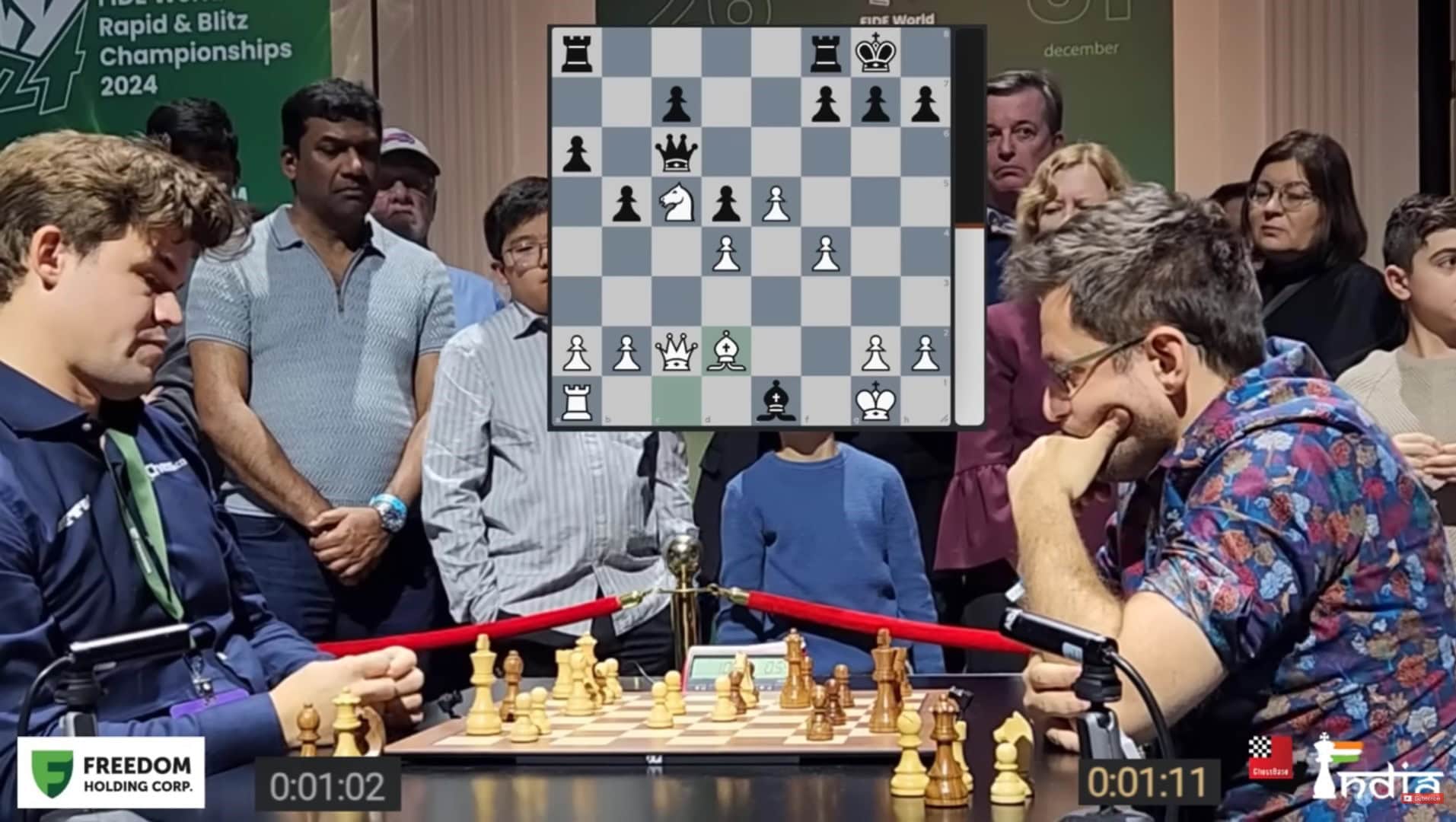
, which put Aronian before a difficult choice. Formally, both 22...Bxd2 23. Qxd2, and 22...Bh4 23. f5 Be7 24. Rc1 Bxc5 25. Qxc5 Qxc5 26. Rxc5 lead to equality, but with only a minute on the clock, it is indeed a crucial decision...
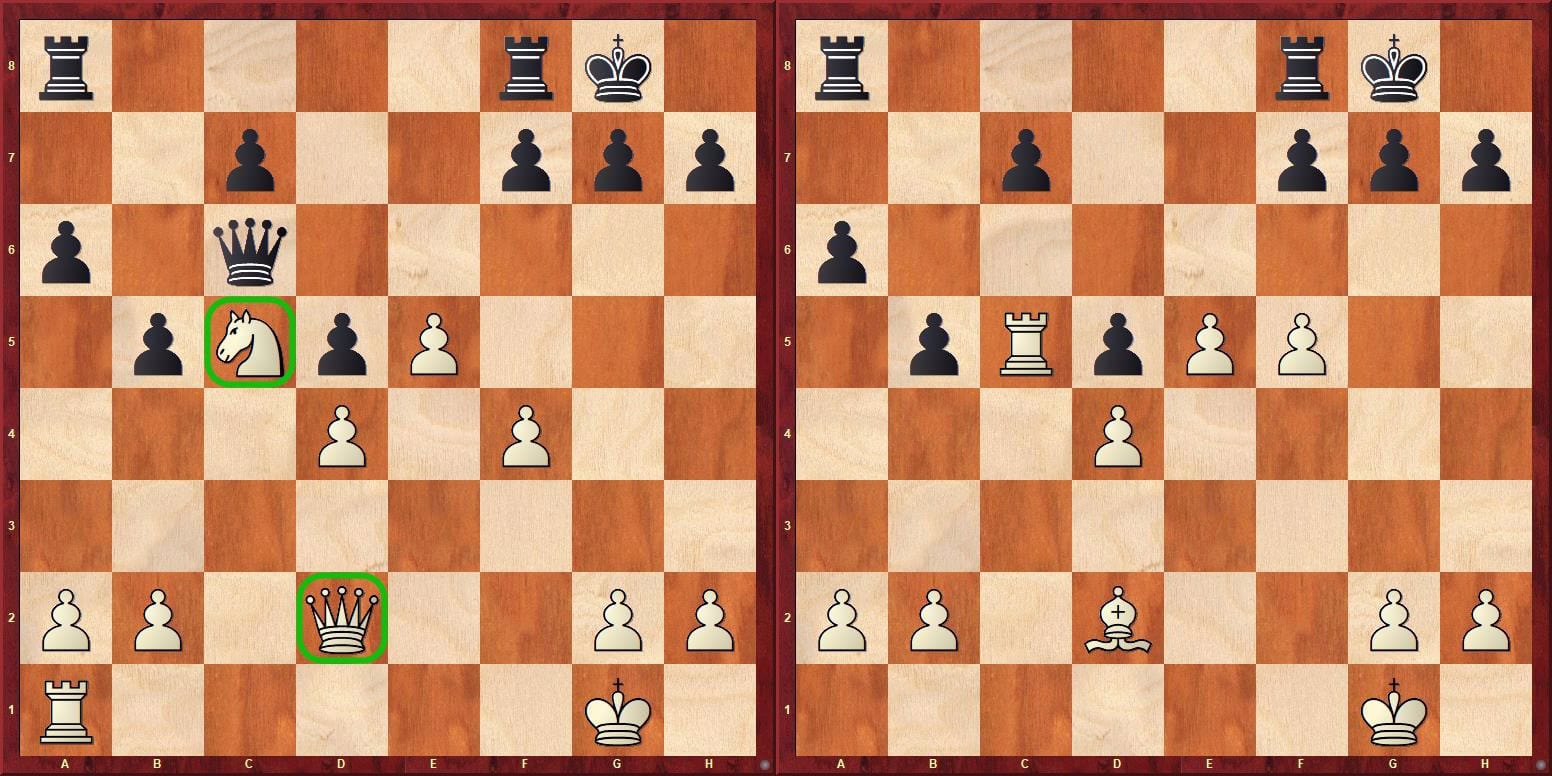
Which alternative did Black choose in the game? And how would you have behaved in Black's situation?
The concert performed by the world champion in the further course and the subsequent mutual intense time trouble deserves not only to be watched but also analysed! Let's look at both videos, while a more detailed analysis (with the option to download a sample) can be found by the reader in the players.
The great final of the eight
The regulations always stipulated 4 blitz games. If the match still had no winner afterwards, play would continue until the first win. (Here FIDE heeded the opinion or wish especially of the FIDE president and the armageddon was removed from the final games programme not only here at the World Championship.)
Already the quarterfinal matches brought together interesting pairs, with the greatest attention drawn to the duel between Carlsen and Niemann. Especially since the world champion lost control of the second game and lost it.
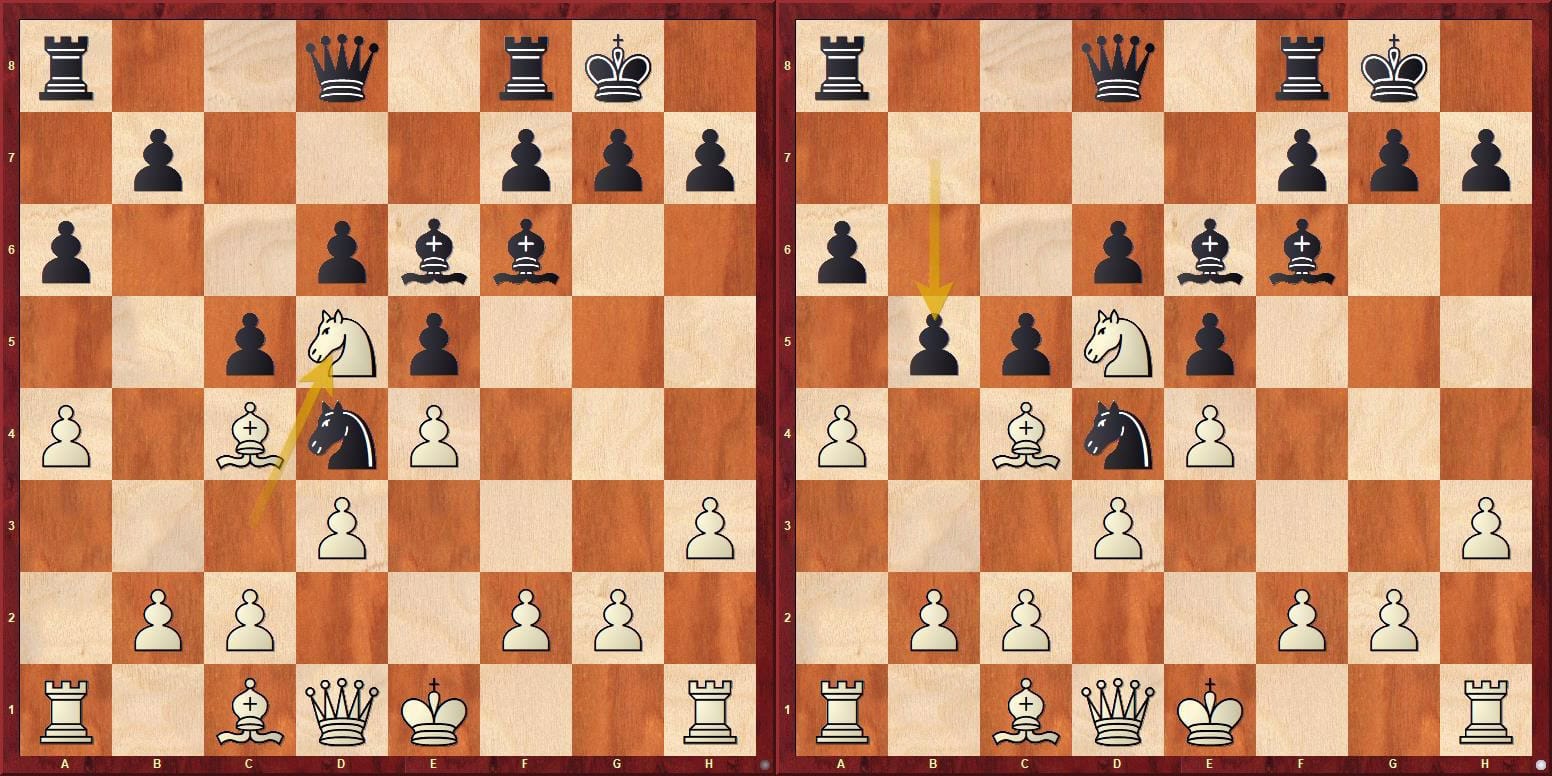
In the approximately balanced position of the left diagram, Black had a strong continuation at his disposal, which we could call by the traditional saying tactics in the service of strategy. How would you continue with Black and which variations would you possibly rely on?
As often happens in blitz, after about 5 seconds of thinking Carlsen played a superficial and mistaken 12...b5?. The move was made by a - mechanical hand. Only after 13.axb5 did he notice what he had done. Although he immediately denied the saying that mistakes come in pairs and replied with the forced 13...Nxb5, the root cause of the loss is found right here. But why actually could Black not continue with 13...axb5?
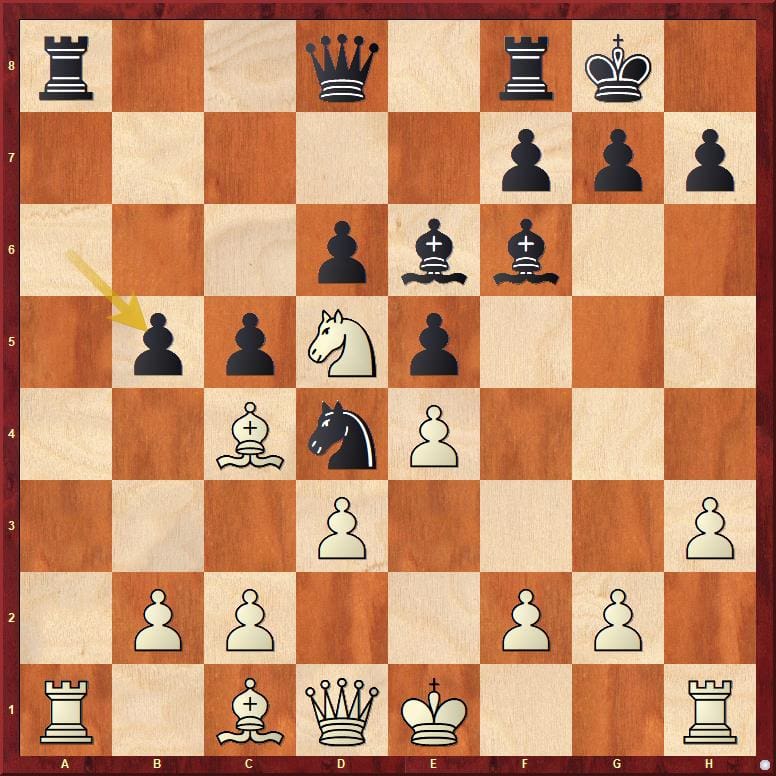
Can you calculate from the diagram position to White's large advantage?
Magnus, however, replied in the 3rd game, so fans surely got their money's worth in the last one. As Hans himself says, even there „the chess probably spoke for itself“!
The record of the entire quarterfinal match Carlsen-Niemann can be seen by the reader here:
Quarter-final match Duda vs. Caruana started unpleasantly for the world star, and, as they say, he never really recovered in the match. Yet he could have won the first game if only…
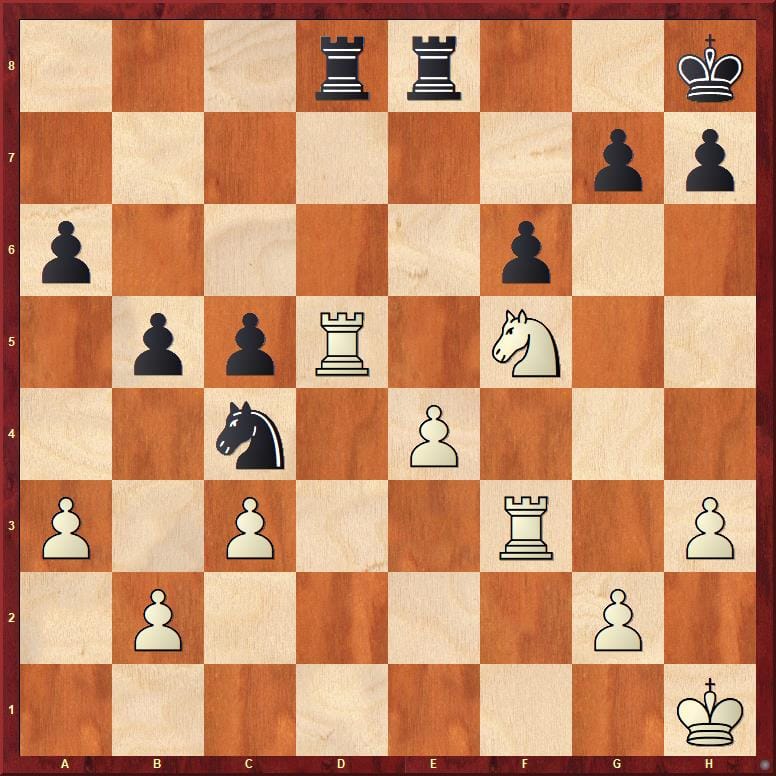
How would you continue if you were Black?
The Polish grandmaster thus managed to advance to the semi-finals, where however he faced a fully warmed-up Magnus. As is often the case, when two stylistically similar players face each other (in this case chess players who emphasise positional, strategic aspects), the weaker of the two in their encounters suffers. The semi-final thus became a clear affair for the world champion; after 3 games and 3 wins it was over. Carlsen then rested and awaited the much more dramatic semi-final Nepomniachtchi vs. So.
An unusual position, and thus a question for you dear readers, arose in the second game of the match Duda vs. Carlsen. Let us take a look:

With the last moves 14…e6-e5 15.Bc1 the position became significantly locked. Certainly neither opponent protested against such a course. Jan-Kryštof because he stands somewhat better, the world champion because the type of position suits him perfectly. Watching this blitz game is another experience for strong and experienced (not only) positional players!
Carlsen achieved exactly what he needs. In the position there is nothing to calculate, the king is safe and success will be achieved by the player who understands the strategic problems of the position better. Time (on the board) is of course not irrelevant here, but more important than WHEN is WHERE!
I recommend replaying the following course very slowly or several times! Let us try to understand not only each move, but the plan as a whole, which we will truly manage only after detailed and probably multiple studies.
As a reward we may gain forever the knowledge of why Magnus, this stylistic reincarnation of Capablanca (I really do not mean elegance and charisma now, but only the kind of genius talent), is still not only the best blitz player world!
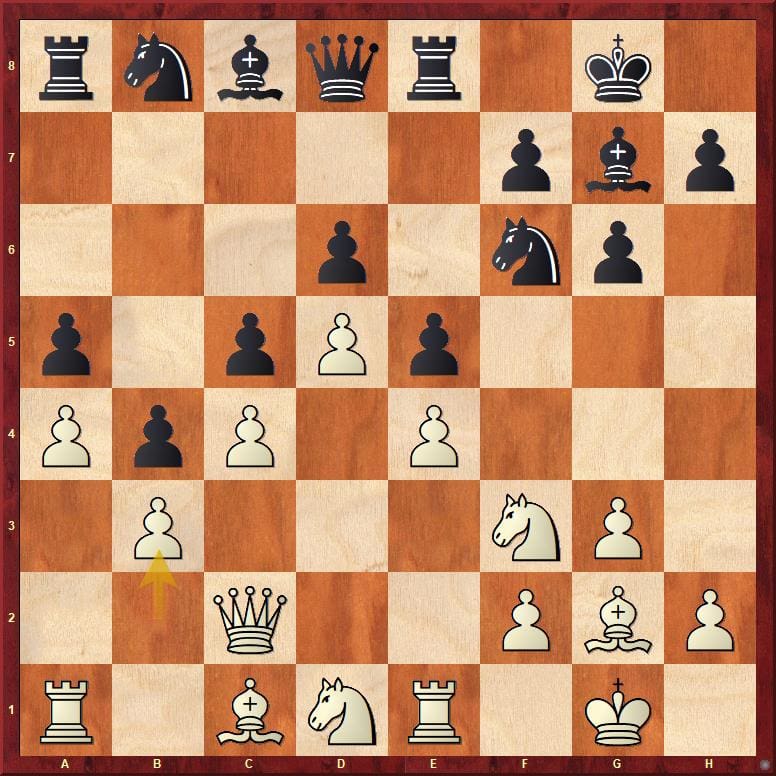
Namely: How and why would you continue as Black? What plan were they trying to implement?
It is time to present the grand final table:
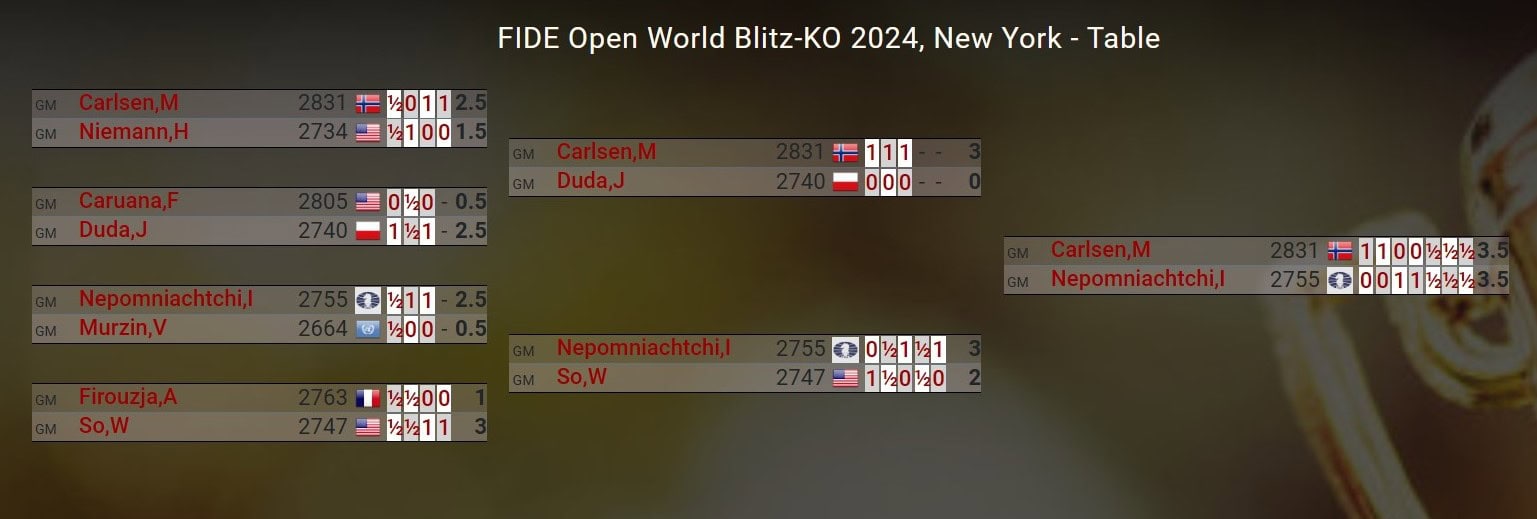
Below, readers can click to see the results of the first day of the World Blitz Championship as well as the women's final matches.
Great final drama without a winner

Fans of Jan Aleksandrovich, who switched off the live broadcast after his second loss, made a gross mistake in chess terminology (I admit I was among them 🙂 ). What happened in the following two games was an experience above all else. The conclusion of game 4 – Jan's brilliant combination – could be seen by readers at the start of the previous article. Below we can (again?) watch the entire final.
Readers who prefer to enjoy the final without interruptions and commentary can watch the following video.
After the seventh game was played, Carlsen had the idea that it would be best not to continue further. The video below captures this moment as well as the subsequent events and a short interview.
It is impossible not to empathise with the feelings of some (paying) spectators at the venue, who, as I have already mentioned, were few in number. Of course, tens of thousands of fans at computer, tablet or phone screens around the world were not disturbed. My feelings were rather ambivalent. On the one hand, I understand the outrage; on the other… to fight for two or three hours before midnight on New Year's Eve and thus disappoint, among others, half the fans? Magnus proposed a compromise and Jan basically had no choice but to accept the offer, precisely because of the time and date when the final was played. Here again we can see the signature of FIDE, which fails to think things through to their consequences…
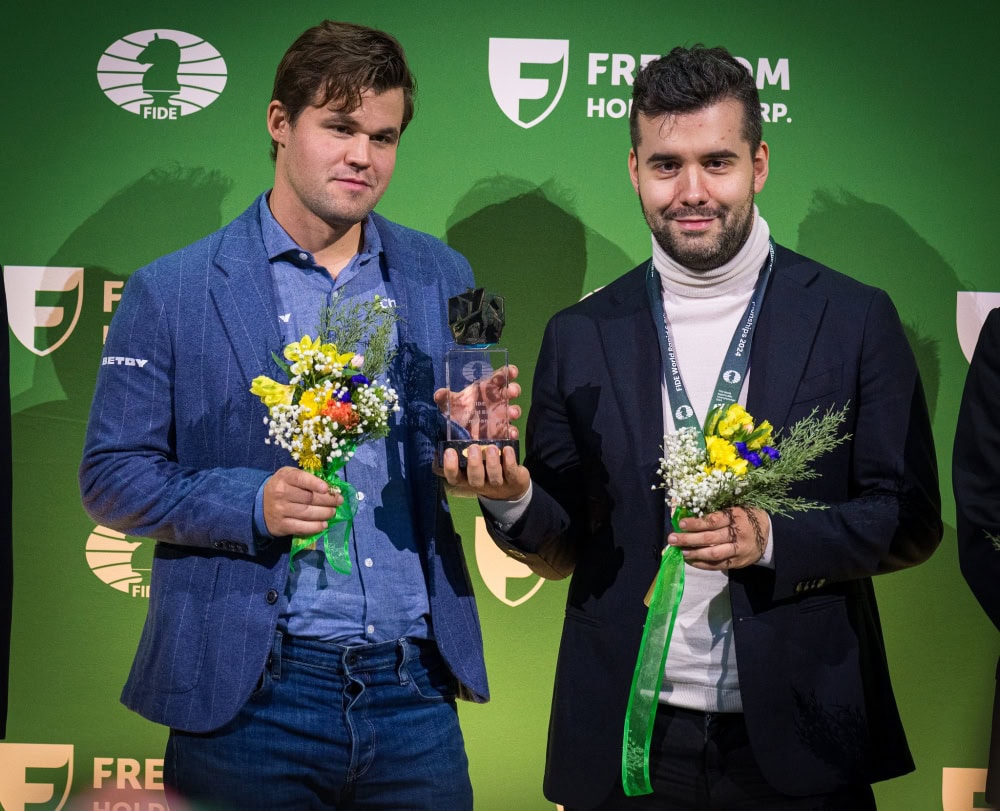
For the first time in history, the World Chess Champion title was shared by two players. Magnus Carlsen kindly agreed that Jan Aleksandrovich would take the gold medal home. He bore his fate considerably better than… Vlasta Burian in the famous Czech comedy Anton Špelec (daj-li-mi-medaili 🙂 ).
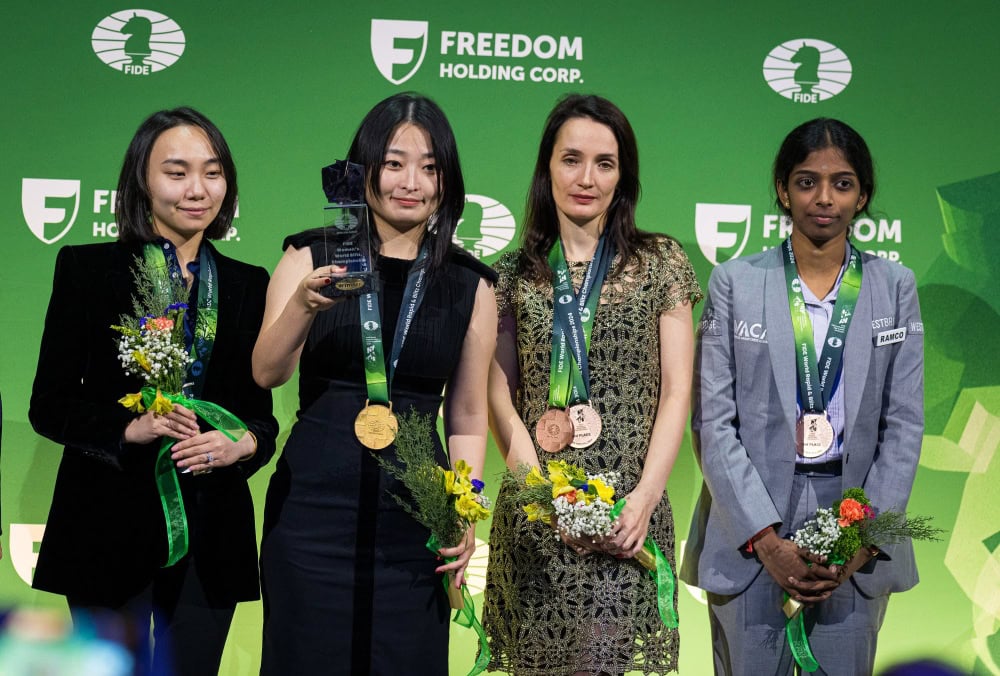
The gold medal was taken from New York by the world champion Ju Wenjun, silver by her 2023 challenger Lei Tingjie. FIDE did not consider it necessary to play matches for third place. This time, two bronze medals were prepared for this purpose. Ekaterina Lahno thus took two valuable medals from the World Championship, and Vaishali Rameshbabu also won bronze.
The tragedy of Vasily Mikhailovich and an experience worse than a horror
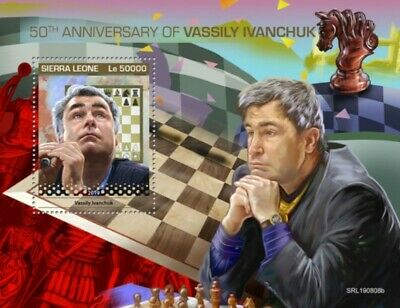
„I should never have watched this before going to bed,“ I told myself, completely shaken by the ending of the video demonstrating the eleventh round game between Vasily Ivanchuk and Daniel Naroditsky. Vasily Mikhailovich is considered by some prominent chess players of the present and past to be among the ten strongest chess players of all time! His understanding of chess gives the impression that he was perhaps born for our beautiful game, science and art in one.
As recently as 2016, when he won the World Rapid Championship in Qatar, viewers could laugh heartily twice. The first time was when Vasily Mikhailovich, in response to the moderator's question: „Will you return to the world elite?“ he stated: „I never left it.“ From another chess player, this would sound either arrogant, offended, or could be understood as sarcasm. Not so with Ivanchuk! He was simply genuinely surprised.
The video of the prize-giving to the winners was then shared on social media not only by many chess amateurs but became one of the most popular among chess fans… including me!
No comment!
„Chess veterans, chess lovers and professionals with innate heightened empathy: if you have not yet seen the video below, do not make the same mistake as I did and do not watch it before going to sleep! For those of us who have dedicated our lives to this beautiful game and art, it is easier to watch a classic horror film like The Exorcist at night than to see this!“ I did not even dare to analyse the game or even its ending, I did not dare to analyse it…
Daniel Naroditsky is not exactly among my favourites, but… all credit to him! He behaved excellently, actually in the only possible way.
Vasily Mikhailovich was apparently preparing for the World Championship and was on track to reach the final. After round 10, he stood at a promising +4, having lost only to Caruana and Nepomniachtchi. If he had won the game, 8 points out of 11 would most likely have moved him at least to decent financial prizes.
When a chess legend cannot be supported – I will rather use a euphemism – by an illegitimate coup banderist regime, then who else but FIDE, its social commission with extended powers, should be concerned with the future and support of this genius!
A delicacy with blitz rules not only for arbiters
I myself once reached arbiter grade 3, and of course I must also take into account how the rules have changed since I have not actively participated in tournaments for some time. For example, I will mention that in my time castling in blitz was allowed to be done with both hands and there were quite a few disputes about the flag falling.
The following video from the game Vakhidov vs. Raja is a real treat not only for arbiters. (After all, knowing the rules well should be expected of players, coaches, and even parents and escorts of children at tournaments.) The dispute that flared up concerns time overstepping, clock manipulation, but mainly the promotion of a pawn to a queen at 9 minutes into the video.
For a bit of a layman I state that the rules do indeed allow the possibility to stop the clocks when promoting a pawn to a piece. If the queen was nowhere in sight or the opponent was even holding it in their hand and did not want to give it up, then Black's behaviour would probably be justified according to the arbiters. What remains a mystery is why Black undertook a complicated operation to stop the clocks when he could simply have taken the queen next to the board into his hand beforehand... I believe that Anish Giri, who joins the discussion later, explains the situation correctly.
Masked Alireza in a New York park
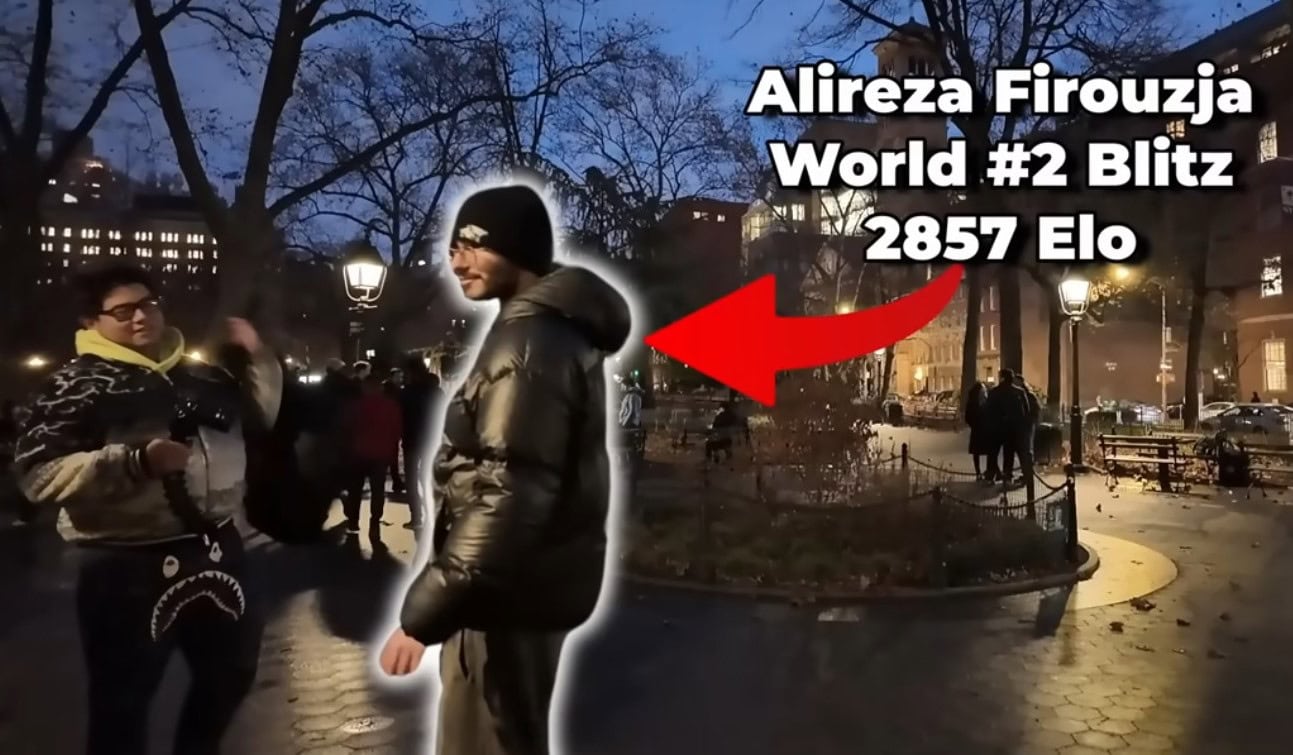
Enough horror and strict rules! The following video from the famous New York park, where chess is allegedly played or was played day and night, in winter and summer, became the stage for an entertaining video. Firouzja (preferably accompanied) set out to find an opponent. Admittedly, we would have a far more impressive experience if Alireza had visited the park incognito (similarly to how in the 1980s Robert Hübner – at one time the world number three by rating – was brought to the Prague café U Nováků to play several blitz games with the famous Řezník 🙂 ), but the situation apparently did not allow this. Nevertheless, it is remarkable to watch Alireza playing bullet chess in a winter jacket with a hood and a hat… His tactical insight and overview are also amazing.
Unforgettable moments and test solutions
In the players below you can find both the solutions to individual tests and the full games that led to the position given. Many other moments and situations full of tactics, calculation and strategy in all phases of the game are also analysed.