

One could perhaps say that the Marshall Attack in the Spanish Game suffered the same fate as the main character in the film ‚The Curious Case of Benjamin Button‘ (2008). It was born as a feeble old man, only to grow younger and stronger throughout its life! It is not entirely clear whether there was a significant period when the counterattack was outright rejected, but the fact is that the final verdict, which computers may have already reached, is: fully sound, in excellent health!
These days – more precisely on 23 October – it has been 105 years since the Marshall Attack entered the stage signifying the world. As has happened many times in history, the premiere was unsuccessful, but it must be added that unlike many, for example musical works, it was not simply forgotten. Rather, it seemed that many distinguished chess players of the time considered the practical failure of its creator Frank Marshall most likely a consequence of the difficulty of the first major performance. The main role of the opponent was played at that time, in 1918, by probably the strongest chess player on the planet, José Raúl Capablanca.
So that some perhaps less experienced readers know which attack is actually being discussed: the Marshall Attack in the Spanish Game arises after the moves:
1.e4 e5 2.Nf3 Nc6 3.Bb5 a6 4.Ba4 Nf6 5.0–0 Be7 6.Re1 b5 7.Bb3 0–0 8.c3 8…d5
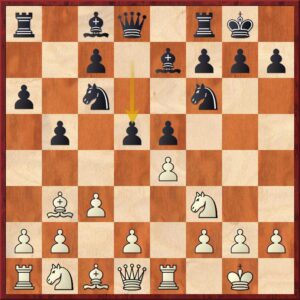
White accepts the gambit after 9.exd5 Nxd5 10.Nxe5 Nxe5 11.Rxe5.
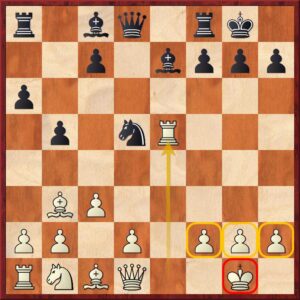
As soon as Black solves the problem with the attacked knight in the centre, it becomes clear to the more experienced player that a storm will break out over the white monarch, or rather his pawn palisade. The white pieces willing to protect the king are either still asleep or somehow separated from the king. Incidentally, the character of the position was excellently described by Capablanca when he later commented on the complicated game.
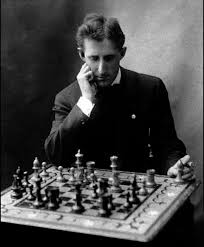
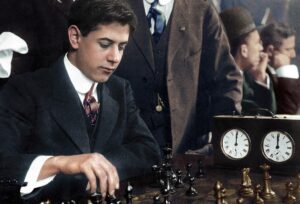
In the photograph Frank James Marshall (1877-1944), US Chess Champion from 1909 to 1936 (sic) and a candidate for the World Championship title. One of the hardest-working chess players of his time! Besides the famous Marshall Attack, the Queen's Gambit Defence 1.d4 d5 2.c4 Nf6 and the gambit 1.e4 d5 2.exd5 Nf6 are also named after him. His aggressive playing style was indeed directly destined for his name to be attached to several other gambit continuations in various variations...
Unsuccessful premiere
However, 105 years ago the Marshall Attack suffered a fiasco! The main reason, as many strong players of the time rightly felt, was not the quality, correctness or incorrectness of the sacrifice of the central pawn, but the practically flawless play of the defender, the future world champion and probably by nature or God the most gifted chess player of all time! (See the chapter below.)
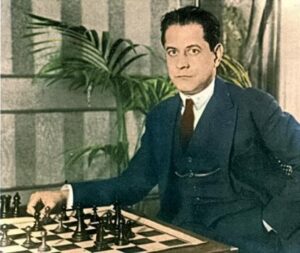
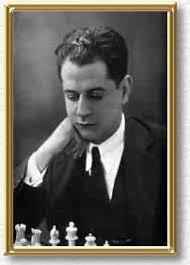
José Raúl Capablanca y Graupera (1888-1942). The 3rd World Chess Champion from 1920 (de iure) to 1927.
True, of course, this did not prove the incorrectness of the Marshall gambit at the time either. Black, after all, it seemed, he could have played better in several places in the game right away. To succeed, he must not have made serious inaccuracies.
Well, enough words for now. Let's look at the actual premiere. The date is 23 October 1918, New York, Manhattan CC, round 1 of the international tournament…
Let us emphasise that Capablanca's comments - the variations to the game - were significantly limited for didactic reasons, as he himself mentions at one point. Capablanca published the game in a book for beginners, and it also seems quite likely to me that some chapters and analyses were probably dictated from memory...
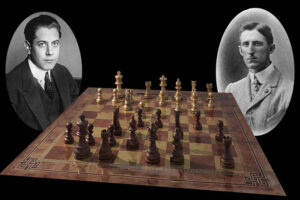
A splendid artistic collage. The entire game naturally circulated around the world. The United States of America was moreover, in the period between the world wars, a chess superpower practically from ‚its own resources‘.
Now let's look at a detailed analysis of the game, contributed to by many prominent chess players including world champions. Especially brilliant is the verbal commentary by IM Cyrus Lakdawala! (For those unfamiliar with this name, I add that he is a significant theoretician, didactician, analyst and author of dozens of books, mostly the ‚Move by Move‘ series.)
Of course, I also subjected the game to deeper computer analysis, in order to – though with only mild surprise, rather to verify – find that Capablanca played the entire game on the first, at worst second, computer line, while many commentators, including world champions and ex-champions (!), who had almost unlimited time for analysis, were mistaken perhaps far too often…
The most gifted chess player in history!
Was Capablanca the greatest natural talent in history?
I watch with great interest the passionate discussions about how matches between the best players of the past and present would turn out. Despite the prevailing opinion that chess has indeed advanced significantly (and if we disregard just opening theory) new strategic concepts are worlds apart from the ‚simple past‘, there are still some willing to at least admit the hypothesis that if Alexander Alexandrovich Alekhine, Mikhail Nechemievich Tal or Robert James Fischer had learnt opening theory, they would remain elite players even today.
Some older chess players, including for example the 12th world champion Anatoly Evgenievich Karpov, however have completely opposite views about contemporary chess.
Very simply and briefly put, two streams of thought collide:
- Today’s chess players play much better, understand chess more, because, like all fields of human activity, chess is developing rapidly today, mainly thanks to computers
- Today’s chess players play worse, understand chess less, because they have stopped training independently – analysing, relying on engines to do their hard work. (I provisionally call this phenomenon the ‚discovered calculator syndrome‘.)
The aim of this chapter or rather the addendum about Capablanca, however, is not to discuss the above outlined problem, about which a thick book could be written, but to try to present arguments for the statement in the title.
Very interesting interviews with the best Russian chess players took place some time ago on the Levitov Chess website. The questions were aimed at who they consider the most talented, the most hardworking, who calculates variations best, who attacks best, who defends best, knowledge of opening theory and so on. The 14th world champion Vladimir Borisovich Kramnik chose Capablanca in response to the question about natural talent. I paraphrase his reasoning: „Capa, from a certain time, actually did not work on chess. He relied only on what he saw on the board around him, in tournaments…“
Botvinnik's scientific analysis
The same opinion regarding the greatest natural talent Capablanca in the history of chess was held by the sixth world champion Mikhail Moiseyevich Botvinnik. His essay, attempting to prove the statement by scientific methods, belongs in my view to the golden fund of applied logic!
Because Botvinnik's original text cannot be published in full and was apparently last edited in the mid-1970s, it requires both a new vocabulary, and simplification as well as shortening.
Below I will present my view on the matter, which, however, does not differ in the slightest from Botvinnik's arguments and conclusions!
Let us begin as follows: which elements create the strength of a chess player? It is hard to argue with the following:
- talent
- character
- special preparation (training)
- physical condition a potential of the nervous system
We determine the strength of a chess player here simply by assigning a school grade to each element. (For our Czech conditions or perhaps for clarity, I will keep 1 = best, 5 = worst.)
Botvinnik ‚graded‘ Capablanca from behind!
Potential of the nervous system: Capablanca ruled in his youth with decent physical condition and strong nerves, but these qualities did not surpass many of his peers: two, three
Special preparation: At least since 1921, when he won the World Championship match against Emanuel Lasker, Capablanca practically did not train. He managed with the information he gained at tournaments, in his own practice, in post-game analyses, simultaneous exhibitions, casual games and occasional discussions: grade insufficient!
Character: (just in case let us note that here Mikhail Moiseyevich does not evaluate character traits in general, but of course relates them mostly to the tournament regime): Here Botvinnik writes this (paraphrased): „Here I must state that Capablanca was a man of distinctly weak character.“ The tournament regime meant nothing to him (at least in his youth). He often stayed up late into the night… Grade: insufficient!
I might add that his ‚tournament romances‘ with beautiful women were legendary, and if his wife Gloria did not come to a tournament or match, we probably could not speak of any tournament regime even today!
Botvinnik further writes roughly this: „If in two areas compared to others Capablanca lagged far behind even the average players of his time, in one he was adequate but did not particularly excel, and yet he conquered the highest possible heights, then it is clear that in the first category we mention – talent – he must have excelled in.!“
Furthermore:
- The move selection algorithm worked automatically during the years of Capablanca's full health. I would add that in positions lacking dynamism his decisions were almost flawless, perhaps even bordering on some kind of instinct!
- It is good to know that from the moment José Raúl Capablanca entered the world chess scene (Botvinnik probably meant from the first European tournament in San Sebastian 1911 or the tournament in New York a year earlier), until he won the world champion title, he lost only eight tournament games!
Thanks to his brilliant play, Capablanca almost shelved Marshall's concept for nearly two decades, but the industrious inventor himself came up in 1937 with an improvement 11…c6, which still thrives in splendour today. Evidence of this is not only the specific variations and results, but also the fact that many players with White avoid the gambit, choosing systems that have become known as ‚Anti-Marshall‘.
All this significantly contributed to the fact that the classical attack continuation 11…Nf6 was at first cast under a shadow of suspicion, followed by scepticism from all theorists. The attack in its classical form fell asleep like Sleeping Beauty…
The eventful fate of the original 11…Nf6
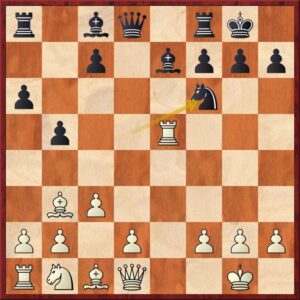
Let us return to the opening of the game itself! It is obvious that immediately after the game was played, many analysts, as well as professionals, began searching for places where the American champion made mistakes. After all, the players themselves also commented on the games. (Let us add that the often-cited story, originally perhaps from Eduard Lasker, that Frank Marshall kept his counterattack ‚in a drawer‘ for 10 years to pull it out only against his greatest rival, is not true, but the core of the story is probably real.)
The analysis of the attack itself, say from Black’s 13th move, gave the analysts a hard time, but in the end they somehow got their bearings. White simply repels the attack, no significant strengthening exists! But where exactly did Black err, when the attack itself arouses such sympathy?
It took some time before the main culprit was identified as the advance 11…Nf6, which, incidentally, remains the overwhelmingly prevailing opinion to this day! As Kasparov and Plisetsky write in their book ‚My Great Predecessors‘ (the former world champion, and in the revised 2020 edition the 11th move is marked as dubious), Marshall himself introduced a new concept into practice 20 years later (actually in 1937) 11...c6!, which is still relevant today.
A hundred years in hibernation!
Thus, the eventful fate of the likeable straightforward original attack developed 11…Nf6. For more than a hundred years it found no support! Despite my youthful, almost pathological trust in the opinions of the greats who then dominated the limited number of monographs, I still liked the classic Marshall Attack more.
But is the retreat of the knight 11…Nf6 really so bad? The following analysis, thanks to my new concepts, tries to prove that the straightforward advance used by Marshall 105 years ago actually gives Black very decent chances! The awakening from hibernation was successful. The patient survived and is in good health.