

In Samarkand, Uzbekistan, one of the strongest Swiss-system tournaments has reached its second half. Two qualifying spots for the Candidates Tournament are at stake. What did the first half bring? The initial flood of draws was gradually replaced by fights to the death! „Those who want to succeed must take more risks,“ declared the World Champion before the tournament. And indeed – even Gukesh tasted the bitterness of defeat, twice!
„Never judge players“ performances before the tournament ends!" is an iron rule which – unlike some other sensation-seeking scribblers – I will not break. However, for the one free day in Samarkand, I bring you four interesting examples from the battles so far.
Almost everyone is in Samarkand...
The most beautiful combination
The most spectacular finish probably belongs to the young Turkish prodigy, only fourteen years old, Kaan Yagiz Erdogmus,, whom I mentioned in the previous article.
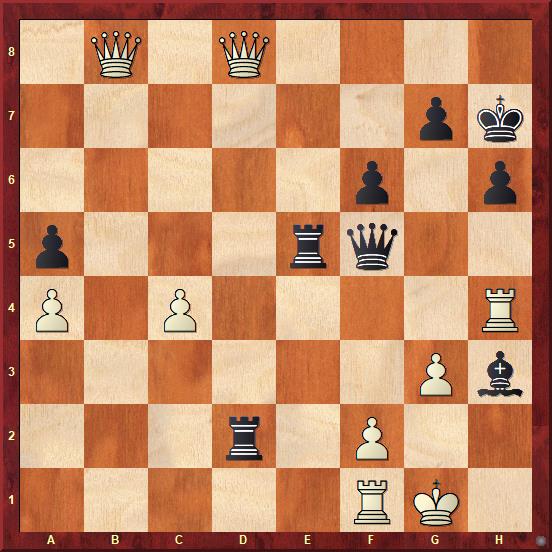
White has just placed a second queen on d8. How would you continue if you were Black?
A very nice finish was seen in round 6, in the game Gumularz vs. Nihal Sarin.. After 14 minutes of thought, White – admittedly in a worse position – made a terrible blunder 21.Rf4??.
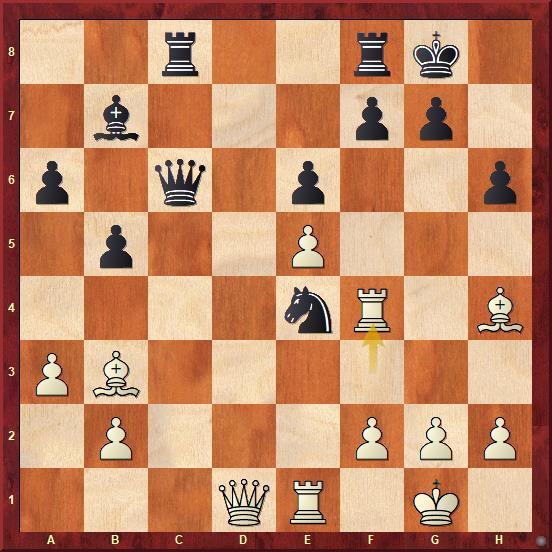
Two moves later, he resigned the game! Can you find the winning combination?
Both solutions can be found in the viewer at the end of the article.
Teacher against his pupil
That could also be the title of the round 3 clash Gelfand vs. Praggnanandhaa. In January 2020, former world champion Vladimir Kramnik asked Boris Abramovich to help him with training at a camp for gifted Indian children in Chennai.
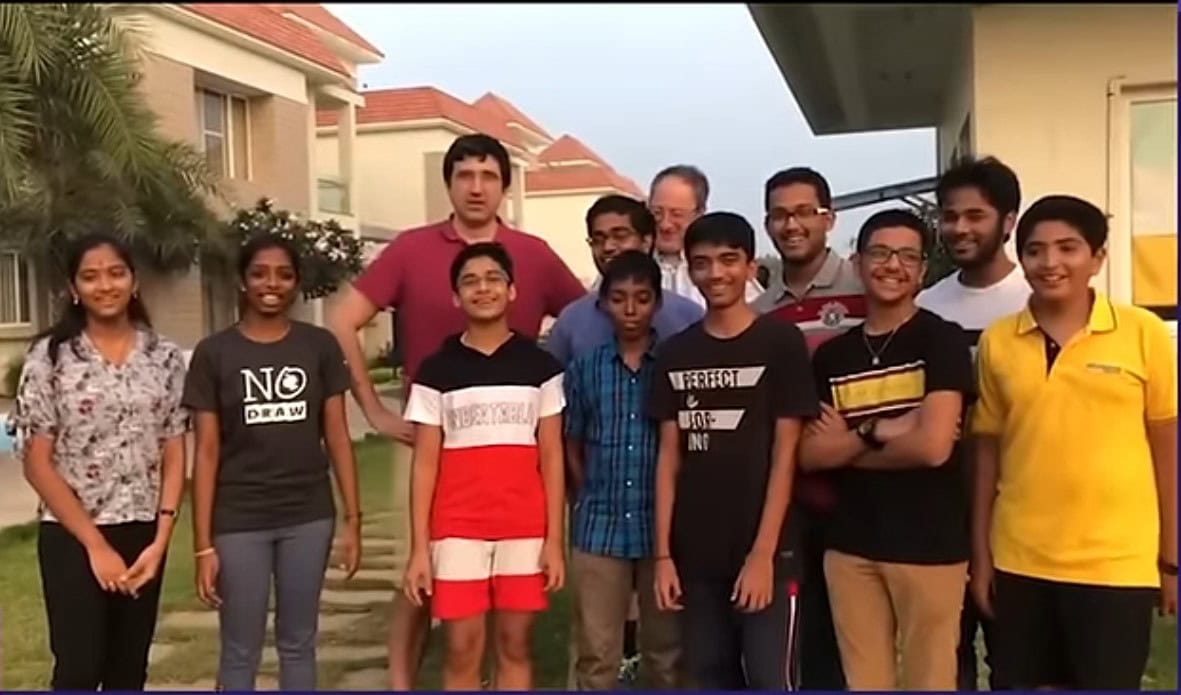
In the article „The Fourth Musketeer“ I wrote: „Do you recognise them? Can you find them in the photo? The three musketeers Gukesh (13 years old), Praggnanandhu (14) and Erigaisi (17). The photo comes from a video from January 2020. A group of Indian talents and coaches, former world champion Vladimir Kramnik and Boris Gelfand wish Sergei Karjakin a happy birthday on his 30th birthday.
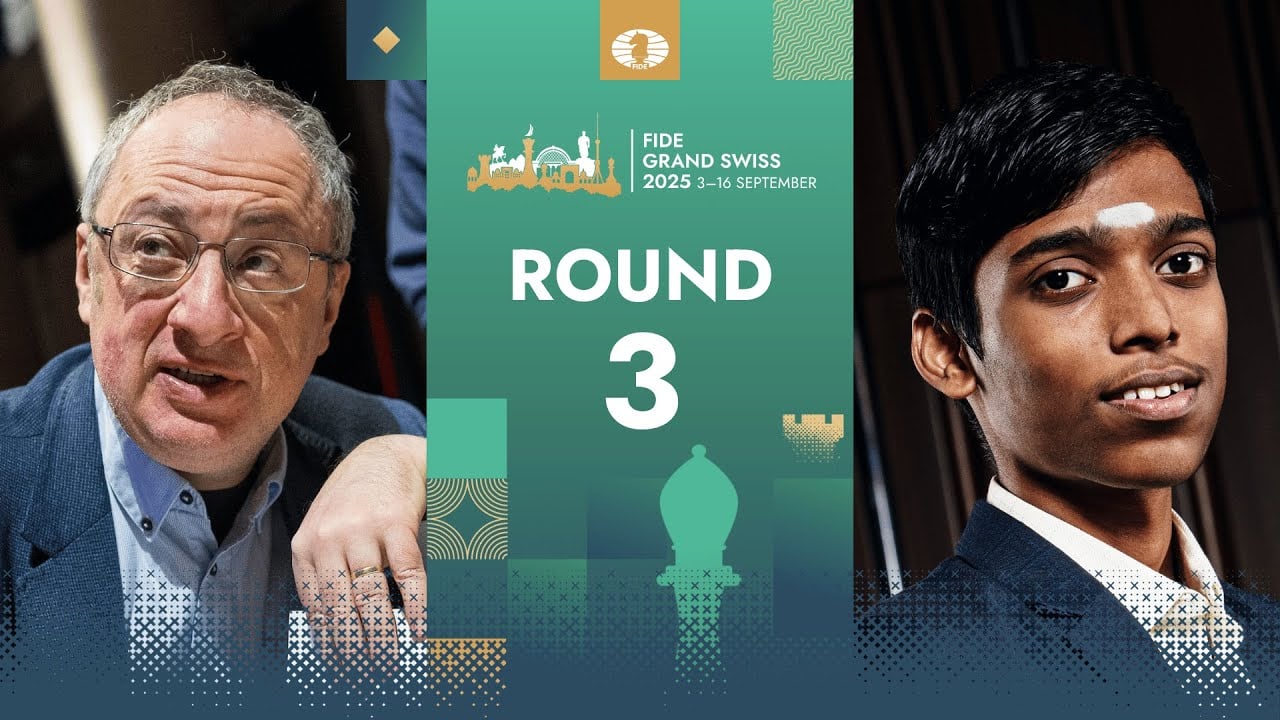
So here the paths of teacher and pupil crossed again. After five years, Praggnanandhu is the world number four by rating, a participant in the 2024 Candidates Tournament, and so far this year clearly the most successful chess player.
This game offers many moments worthy of note. In the end, I chose the one that really stuck in my memory. It is a complex positional manoeuvre. I note that this test is intended for advanced chess players.
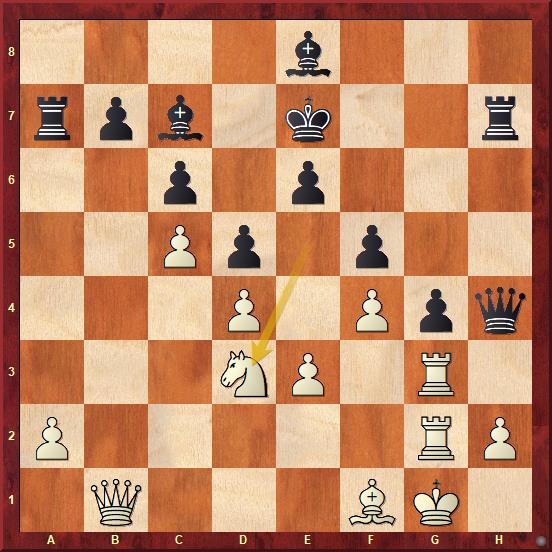
Boris Abramovich has just played 43.Nd3!! Can you, dear readers, figure out why he played like this? With what plan?
What does such a battle look like? We can deduce a lot from the traditional Sagar video. For example, notice that Pragg practically does not get up from the table, while Gelfand (at least until the first time control) does so after almost every move...
How to escape the undertaker’s shovel? Build a fortress!
In the previous article I briefly mentioned the American prodigy and the youngest grandmaster in history, now sixteen-year-old Abhimanyu Mishra. I occasionally look at his games. Here he starts with a rating of 2611, but a closer look reveals that for two years there have been no significant changes. Maybe now? We shall see! Here I follow the law: do not evaluate before the end.
In any case, in a dramatic game full of mistakes, he managed to defeat even the world champion in round 5! One round earlier, coincidentally again against Praggnanandhaa, an endgame arose on the board which, in my opinion – if not the most beautiful, then certainly the most instructive in the entire tournament. Let's take a look!
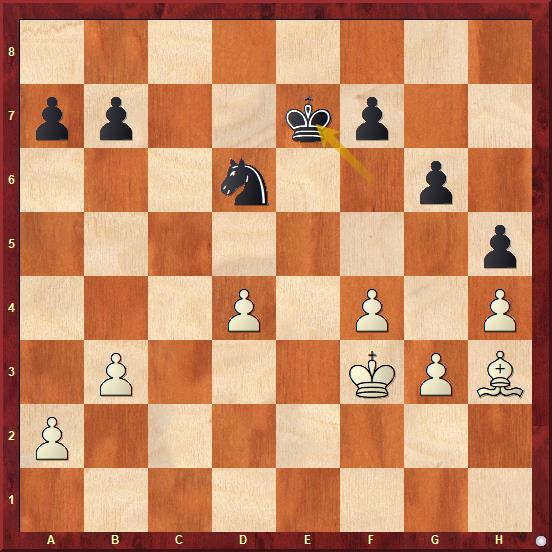
From this moment on, an almost unbelievable exception appears on the scene: living chess players outperform engines! The problem lies in the fact that in endgames positions arise which engines not only fail to see through, but – if we were to personify them – they actually hate. What kind of positions are these? Of course, fortresses.
One could write not only an article but an entire book about the relationship of engines to fortresses. Many readers surely have an idea what I mean. However, it must be emphasised that the situation has dramatically changed in recent years. With the advent of neural networks, engines have begun to detect some fortresses, and even those that still resist are already „on the brink.“.
There are even specialised engines capable of recognising fortresses – including the famous children's blockade of 8×8 pawns.
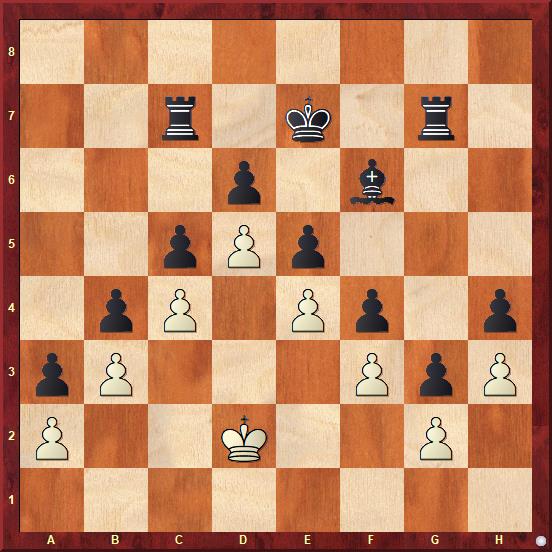
Try entering this position into an engine on your computer! If memory serves, my specific personal record „sounds“ like this: a fortress, i.e. a draw, was recognised here by an 8-year-old protégé. True, I have to look back quite a bit… 🙂
An experienced chess player sees that despite the material deficit, Black has real chances of salvation thanks to possible fortress formations. His pieces stand ideally, especially of course Nimzowitsch's knight.
The fact that Praggnanandhaa did not win the endgame also indicates that although after 38.f5! Kf6??
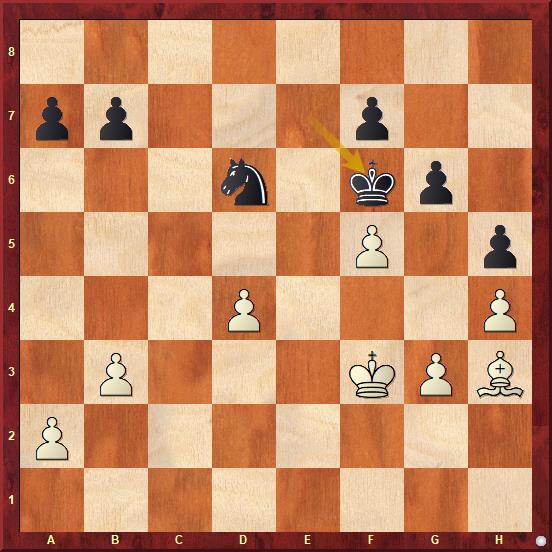
it was possible to achieve a win, it was a task... well, intended for the true technical elite of the Capablanca, Smyslov, Karpov or of course Carlsen type!
Before we watch the full video and replay the game, I will ask two difficult questions: How would you continue if you were White?
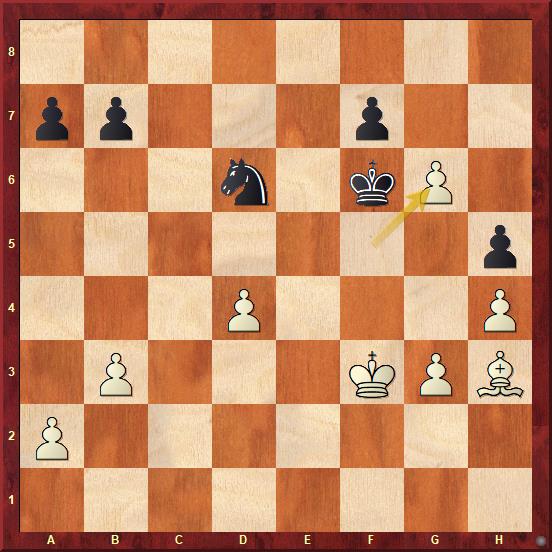
We see that in the game White mechanically captured 39.fxg6. Would you take the pawn with 39...fxg6 or 39...Kxg6?
The following short video, which I deliberately extracted from the original game recording, partially answers these questions. Not only is it instructive and entertaining, but it is also interesting from a psychological point of view…
Here is the full game recording and the subsequent Mishra post-game analysis available.
In the player we analyse the entire endgame Praggnanandhaa vs. Mishra and both spectacular combinations.
The interim standings at the top of the table looked like this on the only free day:
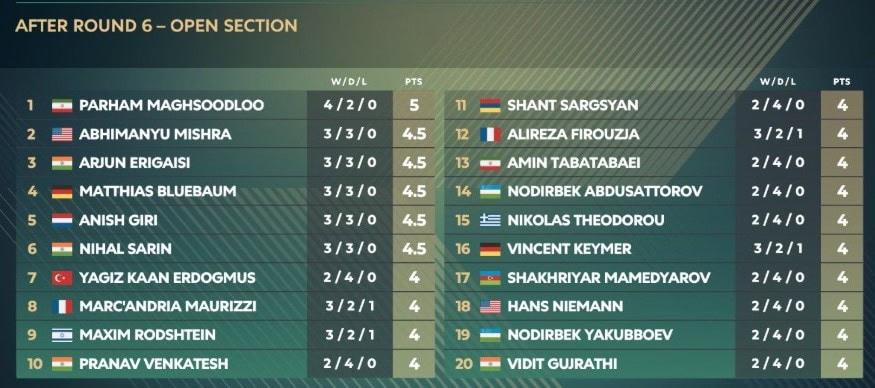
It would certainly be rude to ignore the performance of the tournament leader. So here I offer a video to watch. According to my favourite commentator Andrej Mikitin, Parham showed an accuracy of 98% in the game.
Finally, we can watch a short interview with the tournament leader, the likeable Iranian number one, twenty-five-year-old Parham Maghsoodloo. Since some scribes apparently only know that Parham is a grandmaster from Iran like Firouzja, I’d better add: From mid-2022 until the end of last year he was among the 2700+ elite with a peak rating of 2742! At that time he was the world’s twelfth highest rated player.
Will he endure the enormous tension of the remaining 5 rounds and, by a „start-to-finish“ system, qualify for the Candidates Tournament for the first time in his life? Personally, I would wish him that…