

In the previous article, I dealt with new perspectives on the function of the flank ‚h‘ pawn. I asked the question of who would be the first to pick up the gauntlet and write an undoubtedly voluminous work on how mainly computers elevated this often modest pawn at the turn of the millennium into a modern-day hero.
And lo and behold! While following an online rapid tournament, a kind of distant duel between young talents and seasoned veterans, a game appeared in which the nowadays adored flank pawn stood at the forefront of a strong attack from the very first moves.
It is only a pity that one of the young Indian prodigies, now a junior, probably the best-known to the chess world, Rameshbabu Praggnanandhaa, was unable to realise his huge advantage and bring the game to a victorious conclusion.
I chose the game for analysis also for another reason: in my previous article ‚2033: 1.h2-h4!…‘ I ‚forgot‘ something fundamental. The ‚h‘ pawn does not have to be ‚alive‘, it does not have to be present on the board. Its spirit can – perhaps together with Caissa – hover above the board, and yet it can help the other pieces to work out… well, we might say a nearly won position already in the opening moves! And this, mind you, in a variation that for many years served the supporters of the Ufimcev Defence as a kind of faith and truth. Like a certain remedy in a dangerous system 1.e4 g6 2.d4 Bg7 3.Nc3 d6 4.Be3, which appeared on the scene sometime in the 1990s and began not only to irritate the supporters of the Pirc-Ufimcev Defence but literally to crush them.
I believe it was mainly English players led by Raymond Keene who, after some time, popularised the continuation 4…a6.
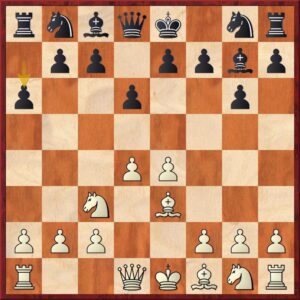
Grandmaster Keene was accustomed to provoking with moves like a6, Nf6+e6 and similarly in many other variations of the Ufimcev Defence. However, since I encountered problems in my beloved defence after the simple return to the Pirc with 4…Nf6 (everything is explained in detail in the game), I eventually joined the group of players – the ‚Keene faction‘.
Nevertheless, the decisive influence on my change of opinion was a game commented on in 2001 not only by a grandmaster but also a brilliant theoretician Marek Vokáč.
(Perhaps together with Caissa and surely with displeasure, they look at today's chess world, where the first issue is assistance even in serious games by an American player caught cheating several times. At the moment I write these lines, Hans Niemann is ‚only‘ proven guilty of assistance by overwhelming statistics.)
I will hardly interfere with Marek's comments – against my habit 🙂.
This is how Black dealt with the hyper-dangerous system about 20 years ago 4.Be3 most often associated with the plan Qd2, 0-0-0 and often f3 with an attempt to develop the Rauzer attack in the style of the Dragon Sicilian.
Now to the promised game. I will say straight away that the attacking system demonstrated by the Indian super-grandmaster I was unable to refute despite all my efforts! By that I mean even a modest request for at least some decent counterplay, where White might be left with only a slight advantage. Of course, the reader will learn more in the game itself, including a test at one of the most critical moments of the game.


The World Champion after the brilliant 6.h5!
According to some analyses and probably also videos, Magnus Carlsen even applauded his opponent at the end of the game. This reminded me of the strange American film 'Pawn Move', in which Boris Spassky, portrayed by actor Liev Schreiber looking like a KGB agent, also stood up after the last game to applaud Bobby along with the spectators present. (In reality, most Icelanders punished Fischer's terrible behaviour simply by quickly turning the page and wishing the likeable Boris Vasilievich success.) I wonder whether Magnus would have applauded even if he had been crushed somewhere around moves 20 - 25, that is, if Pragg had found the correct 13th or 28th move! 🙂
The Indian supertalent will surely 'forget' this somewhat unfortunate game. After all, he still has successes ahead of him that the youth of decadent Western countries (except for Jews and a few exceptions) can only dream of! Why bother thinking 'unnecessarily' hard and straining the brain when you can catch Pokémon on the most expensive mobile phone... 🙁
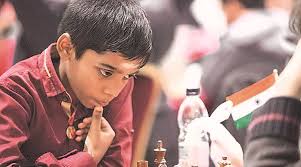
Rameshbabu Praggnanandhaa at the chessboard