

Holidays, vacations, lots of tournaments. It seems that at least for a few months the chess world is returning to normal times. Those readers who followed the June Candidates Tournament for the World Championship could choose from many websites and select live commentary according to their preference. I chose the Russian site Levitov Chess, where the games were commented on by perhaps the most qualified experts. Besides the 14th World Champion Kramnik, we could also see other super grandmasters in the studio. One of the guests was Daniil Dubov several times…
Well, and he was the one who occasionally showed very interesting, instructive, and humorous positions during the breaks. Those of you, dear readers, who do not have time to play one tournament after another, try to solve this somewhat humorous but certainly not easy retrograde study in the diagram below. (I deliberately chose a static diagram so that we can solve the task with the movement of pieces only in our heads, using so-called schematic thinking or step-by-step!)
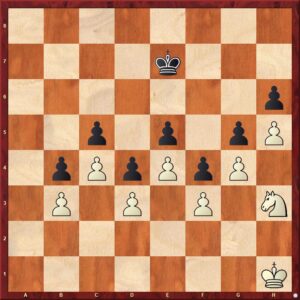
White to move. Can White win? If yes, then how?
The solution (or study, if you prefer) thrilled me, and I only regretted that I did not step away from the computer for a moment when Daniil Dmitrievich demonstrated the solution. Curiosity simply won!
Dubov (the author of the study was not mentioned) also teased strong chess players a bit by saying that even computers have problems with the solution; viewers can try for themselves how strong a machine they have at home. According to him, the ‚dvižok‘ will solve the task only around the 60th half-move, which I can confirm. Well, a stronger computer will find the solution, but still – if you do not dig deeply into the position yourself – you will have trouble understanding the purpose of the computer manoeuvres. As often happens, the computer almost always tells you HOW, but not WHY!
Wishing you a pleasant holiday, vacation, and possibly many successes at the chessboard this summer, dear readers, from the author Jan Bílek.