

„But concrete calculation is surely the domain of computers! It's nothing but mathematics!“ many a reader might argue. Certainly, but in a game with running clocks beside the board, the engine won't help us at least until (hopefully) our descendants have chips built directly into themselves, as was the case in the TV series Fringe. (In the Czech Republic it was broadcast under the title Hranice nemožného.)
„But in analysis the computer sees everything,“ the conversation continues. And here we come to the heart of the problem!
Once I came across a sci-fi story that invited deeper reflection. The plot was set in the future and revolved around the fact that ‚scientists‘ in the story 'discovered' a modest worker from a tucked-away department who – believe it or not – could add, subtract, multiply and divide without the help of a calculator. He only needed paper and pencil. His 'skill' caused a real sensation. After several tests and verification that our hero was not cheating ('mathematicians' checked the results on calculators), the wise heads sought an explanation… in my opinion exactly this is happening now and will happen even more in the future (if we have one at all).
We will briefly return to the opinions of world elites on the issue of chess players' performance, i.e. their ability to calculate variations, at the end of the article, although it deserves separate attention!
The author wants to in this contribution with readers mainly share news from the chess world (not only) of the declining West, but suggests readers verify whether they can manage the calculation of variations where a super grandmaster (yet winner of a strong tournament in Biel) completely failed! He also relies on the opinions of chess greats – former world champions! What is happening to chess?
The organisers of this year's tournament in Swiss Biel this time came up with perhaps the most revolutionary idea to 'make the tournament more attractive' for eight selected and (for this alone they deserve thanks, nothing more can be found) young chess players and of course the spectators. Unfortunately, also how to reduce its creative level as much as possible. They combined the system of playing serious games, rapid and blitz. (Fortunately, spectators will still have to wait for bullet and various hyperbullet; when civilisation goes even crazier, participants will move, in another part of the tournament, even to computers. I assume the time will come when they will bring their own... mice... this is not a joke.) This means that after the rapid tournament several serious games followed, then 'double-round blitz' began to finish the tournament with the remaining serious games. Of course, the number of points for a win and a draw in the individual disciplines was adjusted accordingly. In other words, the tournament calendar required careful study by interested parties, but probably also by players. After all, there is a decathlon in athletics and so there is still room to add more. The fact that chess is probably the only kind of human activity where sport, science and art have complemented each other for centuries is no longer played today.
Allow me a slight digression: To keep everything appropriate to the times we live in, roughly at the same time was active also the current world champion1/ first announced that he would defend the title only if the young Alireza Firouzja won the Candidates Tournament (in my opinion this psychologically damaged him immensely, if not outright destroyed him!), 2/ then announced he was surprised: he had predicted Caruana as the winner of the Candidates Tournament, 3/ proposed a new way of playing the World Championship match! (It will be played in sets, similar to tennis, and he also developed a tiebreak system). 4/ Finally, on the anniversary of FIDE's founding on 20 July 2022 (apparently he found this very appropriate or extraordinarily funny), he announced that the match would… not be played! (Readers who might already consider this a sure thing, I will share my opinion: I do not exclude that Magnus Carlsen wants, among other things, to surpass Fischer in the amount of prize money for a played match.)
Of course, other reasons are also at play. For example, the world champion's laziness to prepare for a match lasting several months for only about a maximum of one million (dollars or euros). Surely certain fears of losing also play a role. "Es kom der Tag!" Jan Aleksandrovich needs to significantly strengthen his nervous system, be on an upward curve of his performance, and perhaps have a bit more luck in the second match for the chess crown, so that, unlike Sergey Karjakin (2016) and Fabiano Caruana (2018) at 6–6 or in the future 7–7 rapid or subsequent blitz, he wins.
But back k crazy tournament in Biel. In my youth, I read a lot and was also interested in the results and curiosities of pre-war tournaments. However, what the organisers and patrons came up with here does not remotely resemble the super tournament of 1938. The AVRO tournament was held in the Netherlands, with the players (only!) travelling from one city to another after each game, to return to the capital city at the end of the 14-round contest. It can be said that both the then world champion, 46-year-old A. A. Alekhine, and especially the ex-world champion J. R. Capablanca, who was four years older (he celebrated his fiftieth birthday at the tournament, and it was here that his eternal rival dealt him a cruel defeat as a present; Capablanca's poor result in the tournament is attributed to his poor health), had, unlike for example the then 27-year-old Mikhail Moiseyevich Botvinnik or even the tournament winner, then only 22-year-old Paul Petrovich Keres, to put it mildly, problems with travelling. Well, the Humberto circus.
In my opinion, however, this does not compare to this year's ‚brilliant format‘. Towards the end of the tournament, the players perhaps even forgot which type of chess they were actually playing today. At least this hypothesis of mine is supported by an example from a serious game, which I have prepared for you, dear readers, including that test. So let's get to it!
Salem, Saleh (2684) - Le, Quang Liem (2722) Biel 20 July 2022
This is the 26th round of the tournament in total, this time a serious game, and the winner receives 4 points for a win. The very likeable thirty-one-year-old Vietnamese grandmaster is a tactician and calculator through and through.
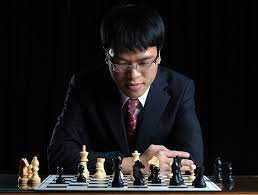
White in the diagram position played 62.Ne2. He was not doing well on time, unlike Black, who had more than half an hour.
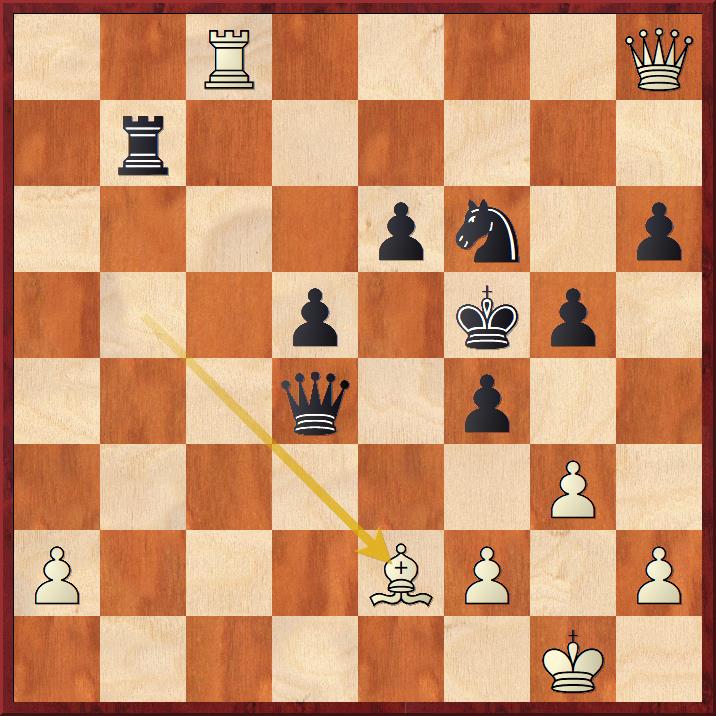
Dear readers, try to attack the enemy king with Black, but, most importantly, calculate all the important variations. I think 20–25 minutes should be more than enough time for you to complete the task. Of course, below you will be able to compare your solution with reality.
At the end of the article, I would like to return to the Candidates Tournament. If you follow the chess world, you probably noticed the video recorded after the 6th or 7th round by the 14th world champion Vladimir Borisovich Kramnik. (Among other things, he comments on games live on the Russian website Levitov chess, was the only guest in the studio who did not use a computer to evaluate positions and explain to viewers what is happening on the boards!) He literally tore the level of the games apart with criticism and described some games as played not at the most prestigious and important tournament of the year, but at a level of 2,300, at most 2,400.
You can watch Kramnik's video, which of course supports his claims with examples, for instance here:
https://www.youtube.com/watch?v=uoEdov57mU0
And its conclusion? Why is this happening? According to the former world champion, one of the most important reasons for the sharp decline in performance is precisely the alternation of different game formats, when online play entered the scene during the Covid period. Simply put: chess players today do not play according to plans, but according to moves, thus imitating chess engines.
When we add to this harsh criticism the earlier words of the 12th world champion Anatoly Yevgenyevich Karpov, namely that chess players today fundamentally lack the ability for independent analysis (it's more convenient and accurate to run an engine, isn't it?), we get to the heart of the problem and, of course, perhaps partly explain the poor calculation of the Vietnamese super grandmaster from another perspective.
About the current calculation abilities of today's super grandmasters (I personally consider this title identical to a rating of 2700+) compared to those who are no longer with us, and I believe, watching with concern not only the chess world, perhaps some other time.