

Let's analyse – twelfth lesson
Bow before the Princess, grandmasters
..., bow deeply and tremble, adds the author.
Many readers surely know the name of the current twenty-three-year-old best female chess player in the world, the princess of chess, who has a huge performance lead over her female competitors, as well as at least two sisters from the Polgár family before her. She logically came to the conclusion quickly that ‚wasting time‘ on women's tournaments (including the World Championship) is completely pointless.
The following short lesson is devoted to just one example from a recently finished strong tournament in Biel, Switzerland. I will not hide that I – as a required observer – find the style of the young Chinese player likeable. Just like Judit Polgár once, she likes sharp complications in which she is excellently oriented.

Source: www.chess24.com
[After all, it is not so long ago that the positional queen sacrifice in the game Borya Ider versus Hou Yifan (Gibraltar 2017) took the world by storm.
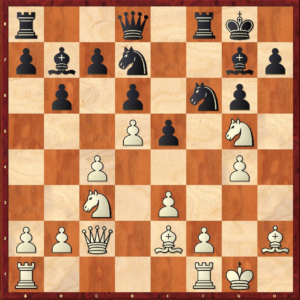
In the diagram position Black continued 15...Nxd5!!, so that after 16.Ne6 sacrificed intuitively the queen for two minor pieces: 16...Nxc3 17.Nxd8 Nxe2+ 18.Qxe2 Bb3!! certainly with an unpleasant initiative.
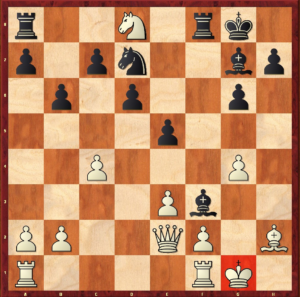
(0-1 52).]
There is no doubt that she will eventually break into the TOP 2700 club, but... can she (just like today's eighteen-year-old Wei Yi) break even higher? Or even much higher?
She has enough time to improve, and thus also to reserve time for training, which simply is not fashionable today. She does not have to ‚desperately‘ travel from tournament to tournament just to support her family. The care for young athletes ‚works‘ apparently quite differently in China... it is enough to write that it ‚works‘. The state will not leave anyone stranded, especially when it concerns a brilliant and exemplary representative of the homeland.
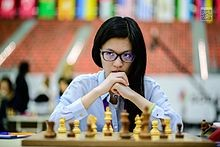
Source: Wikipedia
This is roughly how the author thought about the brilliant Chinese player... until he settled into his chair in front of the computer and started replaying the games of the eighth round of the tournament in Biel, Switzerland on 1 August.
Hou Yifan's abilities of combinational vision and subsequent deep and precise calculation took his breath away!
Let us, dear readers, brighten the holiday period with a truly splendid example.
Vaganjan,R (2562) - Hou,Yifan (2666) Biel 2017
The seasoned grandmaster – the veteran here, after 10 minutes of thinking, apparently unaware of any danger, played 20.b4
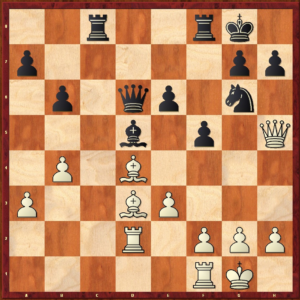
Although White stands worse, who would have guessed what a turnaround the game would take. It would certainly be extremely interesting to find out how many players of the current world elite would see and be able to calculate to the end what I consider not only one of the most surprising combinations of recent years! 20...Bxg2!!
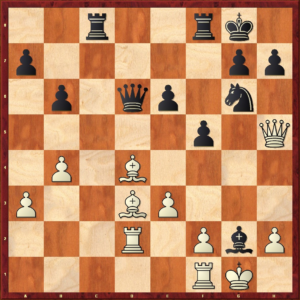
After 11 minutes of thinking. In the author's youth, such turning-point situations were often aptly described as a ‚bolt from the blue‘! Amazing imagination!

Lesson: The combination itself can be discovered (and calculated) if we respect the rule of examining candidate moves (CM) and their order. After all, it is actually the first noisy move (= checks, captures, threats) that we should verify in our mind!
21.Kxg2 Qxd4!! Played on the clock!
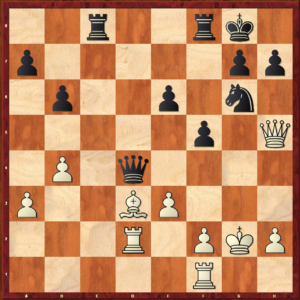
Two terrible blows must have so unsettled Vaganjan that he was no longer able to offer serious resistance. From a theoretical point of view it was best to accept the second sacrifice as well, as the variations show. On the other hand, any reader who saw the aim of the combination only as regaining the queen plus added material or positional value would be very mistaken. Hou Yifan's calculation must have been carried out at least 10 (!) moves ahead in some branches.
22.Qxg6 BWhite's brilliant reply could (perhaps apart from the psychological effect) give the impression that even Vaganjan ‚saw everything‘, but...
[22.exd4. The combination with everything included could therefore be accepted, but in a ‚human‘ game White then practically had no chance of saving the game, although it might have dragged on for dozens of moves. Let's look 22...Nf4+ 23.Kf3 Nxh5 24.Re1
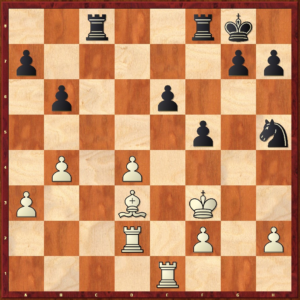
24...Kf7 with a clear advantage. White should have preferred from the unpleasant choice 22.Qxf5 Rxf5 23.exd4 Nf4+ 24.Kh1 Rff8.
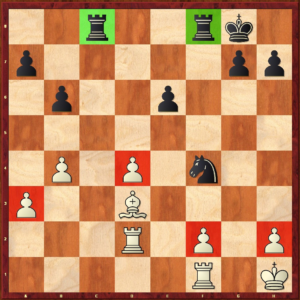
The black knight was certainly not worse than the bishop, but the black rooks controlled the two most important open files on the board – the „c“ and „f“ files. White could not prevent the invasion on c3 along the first of these, and so despite material equality (and also not a perfect black pawn structure) Black stood ‚only‘ significantly better: 25.Be4 Rc3 26.d5 exd5 27.Bxd5+ Nxd5 28.Rxd5 Rxa3. Let us also mention 22.Rfd1 Qf6–+.]
22...Qd5+ played again immediately! 23.e4
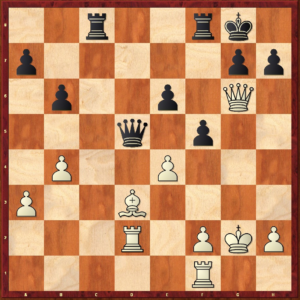
23...fxe4. Black pondered this move for just over a minute... 24.Qxe4?! Corresponds immediately, as if competing with Black to calculate the variations faster and more accurately. Rafael Vaganjan – a lifelong optimist – who had about 34 minutes left on the clock at this moment, should have stopped here!
[Neither was 24.Bxe4?! Qxd2 and then similarly as in the game. On the contrary, the relatively best chances for salvation were given by 24.Ba6
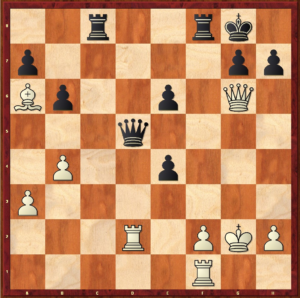
with the following forced manoeuvre: 24...hxg6 25.Rxd5 exd5 26.Bxc8 Rxc8 27.Rd1 Rd8, now after the best 28.f3 e3 29.Rd4 Kf7 30.Kf1 Ke6 31.Ke2 Rc8! 32.Kxe3 Rc3+ and further 33.Ke2 Rxa3 34.Rg4 White could still ‚at least‘ fight on. (We all know the saying about rook endgames.)]
24...Qg5+ 25.Kh1 Qxd2
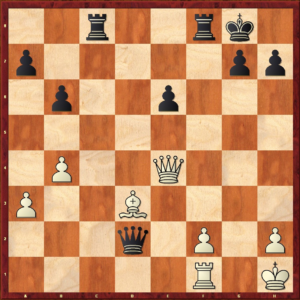
Lesson: Even less experienced players, who are only just getting to know the concept of a ‚forced variation‘, must understand that we must never interrupt or end the calculation of a variation here!
26.Qxh7+ Kf7
Never think about your forced moves! Wasting time thinking is especially noticeable nowadays, when the time on the clock is slowly but surely decreasing.
27.Qg6+. The eight minutes Vaganjan spent on his reply most likely indicate that only now in his calculation he noticed ‚some inconsistency‘. Too late! His position is already completely hopeless, as the counterattack will get stuck in the sand. [27.Rg1 Qh6 (or 27...Qc3); 27.Bg6+ Kf6 28.Be4 Rc1 or safer and more practical 28...Qh6.]
27...Ke7 28.Qxg7+ Rf7–+
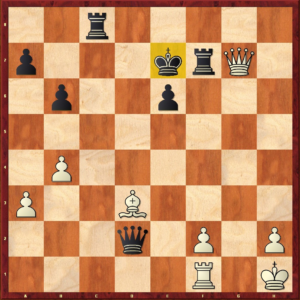
At least up to this point Black had to calculate everything (as the main branch of the analysis) before the strike 20...B×g2!! White was left at a broken trough. No more checks are available, he has two pieces attacked and his king is weak. [Let us add that the attempt to repeat moves here in order to improve the clock situation was a needless adventure: 28...Kd6 29.Qd4+ Ke7 (not 29...Kc7? 30.Qe5+ Kd7 31.Ba6! with obvious counterplay) 30.Qg7+ Rf7 (30.Qh4+ Rf6) with a return to the position from the game.]
29.Qd4 Qf4!
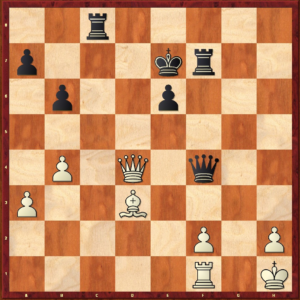
It is over. Black realises that the safest path leading to the goal is a forced transition to the endgame. She pondered this move for about 10 minutes (while practically ‚blitzing‘ the entire long variation!). Why? Obviously, she was considering an alternative attack against the king with her heavy pieces: 29...Rf6 (with the idea 30...Rd8 and 30...Rc3) 30.Qe4. Variation 30...Rcf8 or 30...Rh8 was fully playable, but practical games have their own rules. The black king is also not exactly in the cosy warmth of home, so there would always be some risk of error here, as we see for example in the variation 31.Qb7+ Kd6 32.Bb5 (32.Qe4); now another combination was winning 32...Rxh2+, but - true, the end came also after 32...Qd5+... thowever black could have exchanged queens immediately, as happened in the game.
30.Qxf4 [White could not prevent the queen exchange due to the weakened king: 30.Qb2? Qf3+ 31.Kg1 Rg8+.] 30...Rxf4 31.f3 Rd4 32.Be4
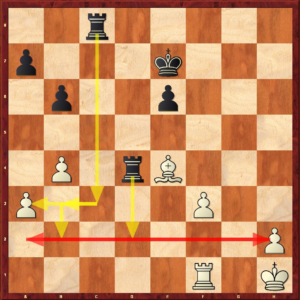
Black also plays the end of the game flawlessly. While the ‚usual‘ realisation of the advantage of rook against bishop and pawn (after the exchange of the pair of rooks) could ‚take time‘, the harmony created on the second rank (rooks on d2 and b2) makes White's position hopeless almost immediately. It even happened 32...Rd2! 33.Rg1 Rc3! (33...Rh8!?) White resigned.
It could have followed 34.Ra1 Rb3! 35.h4 Rbb2
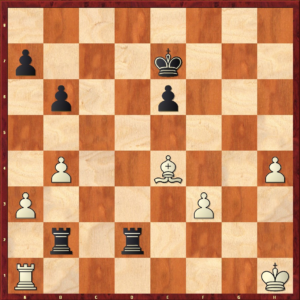
36.Rc1 Rh2+ (=36...Kf6) 37.Kg1 Rbg2+ 38.Kf1 Kf6 or for example =38...Ra2.
A fabulous calculation not only due to the (for ‚ordinary‘ chess players) gigantic technical calculation work, but of course also immense imagination! In the author's opinion, with this game Hou Yifan joined such ‚calculation aces‘ as (from the most famous and significant) Alekhine, Tal, and Kasparov.
Need more proof? Very well! Nowadays there are not few chess players – the author believes they even predominate – who have the habit of ‚checking‘ any played game with a chess engine. So know this, dear readers – let us repeat that from the start of the combination on move 20, which took about 11 minutes of time, until its end Black practically, as the timing shows, without thinking played the best or ‚second best‘ moves that appear in the lines of computer preferences. (Let us also note that the computer solves the combination immediately. From ‚its point of view‘ it is nothing more than a ‚lower class‘ mathematical equation‘...)
Finally, perhaps a stanza: Of course, in the position before 20...Bxg2!! it is possible to test anyone; and anyone can also pass the test... because they simply sense that when it is a test, ‚there will already be something there at the start‘. However to see editorial from afar, means entry among (including historical) super-elite. Judging by the quality of some of today's games, even by players in the world's top ten by rating, the author dares to doubt that anyone would ‚with certainty‘ find the entire combination sequence in their game!

Source: www.betabielchessfestival.ch
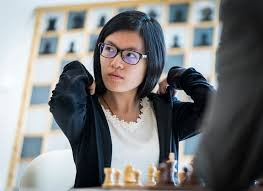
Winner of the Biel tournament Hou Yifan. To her right silver medallist Etienne Bacrot, to her left bronze medallist Pentala Harikrishna.
Source: www.hoogeveenchess.nl
Intelligence combined with beauty...
Article available for download in pdf here: 12_lekce.pdf