
Yes, I know. The video series I present will not appeal to most chess players. Many young chess players live, among other things, under the illusion that the game is played much better today. Nevertheless, I have found that quite a few readers who know the history of our beautiful game in more detail will appreciate the videos below. They have not succumbed to this mirage, and the videos are intended precisely for them. I am not alone in feeling chills down my spine while watching the „animated photographs“ of world champions! I think everyone will find their favourite here.
And dear readers „of my blood group“, do you know in detail the history of the World Championship matches? From the beginnings in 1886 up to the present? At the start of the article, I have therefore included perhaps the clearest video on this topic as well.
History of the World Championship matches
Unfortunately, the Russian language ceased to be compulsory in schools decades ago, and today it is no longer possible to choose it as a supplementary language to compulsory English. Therefore, I searched for videos that would provide similar information in English. However, I mostly encountered some kind of propaganda nonsense such as „how much alcohol Alekhine drank before the game“ or even that he was murdered in Portugal in 1946 by the Soviet secret service NKVD. Well, certainly not... having already in my pocket the promise of a match against Botvinnik!
„My dear conspiracy theorists, have you ever heard of Occam's razor?"...
The following short video in English is therefore only a light summary of the history of the world champions, or rather the matches.
Source
Before I present the main videos of the article, it is appropriate to state the source. I like beautiful studies and history, and so the channel Шахматные заметки (Chess Notes) immediately caught my eye. From every word spoken by the author, one can feel a huge love for chess!
https://www.youtube.com/@chess_notes/videos
AI has brought chess greats to the screen
In the end, I just couldn’t resist! I simply had to extract two greats and the biggest favourites of my childhood from the videos and create two separate short videos.
Not everything can be handled by AI today. In the last sequence, I personally do not recognise Capablanca; rather a suitable actor who could quite well portray him in a film...
Let us now look at the first video. Just below it, I have always placed time codes for better orientation. So which significant personality is AI currently bringing to life. World champions are highlighted in bold.
Are you curious, dear readers? Enough words, let’s get started!
Jefim Bogoljubov; 00:53 Alexander Alekhine; 01:38 David Bronstein; 02:25 Adolf Andersen; 03:10 Ernst Grünfeld 03:56 Louis Paulsen; 04:43 Samuel Reshevsky; 05:29 Richard Réti; 06:14 Richard Teichmann.
Henry Blackburne; 00:53 José Raúl Capablanca; 01:38 Mikhail Chigorin; 02:22 Johann Zukertort; 03:07 Reuben Fine; 03:52 Harry Nelson Pillsbury; 04:37 Henri Rink; 05:22 Siegbert Tarrasch; 06:07 Mikhail Tal.
Mikhail Botvinnik; 00:53 Max Euwe; 01:38 Leonid Kubbel; 02:23 Emanuel Lasker; 03:07 Frank Marshall; 03:53 Miguel Najdorf; 04:37 Akiba Rubinstein; 05:23 Wilhelm Steinitz; 06:08 Savelly Tartakower.
Paul Keres; 00:52 Paul Morphy; 01:37 Aron Nimzowitsch; 02:22 Karl Schlechter; 03:07 Vasily Smyslov; 03:52 Solomon Flohr; 04:38 David Janowski; 05:22 Tigran Petrosian; 06:08 Alexei Trotsky.
Is it really better to play today? Really?
Alas, most young chess players live today with his life to such an extent, that he is not interested not only in the greats of the past, who have long since left us. He shows ostentatious disinterest both towards living world champions and former world-class chess players.
A few years ago, I heard a completely typical story from my colleague and long-time collaborator. Vlastimil Hort – among others, the most successful Czech or Czechoslovak chess player and a former world number six by rating – had a short lecture with a subsequent discussion after a children's tournament. However, just a few minutes after the start, the mother of two of my then pupils commanded: „We have to go now, it’s late!“ She does not know, who who Vlastimil Hort was, but above all she is convinced that the boys must have dinner at the regular hour! Because the disinterest and laziness of children on one hand and the lack of empathy of parents on the other is today one of the basic manifestations of Western civilisation, such an approach no longer surprises me.
I was more surprised, however, by a recent video analysis by Daniil Dubov. No, I do not mean the quality of the analyses, they are simply amazing and among the very best you can watch on the internet. It’s just that Daniil Dmitrievich somehow could not remember in which year the 12th world champion Anatoly Karpov was born…
„Let’s be honest, chess is played much better nowadays,“ declared some time ago in an interview one of the Indian super grandmasters Arjun Erigaisi. This may be where the problem lies. Every new generation naturally thinks it is smarter than the previous one. And so Erigaisi, despite his colossal diligence – I believe – not even knowing, for example, the most famous Alekhine games, expresses such an opinion without hesitation.
I do not want and will not analyse here whether chess is played at a higher level today than before, and thus disturb the conviction of the huge number of fans that Magnus is the strongest chess player of all time! My long-time pupil and prematurely deceased grandmaster Petr Neuman and I had endless debates about this years ago. The topic deserves a separate article, or rather a whole book. So just briefly.
Today's generation of chess players knows for sure about chess much more. But let us now focus on probably the most important area of chess – calculation of variations (let us leave its individual components – subsets – aside for now). We know that in the process of calculation there is, among other things, mentally extremely demanding work. There is a certain similarity here with solving complex mathematical operations or in other words: as if you were multiplying numbers in your head or even solving a complicated equation!
The first scientific comparison was made shortly after World War II by a Dutch master and psychologist Adrian de Groot (1914-2006). That is, unless I refer here to the works of Soviet psychologists.
Chess players and mathematicians
In the way of thinking of a chess player and a mathematician, we find many points in common. The activities of chess players and the analogy of mathematicians' work are clearly demonstrated by the following table.
Summary of mental similarities:
| Chess thinking | Mathematical thinking |
| Calculation of variations | Algorithmic solution |
| Typical positions (patterns) | Abstract symbols |
| Memory | Logical structure |
| Strategy and plan | Deductive logic |
| Intuition and heuristic analysis | Estimates and approximations |
Ability to calculate in a hypothetical test
So let us, dear readers, try to answer this question; or rather, let us imagine the following hypothetical situation:
We will test mathematical abilities – for a start, for example, multiplication of five-digit numbers – of the following great minds. Of course, the level of tasks will then increase (the equivalent of a chess test – complex calculation of positions like a tangle or perhaps an IQ test containing Raven's progressive matrices).
Our hypothetical test involves these mathematical geniuses:
Carl Friedrich Gauss (1777-1855)
Leonhard Euler (1707–1783)
Srinivasa Ramanujan (1887–1920)
John von Neumann (1903–1957)
Henri Poincaré (1854–1912)
Kurt Gödel (1906–1978)
Grigorij Jakovlevič Perelman (1966);
the young generation will be represented by the current fast human calculator Neelakantha Bhanu Prakash (1999).
The winner of the calculation will be the mathematician who first solves a series of identical problems without error!
Conclusion
Are you sure that today's human calculators are faster and more efficient than, for example, in the 17th century?
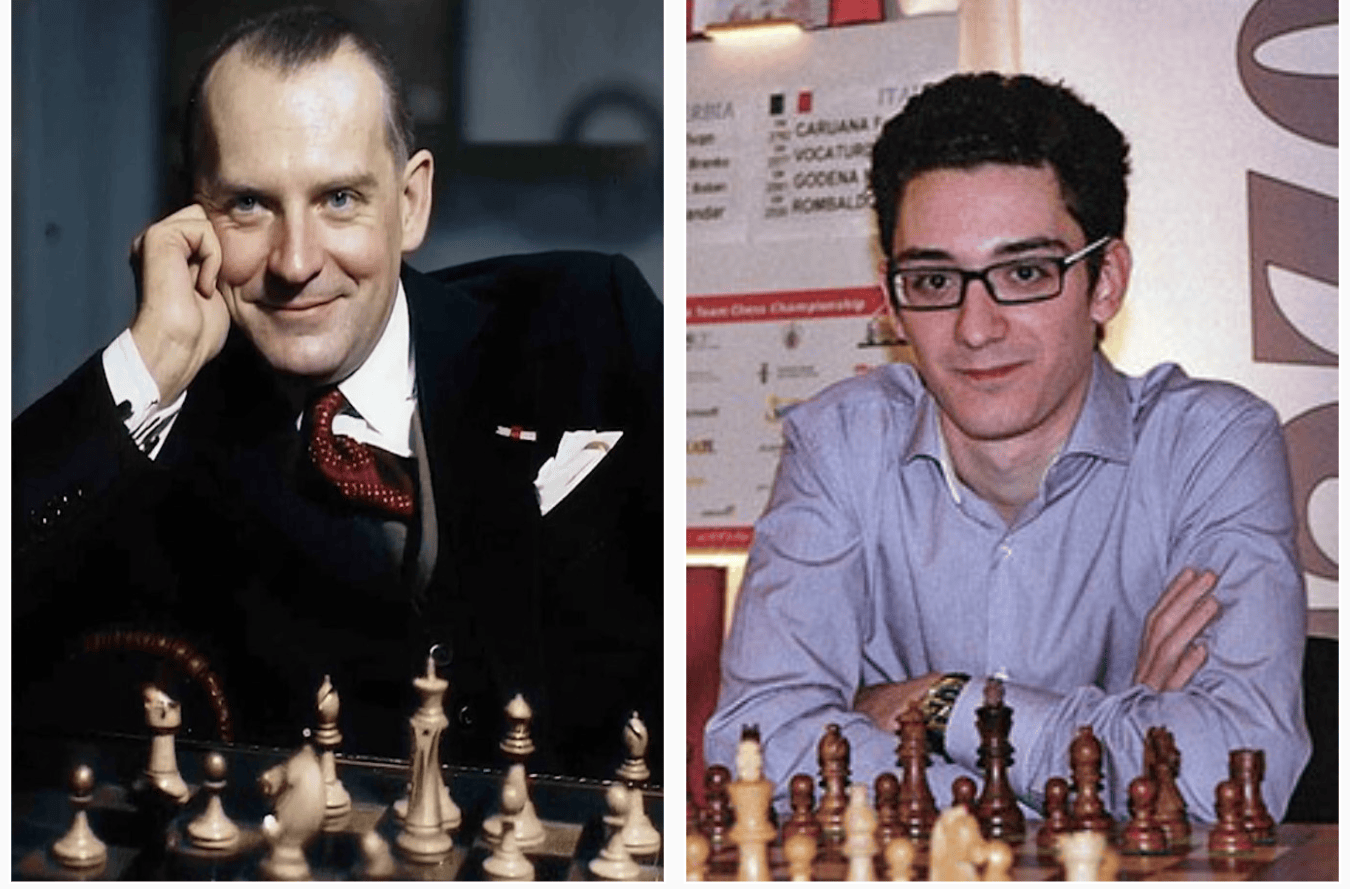
Or: Are you absolutely sure that the young Fabiano Caruana (in his youth, his effort was generally known to calculate everything behind the chessboard) calculated chess variations faster and more accurately than Alexander Alekhine?
Analytical abilities
The calculation of variations itself is, of course, closely related to the ability to analyse positions. While complex calculations behind the chessboard, as a kind of analogy to mathematical and combinatorial skills, are primarily innate – a talent from God – the analytical habits themselves can be trained with greater success.
For some experienced chess players, it will be no revelation to state that the young generation of chess players today actually do not know how to analyse positions in the true sense of the word! And why should they? After all, engines do all the work for them!
If we were to compare past and present: today’s chess players have more knowledge because the theory of openings and partly also middlegames and endgames is still developing.
The question remains, however, whether the ability to conduct independent analysis – those hours of exhausting work – with the aim of achieving an objective evaluation of the position, advantages of today at least compensate for this…
Ah, those endgames
It is well known that young chess players in most cases not only dislike playing endgames, but literally struggle in them. This was true not only historically, in my youth (I was a shining example myself 🙂 ), but it is also typical today.
However, what they can do to create perhaps the most naturally gifted chess player of today, Alireza Firouzja, but not rarely also the current world champion Gukesh, this must make former world champions Karpov, Kasparov, Kramnik and of course Carlsen not only smile, but – according to their nature – perhaps even laugh out loud…
I never think about the future. It comes soon enough anyway
allegedly said Albert Einstein. But nevertheless: a short video clip from the film Idiocracy (2006) from a possible dystopian future explains – admittedly in a humorous form – my reflections and concerns perhaps better than a long text.
Without exaggeration, the situation to which, alas, we seem to be rapidly approaching is brilliantly captured by Isaac Asimov's short story The Feeling of Power. In the Czech Republic, and previously in Czechoslovakia, it was published under the titles Pocit moci or Pocit síly.